
When Leaving Feels Impossible: What a Domestic Abuse Divorce Attorney Can Do for You
If you’re searching for a domestic abuse divorce attorney, here’s what you need to know right now:
Quick answers for survivors:
- You can file for divorce even if you’re afraid. An attorney can take steps to protect you before your spouse is notified.
- Protective orders can be granted the same day in emergency situations — sometimes within 24 hours.
- Abuse affects custody, support, and property division — courts take it seriously.
- You don’t need physical evidence to get legal protection. Testimony, texts, and patterns of behavior count.
- Free and low-cost legal help exists. You don’t have to face this alone or afford a private attorney to get started.
Ending a marriage is hard. Ending one where abuse is present is something else entirely.
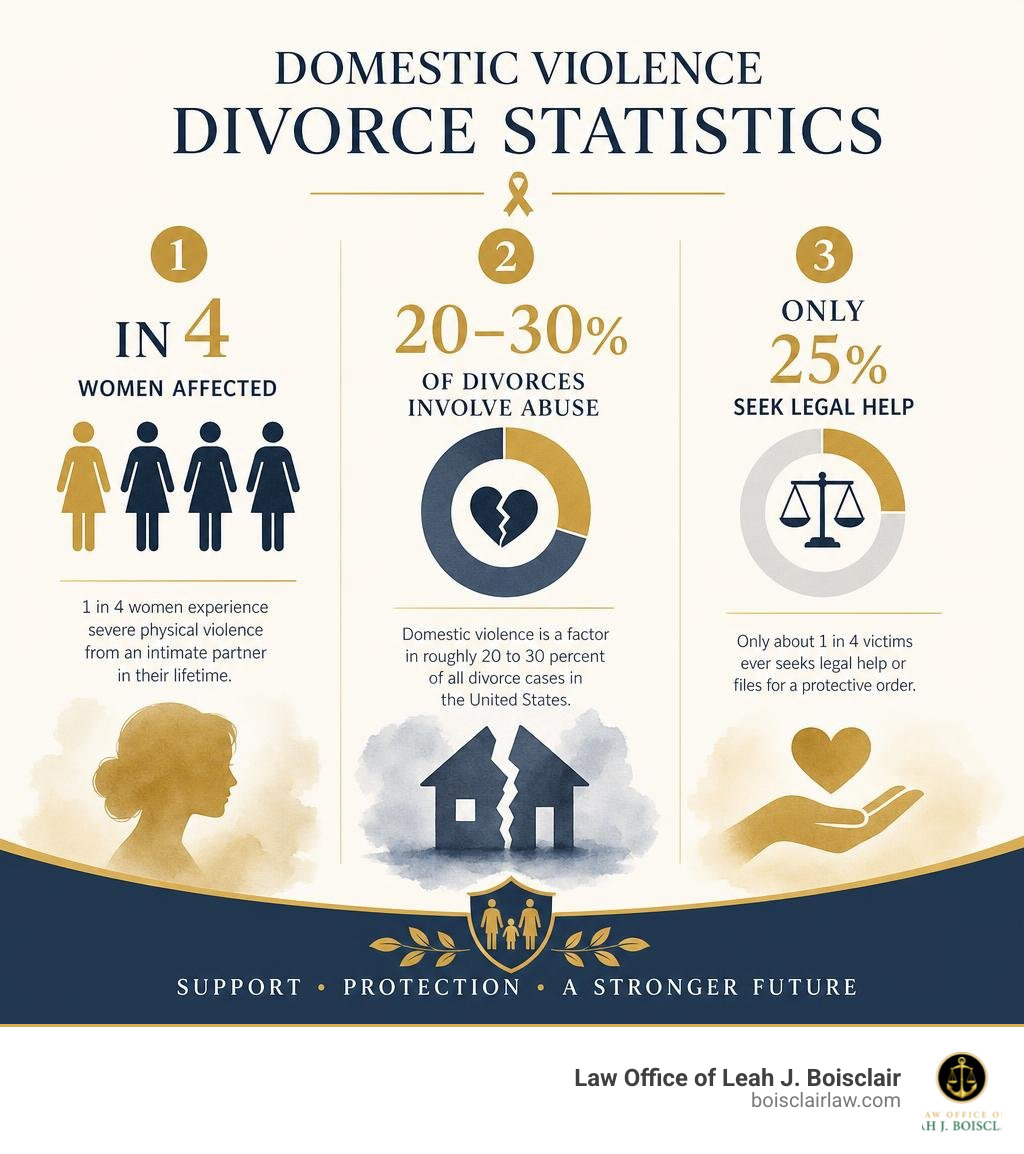
Statistics make the scale clear: 1 in 4 women and 1 in 7 men experience severe physical violence from an intimate partner in their lifetime. Domestic violence is a factor in roughly 20 to 30 percent of all divorce cases in the United States. Yet only about 1 in 4 victims ever seeks legal help or files for a protective order.
That gap — between what survivors need and what they actually pursue — often comes down to fear. Fear of retaliation. Fear of losing their children. Fear of not knowing where to start.
The legal system has tools specifically designed for this situation. The right attorney doesn’t just handle paperwork — they help you build a safety plan, secure court protections, and make sure your voice is heard at every stage of the process.
This guide walks you through exactly how that works.
Learn more about domestic abuse divorce attorney:
- attorney domestic violence case
- criminal defense attorney for domestic violence
- restraining order attorney
Understanding Domestic Violence in the Context of Divorce
When we think of domestic violence, physical assault is often the first thing that comes to mind. However, the legal definition of domestic abuse within Rhode Island Family Courts is much broader. Abuse is not limited to physical harm; it encompasses a pattern of coercive control meant to dominate and isolate a partner.
In a divorce proceeding, domestic abuse can manifest in several distinct ways:
- Physical Abuse: Any unwanted physical contact, force, or threat of force, including hitting, kicking, restraining, or pushing.
- Emotional and Psychological Abuse: Systematic insults, threats of self-harm, isolation from family and friends, and gaslighting. If you are dealing with this form of mistreatment, our A Legal Guide to Divorcing an Emotionally Abusive Partner provides a deep dive into navigating these invisible scars in court.
- Financial Control (Economic Abuse): Withholding access to bank accounts, limiting your ability to work, hiding marital assets, or forcing you to run all purchases by them. This is a highly effective way for abusers to keep survivors trapped.
- Coercive Control: A strategic pattern of behavior that limits your autonomy, which can include monitoring your location via GPS, reading your texts, or dictating who you can speak to.
Under Rhode Island law, these behaviors are heavily scrutinized during divorce proceedings. Whether you reside in Cranston, RI, or Providence, RI, the Family Court views domestic abuse as a direct threat to the safety of the household, and recognizing these non-physical forms of abuse is crucial when building your case.
How a Domestic Abuse Divorce Attorney Protects Your Rights and Safety
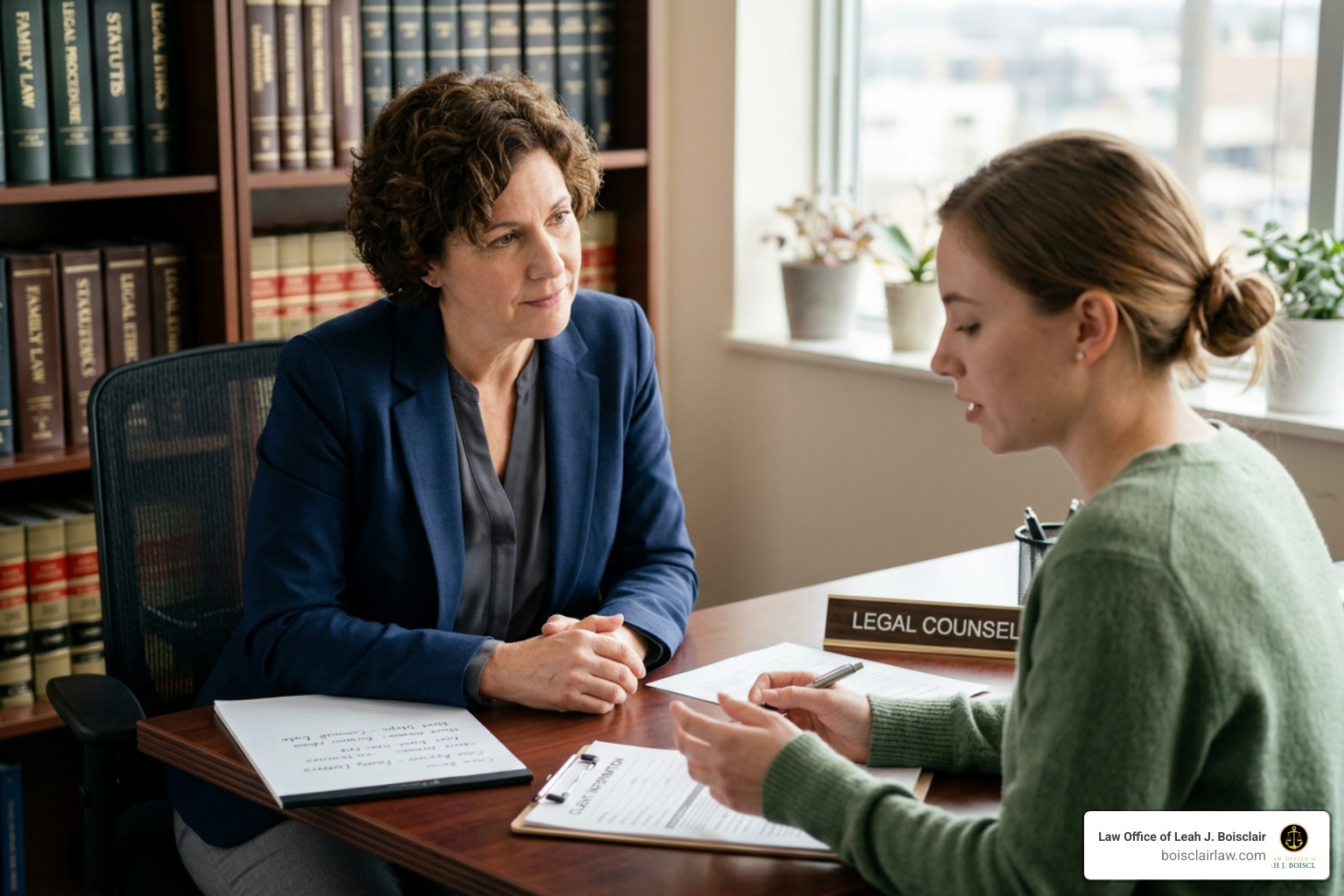
Navigating a divorce when your partner is abusive is incredibly dangerous. In fact, studies show that victims of domestic violence are in the greatest danger when they attempt to leave the relationship. This is why having a specialized domestic abuse divorce attorney on your side is not just a legal asset—it is a matter of physical safety.
At the Law Office of Leah J. Boisclair, we provide compassionate, structured advocacy to help you transition safely out of an abusive marriage. We protect your rights and safety through several critical measures:
- Comprehensive Safety Planning: Before we even file the initial divorce paperwork, we work with you to establish a secure safety plan. This includes setting up secure communication channels, identifying safe housing, and coordinating with local domestic violence advocates and law enforcement in Warwick, RI, or East Providence, RI.
- Strategic Evidence Gathering: Abusive partners often try to control the narrative. We help you systematically gather and organize evidence—such as text messages, financial records, and medical files—while ensuring your safety is never compromised during the process.
- Aggressive Court Representation: We stand between you and your abuser. We handle all communications with your spouse and their legal counsel, shielding you from direct harassment and judicial abuse (where an abuser tries to use the court system to continue controlling you).
- Immediate Protective Measures: We immediately petition the court for emergency orders to ensure your spouse cannot cut off your financial resources, lock you out of your home, or take your children.
If you are trying to find the right legal advocate, you can read our guide on Finding the Right Divorce Lawyer for Domestic Abuse Situations to understand what to look for in a trauma-informed professional.
Legal Protections and Restraining Orders During Divorce Proceedings
One of the most powerful legal shields available to survivors during a divorce is a court-ordered protective measure. In Rhode Island, the Family Court has the authority to issue various restraining orders to keep you and your children safe.
These legal protections can prevent your spouse from coming near your home, your workplace, or your children’s school. They can also grant you “exclusive possession” of the marital home, meaning the court orders the abuser to move out, regardless of whose name is on the lease or deed.
For more information on the specific court resources available in our state, you can consult the Rhode Island Family Court Domestic Violence Resources.
To help you understand the options, here is a comparison of temporary and permanent protective orders available in Rhode Island:
| Type of Order | How It Is Obtained | Duration | Key Protections Provided |
|---|---|---|---|
| Ex Parte (Emergency) Order | Filed without the abuser’s knowledge; granted based on your sworn testimony of immediate danger. | Usually lasts until the formal hearing (typically within 21 days). | Immediate safety; orders the abuser to stay away; can grant temporary custody. |
| Temporary Restraining Order (TRO) | Granted at a preliminary hearing where both sides may present initial arguments. | Active throughout the duration of the divorce proceedings. | Prevents contact, establishes temporary child support, and grants exclusive home possession. |
| Permanent Protective Order | Issued after a full evidentiary hearing where both parties present evidence. | Can last up to several years; can be renewed upon expiration. | Long-term stay-away orders, permanent custody arrangements, and firearm surrender mandates. |
The Role of a Domestic Abuse Divorce Attorney in Securing Protective Orders
Obtaining these orders requires navigating strict legal procedures. A mistake on your petition can result in a denial, leaving you vulnerable. We handle the entire process for you—from drafting the initial petition with detailed, legally sound statements of abuse, to representing you at emergency hearings.
We ensure that the judge hears the full scope of the abuse, including emotional and financial control, so you get the maximum level of protection possible. To learn more about selecting the right representation for this critical task, read our article on How to Choose the Best Domestic Abuse Lawyer for Your Case.
The Impact of Abuse on Child Custody, Support, and Property Division
A history of domestic violence heavily influences how a judge divides assets, awards spousal support, and decides child custody. Under Rhode Island law, the courts prioritize the “best interests of the child” above all else, and a parent’s abusive behavior is a major factor in determining parental fitness.
According to the Rhode Island Family Court Overview, judges have wide discretion to modify standard divorce outcomes when domestic abuse is proven:
- Child Custody and Visitation: There is a strong legal presumption that awarding custody to an abusive parent is detrimental to the child. In cases involving domestic violence, courts are highly likely to award sole custody to the non-abusive parent. If visitation is granted to the abusive parent, the court will often order supervised visitation at a neutral professional facility to ensure the child’s physical and emotional safety.
- Child Support and Spousal Support (Alimony): If an abuser has economically deprived their spouse, the court can adjust temporary and permanent support orders. Additionally, if the victim’s earning capacity was damaged due to physical or psychological trauma, the court may order higher spousal support payments.
- Division of Marital Property: Rhode Island is an equitable distribution state. While this does not always mean an exact 50/50 split, a history of abuse—especially economic abuse where a partner squandered marital assets or prevented the other from working—can lead the judge to award a larger share of the marital property to the survivor.
How a Domestic Abuse Divorce Attorney Advocates for Child Safety
Protecting your children is your top priority, and it is ours as well. We work closely with custody evaluators, guardian ad litems, and child psychologists to present a clear, undeniable picture of how the abuse has impacted your children.
We aggressively advocate for sole legal and physical custody, restricted or supervised visitation, and strict drop-off protocols (such as police station exchanges) to keep you safe during transitions. For more insight into this process, see our guide on How to Choose an Attorney for Domestic Violence Victims.
Frequently Asked Questions About Divorcing an Abusive Partner
How should survivors document abuse and prepare evidence for court?
Gathering evidence must always be done safely. If your spouse monitors your phone or computer, do not store evidence where they can find it.
To build a strong case, try to preserve:
- Digital Communications: Save screenshots of threatening or harassing text messages, emails, and social media posts. Store these in a secure cloud folder or email them to a trusted friend.
- Official Records: Keep copies of police reports, medical records, and photos of any physical injuries.
- Financial Records: Gather tax returns, bank statements, and pay stubs to prove financial abuse or hidden assets.
- Personal Log: Keep a detailed, hidden journal documenting dates, times, and descriptions of abusive incidents.
Even if you do not have physical evidence, your personal testimony, witness accounts, and established behavioral patterns are highly compelling in a family court setting.
What are the potential criminal consequences for violating a protective order?
In Rhode Island, a protective order is not just a piece of paper—it has teeth. Violating a domestic violence protective order is a serious criminal offense.
If your spouse violates a restraining order during your divorce, they can be arrested immediately. A first-offense violation is typically charged as a misdemeanor, carrying penalties of up to one year in jail and heavy fines. Subsequent violations or violations involving weapons can quickly escalate to felony charges, resulting in multi-year prison sentences.
If you are facing a situation where criminal charges are involved, it is vital to understand the intersection of family and criminal law. You can read more about this dynamic in our article Why You Need a Criminal Defense Attorney for Domestic Violence Right Now.
What steps should a survivor take to safely file for divorce?
If you are preparing to file for divorce from an abusive partner, safety must be your first step:
- Establish Secure Communications: Buy a prepaid “burner” phone that your spouse does not know about, and set up a new, secure email address for all legal communications.
- Build a Support Network: Reach out to trusted family members, friends, or local shelters in Rhode Island.
- Secure Your Documents: Safely make copies of birth certificates, social security cards, marriage certificates, and financial documents, and store them outside the home.
- Consult an Attorney Secretly: Meet with a domestic abuse divorce attorney to draft your divorce petition and emergency protective orders before your spouse receives any notification.
Conclusion
Reclaiming your life and your independence from an abusive partner is a brave, life-changing step. You do not have to walk this difficult path alone. At the Law Office of Leah J. Boisclair, we provide compassionate, personalized, and aggressive legal representation to survivors throughout Rhode Island, including Cranston, Providence, Warwick, Johnston, and the surrounding areas.
We understand the unique dangers of divorcing an abuser, and we are prepared to utilize every legal tool available—from emergency restraining orders to sole custody petitions—to secure your physical safety and your financial future.
If you are ready to take the first step toward safety and freedom, contact us today to schedule a strictly confidential consultation. For More info about domestic and family-related offenses, explore our dedicated resources and let us help you protect your future.