

What a Domestic Abuse Defense Lawyer Does — and Why It Matters
Hiring a domestic abuse defense lawyer is one of the most important decisions you can make if you’ve been accused of a domestic violence offense in Rhode Island, Massachusetts, or Connecticut.
Here’s a quick overview of what a domestic abuse defense lawyer can do for you:
- Protect your rights during arrest, questioning, and court proceedings
- Build a defense strategy based on self-defense, false accusations, lack of evidence, or constitutional violations
- Challenge protective orders that may be keeping you from your home or children
- Negotiate with prosecutors to reduce or dismiss offenses before trial
- Coordinate your criminal defense with related family law matters like custody and divorce
Prosecutors — not victims — decide whether to press domestic violence charges. This means offenses can move forward even if the alleged victim recants or refuses to cooperate.
This matters because a domestic violence conviction doesn’t just mean jail time or fines. It can affect where you live, whether you can see your children, and whether you can own a firearm — for the rest of your life.
The stakes are high, and they move fast. After an arrest, protective orders can be issued the same day, often before you’ve had a chance to tell your side of the story.
Whether you’re facing a misdemeanor or a felony offense, having an experienced defense lawyer on your side from the very beginning makes a real difference in how your case unfolds.
Basic domestic abuse defense lawyer glossary:
- divorce attorneys specializing in emotional abuse
- domestic violence lawyer texas
Understanding Domestic Violence Offenses and Qualifying Relationships
Under Rhode Island law, “domestic violence” is not actually a standalone criminal charge. Instead, it is a legal designation added to other criminal offenses—such as simple assault, stalking, cyberstalking, kidnapping, or domestic property damage—when the incident occurs between individuals with a specific domestic relationship.
According to Rhode Island General Laws, qualifying household or family members include:
- Current and former spouses
- Adults who are related by blood or marriage
- Adults who currently reside together, or who have resided together within the past three years
- Individuals who share a child in common (regardless of marital status)
- Persons who are or have been in a significant dating or engagement relationship within the past year
When police respond to a domestic disturbance call in cities like Cranston or Providence, Rhode Island’s mandatory arrest laws often require them to make an arrest if they find probable cause that a domestic violence offense has occurred. Unfortunately, this means officers frequently make rapid, high-pressure decisions, sometimes arresting the wrong person or treating a mutual argument as a one-sided assault.
Statistically, domestic disputes are incredibly common, and they frequently involve complex household dynamics. Data shows that up to 80% of alleged domestic violence victims live with the accused, meaning an arrest immediately tears a household apart. Furthermore, approximately 29% of domestic incidents involve the use of drugs or alcohol, which can cloud recollections and lead to highly exaggerated or inconsistent statements in police reports.
No matter the specific circumstances of your relationship, understanding the exact nature of your charges is the first step toward building a defense. For a deeper look at how Rhode Island classifies these charges, read our guide on domestic and family related offenses.
The Penalties and Collateral Consequences of a Domestic Violence Offense Conviction
The consequences of a domestic violence conviction in Rhode Island are severe and far-reaching. Beyond court-ordered fines and jail time, a conviction carries heavy collateral consequences that can permanently disrupt your life, your career, and your family structure.
Criminal Penalties
The criminal penalties depend largely on the severity of the underlying offense and your prior record:
- Simple Assault and Battery (Domestic): Typically charged as a misdemeanor for a first offense, carrying up to one year in jail, mandatory enrollment in a batterer’s intervention program (which lasts several months and is entirely self-funded), and administrative court fees.
- First-Degree Assault: A felony charge involving serious physical injury or the use of a firearm, carrying up to 25 years in prison.
- Second-Degree Assault: A felony involving the intent to cause serious bodily injury or assault with a dangerous weapon, carrying up to 10 years in prison.
- Reckless Endangerment: Misdemeanor charges that carry up to one year in jail if you are accused of creating a substantial risk of death or serious physical injury to a household member.
- Child Abuse: Felony charges that carry mandatory prison sentences and can permanently strip you of your parental rights.
Collateral Consequences
- Loss of Firearm Rights: Under federal law (the Lautenberg Amendment), even a misdemeanor domestic violence conviction triggers a lifetime ban on possessing firearms. This is particularly devastating for military personnel, law enforcement officers, and security professionals in Rhode Island.
- Protective Orders: Court-ordered restraining orders can legally evict you from your own home, force you to pay temporary spousal support, and restrict you from entering your children’s schools.
- Child Custody and Visitation: Family court judges take domestic violence charges extremely seriously. A pending charge or conviction can result in supervised visitation or a complete loss of physical custody. For those navigating these painful intersections of family law and criminal charges, our A Legal Guide to Divorcing an Emotionally Abusive Partner provides vital context.
Comparison of Assault Offense Penalties in Rhode Island
| Offense Type | Classification | Maximum Prison Time | Key Elements |
|---|---|---|---|
| Domestic Simple Assault | Misdemeanor | Up to 1 year | Offensive physical contact or threat of physical contact |
| Second-Degree Assault | Felony | Up to 10 years | Use of a dangerous weapon or intent to cause serious injury |
| First-Degree Assault | Felony | Up to 25 years | Actual infliction of serious physical injury or permanent disfigurement |
How a Domestic Abuse Defense Lawyer Builds a Strong Case

When we represent clients facing domestic violence charges in Rhode Island, we do not simply accept the police report as the absolute truth. A skilled domestic abuse defense lawyer knows that every story has two sides, and the state’s case is often built on assumptions, highly emotional statements, or outright fabrications.
To build a robust defense, we thoroughly investigate the following areas:
- Self-Defense: In many domestic altercations, our client was actually defending themselves or their children from an aggressive partner. If you used a reasonable amount of force to protect yourself from physical harm, we can argue self-defense.
- False Accusations: It is an unfortunate reality that individuals sometimes fabricate or exaggerate domestic abuse allegations to gain leverage in pending divorce proceedings, child custody disputes, or property battles. We systematically review text messages, emails, voicemail recordings, and social media posts to expose these ulterior motives.
- Lack of Evidence and Inconsistencies: Many domestic cases lack independent physical evidence or neutral third-party witnesses. If the prosecution’s case relies entirely on “he-said, she-said” testimony, we highlight the inconsistencies in the accuser’s statements to establish reasonable doubt.
- Constitutional Violations: We closely examine the actions of law enforcement officers during your arrest. Did they fail to read your Miranda rights? Did they perform an unlawful search of your home or phone without a warrant? If your constitutional rights were violated, we can file motions to suppress the illegally obtained evidence.
By aggressively challenging the state’s narrative, we aim to secure a reduction of charges, a complete dismissal, or an acquittal at trial. Learn more about our approach by exploring Our Domestic Offenses Defense Services and reading about Why You Need a Defense Lawyer for Domestic Violence Offenses Right Now.
Immediate Steps to Take After a Domestic Violence Offense Arrest

An arrest for a domestic violence offense is a chaotic and terrifying experience, but the actions you take in the first 24 to 48 hours can completely shape the outcome of your case. If you have been arrested or accused in Rhode Island, follow these steps immediately:
- Exercise Your Right to Remain Silent: Do not try to explain your side of the story to the police. Officers are not trying to “clear things up” for you; they are actively gathering evidence to secure a conviction. Politely state, “I am exercising my right to remain silent and I want to speak to my attorney.”
- Do Not Contact the Alleged Victim: This is the most critical rule. Even if the accuser regrets calling the police and sends you apologetic text messages, do not respond. Any contact—direct, indirect, through third parties, or via social media—can violate your bail conditions or an active temporary protective order, leading to immediate rearrest and brand-new criminal charges.
- Document Everything: Write down your own detailed recollection of the incident as soon as possible while the memory is fresh. Keep track of names of potential witnesses, timelines, and any physical injuries you sustained (take high-quality photos of any scratches, bruises, or torn clothing).
- Hire a Dedicated Defense Attorney: Do not attempt to navigate the complex Rhode Island court system alone. For step-by-step guidance on what to expect during the initial arrest phase, review our guide on What to Do If You’ve Been Arrested in RI.
Completing Your Client Intake Form for Case Strategy
When you schedule a consultation with our legal team, we will ask you to complete a comprehensive Client Intake Form. This document acts as the foundation of our defense strategy. Here is what you will need to prepare:
- Personal Information: Your full legal name, date of birth, contact details, and a trusted emergency contact. (We promise to keep this completely confidential, and we won’t judge your emergency contact choices!)
- Case Information: The date of your arrest, the specific offenses filed against you, the arresting agency, and any upcoming court dates or arraignment details.
- Legal History: Any prior arrests, convictions, active probation or parole status, or past incarcerations. It is vital to be completely honest with us; surprises in court only help the prosecutor.
- Employment Information: Your current employer and job title. This helps us assess the potential impact of a conviction on your professional licenses or career.
- Case Strategy & Goals: What is your ideal outcome? Whether you are aiming for a complete dismissal of offenses, a negotiated plea to avoid jail time, or a full trial to clear your name, we tailor our strategy to match your goals.
How to Choose the Best Domestic Abuse Defense Lawyer for Your Case
Not all criminal defense attorneys are equipped to handle the unique emotional and legal complexities of domestic violence charges. Choosing the right attorney requires looking beyond standard legal advertisements.
What to Look For in a Domestic Abuse Defense Lawyer
- Local Rhode Island Court Knowledge: A lawyer who regularly practices in Cranston, Providence, Kent County, and Washington County courts will understand the local prosecutors, judges, and court staff. They will know how local judges typically rule on protective orders and bail modifications.
- Trial Preparation and Readiness: Some lawyers prefer to quickly negotiate plea deals to keep their caseloads moving. You need an attorney who prepares every single case as if it is going to trial, showing the prosecution that you are ready to fight.
- Compassionate, Personalized Advocacy: You deserve a legal team that treats you like a human being, not just a case file. Look for a firm that offers direct communication and compassionate support during this stressful time. If you want to expand your search across the state, you can look up local directories like North Providence Domestic Violence Attorneys | LII Rhode Island … or West Warwick Domestic Violence Attorneys | LII Rhode Island … .
Questions to Ask Your Domestic Abuse Defense Lawyer
When you sit down for your initial consultation, ask these direct questions to evaluate the attorney:
- How much of your practice is dedicated to domestic offenses in Rhode Island?
- What is your fee structure? Do you offer flat fees or hourly rates, and are there flexible payment plans available?
- What immediate steps will you take to modify my active no-contact order so I can return to my home or see my kids?
- Based on the initial police report, what do you see as the primary weaknesses in the state’s case?
Ready to speak with an experienced advocate who will stand by your side? Schedule a Consultation with a Domestic Abuse Defense Lawyer at our Cranston office today.
Frequently Asked Questions About Domestic Violence Offenses
Can domestic violence offenses be dismissed if the victim doesn’t want to cooperate?
In Rhode Island, the victim does not have the authority to “drop” the charges. Once the police make an arrest, the case belongs to the State of Rhode Island, represented by the prosecutor. Even if the alleged victim signs an affidavit recanting their statement or refuses to cooperate, the prosecutor may still choose to move forward with the charges using other evidence, such as 911 call recordings, police body camera footage, or physical evidence. However, an uncooperative witness does make the state’s case much harder to prove, which your attorney can leverage during negotiations.
What is the difference between a protective order and a peace order?
- Protective Orders: These are filed in Family Court or District Court and apply strictly to family members, household members, or individuals in a current or former dating relationship. They can last up to several years and carry severe criminal penalties if violated.
- Peace Orders: These apply to non-family or non-dating relationships, such as disputes between neighbors, co-workers, or strangers. They are handled in District Court and generally address harassment or stalking behavior.
How does a domestic violence offense affect my custody rights?
A domestic violence charge can have an immediate, negative impact on your custody rights. Family court judges operate under the “best interests of the child” standard. If a judge believes there is a risk of physical or emotional harm, they may issue temporary orders suspending your visitation rights or requiring that all parenting time be strictly supervised by a professional or a approved family member.
What is the difference between a felony and a misdemeanor domestic offense?
The primary difference lies in the severity of the allegations and the potential penalties:
- Misdemeanor Domestic Offenses: Carry a maximum penalty of up to one year in jail and are typically handled in the Rhode Island District Court.
- Felony Domestic Offenses: Involve allegations of serious physical injury, the use of a weapon, strangulation, or are charged as a felony due to repeat offenses (e.g., a third domestic offense conviction). These carry multi-year prison sentences and are prosecuted in the Rhode Island Superior Court, leaving a permanent mark on your record that cannot be easily expunged.
What is the court process and jurisdiction for domestic offenses in Rhode Island?
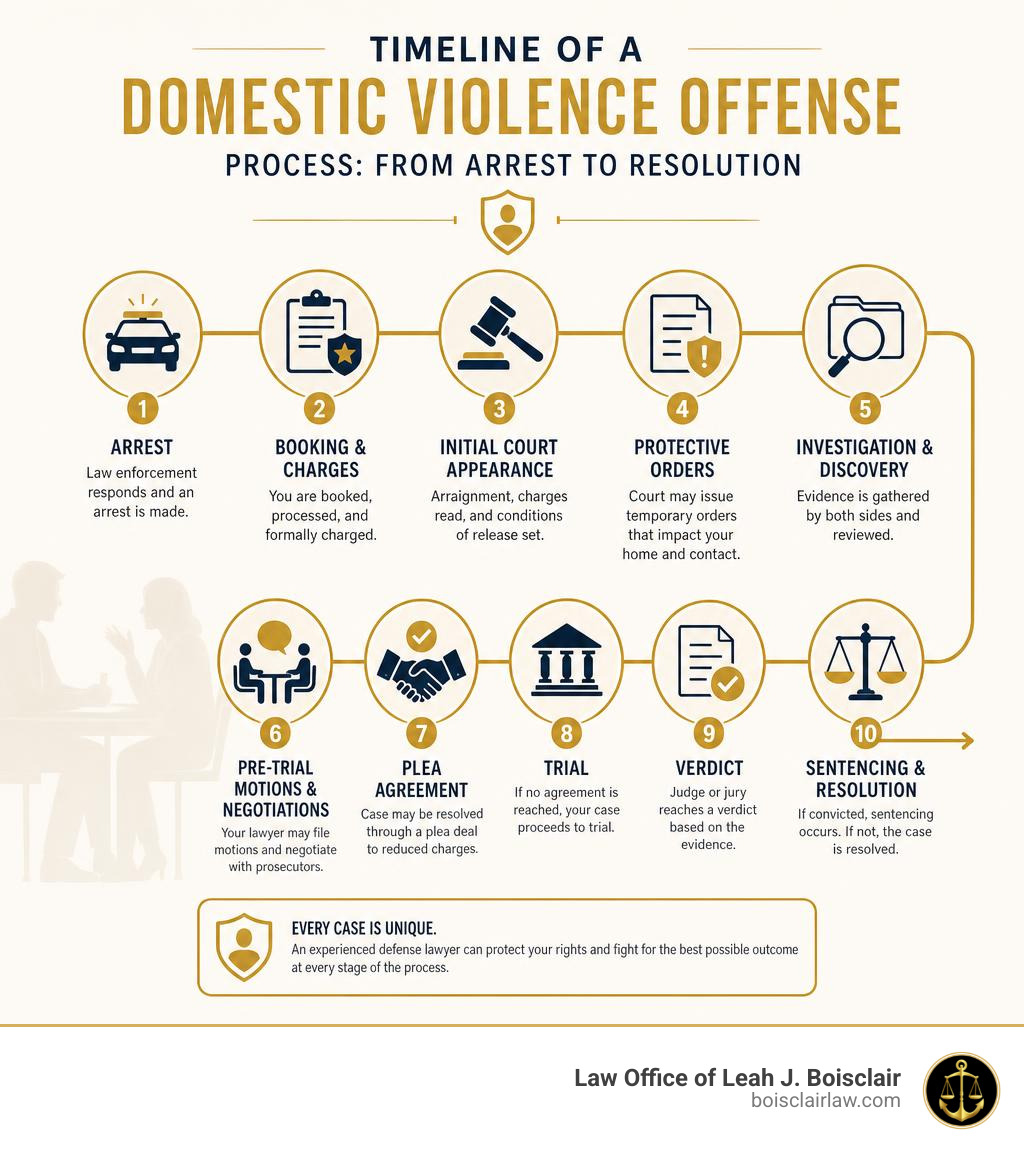
- Arraignment: This is your first court appearance, where the charges are formally read, you enter a plea of “not guilty,” and the judge sets bail conditions, which almost always include a Domestic Abuse No-Contact Order (DANCO).
- Pre-Trial Conferences: Your attorney will exchange discovery materials with the prosecutor, review the state’s evidence, and negotiate potential resolutions or reductions.
- Jurisdiction: Misdemeanor offenses are heard in the District Court (such as the Third Division District Court in Warwick or the Sixth Division in Providence). Felony offenses are transferred to the Superior Court for grand jury proceedings or an information filing.
- Sentencing Options: In Rhode Island, sentences can range from a “filing” (where the charge is held over your head for a year and then dismissed if you stay out of trouble), to probation, suspended sentences, or active prison time.
Conclusion
Facing domestic violence allegations can make you feel like the entire system is stacked against you. But remember: an accusation is not a conviction. You have rights, and you deserve to have your side of the story heard in court.
At the Law Office of Leah J. Boisclair in Cranston, RI, we provide personalized, compassionate, and aggressive criminal defense representation for clients facing misdemeanors, felonies, DUI and Traffic Offenses, and Firearm Offenses. We serve clients throughout Rhode Island—including Providence, Warwick, Johnston, North Providence, East Providence, West Warwick, Pawtucket, East Greenwich, Coventry, and Scituate. Our unique selling proposition is simple: we deliver personalized, compassionate advocacy with a proven track record of dismissals.
Don’t let a single misunderstanding or an exaggerated allegation ruin your future, your career, and your family life. Contact our domestic and family related offenses team today to schedule your confidential consultation, and let us start building your defense.