
Understanding Emotional Abuse in Marriage and Divorce
Divorce attorneys specializing in emotional abuse are lawyers who understand that not all marital harm leaves visible marks — and that the law can still protect you.
If you’re looking for a quick answer, here’s what you need to know:
What divorce attorneys specializing in emotional abuse can help you with:
- Getting orders of protection to keep you safe during the divorce process
- Using evidence like texts, emails, and witness statements to document abuse
- Arguing for fair property division and spousal support when abuse affected your finances or career
- Protecting your children through custody arrangements that reflect the reality of coercive control
- Navigating high-conflict personalities like narcissistic or manipulative spouses
Emotional abuse in a marriage can take many forms — constant criticism, gaslighting, isolation from family and friends, financial control, and intimidation. It’s often invisible to outsiders, which makes leaving feel even harder.
According to national data from the National Coalition Against Domestic Violence, one in three women and one in four men have experienced some form of partner violence in their lifetime. Yet emotional abuse often goes unrecognized — even by the people living through it.
The legal landscape in April 2026 gives victims more tools than ever. Even in no-fault divorce states, emotional abuse can influence custody decisions, spousal support, and how marital assets are divided. But navigating this process without the right legal guidance puts you at serious risk of being taken advantage of by an abusive spouse who knows how to manipulate systems as well as people.
This guide explains your rights, your options, and what to look for when choosing legal representation.
When we sit down for a consultation with a client, we often hear the same thing: “He never hit me, so I didn’t think it was abuse.” This is a common misconception. In the context of Rhode Island family law, emotional abuse is a pattern of behavior used to gain or maintain power and control over a partner.
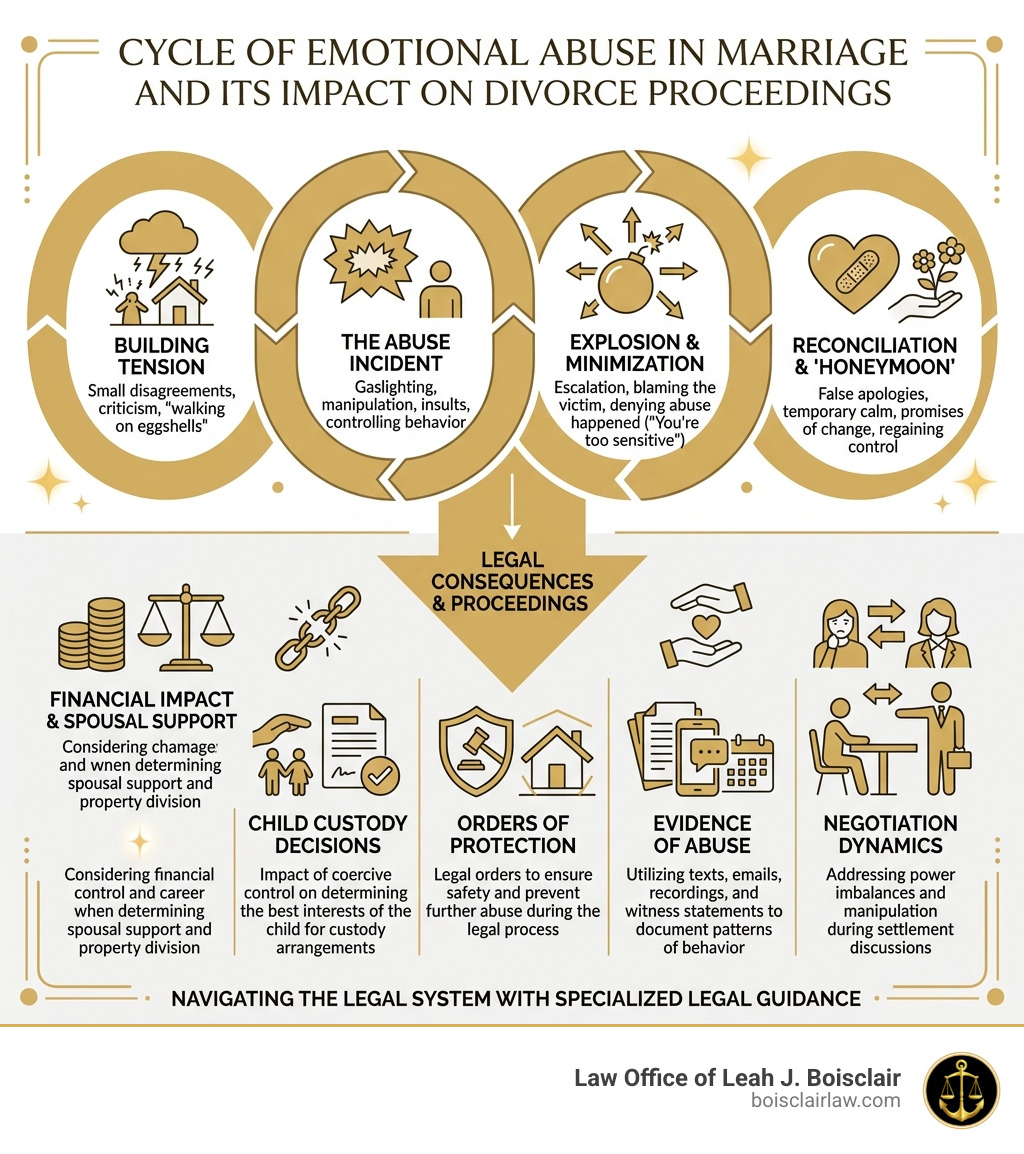
Emotional abuse, often referred to as coercive control, involves several tactics that can be just as damaging as physical violence. These include:
- Gaslighting: This is a psychological tactic where the abuser makes the victim question their own sanity or perception of reality. They might deny events happened or rewrite history to make the victim feel “crazy.”
- Isolation: The abuser may slowly cut the victim off from friends, family, and support networks, making them entirely dependent on the abuser for emotional and financial needs.
- Financial Manipulation: Restricting access to bank accounts, hiding assets, or preventing a spouse from working are all forms of abuse that make leaving feel financially impossible.
- Intimidation and Threats: Using looks, gestures, or loud voices to scare a partner, or threatening to take the children away or “leave you penniless.”
At the Law Office of Leah J. Boisclair, we recognize that these behaviors create deep psychological trauma. If you are facing these challenges, it is vital to understand that Domestic and Family Related Offenses are taken seriously by the courts. Recognizing these patterns is the first step toward reclaiming your life and ensuring your legal rights are protected during the divorce process.
How Emotional Abuse Impacts Divorce Proceedings
Many people worry that because Rhode Island is a “no-fault” divorce state, the abuse they suffered won’t matter in court. While it’s true that you don’t need to prove abuse to get a divorce, evidence of emotional cruelty is highly relevant to several key aspects of your case.
Property Division and Asset Dissipation
In Rhode Island, marital property is divided through “equitable distribution.” This doesn’t always mean a 50/50 split. Judges have the discretion to look at the conduct of the parties. For example, if an abuser engaged in “dissipation of assets”—spending marital funds on a girlfriend or hiding money as a form of financial abuse—the court can award the victim a larger share of the remaining assets to balance the scales.
Spousal Support (Alimony)
Emotional abuse can directly impact a person’s “earning power.” If years of being told you are “worthless” or being prevented from working have left you with a gap in your resume or psychological barriers to employment (like PTSD), a judge may award alimony to help you get back on your feet.
Impact on Children
The court’s primary concern is always the “best interests of the child.” While an abuser might be a “good provider,” their behavior toward the other parent creates a toxic environment. Evidence of emotional abuse can lead to supervised visitation or requirements for the abuser to complete counseling before being granted unsupervised time.
When you are consulting a divorce attorney for emotional abuse cases, we look at the totality of the circumstances to ensure the court sees the full picture of the marriage, not just the “no-fault” surface.
Proving Emotional Abuse with Digital and Physical Evidence
One of the biggest hurdles in these cases is the “he-said, she-said” dynamic. However, in April 2026, we live in a digital world where emotional abuse often leaves a permanent trail.
To meet the “preponderance of evidence” standard (meaning it is more likely than not that the abuse occurred), we work with our clients to gather:
- Digital Records: Text messages, emails, and social media posts are goldmines. If a spouse sends 50 insulting texts in an hour, that is clear evidence of harassment and intimidation.
- Audio and Video: In some cases, recordings of “explosions” or verbal tirades can be used, provided they comply with Rhode Island privacy laws.
- Witness Statements: Statements from teachers, neighbors, or doctors who have observed the abuser’s behavior or the victim’s decline in health are invaluable.
- Medical Documentation: Records from therapists or doctors regarding treatment for anxiety, depression, or stress-related physical ailments caused by the marriage.
- Expert Testimony: We may bring in mental health professionals to explain the dynamics of coercive control and how it has affected the family unit.
It is crucial that you Don’t Go It Alone When Facing Domestic Violence Offenses. Attempting to present this evidence without a legal expert can lead to it being thrown out due to hearsay rules or improper authentication.
Legal Protections and Divorce Attorneys Specializing in Emotional Abuse
Your safety is the absolute priority. For many victims, the most dangerous time in an abusive relationship is when they decide to leave. Divorce attorneys specializing in emotional abuse are equipped to handle the immediate legal protections you need.
Orders of Protection
In Rhode Island, you can seek a Restraining Order or an Order of Protection if you are in immediate fear. This can include “stay-away” orders that prevent the abuser from coming to your home or workplace. In many cases, we can secure an “emergency ex parte order,” which is granted by a judge immediately without the abuser being present, to ensure you are safe from the moment you file.
Qualities of Divorce Attorneys Specializing in Emotional Abuse
When searching for representation, look for these specific traits:
- Psychological Insight: They should understand terms like “narcissistic injury” and “trauma bonding.”
- Litigation Strength: Abusers often use the court system to continue their abuse. You need an attorney who isn’t afraid to stand up to a bully in the courtroom.
- Compassionate Communication: You deserve an attorney who listens without judgment and understands the emotional toll of your experience.
Finding Divorce Attorneys Specializing in Emotional Abuse in Rhode Island
If you are in Cranston, Providence, or anywhere in Rhode Island, local expertise matters. We understand the specific preferences of RI Family Court judges and how they view emotional abuse allegations. Utilizing local bar associations or specialized directories can help, but a personal consultation is the best way to see if an attorney’s approach aligns with your needs.
Navigating High-Conflict Personalities and Child Custody
Divorcing a narcissist or a sociopath is not a standard legal procedure; it is a battle of endurance. These individuals often view the divorce as a game they must “win,” and they will use the children as pawns.
High-conflict spouses often engage in:
- Parental Alienation: Attempting to turn the children against the other parent.
- Gaslighting the Court: Appearing calm and charming in front of the judge while being abusive behind closed doors.
- Restrictive Gatekeeping: Making false accusations of abuse to prevent the other parent from seeing the children.
In these cases, we often advocate for psychological evaluations of both parents. This brings in a neutral third-party expert to see through the “mask” of a manipulative spouse. We also push for highly detailed parenting plans that leave no room for “interpretation,” which is where abusers often find loopholes to exert control.
Immediate Steps and Resources for Victims in 2026
If you are reading this and realize you are in an emotionally abusive marriage, here are the steps you should take immediately:
- Safety First: If you are in physical danger, call 911. If you are being monitored, use a safe computer (like one at a public library) to research your options.
- Secure Documentation: Start gathering financial records, birth certificates, and evidence of abuse. Store these in a safe place outside the home, like a safe deposit box or with a trusted friend.
- Consult an Expert: Speak with divorce attorneys specializing in emotional abuse to understand your rights before you tell your spouse you are leaving.
- Utilize Resources: Organizations like WomensLaw.org provide excellent state-specific information on legal aid and low-cost resources for survivors.
If an abuser violates a protection order, you must report it immediately. For more information on how the law handles these situations, see our guide on Domestic and Family Related Offenses.
Frequently Asked Questions about Emotional Abuse Divorce
Can I get a divorce based on emotional abuse in a no-fault state?
Yes. While you don’t need to prove abuse to be granted the divorce, the abuse is highly relevant to how the judge decides on custody, alimony, and property division. In Rhode Island, “irreconcilable differences” is the standard ground, but the reason for those differences (the abuse) still carries weight.
How do I prove emotional abuse if there are no physical scars?
Proof comes from patterns. We use digital evidence (texts/emails), witness testimony from people who have seen the behavior, and expert testimony from therapists who can speak to the psychological impact the marriage has had on you.
Will emotional abuse affect my child custody arrangement?
Yes. Courts in 2026 increasingly recognize that a parent who emotionally abuses their spouse is creating a harmful environment for children. This can lead to supervised visitation, mandated parenting classes, or the abuser having limited decision-making power.
Conclusion
Leaving an emotionally abusive marriage is one of the hardest things you will ever do, but you don’t have to do it alone. At the Law Office of Leah J. Boisclair, we provide the personalized, compassionate advocacy you need to navigate this complex legal landscape. Whether you are in Cranston, RI, or the surrounding areas, our team is dedicated to protecting your rights, your family, and your future.
Don’t let an abusive partner dictate the terms of your freedom. Protect your rights and family today by scheduling a confidential consultation with our team. We are here to help you turn the page and start your next chapter with strength and security.