
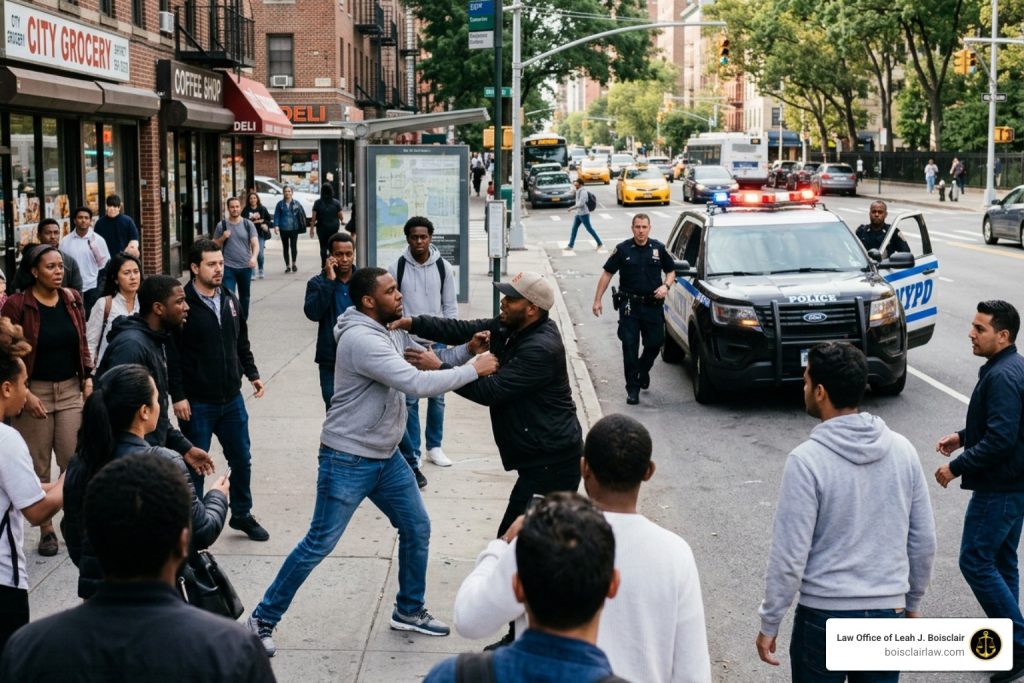
When a Fight Becomes a Crime: Understanding Public Order Offenses
Public order offense fighting or brawling is a criminal charge that applies when a physical altercation — or even the threat of one — disrupts public peace. If you’ve been charged, here’s what you need to know right away:
- What it is: Fighting or brawling in public is typically charged as disorderly conduct or breach of the peace
- Who it applies to: Anyone involved in a public physical altercation, even if you didn’t throw the first punch
- Common penalties: Fines, jail time, and a permanent criminal record
- Possible add-on charges: Assault, battery, or riot charges may also apply
- Key defense: Self-defense is a recognized legal defense in most jurisdictions
- What to do: Stay silent and contact a criminal defense attorney immediately
A bar fight that spills onto the street. A road rage incident that turns physical. A sidewalk argument that crosses a line. These are everyday situations — but they can result in serious criminal charges.
The law treats public fighting as more than just a personal dispute. It’s viewed as a violation of the social contract that keeps communities safe. And in every U.S. state, there are statutes on the books to punish it.
What surprises many people is how broad these laws are. You don’t have to seriously injure anyone. In some states, simply challenging someone to fight in public is enough to trigger a charge.
The consequences can follow you for years — affecting your job, your housing, and your reputation.
Defining the Public Order Offense: Fighting or Brawling
When we talk about a public order offense fighting or brawling, we are usually looking at a specific subset of “disorderly conduct” or “breach of the peace” laws. These laws are designed to protect the collective comfort and safety of the community. In the eyes of the law, a fight isn’t just a private matter between two people; it is an act that “corrupts public morals” or “outrages public decency.”
In many jurisdictions, the legal definition hinges on the intent to cause public inconvenience, annoyance, or alarm. For example, California Code, PEN 415 specifically criminalizes “unlawfully fighting in a public place or challenging another person in a public place to fight.”
Closer to home, the General Laws of Rhode Island Section 11-45-1. (2025) – Disorderly Conduct outlines that a person commits this offense if they intentionally, knowingly, or recklessly engage in fighting or threatening, or in violent or tumultuous behavior. Because these laws are written broadly, police often use them as a “catch-all” charge when they encounter a disturbance. If you find yourself caught in this net, working with a Public Order Offense Defense Attorney is the best way to ensure your side of the story is heard.
Common Examples of Fighting or Brawling Conduct
It doesn’t always take a cinematic “bar room brawl” to land you in handcuffs. Law enforcement has wide discretion to determine what constitutes a threat to public order. Common scenarios we see include:
- Bar Fights: Altercations that start inside and spill out onto the sidewalk or parking lot.
- Road Rage: Two drivers exiting their vehicles to engage in a physical or highly aggressive verbal confrontation on a highway.
- Sidewalk Scuffles: Heated arguments between pedestrians that escalate into pushing, shoving, or “squaring up.”
- Challenging to Fight: In many states, you don’t even have to land a punch. Simply clenching your fists and daring someone to hit you in a public square can be enough for a charge.

Defining a “Public Place” Under the Law
A crucial element of a public order offense fighting or brawling is where the incident occurs. If you and a friend have a wrestling match in your private living room, it’s rarely a crime (unless it becomes domestic violence). However, the definition of a “public place” is much wider than most people realize.
According to TITLE LXII CRIMINAL CODE and similar statutes, a public place includes any location to which the public or a substantial group has access. This typically encompasses:
- Highways and sidewalks
- Schools and government buildings
- Transport facilities (bus stations, airports)
- Lobbies and hallways of apartment houses or hotels
- Places of amusement (theaters, stadiums, parks)
- Neighborhood streets
Essentially, if a member of the public could reasonably stumble upon your fight and feel “alarmed” or “disturbed,” you are in a public place.
State-Specific Statutes and Recent Legislative Changes
Laws regarding public brawling are constantly evolving. For instance, New Jersey recently updated its code with P.L. 2025, c.059, which specifically addresses “inciting a public brawl.” This law targets individuals who act with the purpose of provoking a group of four or more people to engage in disorderly conduct. It also clarifies that “failure to disperse” when ordered by a peace officer during a disturbance is its own separate offense.
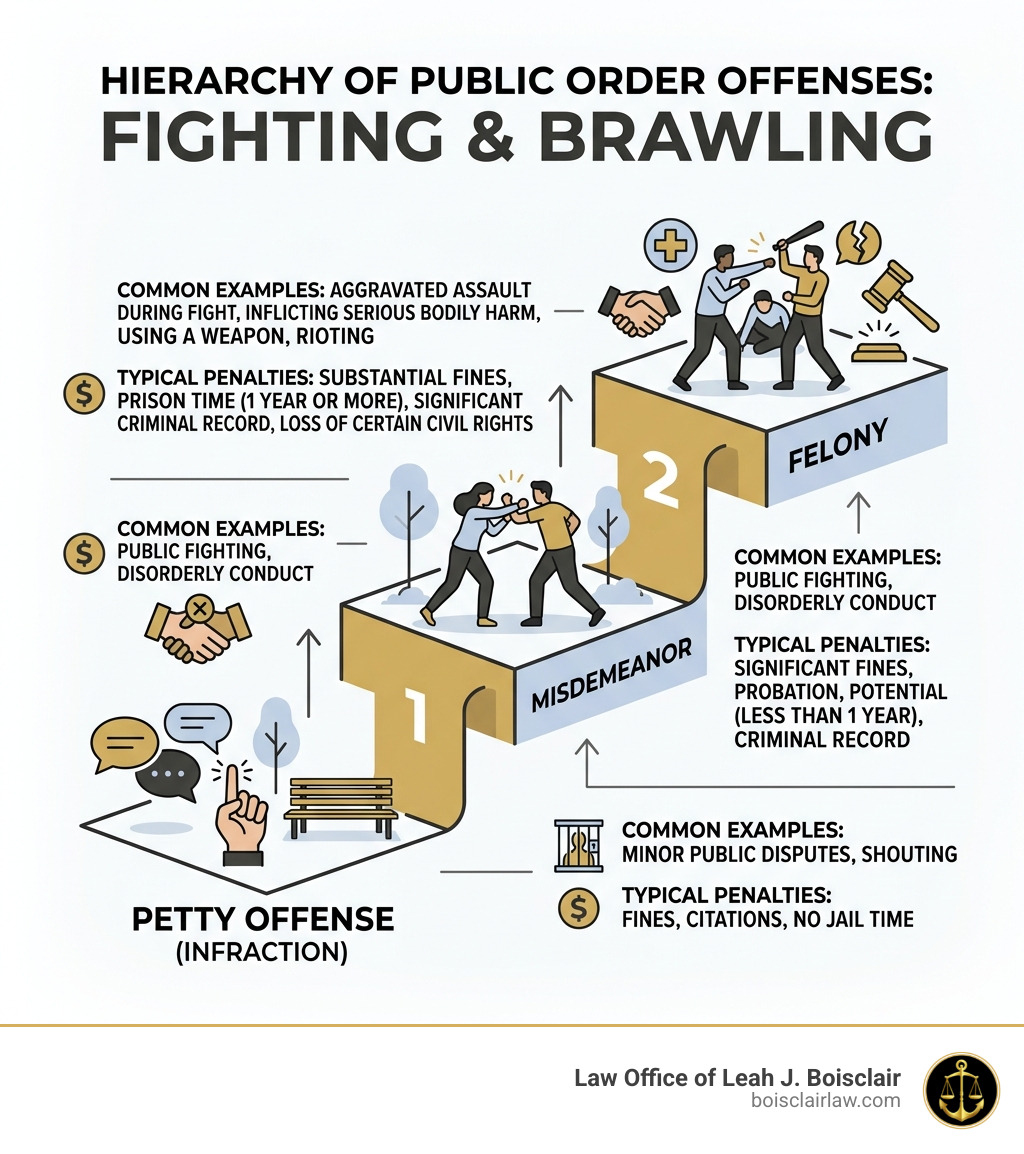
These nuances matter because they dictate whether you are facing a Felony or a Misdemeanor. While most public fighting charges start as misdemeanors, they can be “upgraded” based on the number of people involved or the presence of a weapon.
Penalties for a Public Order Offense: Fighting or Brawling
The penalties for fighting in public vary significantly depending on the state and the severity of the disruption. Most are classified as “petty offenses” or “misdemeanors,” but even these carry the risk of jail time.
| State | Classification | Potential Jail Time | Maximum Fine |
|---|---|---|---|
| Rhode Island | Petty Misdemeanor | Up to 6 months | Up to $500 |
| Florida | 2nd Degree Misdemeanor | Up to 60 days | Up to $500 |
| California | Misdemeanor | Up to 90 days | Up to $400 |
| Minnesota | Misdemeanor | Up to 90 days | Up to $1,000 |
In New Jersey, under the P.L. 2025, c.059 (A4652 2R) amendments, inciting a brawl can even reach the level of a fourth-degree crime, which carries much steeper penalties than a standard disorderly persons offense.
International Perspectives: Affray and Summary Offences
If you’ve traveled abroad, you might have heard the term “Affray.” In the UK, Australia, and New Zealand, this is the common law equivalent of public brawling.
In New Zealand, under the Summary Offences Act 1981 No 113 (as at 27 November 2025), Public Act 7 Fighting in public place, the focus is on the disturbance of the peace. Similarly, in the UK, an affray charge can be brought if a person uses or threatens unlawful violence toward another, and their conduct is such as would cause a “person of reasonable firmness” present at the scene to fear for their personal safety. These international laws highlight a global legal consensus: the public has a right to move through the world without witnessing or being caught in the crossfire of physical violence.
Related Charges: Assault, Battery, and Riot
A charge for public order offense fighting or brawling rarely travels alone. Depending on the specifics of the fight, the prosecution may pile on additional Offenses.
- Assault: This is often defined as an intentional act that puts another person in reasonable apprehension of imminent harmful or offensive contact. You don’t have to touch them; the “threat” is the crime.
- Battery: This is the actual “unwanted touching.” Even a minor shove or hitting someone with an object (like an umbrella) can constitute battery.
- Riot: If the fight involves a large group (usually four or more people) and is intended to commit a crime or prevent official action, it can escalate to a riot charge.
- Firearm Offenses: If a weapon is displayed or discharged during the brawl, the legal stakes skyrocket from a misdemeanor to a serious felony.
If you are facing a combination of these, you need a Violent Crimes Defense Attorney who understands how these charges overlap. Check our Practice Areas page for more details on how we handle multi-charge cases.
Legal Defenses and Long-Term Consequences
While the situation may seem dire, there are several legal defenses available for those charged with a public order offense fighting or brawling.
- Self-Defense: This is the most common defense. If you did not start the fight and only used the amount of force necessary to protect yourself from an imminent threat, you may be acquitted.
- Defense of Others: Similar to self-defense, you may be justified if you stepped in to protect a third party from harm.
- Medical Exceptions: Some states, like Minnesota, specifically list exceptions for conduct caused by medical emergencies, such as an epileptic seizure. If the “brawling” behavior was actually an involuntary physical reaction, it is not a crime.
- Lack of Public Element: If the fight occurred in a truly private location where the public had no access, the “public order” element of the charge might fail.
It is vital to fight these charges because the long-term consequences are more than just a fine. A conviction creates a permanent criminal record. This can lead to:
- Employment Barriers: Many employers conduct background checks and may be hesitant to hire someone with a “violent” or “disorderly” history.
- Housing Issues: Landlords often deny applications based on criminal records.
- Professional Licensing: If you are a teacher, nurse, or lawyer, a public order conviction can trigger disciplinary action from your licensing board.
For more on local Rhode Island consequences, see our guide on Rhode Island Disorderly Conduct Statute and Penalties.
Frequently Asked Questions about Public Fighting Charges
What should I do if I am arrested for fighting in public?
First and foremost, exercise your right to remain silent. Anything you say to the police in the heat of the moment—even if you are trying to explain that you were defending yourself—can be used against you in court. Seek legal counsel immediately. For a step-by-step guide on navigating the immediate aftermath of handcuffs, read What to Do If You’ve Been Arrested in RI.
Can a public brawling conviction be expunged?
In many cases, yes. Rhode Island law allows for the expungement of certain records if specific criteria are met (such as being a first-time offender and completing your sentence). This process can “clean” your record for employment and housing purposes. We recommend consulting The Ultimate Guide to RI Criminal Attorneys to see if you qualify for an expungement.
How does a fight differ from an assault charge?
While they often happen together, they are legally distinct. A “fight” or “brawl” focuses on the disturbance to the public peace. An assault focuses on the fear instilled in a specific victim. You can be charged with a public order offense even if the other person wasn’t afraid, simply because you were making a scene that disturbed the neighborhood. Our RI Criminal Attorney page breaks down these differences in detail.
Conclusion
A public order offense fighting or brawling might feel like a minor mistake or a “heat of the moment” lapse in judgment, but the legal system takes it very seriously. Whether it’s a petty misdemeanor or a more serious charge involving multiple people, the impact on your future is real.
At the Law Office of Leah J. Boisclair, we provide personalized, compassionate advocacy for those facing public order charges in Rhode Island. We understand that there are two sides to every story, and we have a proven track record of securing dismissals and reduced Charges for our clients.
Don’t let one night of conflict define your future. Understanding Why Hire a Rhode Island Criminal Defense Attorney is the first step toward protecting your rights. If you’re ready to discuss your case, visit our Public Order Offense Defense Attorney page or contact us today for a consultation.