
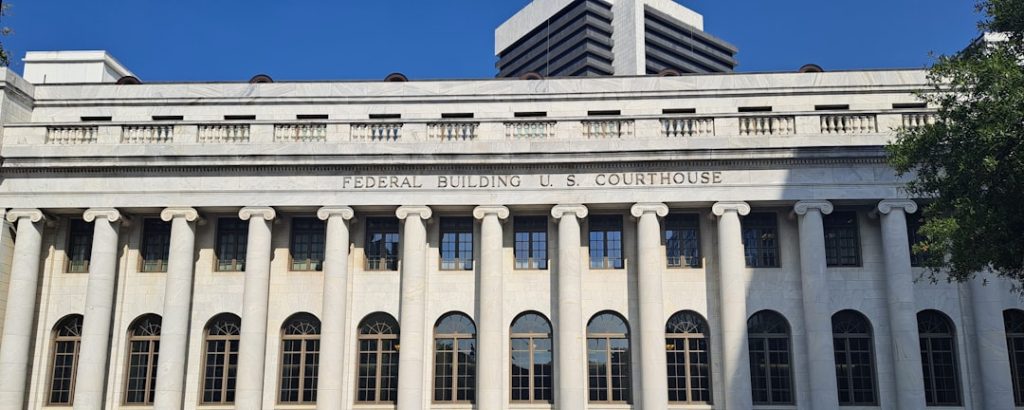
When Your Freedom Is on the Line: What a Habeas Corpus Attorney Can Do for You
A habeas corpus attorney is a lawyer who helps people challenge unlawful imprisonment or detention in court — whether after a wrongful conviction, a constitutional violation, or prolonged ICE custody with no end in sight.
Here’s what you need to know right away:
- What it is: A writ of habeas corpus is a court order demanding the government justify why it is holding someone. It is sometimes called “the Great Writ.”
- Who can file: The incarcerated person, or a family member or friend acting on their behalf.
- Where it’s filed: In state court (for state convictions) or federal court (for constitutional claims and immigration detention).
- Common grounds: Ineffective assistance of counsel, due process violations, actual innocence, Brady violations, or prolonged detention without a hearing.
- What it can achieve: Release from custody, a new trial, a reduced sentence, or a court-ordered bond hearing.
- Key deadline: Federal habeas petitions generally must be filed within one year of a conviction becoming final.
If you or someone you love is behind bars — or held by ICE with no hearing in sight — this is one of the most powerful legal tools available to you.
The numbers tell a sobering story. Federal habeas corpus petitions filed by state prisoners climbed from roughly 12,000 in 1996 to nearly 19,500 in 2022. Yet only about 1.2% of those petitions result in relief. That is not a reason to give up. It is a reason to get the right attorney before you file — because in most cases, you only get one shot.
This guide walks you through exactly how the process works, what grounds apply, and how the Law Office of Leah J. Boisclair can help you build the strongest possible case.
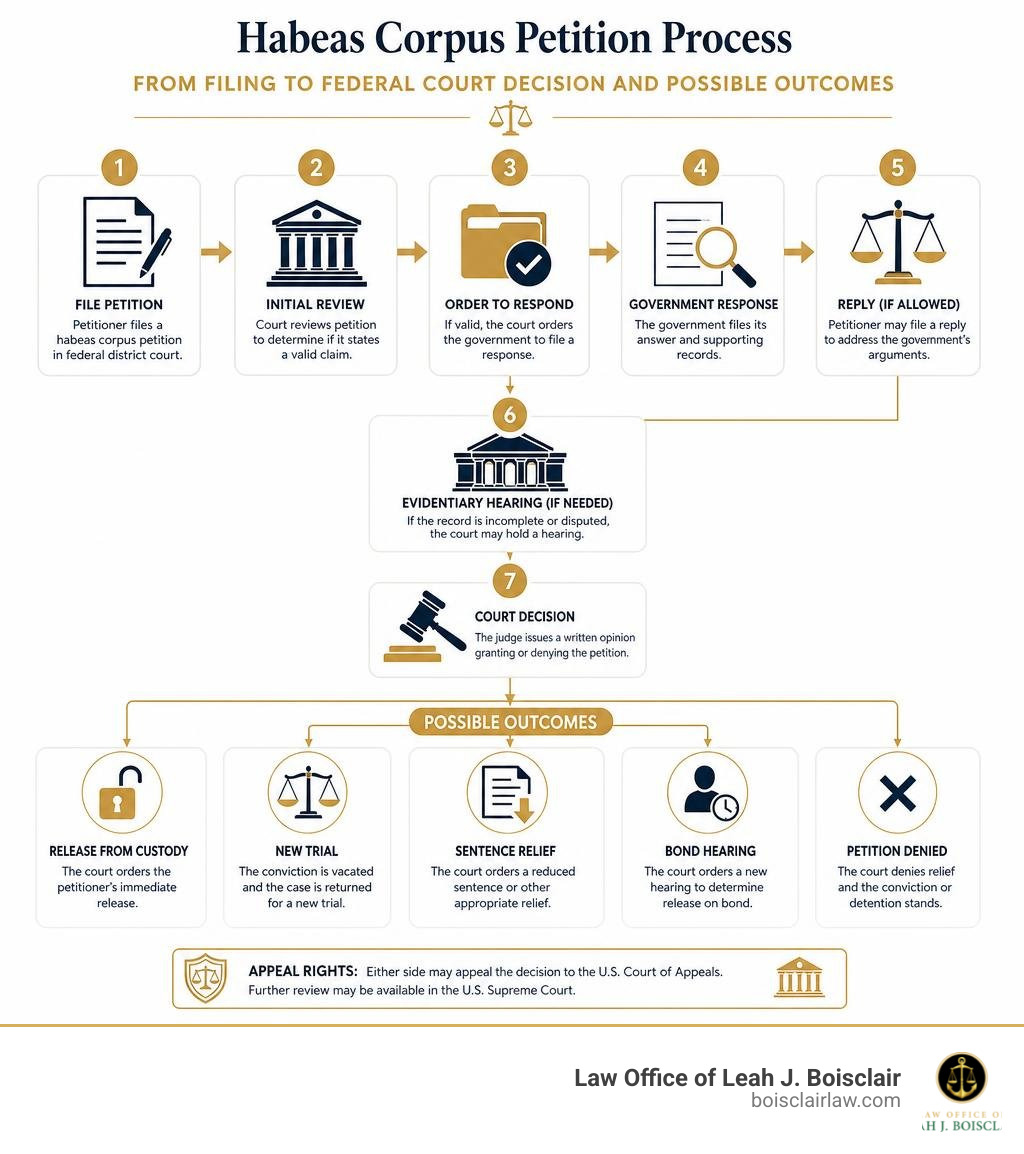
Habeas corpus attorney word list:
Understanding the Writ of Habeas Corpus and How It Functions

Dating back to the Magna Carta, the writ of habeas corpus—literally meaning “you shall have the body” in Latin—serves as the ultimate constitutional safeguard against arbitrary or unlawful detention. Unlike a direct appeal, which is a straight review of the trial record to find legal errors made by the judge, a habeas petition is a “collateral attack” on the conviction or detention itself.
This means it is treated as a completely separate civil lawsuit filed against the warden or custodian holding the individual. Because it is a collateral attack, it allows us to introduce brand-new evidence that was never seen by the original trial jury or reviewed during a direct appeal.
To file a habeas petition, the individual must meet the “custody” requirement. This does not strictly mean being locked in a prison cell; it can include probation, parole, supervised release, or being held in immigration detention.
For those navigating the state system, pursuing Post-Conviction Relief: Your Second Chance in the Rhode Island Justice System is often the necessary first step before ever stepping foot in federal court. If the state courts refuse to correct a fundamental injustice, we can then escalate the fight by filing a federal habeas petition under 28 U.S.C. § 2254.
Common Grounds for Challenging Unlawful Detention
Filing a successful petition requires showing that the detention violates the U.S. Constitution or federal law. It is not enough to simply argue that the jury made the wrong decision. We must pinpoint severe constitutional violations or structural trial errors that undermined the fundamental fairness of the entire proceeding.
When your freedom is on the line, understanding these complex constitutional concepts is critical. To see why having specialized representation makes all the difference in identifying these errors, you can read about Why Hire a Rhode Island Criminal Defense Attorney?.
Ineffective Assistance of Counsel and Due Process Violations
The Sixth Amendment guarantees every accused person the right to effective legal representation. If a trial attorney made errors so egregious that they essentially acted as no lawyer at all, it violates the defendant’s constitutional rights. Common examples of ineffective assistance include:
- Failing to interview key eyewitnesses or hire necessary forensic experts.
- Failing to object to highly prejudicial, inadmissible evidence.
- Failing to convey a favorable plea offer to the defendant.
- Advising a client to plead guilty based on an incorrect understanding of the law.
Due process violations under the Fifth and Fourteenth Amendments also serve as strong grounds for relief. This includes “Brady violations,” which occur when the prosecution illegally suppresses exculpatory evidence—evidence that could prove the defendant’s innocence or impeach a state witness. When the state plays dirty, a federal court can step in to vacate the conviction. Navigating these highly technical claims is incredibly challenging, which is why reviewing The Ultimate Guide to RI Criminal Attorneys can help you understand the standard of advocacy you should expect.
Actual Innocence and Newly Discovered Evidence
An extraordinary ground for habeas corpus is a claim of “actual innocence.” This is not merely a legal technicality; it is an assertion that the petitioner did not commit the crime. To succeed, we must present newly discovered, reliable evidence—such as DNA testing, reliable recantations of key witness testimony, or proof of a fabricated state case—that was unavailable at the time of the trial.
If we can show that, in light of this new evidence, no reasonable juror would have voted to find the defendant guilty beyond a reasonable doubt, the federal court has the authority to overturn an unconstitutional conviction and order a release or a new trial.
State vs. Federal Habeas Corpus: Key Differences and Deadlines
The procedural landscape of post-conviction work is filled with traps for the unwary. State-level post-conviction relief (PCR) and federal habeas corpus are governed by entirely different rules, standards, and strict timelines.
| Feature | State Post-Conviction Relief (PCR) | Federal Habeas Corpus (28 U.S.C. § 2254) |
|---|---|---|
| Primary Governing Law | State statutes (e.g., General Laws of Rhode Island Chapter 10-9 (2025) – Habeas Corpus) | Federal law (AEDPA / 28 U.S.C. § 2254) |
| Filing Deadline | Generally more flexible depending on state rules | Extremely strict one-year statute of limitations |
| Evidentiary Scope | Can raise state-level errors and constitutional claims | Limited strictly to violations of the U.S. Constitution or federal law |
| Exhaustion Requirement | None (this is the starting point) | Must exhaust all available state court remedies first |
Under the Antiterrorism and Effective Death Penalty Act (AEDPA), federal courts are highly deferential to state court rulings. Before a federal judge will even look at your constitutional claims, you must “exhaust” your state remedies. This means you must present every single one of your federal constitutional claims to the state’s highest court first. If you skip this step, the federal court will dismiss your petition out of hand.
Texas Article 11.07 Writs vs. Federal Petitions
While our firm focuses our practice on representing clients throughout Rhode Island—including Cranston, Providence, Warwick, and Johnston—it is highly instructive to compare different state systems to understand how post-conviction remedies operate across jurisdictions.
For example, in Texas, the primary post-conviction remedy for non-death penalty felony cases is the Article 11.07 writ of habeas corpus. Under Article 11.07, the petition is initially filed in the trial court where the conviction occurred, but the ultimate authority to grant or deny relief rests solely with the Texas Court of Criminal Appeals.
Whether dealing with a state-specific process like Rhode Island’s PCR statute or a Texas Article 11.07 writ, these state-level actions serve as the essential gateway. Only after these state procedures are fully completed and exhausted can an individual successfully transition their fight into federal court via a federal petition.
Strict Deadlines and the Danger of Successive Writs
Under AEDPA, you generally have a strict one-year window to file a federal habeas petition. This clock usually starts ticking the moment your direct appeal finishes and your conviction becomes “final.”
The legal system strongly dislikes “successive writs”—meaning you cannot file one petition, lose, and then file another one later with different arguments. With very rare exceptions (such as a retroactive change in constitutional law or newly discovered evidence that could not have been found earlier), you get exactly one shot at federal habeas relief.
If you leave out a winning argument in your first petition, it is likely gone forever. This makes it absolutely critical to work with an experienced habeas corpus attorney to draft a comprehensive, compelling, and legally flawless initial petition.
Challenging ICE Detention: Habeas Corpus in Immigration Cases

Habeas corpus is not limited to criminal convictions. It is also the single most powerful tool available to challenge unlawful civil detention by Immigration and Customs Enforcement (ICE). Thousands of non-citizens are held in immigration facilities for months or even years while their removal cases wind through the system.
When ICE holds someone indefinitely without a meaningful opportunity for release, we can bypass the backlogged immigration courts entirely and file a petition for a writ of habeas corpus directly in federal district court under 28 U.S.C. § 2241. To explore how federal litigation can challenge these unlawful detentions nationwide, you can refer to the resources provided by an Immigration Habeas Corpus Attorney | Challenging Unlawful Detention .
In the landmark case Zadvydas v. Davis, the U.S. Supreme Court ruled that the government cannot detain a non-citizen indefinitely. Generally, holding someone for more than six months after a final order of removal is presumptively unconstitutional if there is no significant likelihood of their removal in the reasonably foreseeable future.
How a Habeas Corpus Attorney Fights Prolonged ICE Custody
When we file a § 2241 petition in federal court, we bring the matter before an independent, life-tenured federal judge who does not work for the Department of Justice or ICE. This independent judicial review is a game-changer. We can aggressively challenge:
- Prolonged Detention: Demanding immediate release or a constitutionally adequate bond hearing if detention has exceeded six months.
- Mandatory Detention Mistakes: Arguing that ICE has misclassified your loved one under mandatory detention statutes.
- Due Process Violations: Challenging inhumane conditions of confinement or arbitrary transfers to remote facilities designed to isolate detainees from their families and legal counsel.
- Emergency Situations: Filing emergency motions to halt unlawful transfers or deportations while federal claims are being actively reviewed.
The Role of a Habeas Corpus Attorney in Your Post-Conviction Case
Navigating the post-conviction process without a specialized advocate is like trying to perform surgery on yourself—it is incredibly complicated, highly technical, and a single mistake can be fatal to your case. An experienced habeas corpus attorney acts as your legal investigator, strategist, and champion.
Our work begins with a forensic review of the entire trial transcript, prosecution files, and previous appellate briefs to uncover hidden constitutional errors. We locate witnesses, gather sworn affidavits, obtain fresh forensic evaluations, and build a bulletproof evidentiary record.
If the federal court grants an evidentiary hearing, we represent you in court, cross-examine state witnesses, and present the legal arguments necessary to secure your freedom. While we fight to overturn an unjust conviction, many clients also ask about cleansing their records entirely; you can learn more about this in our guide on Can You Actually Clear Your Criminal Record?.
What to Expect When Consulting a Habeas Corpus Attorney
When you reach out to the Law Office of Leah J. Boisclair, we start with an honest, thorough evaluation of your case. We do not make false promises; we give you a realistic assessment of your chances and map out a strategic path forward.
To help us evaluate your case as quickly and accurately as possible, we utilize a detailed Client Intake Form. When preparing to speak with us, it is incredibly helpful to gather the following details:
- Personal Information: Full name, date of birth, and current location of confinement.
- Case Information: The specific charges, the date of conviction or arrest, the arresting agency, and any upcoming court dates.
- Legal History: Details of the trial, direct appeals, and whether any prior post-conviction petitions have been filed.
- Employment & Community Ties: Information that can support a release on bond or show deep roots in the community.
- Your Legal Goals: Whether you are seeking a complete dismissal, a new trial, a sentence reduction, or a bond hearing.
Because of the strict one-year federal filing deadline, acting promptly is absolutely vital. The sooner we can review your trial files, the more time we have to craft a winning petition.
Frequently Asked Questions about Habeas Corpus
Who is eligible to file a habeas corpus petition?
Any person who is currently under a significant restraint on their liberty (satisfying the “custody” requirement) due to a state or federal court order, or federal administrative action (like ICE detention), may be eligible. If the incarcerated person is unable to file the petition themselves due to physical isolation or mental incapacity, a family member, friend, or attorney can file a “next friend” petition on their behalf.
What remedies can a successful habeas petition achieve?
A successful federal habeas petition can result in several powerful outcomes:
- Immediate Release: The court orders the individual to be set free from custody.
- A New Trial or Hearing: The court vacates the unconstitutional conviction and orders the state to either release the individual or conduct a fair, constitutionally compliant trial.
- Sentence Modification: The court orders a reduction of an illegal or unconstitutional sentence.
- A Bond Hearing: In immigration cases, the federal judge can compel ICE to provide a constitutionally sound bond hearing before an immigration judge.
How long does the federal habeas corpus process take?
The timeline varies widely depending on the complexity of the constitutional issues and the court’s caseload. According to federal court statistics, the median time from filing to disposition for federal habeas corpus cases was 7.3 months in FY 2022. While some emergency immigration petitions can resolve in a matter of weeks, complex criminal post-conviction cases involving evidentiary hearings can take a year or more to reach a final decision.
Conclusion
When the gates of the traditional justice system seem to have slammed shut, a writ of habeas corpus represents your final, most powerful opportunity to fight back. Whether you are battling an unconstitutional state conviction, a devastating trial error, or prolonged civil detention by immigration authorities, you do not have to fight this battle alone.
At the Law Office of Leah J. Boisclair, we provide compassionate, personalized, and relentless advocacy for individuals facing misdemeanors, felonies, and complex post-conviction challenges throughout Rhode Island—including Cranston, Providence, Warwick, Johnston, East Providence, and West Warwick. We know that behind every case file is a human being, a family, and a life hanging in the balance.
If you or a loved one is being held unlawfully, contact us today to schedule a consultation. Let us help you navigate the federal court system and fight to bring you home. If your situation involves other public order issues, you can also learn about our work as a Public Order Offense Defense Attorney.