
Why Finding the Right Domestic Violence Attorney Can Change Everything
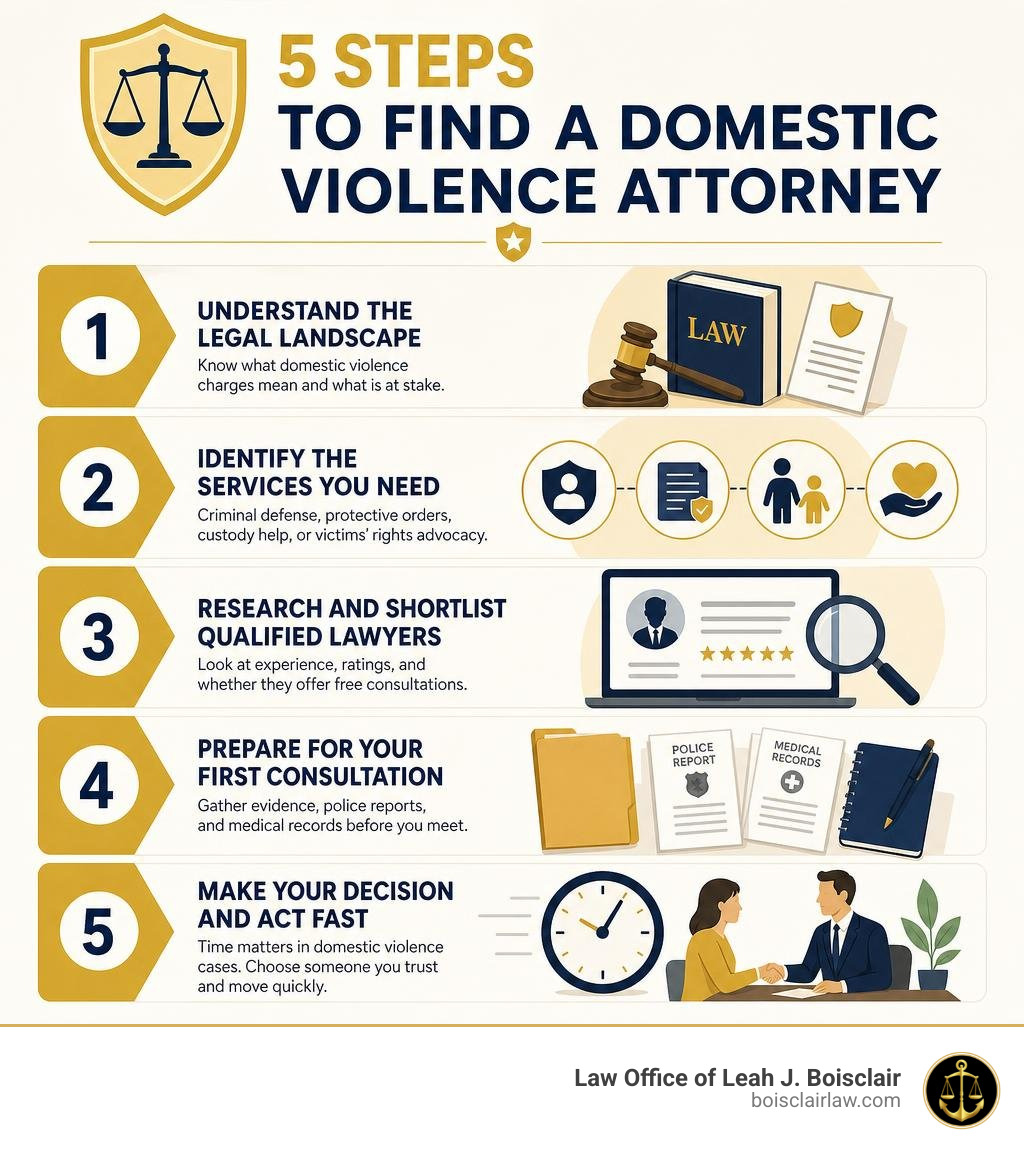
If you need a domestic violence attorney, here is a quick overview of the 5 steps to find one:
- Understand the legal landscape — Know what domestic violence offenses mean under the law and what is at stake.
- Identify the services you need — Criminal defense, protective orders, custody help, or victims’ rights advocacy.
- Research and shortlist qualified lawyers — Look at experience, ratings, and whether they offer free consultations.
- Prepare for your first consultation — Gather evidence, police reports, and medical records before you meet.
- Make your decision and act fast — Time matters in domestic violence cases. Choose someone you trust and move quickly.
A domestic violence allegation does not just affect one area of your life. It can trigger criminal offenses, restraining orders, and family law consequences — all at the same time. According to national data, domestic violence accounts for 15% of all violent offenses in the United States. Yet many people facing these situations — whether accused or victimized — do not know where to start when looking for legal help.
The stakes are high. A conviction can affect your job, your home, your gun rights, and your relationship with your children. And if you are a victim, getting the wrong legal help — or no help at all — can leave you unprotected.
This guide walks you through exactly how to find qualified legal representation, step by step, based on what actually matters.
Domestic violence attorney terms simplified:
- divorce attorneys specializing in emotional abuse
- domestic abuse defense lawyer
- domestic violence lawyer texas
Step 1: Understand the Legal Landscape of Domestic Violence Offenses
Before you pick up the phone to call a domestic violence attorney, you must understand what you are up against. Under Rhode Island law, domestic violence is not a single, standalone offense. Instead, it is a legal designation added to other offenses—such as simple assault, cyberstalking, vandalism, or disorderly conduct—when the offense is committed against a family or household member.
These family or household relationships include:
- Spouses or former spouses
- Individuals related by blood or marriage
- People who have a child in common
- Individuals who are currently or were recently in a substantive dating or engagement relationship
When a domestic relationship exists, the state attaches “domestic” penalties to the underlying offense. This means even a simple misdemeanor can carry mandatory domestic violence counseling, a loss of firearm rights, and the immediate implementation of a no-contact order.
Understanding the dual nature of these proceedings is crucial. A single incident often splits into two entirely separate legal battles: criminal prosecution and civil protective order hearings. To help visualize this split, we have outlined the core differences below:
| Feature | Criminal Defense Proceedings | Protective Order Proceedings (Civil) |
|---|---|---|
| Objective | To determine guilt or innocence regarding criminal offenses. | To establish safety measures and stay-away orders. |
| Initiated By | The state prosecutor (e.g., in Cranston or Providence). | The individual seeking protection (the plaintiff). |
| Standard of Proof | Beyond a reasonable doubt (highest standard). | Preponderance of the evidence (more likely than not). |
| Potential Penalties | Jail time, probation, fines, and a criminal record. | Restraining orders, temporary custody loss, eviction. |
| Right to Counsel | Court-appointed attorney if you cannot afford one. | No court-appointed attorney; both sides must hire private counsel. |
Whether you are facing misdemeanor or felony offenses, these consequences can reshape your future. If you want to learn more about how Rhode Island handles these specific offenses, read our comprehensive guide on Domestic and Family Related Offenses.
Step 2: Identify the Specific Services You Need from a Domestic Violence Attorney
Not all domestic violence lawyers handle cases the same way. Some focus strictly on criminal defense, while others operate primarily within family law. Identifying your specific legal needs early prevents you from wasting time with the wrong type of advocate.

Criminal Defense Representation
If you have been arrested or are facing formal prosecution for offenses in Rhode Island, your immediate priority is criminal defense. A conviction for a domestic offense can carry devastating long-term consequences, including a lifetime firearm ban under federal law and mandatory enrollment in a costly, 26-week batterer’s intervention program. We help clients challenge the prosecution’s evidence, expose false allegations, and fight for dismissals or reduced penalties. If you are facing prosecution right now, understand Why You Need a Criminal Defense Attorney for Domestic Violence Right Now.
Restraining Orders and Civil Protection
If you are a victim seeking safety, or if you are defending against a wrongful restraining order, you need an attorney who understands the civil court system. In Rhode Island, a civil restraining order can force a respondent out of their home, strip them of temporary child custody, and restrict their movements. Whether you are seeking protection or defending your reputation, having a skilled Rhode Island Domestic Violence Attorney ensures your rights are protected during these hearings.
Child Custody, Visitation, and Family Law
When domestic allegations enter the family court system, judges prioritize child safety above all else. A pending domestic offense can severely limit your visitation rights or result in supervised visits only. We work to ensure that custody determinations are based on factual evidence rather than exaggerated claims, protecting the parent-child relationship while keeping children safe.
Step 3: Research and Shortlist Qualified Lawyers
Once you know what services you need, it is time to build a shortlist of qualified attorneys. Do not simply hire the first name that pops up on a search engine. Take a structured approach to find a legal advocate who is highly familiar with Rhode Island’s local court systems.

Look for Deep Local Experience
Law is highly local. An attorney who regularly practices in the Providence County Superior Court or the Kent County District Court will understand the local prosecutors, judges, and court staff. This familiarity is invaluable when building a defense strategy or negotiating a resolution.
Evaluate Ratings and Client Reviews
Read what former clients have to say. Look for reviews that mention:
- Communication and responsiveness
- Compassion and empathy during difficult times
- Clear explanations of complex legal strategies
- Successful case resolutions (such as dismissals or dismissed offenses)
Take Advantage of Free Consultations
Most reputable attorneys offer a free initial consultation. Use this meeting to assess whether the lawyer is a good fit for your personality and goals. Ask direct questions about their experience with domestic offenses, their fee structures, and how they plan to communicate with you throughout the case. For more guidance on this step, see our article on How to Choose the Best Domestic Abuse Lawyer for Your Case.
If you are looking for local representation tailored to Rhode Island’s unique court rules, consult a dedicated Rhode Island Domestic Violence Offenses Attorney.
Step 4: Prepare for Your Initial Consultation
To get the most out of your consultation, you should arrive prepared. The more accurate information you can provide, the faster your attorney can build an effective strategy.
Gather Essential Evidence and Documentation
Bring every piece of paper or digital file related to your case. This includes:
- Police reports, arrest warrants, or court summonses
- Medical records or photographs of injuries (if applicable)
- Text messages, emails, or call logs between you and the other party
- A list of potential witnesses and their contact information
Complete a Mental Legal History
Be ready to share your background. At our firm, we use a structured intake process to understand your situation fully. We will ask about:
- Personal Information: Your contact details, employment status, and family structure.
- Case Information: The exact offenses, arresting agency, and upcoming court dates.
- Legal History: Any prior arrests, convictions, or existing probation terms.
- Your Goals: Whether you are seeking a complete dismissal, a negotiated plea deal, or preparing for trial.
Understand the Rules of Confidentiality
Everything you discuss with an attorney during a consultation is protected by attorney-client privilege, even if you do not end up hiring them. Be completely honest. Disclose even the negative details of your case so your attorney can prepare for the prosecution’s arguments. For more practical advice on preparing your case, read Don’t Go It Alone When Facing a Domestic Violence Case.
Step 5: Make Your Final Decision and Take Immediate Action
Domestic violence cases move incredibly fast. In Rhode Island, a defendant is typically arraigned within 24 hours of an arrest, and civil restraining order hearings are often scheduled within 10 to 14 days of filing. Delaying your decision can result in missed deadlines, default judgments, or violations of active no-contact orders.
When making your final choice, consider these three factors:
- Trust: Do you feel heard, respected, and supported by the attorney?
- Clarity: Did they explain their fee structure (flat fee vs. hourly) and legal strategy clearly?
- Responsiveness: Did they answer your calls and address your concerns promptly?
If you are facing domestic allegations in Cranston, Warwick, or Providence, you need to find the best domestic violence attorney Rhode Island has to offer. Do not wait for the prosecution to build an uncontested case against you. Take control of your situation, secure professional representation, and protect your future today.
Frequently Asked Questions about Domestic Violence Offenses
How can a domestic violence attorney help someone accused of domestic violence offenses?
A defense attorney helps by investigating the facts of the arrest, identifying inconsistencies in the prosecution’s evidence, and protecting your constitutional rights. We often uncover evidence of false allegations, self-defense, or lack of intent. Additionally, we guide you through the complex rules of active no-contact orders to ensure you do not accidentally violate the law and face additional criminal offenses. For those navigating divorce alongside these accusations, our guide on A Legal Guide to Divorcing an Emotionally Abusive Partner offers critical strategic insights.
How does a domestic violence attorney assist victims seeking protection?
For victims of abuse, an attorney is an essential guide through the civil court system. We help draft clear, detailed petitions for protective orders, represent you at hearings to secure long-term stay-away orders, and advocate for temporary child custody and financial support. We also assist in safety planning and coordinate with local support organizations to ensure you are fully protected. To learn more about securing these protections, review our resources on finding a Reliable Domestic Violence Attorney in Rhode Island.
How do courts handle domestic violence cases involving children and custody?
Rhode Island courts place the safety and well-being of the child above all else. If there is a pending domestic offense or an active protective order, the court may temporarily suspend visitation or order that all visits be supervised by a professional or a mutually agreed-upon third party. A conviction for a domestic offense can permanently alter custody arrangements, making it much harder to secure joint custody in the future. For an in-depth look at how domestic allegations impact family law, read about Domestic and Family Related Offenses.
Work with a Dedicated Rhode Island Defense Team
Facing domestic violence allegations can feel incredibly isolating, but you do not have to navigate this challenging time alone. At the Law Office of Leah J. Boisclair, we provide personalized, compassionate advocacy to clients throughout Cranston, Providence, Warwick, Johnston, and the surrounding Rhode Island communities.
We understand that every story has two sides. Our team is committed to thoroughly investigating your case, protecting your rights, and pursuing proven dismissals or reduced penalties. Contact us today to schedule a confidential consultation and discover how we can help you protect your family, your reputation, and your future. Learn more about our approach to Domestic and Family Related Offenses and take the first step toward reclaiming your life.