Why Speedy Trial Rights Could Change the Outcome of Your Case
Speedy trial rights are one of the most powerful — and most overlooked — protections in the U.S. criminal justice system. If the government takes too long to bring you to trial, you may have the right to have your charges dismissed entirely.
Here is a quick answer to what speedy trial rights mean for you:
| Question | Quick Answer |
|---|---|
| What are speedy trial rights? | Your constitutional right (6th Amendment) to be tried within a reasonable time after being charged |
| When do they apply? | From the time of arrest or formal charge through conviction |
| Who protects this right? | Both the U.S. Constitution and federal/state statutes |
| What happens if the right is violated? | Charges can be dismissed — often with prejudice, meaning they cannot be refiled |
| Do they apply in RI, MA, and CT? | Yes — all three states have constitutional and/or statutory protections |
The Sixth Amendment to the U.S. Constitution states that anyone accused of a crime has the right to a speedy and public trial. This protection has been part of American law since the founding — and its roots go back even further, to the Magna Carta of 1215.
But knowing the right exists and knowing how to use it are two very different things.
Delays in criminal cases are common. Court backlogs, complex charges, and procedural motions can stretch a case out for months or even years. During that time, you may be sitting in pretrial detention, unable to work, and living under the stress of unresolved charges.
That is exactly what this right was designed to prevent.
Whether you are facing a misdemeanor or a felony — a DUI charge, a drug offense, or something more serious — understanding your speedy trial rights could be the key to protecting your freedom.
Understanding Your Constitutional Speedy Trial Rights
When we talk about the constitutional foundation of your defense, the Sixth Amendment is our strongest shield. The Overview of the Right to a Speedy Trial shows that this right is not a modern luxury; it is a fundamental pillar of justice designed to prevent the government from keeping a dark cloud of suspicion over your head indefinitely.
Historically, as detailed in The Speedy Trial Clause, this right was designed to prevent prolonged pretrial imprisonment and to limit the anxiety and public suspicion that accompanies a pending criminal charge. It ensures that the government must put up or shut up within a reasonable timeframe.
But how do courts actually determine if a delay is “unreasonable”? Because the U.S. Constitution does not list a specific number of days, the United States Supreme Court had to create a framework.
In the landmark 1972 case Barker v. Wingo, the Supreme Court established a flexible, four-factor balancing test that judges must use to evaluate whether a defendant’s speedy trial rights have been violated:
- Length of the Delay: This is the triggering mechanism. Generally, a delay approaching one year is considered “presumptively prejudicial” and will prompt the court to look at the other three factors.
- Reason for the Delay: Who is at fault? If the prosecution deliberately delayed the trial to hamper the defense, this factor weighs heavily against the government. If the delay was caused by court congestion, it still weighs against the government, but less heavily. If the defendant caused the delay (for example, by firing their lawyer or failing to show up), this factor weighs against the defendant.
- The Defendant’s Assertion of the Right: Did you actively ask for a speedy trial? If a defendant sits back quietly and never objects to the delays, courts are much less likely to find a violation. Asserting your right early and often is critical.
- Prejudice to the Defendant: This is often the most critical factor. The court looks at how the delay harmed you. Did you spend months in jail? Did you suffer extreme anxiety? Most importantly, did the delay damage your ability to defend yourself (e.g., did a key witness pass away, or did crucial evidence get lost)?
For a deeper dive into how this constitutional balancing act works in daily practice, you can read A Comprehensive Guide to Your Right to a Speedy Trial.
Federal and State Statutory Time Limits
While the Constitution provides a broad, flexible balancing test, both federal and state governments have enacted specific statutes to put concrete numbers on these timelines. These laws establish rigid “speedy trial clocks” that start ticking the moment you are arrested or formally charged.
| Jurisdiction | Arrest to Indictment Limit | Indictment to Trial Limit | Key Statutory/Constitutional Authority |
|---|---|---|---|
| Federal Court | 30 Days | 70 Days | Federal Speedy Trial Act (18 U.S.C. § 3161) |
| California | 15 Days (Arrest to Charge) | 60 Days (Felony Arraignment to Trial) | California Penal Code Section 1382 |
| North Carolina | N/A (No statutory limits) | N/A (No statutory limits) | NC Constitution, Article I, Section 18 |
| Rhode Island | Case-by-case constitutional limits | Case-by-case constitutional limits | RI Constitution, Article I, Section 10 |
As we can see, the protections you enjoy depend entirely on where your case is being prosecuted. The Overview of the Right to a Speedy and Public Trial highlights that these statutory limits are designed to give teeth to the Sixth Amendment, ensuring that the abstract concept of “speediness” is backed by actual, enforceable deadlines.
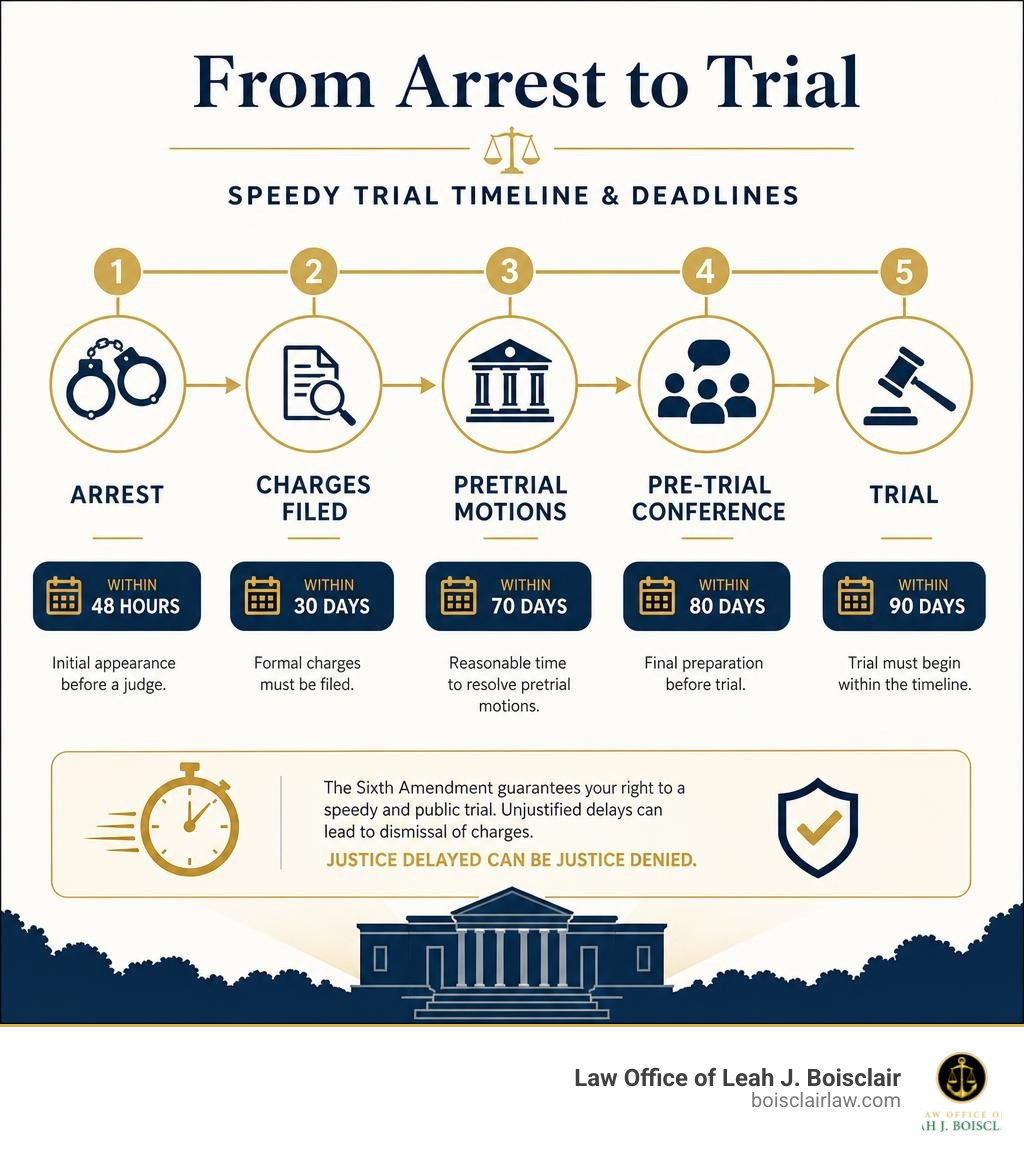
Under 18 USC Ch. 208: SPEEDY TRIAL, the federal system lays down very clear rules. The government has exactly 30 days from your arrest to file an indictment, and then 70 days from that indictment or your first court appearance to begin your trial. If they miss these windows without a legally recognized excuse, we can move to dismiss the charges.
Federal vs. State Protections of Speedy Trial Rights
The federal system relies heavily on the strict guidelines of the Speedy Trial Act of 1974. Under 18 USC 3161: Time limits and exclusions, the court must carefully track every single day, subtracting “excludable” delays (such as time spent resolving defense motions) to ensure the 70-day limit is respected.
State laws, however, vary wildly:
- California: Under Penal Code 1382, the state has incredibly strict timelines. For instance, a felony trial must generally begin within 60 days of the defendant’s arraignment. If the prosecution fails to meet this deadline without showing “good cause,” the court is legally required to dismiss the case.
- North Carolina: Interestingly, North Carolina completely repealed its statutory speedy trial laws in 1989. Today, defendants in North Carolina must rely solely on the constitutional protections found in the North Carolina Constitution and the federal Sixth Amendment, meaning judges there must apply the slower, more complex four-factor Barker test rather than counting down a set number of statutory days.
- Rhode Island: In our home state, we do not have a single, rigid statutory countdown like California. Instead, Rhode Island courts rely on the constitutional framework of Article I, Section 10 of the Rhode Island Constitution, combined with the Barker v. Wingo analysis. This makes having an experienced advocate on your side even more important, as we must build a persuasive, fact-based argument showing how the delay has prejudiced your life and your defense. If you want to understand how local courts handle these issues, check out The Ultimate Guide to RI Criminal Attorneys.
Specific Timeframes for Misdemeanor and Felony Offenses
Generally, the law expects simpler cases to move much faster than complex ones. This means misdemeanor offenses usually carry shorter speedy trial windows than major felonies.
For example, in states with strict statutory limits like California, a misdemeanor trial must typically begin within 30 days of arraignment if the defendant is in custody, or 45 days if they are out of custody. Felonies, due to their complexity, are granted a standard 60-day window.
To explore how these timelines impact minor charges locally, you can read about Getting to Not Guilty with Proven RI Misdemeanor Defense.
Regardless of whether a state uses strict statutory days or constitutional balancing, the type of charge plays a massive role in how much delay a court will tolerate:
- DUI and Traffic Offenses: Because these cases rely heavily on chemical tests and officer testimony, courts expect them to move quickly. Long delays can lead to degraded chemical evidence or officers forgetting key details of the traffic stop.
- Firearm Offenses & Drug Offenses: These cases often involve lab testing (ballistics or chemical analysis). While courts allow some time for lab results, unreasonable delays by state labs can violate your rights.
- Assault and Battery Offenses & Domestic Offenses: These cases rely heavily on witness testimony. Delays can cause witnesses to move, change their minds, or lose clear recollection of the events, which heavily prejudices the defense.
- Property Offenses & Computer Offenses: These can range from simple shoplifting to complex digital forensics. Simple property crimes are expected to be resolved swiftly, while computer crimes involving hard drive imaging may justify longer preparation windows.
- White Collar Offenses, Sex Offenses, & Violent Offenses: These are highly complex. Courts almost always grant wider latitude for delays in these categories because defense teams and prosecutors alike require months to review thousands of pages of financial records, DNA evidence, or medical reports.
Exceptions, Waivers, and Delays in Criminal Cases

It would be wonderful if the speedy trial clock was a simple, uninterrupted countdown. In reality, the clock stops and starts constantly.
The most common reason the clock stops is a time waiver. When you waive time, you are voluntarily telling the court, “I agree to push back the deadline to give my attorney more time to prepare.” Defense attorneys frequently request these waivers because a rushed trial is often a losing trial. Preparing a strong defense takes time.
Courts can also delay a trial without your consent if they find good cause. Good cause can include:
- The sudden illness or incapacitation of the defendant, judge, or lead prosecutor.
- Natural disasters or public health crises that make it unsafe to assemble a jury.
- Highly complex case circumstances (such as a multi-defendant conspiracy case).
However, if you are held in pretrial detention, delays are far more damaging. Statistics from the federal system show just how high the stakes can be. In the Southern District of Iowa’s federal courts, for example, 65% of defendants were detained pretrial in 2007, leaving only 35% released. When you are sitting in a jail cell, every single day of delay is a day of lost freedom.
This immense pressure of pretrial detention is a major reason why 86.6% of criminal cases in that same district resulted in guilty or nolo contendere pleas in 2007. When trials are delayed, many detained defendants simply give up and plead guilty just to resolve their cases and get out of local transit jails.
How Courts Balance Speedy Trial Rights with Judicial Efficiency
Courts are constantly trying to balance your constitutional rights with their own administrative limitations. The Current Doctrine of the Right to a Speedy Trial shows that while judges must respect the Sixth Amendment, they also have to deal with crushing case backlogs, limited courtroom space, and overworked prosecutors.
However, chronic underfunding of the court system or a lack of prosecutors is not a valid excuse to keep a defendant in jail indefinitely. While a court might tolerate a slightly longer delay due to an overcrowded docket, systemic judicial delays still weigh against the government when we calculate whether your rights were violated.
Common Legal Grounds for Excludable Delay
Under both federal and state rules, certain blocks of time are officially “excluded” from the speedy trial calculation. This means the clock simply pauses. Common grounds for excludable delay include:
- Pretrial Motions: The time it takes for a judge to hear and rule on defense motions (like a motion to suppress evidence).
- Mental Competency Proceedings: Any time spent evaluating whether a defendant is mentally fit to stand trial.
- Interlocutory Appeals: When a legal issue is appealed to a higher court before the trial even begins.
- “Ends of Justice” Continuances: When a judge formally rules that the administrative need for a delay outweighs the public’s and the defendant’s interest in a speedy trial.
To see how these exclusions play out, we can look back at historical federal court data. In the Southern District of Iowa, the average number of days between an indictment and a trial was 284 days in 2005, 230 days in 2006, and 156 days in 2007. While the standard limit is 70 days, these much higher averages show just how many days are routinely paused and excluded due to pretrial litigation and complex motions.
Remedies for Violations and Filing a Motion to Dismiss
What happens if the government actually violates your speedy trial rights? The remedy is absolute and powerful: dismissal of the charges.
There are two ways a court can dismiss a case:
- Dismissal with Prejudice: This is the ultimate victory. It means the government is forever barred from prosecuting you for this specific crime. The case is dead, permanently.
- Dismissal without Prejudice: This is a partial victory. The current case is dismissed, but the prosecution is allowed to refile the charges and start the process all over again.
When deciding between the two in federal court, judges look at the seriousness of the offense, the facts and circumstances that led to the delay, and the impact of a re-prosecution on the administration of justice.
To win a dismissal, we must file a formal written motion. In many jurisdictions, this is known as a Serna motion (named after a famous California Supreme Court case, Serna v. Superior Court). This motion lays out the exact timeline of the delay, identifies which periods of time should not have been excluded, and proves how the delay prejudiced your ability to get a fair trial.
It is also important to distinguish between speedy trial violations and pre-charge delays. Speedy trial rights only apply after you have been arrested or formally charged. If the police take years to investigate a crime before charging you, that is a pre-charge delay. To fight a pre-charge delay, we must rely on the statute of limitations or prove that the delay violated your Fifth Amendment Due Process protections.
Additionally, these delays can impact other rights, such as your right to reasonable bail. If the government cannot bring you to trial in a reasonable timeframe, we can argue for a reduction in bail or release on personal recognizance.
Once a case does reach a conviction, the speedy trial clock stops. However, due process still requires timely sentencing. Looking again at historical data, the average days between conviction and sentencing in the Southern District of Iowa was 164 days in 2005, 158 days in 2006, and 100 days in 2007. While not governed by the strict 70-day trial clock, courts still strive to keep this post-conviction window as short as possible to avoid separate due process violations.
Frequently Asked Questions About Speedy Trial Violations
What is a Serna motion and when is it filed?
A Serna motion is a specific legal motion used to dismiss criminal charges due to a violation of your constitutional right to a speedy trial. It is named after the landmark 1985 case Serna v. Superior Court.
We file this motion before the trial begins. If we are dealing with a misdemeanor, a delay of more than one year between the filing of the complaint and your arrest or trial is considered “presumptively prejudicial,” meaning the burden shifts to the prosecution to justify the delay. For felonies, we use the motion to show that the delay has severely compromised your defense—such as by causing physical evidence to spoil or key witnesses to become unavailable.
Can a defendant waive their speedy trial rights?
Yes, and it happens in the vast majority of criminal cases. When you waive your speedy trial rights, you are signing a “time waiver.”
While it might sound counterintuitive to give up a constitutional protection, it is often a highly strategic move. If your defense attorney needs more time to interview witnesses, hire independent expert testing, or review thousands of pages of police records, rushing to trial within 30 or 60 days would be incredibly dangerous. A voluntary time waiver gives your legal team the breathing room needed to build a winning defense.
What happens if the government violates the Speedy Trial Act?
If the federal government fails to bring you to trial within the statutory 70-day limit (minus excludable delays), the law states that the indictment must be dismissed upon the defendant’s motion.
However, the catch is that the judge has the discretion to dismiss the case without prejudice, which allows the prosecutor to simply indict you again. If we can prove that the prosecutorial delay was intentional, negligent, or caused severe, irreversible harm to your life and defense, we will fight for a dismissal with prejudice so you can walk away completely free.
Conclusion
When you are facing criminal charges, time is your most valuable asset—and the government’s biggest constraint. Understanding and asserting your speedy trial rights can mean the difference between a lifetime criminal record and a complete dismissal of your case.
At the Law Office of Leah J. Boisclair, we provide expert criminal defense representation across Rhode Island, including Cranston, Providence, Warwick, Johnston, and the surrounding areas. We offer personalized, compassionate advocacy focused on achieving proven dismissals for our clients.
We represent individuals facing all types of state and federal charges, including:
- DUI and Traffic Offenses
- Firearm Offenses
- Assault and Battery Offenses
- Domestic Offenses
- Drug Offenses
- Property Offenses
- White Collar Offenses
- Sex Offenses
- Violent Offenses
- Computer Offenses
If you believe your case has been unfairly delayed, or if you are ready to build a strong, proactive defense, we are here to help. Contact our Cranston criminal defense team today to schedule a consultation and let us put our experience to work for you.