

When a Misdemeanor Charge Doesn’t Have to Follow You Forever
Proven misdemeanor dismissals in RI are more achievable than most people realize — but only if you know the right steps to take.
If you’re facing a misdemeanor charge in Rhode Island and want to know your options fast, here’s the short answer:
How to get a misdemeanor dismissed or sealed in Rhode Island:
- Get the charge dismissed — through weak evidence, procedural errors, suppression motions, or prosecutorial discretion
- File to seal the record — dismissed charges can be sealed immediately with no waiting period under R.I. Gen. Laws § 12-1.3-2(c)
- Confirm your eligibility — you must not have a prior felony conviction (a nolo plea with probation does not count as a conviction under the sealing statute, per State v. Poulin)
- Notify the Attorney General — at least 10 days before any hearing
- Attend the hearing and show good moral character if required
A misdemeanor charge can affect your job, your housing, and your peace of mind — even if you were never convicted. The good news is that Rhode Island law gives you real tools to fight back, and in many cases, to clear the record entirely.
Proven misdemeanor dismissals RI further reading:
- Providence misdemeanor defense lawyer
- RI misdemeanor record expungement
Understanding Misdemeanor Charges and the Path to Dismissal
When you are facing misdemeanor charges in Rhode Island, the legal system can feel like an intimidating maze. To navigate it successfully, you must first understand where your case sits and how it moves through the courts.
In Rhode Island, criminal charges are divided into two primary categories: felonies and misdemeanors. While a felony is a severe charge carrying more than one year in prison, a misdemeanor is a less severe charge carrying up to one year of imprisonment. However, do not let the “less severe” label fool you. A misdemeanor conviction still goes on your permanent record, carries hefty fines, and can disrupt your life. You can read more info about felonies and misdemeanors to understand these critical distinctions.
The Court System: District Court vs. Superior Court
The venue where your case is heard depends on the severity of the charges:
- District Court: This is where the vast majority of misdemeanor cases are processed. Rhode Island is divided into several judicial districts. For example, if you are arrested in Cranston, Johnston, or East Greenwich, your case will begin in the Third Division District Court. If you are arrested in Providence, Pawtucket, or East Providence, it will be heard in the Sixth Division District Court.
- Superior Court: This court primarily handles felonies. However, a misdemeanor can end up in Superior Court if it is joined with a felony charge arising from the same incident, or if you appeal a misdemeanor conviction from the District Court for a trial de novo (a brand-new trial).
The Step-by-Step Case Process
Every misdemeanor case follows a structured path. Understanding this timeline helps demystify what lies ahead:
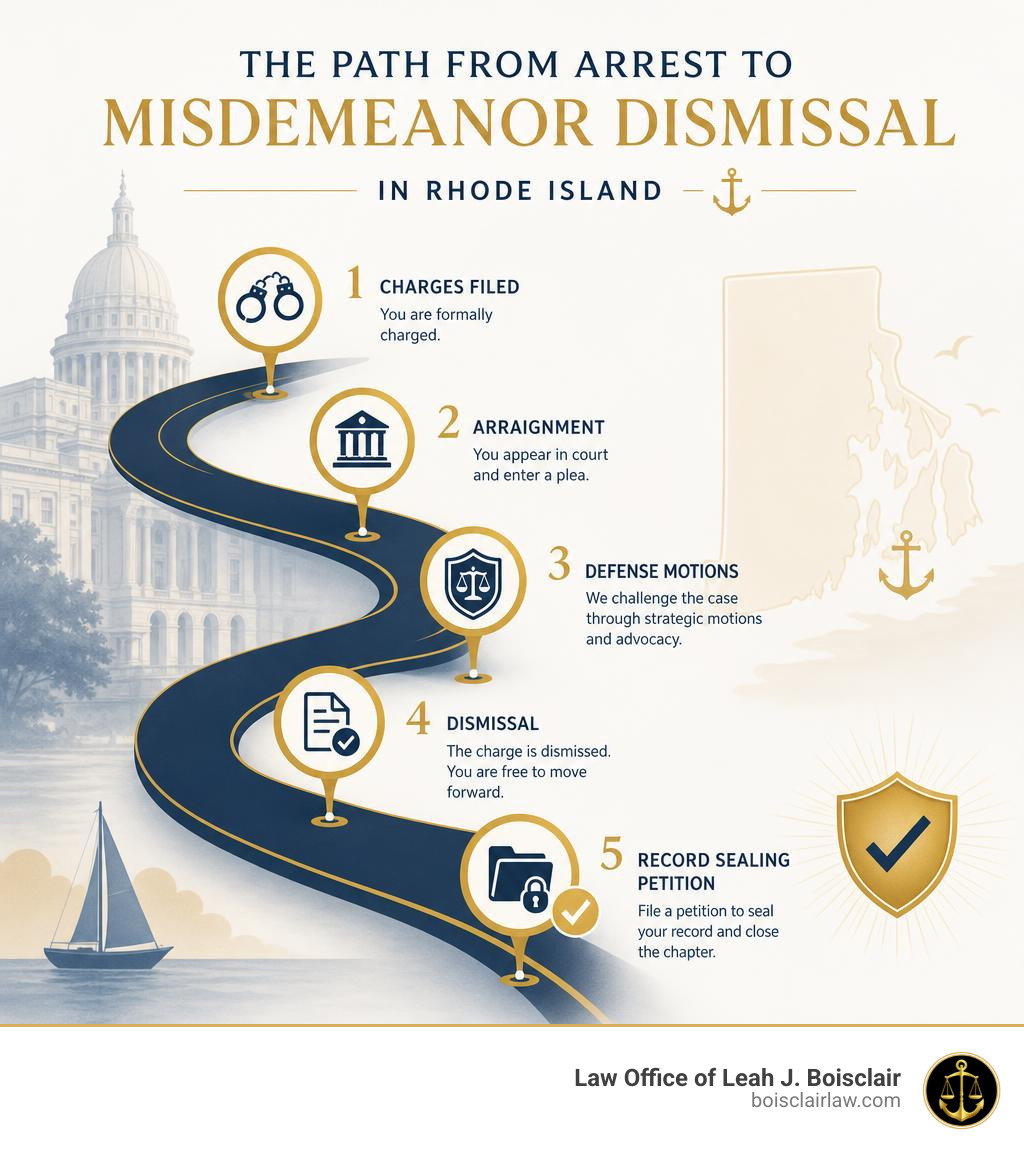
- Arrest or Summons: Your case begins when law enforcement either arrests you or issues a summons to appear in court. Knowing what to do if you’ve been arrested in RI is crucial to protecting your rights from the very start.
- Arraignment: This is your first official court appearance. The judge reads the charges against you, and you enter a plea (typically “not guilty” at this stage). The court also sets bail and release conditions.
- Pretrial Conferences: Your attorney meets with the prosecutor to review the evidence (discovery). This is where the groundwork for proven misdemeanor dismissals in RI is laid. We look for holes in the prosecution’s case, missing evidence, or constitutional violations.
- Motion Practice: If the police violated your rights—such as conducting an illegal search or failing to read your Miranda rights—your defense attorney files motions to suppress evidence. If key evidence is suppressed, the prosecution may have no choice but to dismiss the charges.
- Trial or Disposition: If the case is not dismissed or resolved through a plea negotiation, it goes to trial before a judge or jury.
Types of Sentences in Rhode Island
If your case is not dismissed outright, it may be resolved through various sentencing options. It is important to know how these impact your record:
- Filing: Under Rhode Island law, a case can be “filed” for one year. This means the charges are put on hold. If you stay out of trouble for that year, the charges are dismissed.
- Probation: You remain free in the community under court supervision.
- Deferred Sentence: You agree to certain conditions. If you complete them successfully, the charges are dismissed.
- Suspended Sentence: A prison sentence is imposed but put on hold. You are placed on probation instead. If you violate probation, you may have to serve the suspended time.
Proven Misdemeanor Dismissals RI: Sealing vs. Expungement
If your misdemeanor case was dismissed, you might think your record is automatically clean. Unfortunately, that is a common misconception. A dismissal means you were not convicted, but the arrest, the charges, and the court proceedings still exist in public databases and BCI (Bureau of Criminal Identification) records.
To clear your name, you must actively pursue either record sealing or expungement. While people often use these terms interchangeably, Rhode Island law treats them differently.

The Difference Between Sealing and Expungement
- Expungement: Under R.I. Gen. Laws § 12-1.3, expungement is defined as the sealing and physical destruction of all records relating to a conviction. It essentially erases the event so that, in the eyes of the law, it never occurred.
- Record Sealing: Under R.I. Gen. Laws § 12-1-12.1, sealing restricts public access to your records. The files are removed from active public databases, meaning standard employers, landlords, and nosey neighbors cannot see them. However, the records are not physically destroyed; they remain accessible to specific law enforcement, judicial, and regulatory agencies.
For dismissed charges, the legal mechanism used is record sealing. If you want to dive deeper into this topic, you can learn if you can actually clear your criminal record.
Waiting Periods for Clearing Your Record
The timeline for clearing your record depends entirely on the outcome of your case:
| Case Outcome | Relief Type | Waiting Period |
|---|---|---|
| Dismissed Charges / Acquittals | Record Sealing | Immediate (No waiting period) |
| One-Year Filing | Record Sealing | 1 Year (After filing period ends) |
| Domestic Violence Filing | Record Sealing | 3 Years (After filing period ends) |
| Misdemeanor Conviction | Expungement | 5 Years (After sentence completion) |
Because dismissed charges carry no mandatory waiting period, we can petition the court to seal your records immediately after the dismissal is finalized.
Legal Eligibility and the Impact of Prior Charges
While the law allows for the immediate sealing of dismissed misdemeanor charges, your overall criminal history plays a major role in your eligibility.

In Rhode Island, standard expungement of a conviction is strictly limited to first-time offenders. If you have multiple convictions on your record, the path to expungement becomes significantly more complicated. But what if the charges you want to seal were completely dismissed?
Historically, the state argued that if you had a prior felony conviction, you were permanently barred from sealing later dismissed charges. The state relied on cases like State v. Manocchio, which established that Rhode Island courts do not possess the inherent power to expunge or seal records outside of the strict boundaries set by state statutes.
However, when it comes to sealing dismissed charges, the legal landscape is much friendlier to defendants, thanks to landmark decisions by the Rhode Island Supreme Court.
How State v. Poulin Affects Proven Misdemeanor Dismissals RI
For years, there was massive confusion over what actually counted as a “conviction” when someone tried to seal a dismissed misdemeanor. Specifically, prosecutors argued that if a defendant had previously entered a plea of nolo contendere (no contest) and received probation, that plea counted as a prior conviction, disqualifying them from sealing later dismissed charges.
This changed with the landmark case State v. Poulin. In this case, the defendant had entered a nolo contendere plea to a felony drug charge in 1996 and successfully completed probation. Years later, he had two separate misdemeanor charges dismissed. When he petitioned to seal those dismissed charges, the state objected, claiming his prior nolo plea and probation constituted a conviction that barred him from sealing.
The Rhode Island Supreme Court ruled in favor of the defendant. The Court clarified that:
- Sealing statutes (§ 12-1-12.1) and expungement statutes serve entirely different purposes and must be interpreted separately.
- Under Rhode Island law, a plea of nolo contendere followed by probation does not constitute a conviction for the purposes of the record-sealing statute.
Because of the Poulin decision, if you have a prior nolo plea with probation on your record, it does not act as a conviction block. You remain fully eligible to seal subsequent dismissed misdemeanor charges immediately.
Step-by-Step Guide to Petitioning for Record Sealing
Clearing your record is not automatic. Even with a dismissed charge, you must actively petition the court to have the records sealed.
Here is the exact process we guide our clients through to achieve a clean slate:
Step 1: Obtain Your BCI Report
Before filing anything, you must get an official copy of your Bureau of Criminal Identification (BCI) record. This report lists your entire Rhode Island criminal history. You can obtain this from the Rhode Island Attorney General’s Office in Providence for a small fee (or free if you are over 62 or disabled).
Step 2: Draft and File the Petition
We draft a formal Motion to Seal pursuant to R.I. Gen. Laws § 12-1-12.1. This petition must be filed in the clerk’s office of the specific court where your case was dismissed (e.g., the Third Division District Court in Warwick or the Sixth Division District Court in Providence).
Step 3: Serve Notice to the State
Rhode Island law requires you to provide at least 10 days’ written notice of your motion to the Attorney General’s Office and the police department that arrested you. This gives the state time to review your petition and decide if they will object.
Step 4: Attend the Court Hearing
A judge will hear your motion. If the state does not object, and we demonstrate that you meet all statutory requirements, the judge will sign an order granting the sealing of your record. To make sure you are fully prepared, you can read about these expungement steps.
Step 5: Verify Record Destruction and Sealing
Once the judge signs the order, it must be sent to the BCI division, the arresting police department, and court administration. They will physically remove your name from active public search systems.
Practical Benefits of Securing Proven Misdemeanor Dismissals RI
Sealing a dismissed misdemeanor provides life-changing benefits:
- Background Checks: When standard employers or landlords run a background check, your dismissed charge will no longer appear.
- Employment Opportunities: You can legally and truthfully state on job applications that you have never been arrested or charged with the crime.
- Housing Access: Many modern apartment complexes use automated screening tools that reject applicants with any criminal record. Sealing ensures you pass these filters.
- Peace of Mind: You no longer have to worry about a past mistake or a false accusation showing up when someone searches your name online.
Note: There are five specific sensitive career fields in Rhode Island where you must still disclose sealed or expunged records: law enforcement, early childhood education, teaching, coaching, and applying to the state bar association to practice law.
Frequently Asked Questions about Rhode Island Misdemeanor Dismissals
Can a traffic violation dismissal be based on a clean driving record?
Yes! Under Rhode Island General Laws Section 31-41.1-7, you can apply to have a traffic violation dismissed if you have a clean driving record.
To qualify, you must have held a driver’s license for at least three years, and you must not have had any traffic violations in the preceding three years (excluding parking tickets). If eligible, the Traffic Tribunal or municipal court can dismiss the charge upon payment of a $35 administrative fee and a $25 surcharge.
However, certain severe violations—such as speeding more than 14 mph over the limit, school bus violations, commercial driver’s license violations, or accidents causing injury—cannot be dismissed under this statute.
What is the waiting period to seal a dismissed misdemeanor charge?
There is no waiting period to seal a dismissed misdemeanor charge in Rhode Island. Under R.I. Gen. Laws § 12-1.3-2(c), cases that end in a dismissal, a “no true bill” by a grand jury, or a “not guilty” verdict are eligible for immediate record sealing. You do not have to wait years to clear your name; the petition can be filed as soon as the court enters the dismissal.
Does a dismissed charge automatically disappear from my record?
No. This is one of the biggest traps defendants fall into. A dismissal means the criminal case is over and you will not face penalties, but the paper trail remains in active law enforcement and court databases. It will continue to show up on background checks as a “dismissed charge” until you manually file a petition to seal the record and a judge signs the order.
Conclusion
Facing criminal charges is stressful, but a misdemeanor charge does not have to define your future. By building a strong defense, identifying weaknesses in the prosecution’s evidence, and taking immediate action to seal your records, you can protect your reputation, your career, and your peace of mind.
At the Law Office of Leah J. Boisclair, we provide personalized, compassionate advocacy with a focus on securing proven misdemeanor dismissals in RI. From our office in Cranston, we proudly serve clients across Rhode Island, including Providence, Warwick, Johnston, East Greenwich, and Coventry. We understand how much is at stake, and we are ready to stand by your side.
If you are ready to fight your charges or clear an old arrest from your record, contact our DUI and Traffic Offenses defense attorney today to schedule a confidential consultation. Let us help you wipe the slate clean.