
What You Need to Know About Misdemeanor Property Crime in RI
A misdemeanor property crime in RI is any offense involving damage to or unlawful taking of another person’s property where the value or severity falls below the felony threshold — generally under $1,500 in Rhode Island.
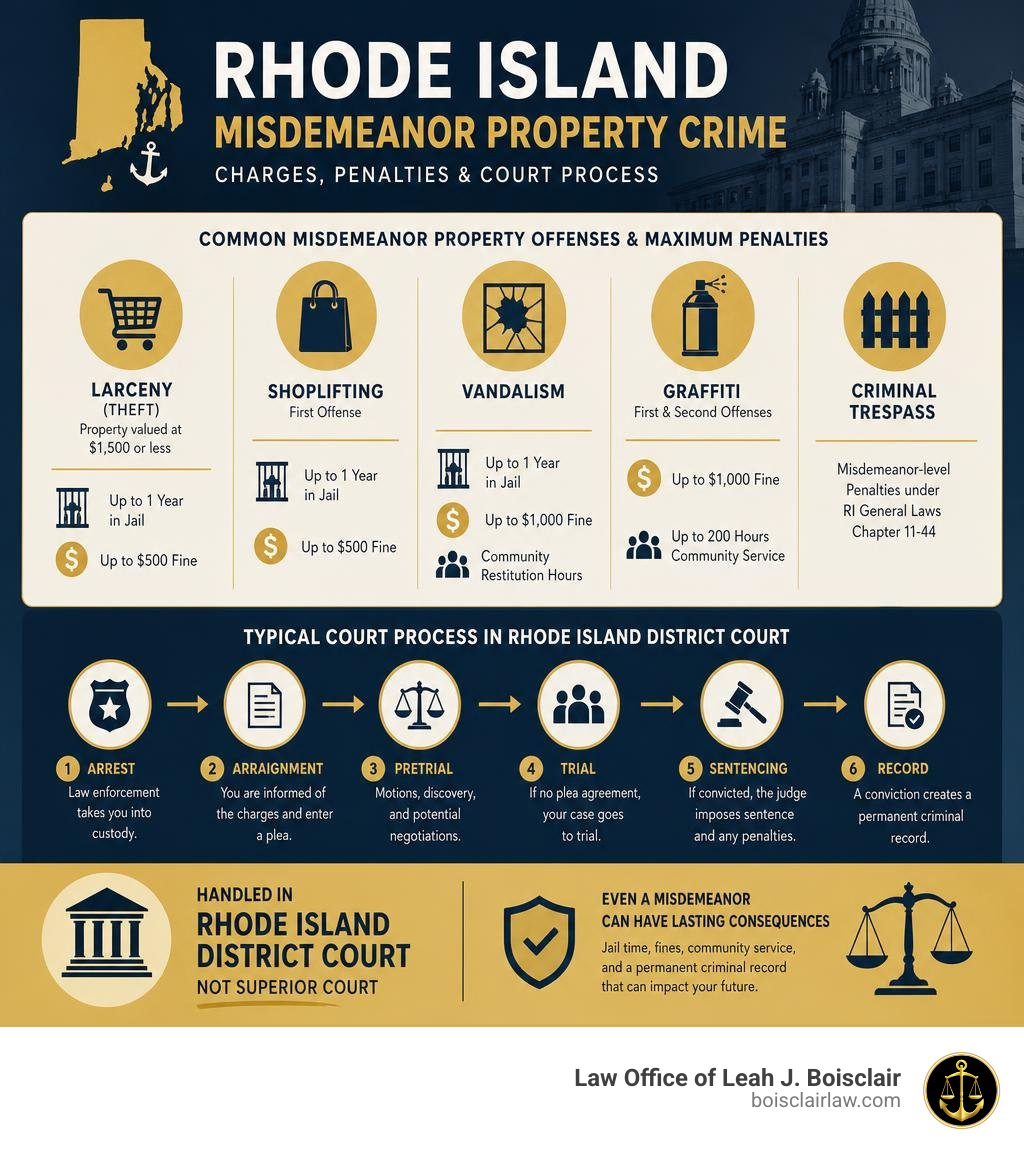
Quick answer: The most common misdemeanor property offenses in Rhode Island include:
- Larceny (theft) — property valued at $1,500 or less: up to 1 year in jail and a $500 fine
- Shoplifting — first offense: up to 1 year in jail and a $500 fine
- Vandalism — up to $1,000 fine and/or 1 year in jail, plus community restitution hours
- Graffiti — first and second offenses: up to $1,000 fine and up to 200 hours of community service
- Criminal trespass — misdemeanor-level penalties under RI General Laws Chapter 11-44
These charges are handled in Rhode Island District Court — not Superior Court, which handles felonies.
Facing one of these charges can feel overwhelming — even if it sounds “minor.” A misdemeanor conviction in Rhode Island can mean jail time, fines, mandatory community service, and a permanent mark on your criminal record that affects jobs, housing, and licensing.
This guide explains exactly how Rhode Island law defines and punishes misdemeanor property offenses, what the state has to prove, and what your options are.
Navigating Misdemeanor Property Crime RI Laws
Navigating the legal system in Rhode Island can feel like trying to find your way through a maze in the dark. If you or a loved one has been accused of property damage or trespass in cities like Cranston, Providence, or Warwick, understanding the specific statutes is the first step toward protecting your future.
Under Rhode Island law, property offenses are defined by the unlawful interference with, damage to, or taking of someone else’s physical possessions. While the state takes all property violations seriously, the law draws a clear distinction between minor infractions and major felonies.

Whether you are dealing with an accidental boundary crossing that turned into a trespass allegation, or a misunderstanding over a borrowed item that led to a larceny charge, having a knowledgeable Property Crimes Defense Attorney by your side can make all the difference in how your case is resolved.
Common Types of Misdemeanor Property Crime RI Offenses
When people think of property offenses, they often picture high-stakes bank robberies or elaborate corporate embezzlement. However, the vast majority of cases processed daily in Rhode Island courts involve much more common, everyday scenarios. Here are the most frequent misdemeanor property offenses we see:
- Larceny Under $1,500: Under 2024 Rhode Island General Laws Title 11 – Criminal Offenses Chapter 11-41 – Theft, Embezzlement, False Pretenses, and Misappropriation Section 11-41-5. – Penalties for larceny., taking property valued at $1,500 or less constitutes a misdemeanor. This includes standard theft, receiving stolen goods, or obtaining property through false pretenses.
- Shoplifting: This occurs when someone intentionally takes merchandise from a retail establishment without paying, alters price tags, or transfers items to different containers to avoid paying full retail value.
- Vandalism: This involves defacing, damaging, or obstructing another person’s or the public’s property. It can range from breaking a window to tearing down a fence.
- Graffiti: Specifically defacing private or public buildings, offices, or commercial property with paint, markers, or other substances.
- Criminal Trespass: Entering or remaining on someone else’s land or property after being forbidden to do so, or refusing to leave when asked.
Misdemeanor vs. Felony Thresholds for Property Offenses
In Rhode Island, the line between a misdemeanor and a felony is often determined by a simple dollar bill. For most theft and property damage offenses, that magic number is $1,500.
If the value of the property stolen or damaged is $1,500 or less, it is classified as a misdemeanor. If it exceeds $1,500, it automatically climbs into felony territory, which carries much stiffer penalties, including multi-year prison sentences.
However, there are critical exceptions where the value of the property does not matter. The state will automatically elevate a misdemeanor to a felony under the following circumstances:
- Elderly Victims: Under Rhode Island law, stealing any amount of property from a victim who is 65 years of age or older is treated as a felony. Even theft of a $10 item from an elderly individual carries a potential felony penalty of 1 to 5 years in prison.
- Firearm Theft: Stealing a firearm is always classified as a felony, regardless of whether the gun is worth $100 or $2,000. It carries a maximum penalty of up to 10 years in prison.
- Prior Convictions: For certain offenses like shoplifting, having a prior conviction can elevate a second offense involving property valued over $100 into a felony.
Understanding these distinctions is vital, as a felony charge carries life-altering consequences that far exceed those of a misdemeanor. For a deeper look at how these classifications differ, read our detailed guide on Felonies and Misdemeanors.
| Property Offense Type | Misdemeanor Threshold | Felony Threshold | Key Exceptions |
|---|---|---|---|
| Larceny / Theft | Value of $1,500 or less | Value over $1,500 | Victim 65+ or firearm theft (always a felony) |
| Shoplifting | First offense (any value) | Second offense over $100 | Prior shoplifting conviction elevates the charge |
| Vandalism | General property damage | High-value destruction | Domestic violence enhancements may apply |
| Graffiti | First and second offenses | Third or subsequent offense | Overpass/underpass graffiti carries extra fines |
Penalties and Consequences for Misdemeanor Property Offenses
If you are facing a misdemeanor property charge, you might assume that because it is not a felony, the consequences are minor. This is a dangerous misconception. The state of Rhode Island takes property rights very seriously, and a conviction can still result in active jail time, heavy financial penalties, and mandatory community service.

For a standard misdemeanor property offense, the maximum statutory penalties include:
- Up to 1 year in jail
- Fines of up to $500 (or up to $1,000 for vandalism offenses)
- Mandatory restitution (paying the victim back for the value of the stolen or damaged property)
- Mandatory community service hours
Under 2024 Rhode Island General Laws Title 11 – Criminal Offenses Chapter 11-44 – Trespass and Vandalism Section 11-44-1. – Vandalism — Obstruction of lawful pursuits., a person convicted of vandalism must also pay full restitution for the damage caused and complete public community service, in addition to facing standard court fines.
First-Time vs. Repeat Offender Penalties for Property Offenses
Rhode Island’s sentencing structure is designed to offer some leniency to first-time offenders, while progressively punishing those who repeatedly break the law. If this is your first run-in with the law, your attorney may be able to negotiate a program that avoids jail time entirely, such as a filing, probation, or a diversion program.
However, if you have a prior record, the penalties escalate quickly:
- Vandalism Community Restitution: For a first-time vandalism offense, the court requires up to 100 hours of public community restitution. For a second or subsequent offense, that requirement doubles to up to 200 hours.
- Graffiti Offenses: Under Title 11 Criminal Offenses (R.I. Gen. Laws § 11-44-21.1), a first or second graffiti offense is a misdemeanor punishable by a fine of up to $1,000 and up to 200 hours of community service. However, a third or subsequent graffiti offense is elevated to a felony, carrying up to 2 years in prison, a $2,000 fine, and up to 300 hours of community service.
- Habitual Offender Status: Rhode Island has strict laws for habitual property offenders. If you are convicted of three or more separate theft-related offenses, you may be classified as a habitual offender, which triggers mandatory minimum sentences of 6 to 12 months in prison and additional fines.
For minor offenders, graffiti convictions can also result in the suspension of their driver’s license. Furthermore, if a minor is convicted of graffiti and their parents are found to have been negligent in supervising them, the parents can be held financially liable for up to $10,000 in restitution.
Legal Elements and Defense Strategies for Property Offenses
To secure a conviction for any property offense, the prosecution must prove several specific legal elements beyond a reasonable doubt. They cannot simply point to damaged property or a missing item and assume you are guilty. They must connect the dots legally.
In a misdemeanor larceny case, for example, the state must prove that:
- You took and carried away the property of another person.
- You did so without their consent.
- You had the specific intent to permanently deprive the owner of that property.
If any of these elements are missing, the state’s case falls apart. This is where a strategic, proactive defense comes into play. By thoroughly examining the evidence, we can identify weaknesses in the prosecution’s case and build a robust defense. To learn more about our approach, read our guide on Getting to Not Guilty with Proven RI Misdemeanor Defense.
Defending Against a Misdemeanor Property Crime RI Offense
When we take on a misdemeanor property case, we analyze every detail to find the best defense strategy. Some of the most common and effective defenses include:
- Lack of Intent: If you honestly believed you had permission to use the property, or if you took an item by mistake (such as accidentally walking out of a store with an item left in your cart), the state cannot prove the required “intent to permanently deprive.”
- Claim of Right: If you took property under a good-faith belief that the property actually belonged to you, or that you had a legal right to possess it, this can defeat a larceny charge.
- Consent: If the owner of the property previously gave you permission to use or possess the item, you cannot be convicted of theft.
- Evidence Suppression: If the police violated your constitutional rights during their investigation — such as conducting an illegal search of your car or home without a warrant — we can file motions to suppress that evidence so it cannot be used against you in court.
- Civil Restitution Agreements: In many misdemeanor shoplifting or vandalism cases, we can negotiate a civil compromise. By paying the business or individual for the damage or lost goods immediately, we can often convince the prosecution to dismiss the criminal charges entirely.
To explore more about how larceny and theft offenses are penalized and defended in our state, you can read about What Are the Penalties for Stealing in Rhode Island?.
Frequently Asked Questions About Rhode Island Property Offenses
Can a misdemeanor property offense conviction be expunged in RI?
Yes! Rhode Island allows individuals convicted of misdemeanor property offenses to expunge their records, provided they meet specific criteria. Expungement is the legal process of sealing your criminal record so that it no longer appears on public background checks, allowing you to confidently apply for jobs, housing, and professional licenses.
Generally, for a misdemeanor conviction, you must wait 5 years after successfully completing your sentence (including probation, community service, and paying all fines and restitution) before you can apply for expungement. Additionally, you must have maintained a clean record during that waiting period. If your case was dismissed or you received a “one-year filing” that was successfully completed without violation, you may be eligible to clear your record much sooner.
To learn more about how to clear your name, read our guides on Wiping the Slate Clean in Rhode Island and Can You Actually Clear Your Criminal Record?.
What is the difference between larceny and shoplifting in Rhode Island?
While both offenses involve taking property that does not belong to you, they are governed by different statutes and carry different legal definitions:
- Larceny: Under Rhode Island law, larceny is a broad term that covers many forms of theft, including physically stealing an item, receiving stolen goods, or obtaining property through fraud or false pretenses. It applies to any setting — whether you steal a bicycle from a neighbor’s yard or a laptop from an office.
- Shoplifting: Governed specifically by Title 11 Criminal Offenses (R.I. Gen. Laws § 11-41-20), shoplifting applies strictly to retail establishments. It includes concealing unpaid merchandise, altering price tags, transferring items to different containers, or removing shopping carts without consent. Notably, shoplifting is legally complete the moment you conceal the item with the intent to steal it — the prosecution does not have to prove you actually succeeded in leaving the store.
What court handles misdemeanor property offenses in Rhode Island?
In Rhode Island, all misdemeanor offenses are handled by the District Court system. There are several county-based District Court locations throughout the state, including the 3rd Division District Court in Warwick (serving Kent County) and the 6th Division District Court in Providence (serving Providence County).
The process begins with an arraignment, where you will appear before a judge, hear the formal charges against you, and enter an initial plea (which should almost always be “not guilty” while your attorney reviews the evidence). The court will also set bail conditions.
Following the arraignment, your case will proceed to a pre-trial conference. This is where your defense attorney meets with the prosecutor to review the evidence, discuss potential legal defenses, and negotiate a potential resolution, such as a dismissal, reduced charges, or a plea agreement. If an agreement cannot be reached, the case will proceed to a trial before a District Court judge.
Conclusion
A misdemeanor property charge does not have to define your future. Whether you are facing allegations of shoplifting, vandalism, or trespass, the decisions you make in the days following an arrest can impact your life for years to come.
At the Law Office of Leah J. Boisclair, we provide personalized, compassionate, and aggressive defense representation to individuals facing misdemeanor and felony offenses across Rhode Island, including Cranston, Providence, Warwick, Johnston, and Coventry. We understand how stressful this experience is, and we are committed to fighting for the best possible outcome for your case — whether that means negotiating a dismissal, securing a restitution agreement, or defending your rights at trial.
Do not face the legal system alone. Contact us today to schedule a confidential consultation with an experienced Property Crimes Defense Attorney and let us help you protect your future.