
What Is a No Contact Order in Rhode Island — And Why It Matters
A no contact order Rhode Island courts issue is a legal order that prohibits a person accused of a crime from having any contact with the alleged victim. It is automatically imposed the moment someone is charged with a domestic violence offense — no judge’s signature required at that moment, no hearing needed first.
Here’s a quick breakdown of the key facts:
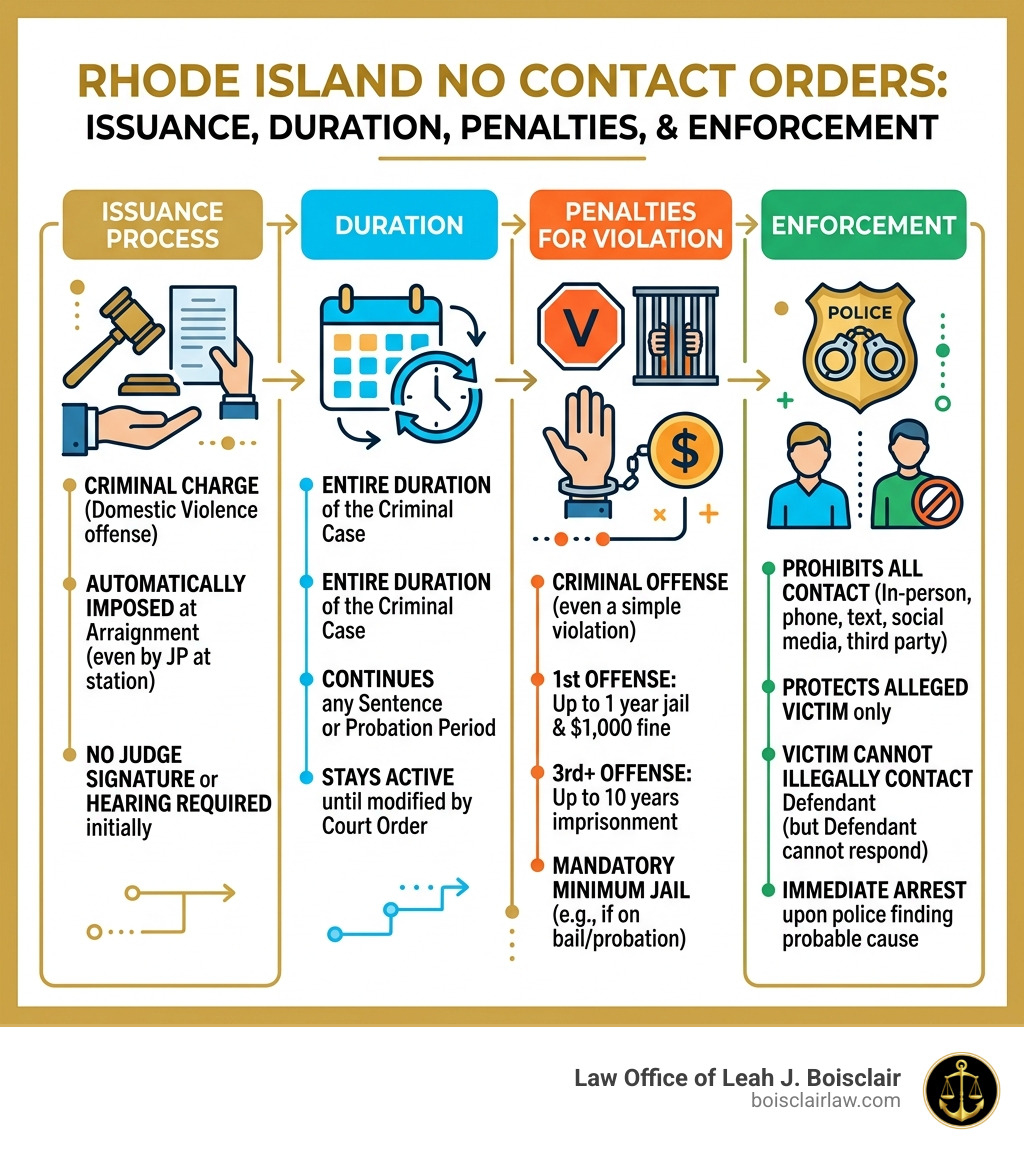
- What it is: A court order banning all contact between a criminal defendant and the alleged victim
- When it’s issued: Automatically at arraignment (even at the police station, by a Justice of the Peace) for any domestic violence charge
- What contact is banned: In-person, phone, text, email, social media, and even contact through a third party
- Who it protects: The alleged victim — not the defendant (the victim can legally contact the defendant; the defendant cannot respond)
- Penalties for violation: Up to 1 year in jail and a $1,000 fine for a first offense; up to 10 years for a third or subsequent offense
- How long it lasts: For the entire duration of the criminal case, and through any sentence or probation period
If you are subject to one of these orders — or have been charged with violating one — the stakes are high. Even a single phone call can result in arrest and a mandatory 10-day minimum stay at the ACI (Adult Correctional Institutions) if you are on bail or probation.
This guide covers everything you need to know: how these orders work, what violates them, how to modify or terminate them, and what your legal options are in Rhode Island as of April 2026.
Understanding the No Contact Order Rhode Island Process
In Rhode Island, the legal framework for a no contact order Rhode Island is primarily governed by RI Gen. Law § 12-29-4. This statute is part of the Domestic Violence Prevention Act, and it is designed to provide immediate protection to alleged victims the moment a criminal charge enters the system.
Unlike other types of legal proceedings where you might have a chance to argue your side before an order is issued, a No Contact Order (NCO) is a mandatory condition of bail. This means that if you are arrested for any Domestic and Family Related Offenses, the order is going to be part of your release paperwork whether you like it or not.
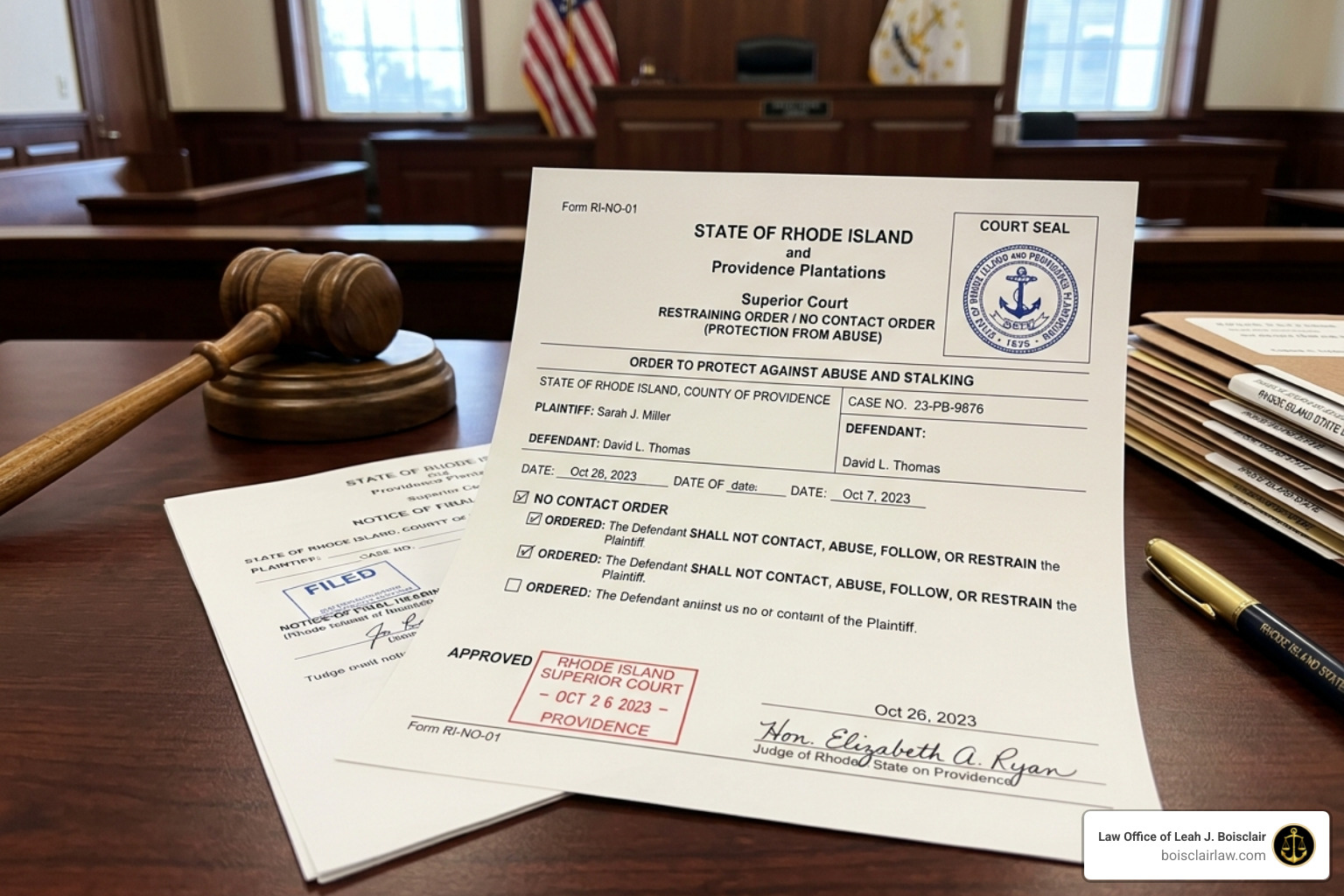
When a person is arrested, they are often brought before a Justice of the Peace at the police station for an initial arraignment. This official has the authority to set bail and, by law, must include the NCO as a condition of that bail. You will be required to sign the Official RI No Contact Order Form, often referred to as a DC-27 in District Court. This form explicitly states that you must not have any contact with the protected party, and it serves as your formal notice.
How a No Contact Order Rhode Island is Issued
The issuance of a no contact order Rhode Island is an automatic imposition. There is no judicial discretion involved at the start; if the charge is classified as “domestic,” the order is issued. This applies to both misdemeanors and felonies.
Whether your case is heard in the District Court (for misdemeanors) or the Superior Court (for felonies), the NCO remains a standard hurdle. Because these orders happen so fast—often within hours of an arrest—it is vital that you don’t go it alone when facing a domestic violence case. Having an attorney early in the process can help ensure that the terms of your bail are handled correctly and that you fully understand the boundaries of the order from day one.
The Difference Between NCOs and Restraining Orders
One of the most common points of confusion we see in Cranston is the difference between a No Contact Order and a Restraining Order. While they both aim to prevent contact, they come from different “sides” of the legal system.
- No Contact Order (Criminal): This is tied directly to a criminal charge. It is issued by a criminal court judge or bail commissioner. It ends when the criminal case ends (unless it’s part of a sentence).
- Restraining Order (Civil): This is a civil matter. A person can go to Family Court, District Court, or Superior Court to request a Restraining Order independently of any criminal charges.
- Family Court: Used for spouses, former spouses, or people who have a child together.
- District Court: Used for people who have been in a substantive dating relationship or cohabited within the last year.
- Superior Court: Used for other relationships (like neighbors or coworkers).
A civil Restraining Order typically starts with a 21-day Temporary Restraining Order (TRO). If a judge finds it necessary after a hearing, a final order can be issued for up to three years. For more information on the civil side, you can visit the Rhode Island Coalition Against Domestic Violence.
Violations and Penalties for a No Contact Order Rhode Island
Violating a no contact order Rhode Island is a serious criminal offense in its own right. It doesn’t matter if the contact was “friendly” or if the other person invited you over. If the order is active, any contact is a crime.
| Violation Level | Classification | Potential Penalties |
|---|---|---|
| 1st or 2nd Offense | Misdemeanor | Up to 1 year in jail, $1,000 fine, and Batterer’s Intervention Program |
| 3rd or Subsequent | Felony | Up to 10 years in jail (1-year mandatory minimum) |
| While on Bail/Probation | Violation | Immediate incarceration at the ACI (often 10+ days) |
If you find yourself accused of a violation, you need to know what to do if you’ve been arrested in RI. The police do not need a warrant to arrest you if they have probable cause to believe you violated an NCO.
Third-Party Contact and Accidental Encounters
Many people think they can circumvent a no contact order Rhode Island by having a friend send a message or by posting something on social media “hoping” the other person sees it. This is a mistake.
- Third-Party Contact: Asking a mutual friend to “tell her I’m sorry” or asking your mom to call the victim to check on the kids is a violation.
- Electronic Communication: Texts, emails, DMs, and even “liking” a photo on Instagram can be used as evidence of a violation.
- Accidental Encounters: If you are at a grocery store or a public park and see the protected person, you must leave immediately. Do not wave, do not say “hello,” and do not explain why you are there. Just turn around and walk away. Staying in the same vicinity once you realize they are there can be interpreted as a violation.
Impact on Bail and Probation Status
The most immediate danger of an NCO violation is the impact on your current legal status. If you are out on bail for a pending charge and you violate the NCO, you are technically a “bail violator.” Under Rhode Island law, this can lead to being held “without bail” for up to 90 days while your case is pending.
If you are already on probation for a previous offense, even a single phone call can trigger a probation violation. In these cases, the court often imposes a minimum of 10 days at the ACI just for the violation itself, regardless of whether you are eventually found guilty of the new charge. To protect your freedom, it is essential to work with a RI criminal attorney who understands how to navigate these high-stakes violation hearings.
Modifying or Terminating a No Contact Order
A no contact order Rhode Island does not have to be a “forever” sentence. There are legal avenues to change the terms of the order or have it removed entirely. However, you cannot just decide the order is over because you and the other person made up. Only a judge can vacate or modify the order.
To change an NCO, a “Motion to Vacate” or “Motion to Modify” must be filed with the court. This leads to a formal hearing where a judge will listen to arguments from both sides. This is a delicate process, which is why you should hire a Rhode Island criminal defense attorney to handle the filing and the hearing.
Who Can Request to Drop an Order?
While the defendant’s attorney usually files the motion, the court places a significant amount of weight on the victim’s wishes. However, the victim’s request is not a “get out of jail free” card. The judge has the final say and will consider:
- The nature of the original charges.
- The defendant’s criminal history.
- Whether the defendant has started or completed a Batterer’s Intervention Program (BIP).
- The input of the Victim Advocate.
Victims who wish to drop the order must typically meet with a Victim Advocate at the courthouse first to ensure they aren’t being pressured or coerced into making the request.
Duration and Expiration of Orders
An NCO typically lasts as long as the criminal case is active. If the case is dismissed or you are acquitted (found not guilty) at trial, the order terminates automatically.
However, if you plead guilty or are convicted, the NCO is usually extended as a condition of your sentence. If you receive one year of probation, the NCO will likely stay in effect for that entire year. Furthermore, being subject to a domestic NCO can trigger federal Firearm Offenses restrictions, meaning you may be prohibited from possessing a gun or ammunition under 18 U.S.C.A. § 922(g)(8).
Enforcement and the R.O.N.C.O. System
Rhode Island takes enforcement very seriously through a centralized tracking system known as R.O.N.C.O. (Restraining Order No-Contact Order system). This system is managed by the Attorney General’s Bureau of Criminal Identification (B.C.I.) unit.
Whenever a no contact order Rhode Island is issued, modified, or terminated, the court must fax or electronically send the details to the B.C.I. unit by the end of that day. This ensures that any police officer in the state can instantly see if an order is active during a traffic stop or a call for service. You can read the specific statutes regarding the R.O.N.C.O. system to see how strictly these records are kept.
Expungement of No Contact Orders
One piece of good news is that the law requires these records to be cleaned up once they are no longer needed. If an NCO is terminated or expires, it must be expunged from the R.O.N.C.O. system within 30 days.
Once expunged, the prior existence of the order is not supposed to be disclosed to the public or other agencies except by a specific court order. This record sealing is a vital part of moving on with your life after a domestic case is resolved.
Frequently Asked Questions about No Contact Orders
Does a No Contact Order prevent the victim from contacting the defendant?
Technically, no. The NCO is “one-way.” It is an order directed at the defendant, not the victim. The victim cannot be arrested for calling, texting, or visiting the defendant.
However, this is a massive trap for defendants. If the victim calls you and you pick up the phone, you are the one who will be arrested. If the victim invites you over to “talk things through” and the police show up, you are the one going to jail. Never respond to contact from a protected person until you have a judge-signed order in your hand vacating the NCO.
What happens if the underlying Domestic case is dismissed?
If the underlying charges are dismissed, the no contact order Rhode Island was based on generally terminates automatically. The court will notify the B.C.I. unit to remove the entry from the R.O.N.C.O. system. This also usually restores your rights regarding Firearm Offenses, though you should always verify with your attorney that no other restrictions (like probation terms) remain.
Can I communicate with my children if an NCO is in place?
This is one of the most difficult aspects of an NCO. If the NCO is “full,” it often prevents you from going to the family home or communicating with the other parent at all—even about the kids.
In these cases, we often file a motion to modify the order to allow for “limited contact regarding the children.” This might allow for text messages strictly about pick-up/drop-off times or medical emergencies. In more complex situations, the Family Court may need to step in to establish a formal visitation schedule or order supervised visitation to ensure you can still see your children without violating the criminal order.
Conclusion
Navigating a no contact order Rhode Island can feel like walking through a minefield. The rules are strict, the enforcement is immediate, and the penalties for a simple mistake can be life-altering. Whether you are dealing with a new charge or trying to modify an existing order to see your children, you need an advocate who understands the system from the inside out.
At the Law Office of Leah J. Boisclair, we provide expert criminal defense representation with a focus on personalized, compassionate advocacy. Based in Cranston, we have a proven track record of helping clients achieve dismissals and navigate the complexities of domestic charges in Rhode Island state and federal courts.
If you are facing a domestic violence charge or have questions about a No Contact Order, don’t wait for a violation to happen. Contact Us today for a consultation, or learn more about our work with Domestic and Family Related Offenses. We are here to help you protect your rights and your future.