
When Financial Fraud Charges Turn Your Life Upside Down
A credit card theft attorney can be the difference between a conviction that follows you forever and a defense that protects your future.
If you’re facing charges right now, here’s what you need to know fast:
Quick answers for those facing credit card theft or fraud charges:
- Get an attorney immediately — before speaking to investigators or police
- Do not discuss your case with anyone other than your lawyer
- Write down everything you remember about the alleged incident
- Preserve any evidence that supports your side of the story
- Know your rights — you have the right to remain silent and the right to counsel
The numbers behind financial fraud charges are serious. In 2023, the Federal Trade Commission received over 1.1 million identity theft reports, with credit card fraud making up roughly 20% of those cases. Average losses per victim topped $1,261, and total U.S. credit card fraud losses exceeded $12.5 billion — a 14% jump from the year before.
For someone accused of these offenses, the stakes are just as high on the other side. A conviction can mean prison time, heavy fines, a permanent felony record, and collateral consequences that affect your job, housing, and reputation for years.
Whether you’re dealing with state charges, federal prosecution under laws like the Computer Fraud and Abuse Act, or both at once — you need a skilled defense attorney in your corner right away.
Credit card theft attorney terms made easy:
Understanding Credit Card Theft and Lottery Scam Charges
To build a strong defense, we first have to look at how the law defines these offenses. In Rhode Island, financial crimes are taken incredibly seriously. State prosecutors and federal agencies work hand-in-hand to crack down on anything resembling white-collar crime.
Under Rhode Island law, credit card theft is distinct from credit card fraud, though they are often charged together.
- Credit Card Theft occurs when someone takes or obtains a credit card (or credit card information) from the possession of another without the cardholder’s consent. This includes taking a lost or mislaid card, or buying/selling a credit card from anyone other than the issuer.
- Credit Card Fraud, on the other hand, involves the actual use of that stolen card or account information to purchase goods, secure services, or obtain cash under false pretenses.
Lottery scams represent another tier of theft. These typically involve telling a victim they have won a major lottery or sweepstakes but must first pay “taxes,” “processing fees,” or “customs duties” to release the funds. Because these schemes almost always rely on phones, email, or online payment portals, they quickly cross state lines, bringing federal wire fraud and mail fraud statutes into play.
Navigating this complicated web of state and federal laws requires a deep understanding of the legal landscape in 2026. If you want to dive deeper into how these allegations are evaluated, check out An Essential Guide to White Collar Offenses Defense and learn more about navigating Rhode Island fraud defense strategies.
Why You Need a Credit Card Theft Attorney for Federal and State Charges
When you are accused of credit card theft or a sweepstakes scheme, you aren’t just fighting a simple theft allegation. You are fighting a highly technical, paper-heavy prosecution. State and federal law enforcement agencies have specialized units dedicated entirely to tracking digital footprints, IP addresses, and banking transactions.
For example, the federal government frequently utilizes the Computer Fraud and Abuse Act (CFAA). This powerful statute criminalizes accessing a computer system without authorization or exceeding authorized access. If prosecutors allege you used a database, a corporate computer, or a skimming device to harvest credit card numbers, you could find yourself facing severe federal charges under the CFAA.
Determining which court has jurisdiction over your case depends heavily on where the alleged transactions occurred and the total financial loss. If the activity crossed state borders—even if you never left Cranston or Providence—federal prosecutors can step in.
Having an experienced credit card theft attorney on your side is critical. We understand how to challenge the technical evidence, dispute the prosecution’s jurisdiction, and protect you from overreaching federal agencies.

If you are facing complex charges involving digital evidence, speaking to a computer offenses defense specialist is your best line of defense.
How a Credit Card Theft Attorney Investigates Your Case
We don’t simply accept the prosecution’s version of events. When we take on a case, we launch our own comprehensive investigation to uncover the truth. Here is how we build your defense:
- Reviewing the Evidence: We meticulously analyze banking records, store surveillance footage, IP login histories, and digital forensic reports. We look for gaps in the chain of custody or technical errors that show the digital footprint doesn’t actually point to you.
- Challenging Search Warrants: Many credit card and computer investigations rely on search warrants for physical homes, cell phones, or online accounts. We carefully review the affidavits used to obtain those warrants. If the police lacked probable cause, we will file motions to suppress the evidence, aiming to have it thrown out of court entirely.
- Interviewing Witnesses: From store clerks to digital forensic analysts, we interview key witnesses to identify inconsistencies in their statements.
If your charges involve physical property or allegedly stolen physical cards, a strong property offenses defense approach can help dismantle the state’s case.
Key Defenses a Credit Card Theft Attorney Can Deploy
Every case is unique, but several powerful, time-tested defenses can be used to fight financial fraud charges:
- Lack of Intent: To be convicted of fraud or theft, the prosecution must prove beyond a reasonable doubt that you had the specific intent to defraud someone. If you honestly believed you had permission to use the card, or if you made an administrative error, there is no criminal intent.
- Consent: If the cardholder authorized you to use the card—even if they later regretted it or forgot—you cannot be guilty of credit card theft. This is incredibly common in cases involving former business partners, spouses, or family members.
- Mistaken Identity: With approximately 60% of credit card fraud cases involving unauthorized use of existing accounts (often online), it is very easy for IP addresses or account logins to be misattributed. If someone else used your Wi-Fi network or spoofed your device, you may have been wrongly accused.
By working with a dedicated white collar offenses defense attorney, you can ensure that these defenses are presented clearly and persuasively to the court.
Penalties and Collateral Consequences of Fraud Charges
The penalties for credit card crimes in Rhode Island depend heavily on the monetary value of the theft and whether the charges are brought at the state or federal level.
| Charge Level | Jurisdiction | Potential Prison Time | Potential Fines |
|---|---|---|---|
| Misdemeanor Credit Card Fraud (Under $100) | Rhode Island State | Up to 1 year | Up to $1,000 |
| Felony Credit Card Fraud (Over $100) | Rhode Island State | Up to 3 years | Up to $3,000 |
| Federal Credit Card Fraud / CFAA Violation | Federal Court | Up to 10–20 years | Up to $250,000 (or more) |
Beyond the immediate threat of jail time and fines, a conviction carries devastating collateral consequences:
- Employment Restrictions: A fraud conviction on your record makes it incredibly difficult to pass background checks, particularly for jobs in finance, retail, healthcare, or any position handling money.
- Housing Limitations: Many landlords run criminal background checks and refuse to lease to individuals with theft or fraud records.
- Professional Licensing: If you hold a professional license (such as in nursing, real estate, or insurance), a felony conviction can lead to automatic suspension or revocation.
Immediate Steps to Take After Facing Charges
If you are arrested or contacted by law enforcement regarding credit card theft or a lottery scam, the steps you take in the first 24 hours are critical.

First, exercise your absolute right to remain silent. Do not try to explain your way out of the situation; investigators are trained to use your words against you.
Second, begin documenting your information so your defense team can get to work immediately. At the Law Office of Leah J. Boisclair, we use a structured client intake process to gather everything we need to fight for you. You can prepare by compiling these key details:
- Personal Information: Your full legal name, date of birth, contact details, and current employment status.
- Case Information: The date of your arrest (if applicable), the specific offenses you are accused of committing, the arresting agency, and any upcoming court dates (such as your arraignment).
- Legal History: Any prior arrests, convictions, or current probation status. Knowing your background helps us anticipate how the prosecution will approach your case.
- Case Strategy & Goals: Think about what you want to achieve—whether that is a complete dismissal of charges, avoiding a license suspension, or preparing your case for a full trial.
Diversion Programs and Alternative Resolutions for Fraud Charges
If you are a first-time offender or facing low-level charges, you may not have to go to trial to protect your future. Rhode Island offers several alternative pathways that can keep a conviction off your record.
- Diversion Programs: These programs focus on rehabilitation rather than punishment. They may require you to perform community service, complete financial counseling, and remain arrest-free for a set period. If you complete the program successfully, the state will dismiss the charges against you.
- Restitution and Plea Agreements: In many financial cases, the state’s primary goal is making the victim whole. If you are able to pay restitution (repaying the lost funds), we can often negotiate a plea deal that reduces felony charges to misdemeanors or secures a deferred sentence, which can later be expunged.
To learn more about how we navigate these negotiations, read our white collar offenses overview.
Frequently Asked Questions About Financial Fraud Charges
What is the difference between credit card theft and credit card fraud?
Credit card theft is the physical or digital act of taking someone else’s credit card or account information without their consent. Credit card fraud is the next step — using that stolen information to make unauthorized purchases, withdraw cash, or obtain services.
Can a lottery scam charge be prosecuted at the federal level?
Yes. Because lottery scams almost always involve using the internet, phones, or the postal service to contact victims across state lines, they are routinely prosecuted in federal court as mail fraud or wire fraud.
How can victims of identity theft clear their records?
If you are a victim of identity theft, you should immediately file a report at the FTC identity theft recovery resources website. You will also need to send dispute letters to the credit bureaus and provide them with a copy of your police report to block fraudulent accounts from your credit file. Taking these steps promptly can help you recover losses and clear your records.
What is the difference between a felony and a misdemeanor charge?
In Rhode Island, a misdemeanor is a less severe offense carrying a maximum penalty of up to one year in jail. A felony is a major offense that carries more than one year in state prison, higher fines, and a permanent loss of certain civil rights, such as firearm ownership.
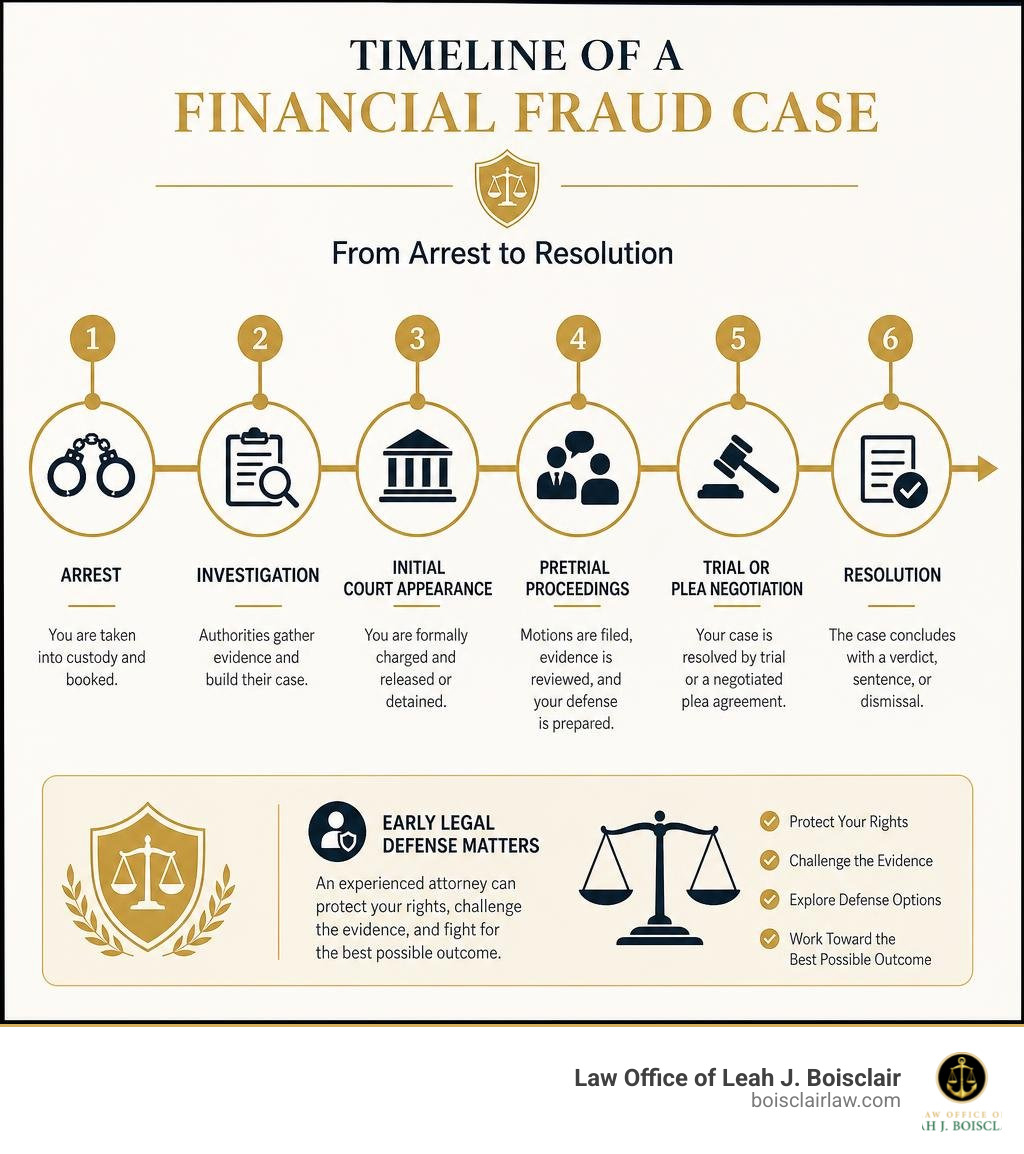
What is the typical process of a criminal fraud case?
A typical case begins with an arraignment, where you are formally read your charges and enter a plea. Next is the discovery phase, where your attorney reviews the state’s evidence. This is followed by pre-trial conferences and plea negotiations. If no agreement is reached, the case moves to trial proceedings.
How is court jurisdiction determined for state vs. federal fraud charges?
Jurisdiction is determined by whether the alleged crime crossed state lines, involved federal agencies (like the FBI or USPS), or exceeded specific financial loss thresholds. If a scheme involves victims in multiple states, it is almost always prosecuted federally.
Conclusion
Facing financial fraud charges can feel like an uphill battle against an opponent with unlimited resources. But you do not have to fight this alone. At the Law Office of Leah J. Boisclair, we provide personalized, compassionate, and aggressive defense representation designed to protect your rights, your freedom, and your future.
Whether you are in Cranston, Providence, Warwick, or anywhere else in Rhode Island, we are here to stand by your side. Contact us today to schedule your consultation.
If you are dealing with other legal challenges, we also serve as a trusted disorderly conduct and public peace offenses defense attorney to protect your record from minor infractions. Let us help you navigate the system and get your life back on track.