

When Federal Sex Charges Put Everything on the Line
If you’re looking for a federal court sex attorney, here’s what you need to know right now:
Quick Answer: Federal vs. State Sex Offense Jurisdiction
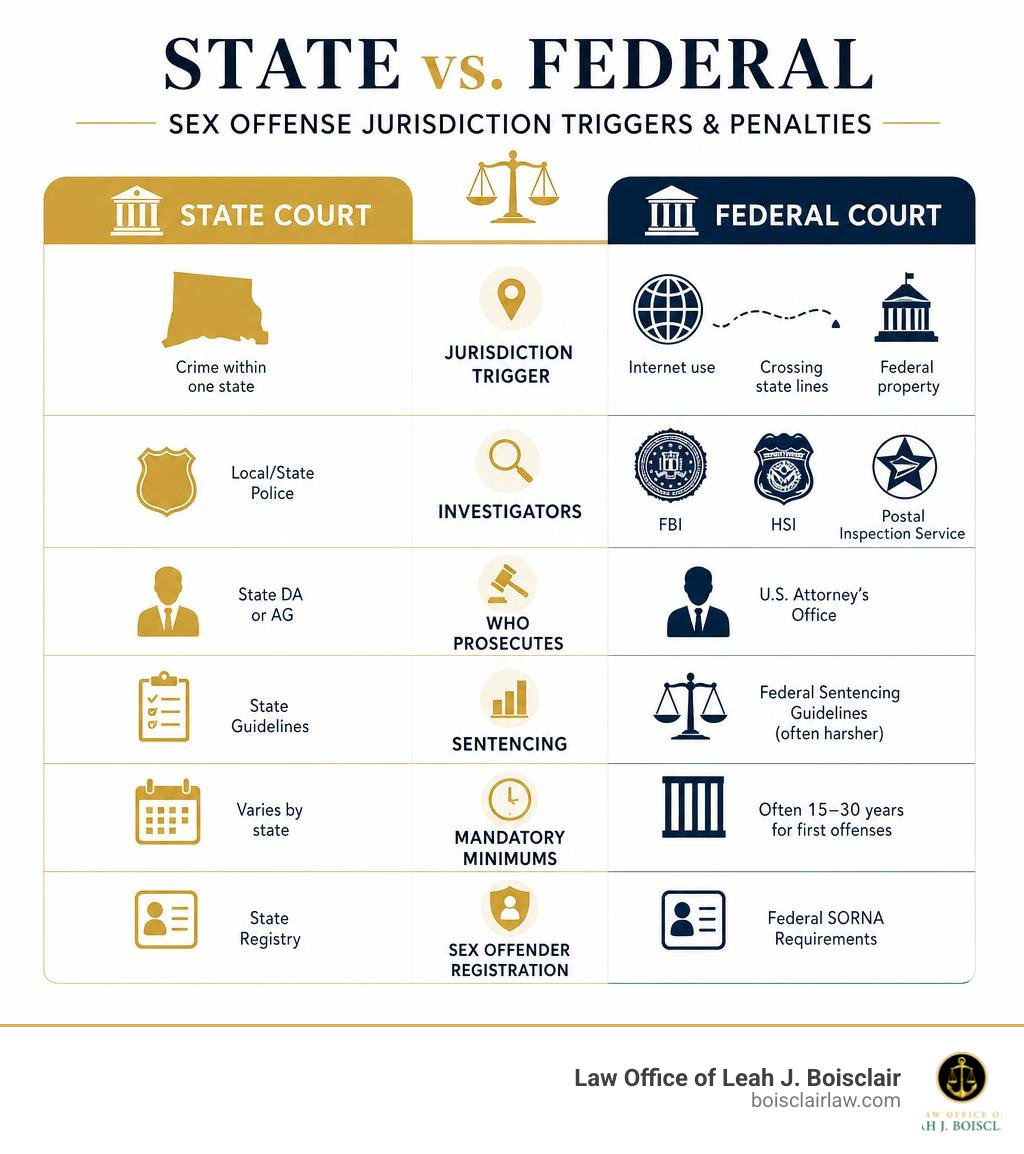
| Factor | State Court | Federal Court |
|---|---|---|
| Who prosecutes | State DA or AG | U.S. Attorney’s Office |
| Jurisdiction trigger | Crime within one state | Internet use, crossing state lines, federal property |
| Sentencing | State guidelines | Federal sentencing guidelines (often harsher) |
| Mandatory minimums | Varies by state | Often 15–30 years for first offenses |
| Sex offender registration | State registry | Federal SORNA requirements |
| Investigators | Local/state police | FBI, HSI, Postal Inspection Service |
Few legal situations are more serious — or more frightening — than facing a federal sex offense charge.
Unlike state charges, federal cases come with vastly more resources on the prosecution’s side, specialized task forces, and sentencing guidelines that can mean decades behind bars even for first-time offenses. Federal sex crime convictions frequently result in mandatory minimum sentences ranging from 15 to 30 years, lifetime supervised release, and permanent placement on the sex offender registry.
The difference between state and federal prosecution isn’t just about which courthouse you walk into. It’s about a completely different set of rules, investigators, and consequences.
And the stakes couldn’t be higher.
Consider this: in one widely reported case, a former criminal defense attorney — someone who knew the legal system inside and out — was convicted in federal court on multiple sex charges involving minors and faced 25 years to life in prison. Federal prosecutors don’t lose cases often. They come prepared.
That’s exactly why the attorney you choose matters so much.
The Law Office of Leah J. Boisclair serves clients in Rhode Island, Massachusetts, and Connecticut who are facing serious criminal charges — including those caught in the web of federal jurisdiction. This guide breaks down what federal sex charges actually mean, how they differ from state offenses, and what a skilled federal defense can look like.
Similar topics to Federal court sex attorney:
Understanding Federal vs State Jurisdiction in Sex Offenses
To understand how to defend against these serious allegations, we must first look at how the legal landscape is divided. As we navigate the complex legal environment of June 2026, the division between state and federal power remains one of the most critical aspects of criminal defense.
Most everyday violations are handled by state courts. If an incident occurs entirely within the borders of Rhode Island—whether in Cranston, Providence, or Warwick—and does not involve federal property or interstate systems, it generally falls under state jurisdiction.
Federal jurisdiction, however, is triggered when an offense touches “interstate commerce” or occurs on federal property (such as military bases, national parks, or federal buildings). Because the federal government has broad authority to regulate interstate commerce, almost any activity that crosses state lines or utilizes an interstate network will move the case into the federal system.
| Jurisdictional Element | State Sex Offenses | Federal Sex Offenses |
|---|---|---|
| Primary Law Source | Rhode Island General Laws | Title 18 of the United States Code |
| Geographic Scope | Limited to state borders | Across state lines, international, or federal land |
| Technology Trigger | Local devices, local transmission | Any use of the internet, interstate servers, or mail |
| Prosecuting Agency | Rhode Island Department of Attorney General | United States Attorney’s Office (District of RI) |
| Investigating Agency | Cranston Police, Providence Police, State Police | FBI, HSI, Postal Inspection Service |
When Does a Sex Offense Become a Federal Case?
A sex offense is not directed to federal court simply because it is serious. It becomes a federal matter because of specific jurisdictional triggers. The most common trigger in the modern era is internet usage. Because the internet is inherently an interstate network, sending, receiving, or downloading restricted material instantly establishes federal jurisdiction.
Other common triggers include:
- Crossing State Lines: Transporting an individual across state boundaries for unlawful sexual activity.
- Mailing Systems: Utilizing the U.S. Postal Service or private interstate carriers to transmit illegal materials.
- Federal Land: Unlawful physical contact occurring within national parks, military installations, or federal correctional facilities.
When federal investigators step in, the rules of the game change entirely. The resources of national agencies are brought to bear, which is why understanding your rights from the very beginning is so critical. For a deeper look at why local representation matters when facing powerful prosecutors, read our guide on Why Hire a Rhode Island Criminal Defense Attorney.
How Do Simultaneous State and Federal Offenses Interact?
One of the most common points of confusion for individuals facing these allegations is whether they can be prosecuted by both the state of Rhode Island and the federal government for the same conduct. Many assume that the constitutional protection against double jeopardy prevents this.
However, under the legal doctrine known as “dual sovereignty,” the state government and the federal government are considered separate sovereign entities. This means both jurisdictions can legally prosecute you for the same act without violating double jeopardy protections.
In practice, local police and federal agents often coordinate their efforts. If federal authorities decide to take the lead, state prosecutors will frequently defer to the U.S. Attorney’s Office, allowing the federal case to proceed first. If you are facing this multi-layered threat, you need a defense strategy that addresses both fronts. To learn more about how local defense strategies align with broader legal protections, explore The Ultimate Guide to RI Criminal Attorneys.
Why You Need a Specialized Federal Court Sex Attorney
Defending a case in federal court requires an entirely different skill set than defending one in state court. Federal judges are appointed for life, federal prosecutors have smaller caseloads with larger budgets, and the procedural rules are highly structured.
An experienced federal court sex attorney must be intimately familiar with:
- The Federal Rules of Evidence: These rules dictate what can and cannot be presented to a jury, and they are enforced with extreme precision by federal judges.
- The Federal Sentencing Guidelines: A complex, point-based system that judges use to calculate prison sentences. Navigating these guidelines requires deep technical knowledge to successfully argue for downward departures or variances.
- Grand Jury Proceedings: Federal charges are initiated through a grand jury indictment. Understanding how to navigate this secretive process is vital to protecting your future.

Without an attorney who specializes in this specific arena, a defendant is at a severe disadvantage. The federal government builds its cases meticulously, often spending months or even years gathering evidence before filing formal charges. To understand the level of specialization required to counter these efforts, see our dedicated page on Sex Crimes Defense Attorney.
The Role of a Federal Court Sex Attorney During Investigations
The best time to defeat a federal case is before it is ever officially filed. If you learn that you are the subject of an investigation, you must act immediately.
Federal agencies often initiate contact in one of two ways:
- A Knock on the Door: Federal agents (such as FBI or HSI officers) may show up at your home or workplace in Cranston or Providence, seeking a “friendly chat.” They may tell you that you are not in trouble and just want to clear some things up. Do not fall for this trap. Anything you say can and will be used to build a case against you.
- A Target Letter: This is an official letter from the U.S. Attorney’s Office informing you that there is substantial evidence linking you to a federal offense and that you are the target of a grand jury investigation.
A specialized attorney will immediately step between you and the government. We can handle all communications with federal agents, present mitigating evidence to prosecutors, and work to prevent an indictment from ever occurring. If you have been contacted by investigators, learn how to protect yourself by reading Your Guide to Picking a Criminal Defense Attorney for Sex Crimes.
How a Federal Court Sex Attorney Challenges Digital Evidence
The vast majority of federal sex offenses rely heavily on electronic evidence. This includes computer hard drives, smartphones, cloud storage accounts, IP addresses, and internet service provider (ISP) logs.
The government uses highly sophisticated forensic software to extract data, but these methods are not infallible. A skilled defense attorney will work with independent digital forensic experts to analyze the government’s findings.
We look for critical weaknesses in the prosecution’s technical case:
- Chain of Custody Issues: Was the digital evidence handled, stored, and transferred correctly? Any gap in the chain can compromise the integrity of the data.
- Search Warrant Violations: Did federal agents exceed the scope of their search warrant? If a warrant authorized them to search for specific files on a computer, but they searched your entire home without authorization, we can file motions to suppress that evidence.
- Malware and Unauthorized Access: Was your device compromised by a virus, trojan, or shared network access? It is entirely possible for illicit material to be downloaded to a device without the owner’s knowledge or consent.
Challenging the technical aspects of the prosecution’s case is a cornerstone of a robust defense. To explore how we build these technical and constitutional defenses, read about The Art of the Defense Using Consent and False Allegation Strategies.
Common Federal Sex Offenses and Their Severe Penalties
Federal statutes cover a wide range of conduct, but certain offenses are prosecuted with particular frequency and intensity. Understanding the specific nature of these offenses is the first step in building a defense.

- Child Exploitation Offenses: This category includes the production, distribution, receipt, or possession of child pornography. These offenses carry some of the harshest penalties in the federal system. Even simple possession can carry a 5-to-20-year prison sentence, while production offenses carry mandatory minimums of 15 to 30 years for first-time offenders.
- Sex Trafficking: This involves recruiting, harboring, transporting, or obtaining a person for commercial sex through force, fraud, or coercion. If the offense involves a minor, no force or coercion needs to be proven—any commercial sex involving a minor is automatically treated as sex trafficking under federal law and carries a mandatory minimum of 15 years to life in prison.
- Online Enticement: Using the internet, social media, or messaging apps to entice or attempt to entice a minor to engage in sexual activity. These cases often stem from undercover sting operations where federal agents pose as minors online.
The penalties for these offenses are designed to be devastating, which is why an aggressive defense is your only real option.
Severe Consequences of Federal Sex Offense Convictions
The consequences of a federal conviction extend far beyond the initial prison term. The federal system has eliminated parole, meaning that federal inmates must serve at least 85% of their imposed sentence.
Once released from prison, individuals face a lifetime of ongoing restrictions:
- Supervised Release: Unlike state probation, federal supervised release is managed by federal officers who enforce strict conditions. This can include lifetime monitoring of your computer usage, travel restrictions, and mandatory therapy.
- Sex Offender Registration: Under the federal Adam Walsh Child Protection and Safety Act (specifically SORNA), individuals convicted of federal sex offenses must register as sex offenders. This registry is public, easily searchable, and places permanent limitations on where you can live, work, and travel.
- Loss of Civil Rights: A federal felony conviction results in the permanent loss of your right to possess firearms, vote, and hold public office.
The reality of these outcomes is underscored by high-profile prosecutions. For example, as detailed by the United States Secret Service, a Federal Jury Convicts Former Roane County Defense Attorney of serious exploitation offenses, highlighting that the federal system spares no one when these allegations are proven.
Proven Defense Strategies in Federal Court
While the federal government has immense power, they still must prove every element of their case beyond a reasonable doubt. A skilled defense team will identify the weak points in their evidence and present a compelling counter-narrative.
Some of the most effective defense strategies in federal court include:
- Entrapment: In online sting operations, federal agents sometimes cross the line from providing an opportunity to commit an offense to actively inducing an otherwise law-abiding person to do so. If we can prove that you were pressured or coerced into the act by undercover agents, an entrapment defense may apply.
- Lack of Intent or Knowledge: Many federal offenses require the government to prove that you acted knowingly. If digital evidence was downloaded automatically, placed on your device by someone else, or accessed through an unsecured Wi-Fi network, we can argue a lack of knowledge.
- Constitutional Violations: If federal agents violated your Fourth Amendment rights during a search, or your Fifth Amendment rights during questioning, we can fight to have the resulting evidence thrown out of court.
Every case is unique, and a successful defense requires a customized approach tailored to the specific facts of your situation. To see how we apply these strategies under local and federal rules, check out our guide on Rhode Island Sex Assault Defense Navigating Local Laws with a Pro.
Navigating Ethical Issues and Conflicts in Federal Courts
The integrity of the judicial system is paramount, especially in high-stakes federal cases. Ethical issues, conflicts of interest, and inappropriate relationships can severely compromise the fairness of legal proceedings.
For instance, judicial ethics investigations have occasionally revealed deep conflicts within federal districts, such as the widely publicized incident where a Local Attorney Who Sent “Sexually Suggestive Text Messages” to Judge Kindred Is Wife of Anchorage Superior Court Judge. When such conflicts arise, cases must be reassigned to entirely different judges to preserve the constitutional right to an impartial forum.
As your defense counsel, we monitor every aspect of the prosecution and the court’s conduct. If there is even a hint of bias, conflict, or procedural impropriety, we will immediately take action to protect your rights, demand recusal, or seek a reassignment of your case.
Frequently Asked Questions about Federal Sex Offenses
What should I do if contacted by federal agents?
If federal agents contact you, remain calm, polite, and completely silent regarding the details of any investigation. Clearly state: “I am exercising my right to remain silent, and I want to speak with my attorney before answering any questions.” Do not try to explain your way out of the situation or make excuses, as federal agents are trained to use your statements to build their case.
How do federal sentencing guidelines differ from state guidelines?
Federal sentencing guidelines use a highly structured, point-based system that calculates a recommended sentence based on the offense level and your criminal history. Unlike state systems, which often allow for significant judicial discretion or probation, federal guidelines are heavily weighted toward prison terms and feature strict mandatory minimums that federal judges are legally bound to enforce in many sex offense cases.
Can a state sex offense be upgraded to a federal offense?
Yes. If a state-level investigation reveals that the alleged conduct involved interstate elements—such as using the internet to communicate, crossing state lines, or utilizing the mail system—federal prosecutors can choose to take over the case. When this occurs, the state charges are typically dismissed, and the case is transferred to the federal court system.
Conclusion
When you are facing the federal government, you cannot afford to take chances. The resources, laws, and penalties of the federal system are stacked against you from day one. You need a dedicated legal team that understands how to level the playing field.
At the Law Office of Leah J. Boisclair, we provide personalized, compassionate advocacy for clients throughout Rhode Island—including Cranston, Providence, Warwick, Johnston, and West Warwick. We know what is at stake, and we fight tirelessly to protect your rights, your freedom, and your future.
If you or a loved one is under investigation or facing federal charges, do not wait for the government to make the first move. Contact us today to schedule a confidential consultation.