

When the Offenses Are Financial, the Stakes Are Just as High
White collar crimes defense is the area of criminal law focused on protecting individuals and businesses accused of non-violent offenses involving deceit, concealment, or violation of trust for financial gain.
If you or your business is under investigation, here is what you need to know right away:
What white collar crimes defense covers:
- Challenging evidence of criminal intent — the government must prove you knowingly acted to defraud
- Protecting your rights during federal investigations, grand jury proceedings, and subpoenas
- Negotiating with the DOJ, SEC, or IRS before offenses are filed
- Reducing or dismissing offenses through compliance history, cooperation, or pre-indictment advocacy
- Managing collateral consequences like professional licenses, reputation, and employment
These are not minor matters. Bank fraud alone can carry up to 30 years in prison and a $1 million fine. Wire fraud can mean up to 20 years per count. And investigations often begin long before you receive any official notice.
The FBI defines white collar offenses as those “characterized by deceit, concealment, or violation of trust” — and while they are non-violent, they are far from victimless. Federal agencies dedicate enormous resources to building these cases. By the time you learn you are a target, the government may already have months of evidence.
That is why the most important step you can take is getting experienced legal representation early — often before any offenses are filed.
This guide walks through everything you need to know: how these investigations work, what offenses are involved, what defenses apply, and how to protect yourself starting today.
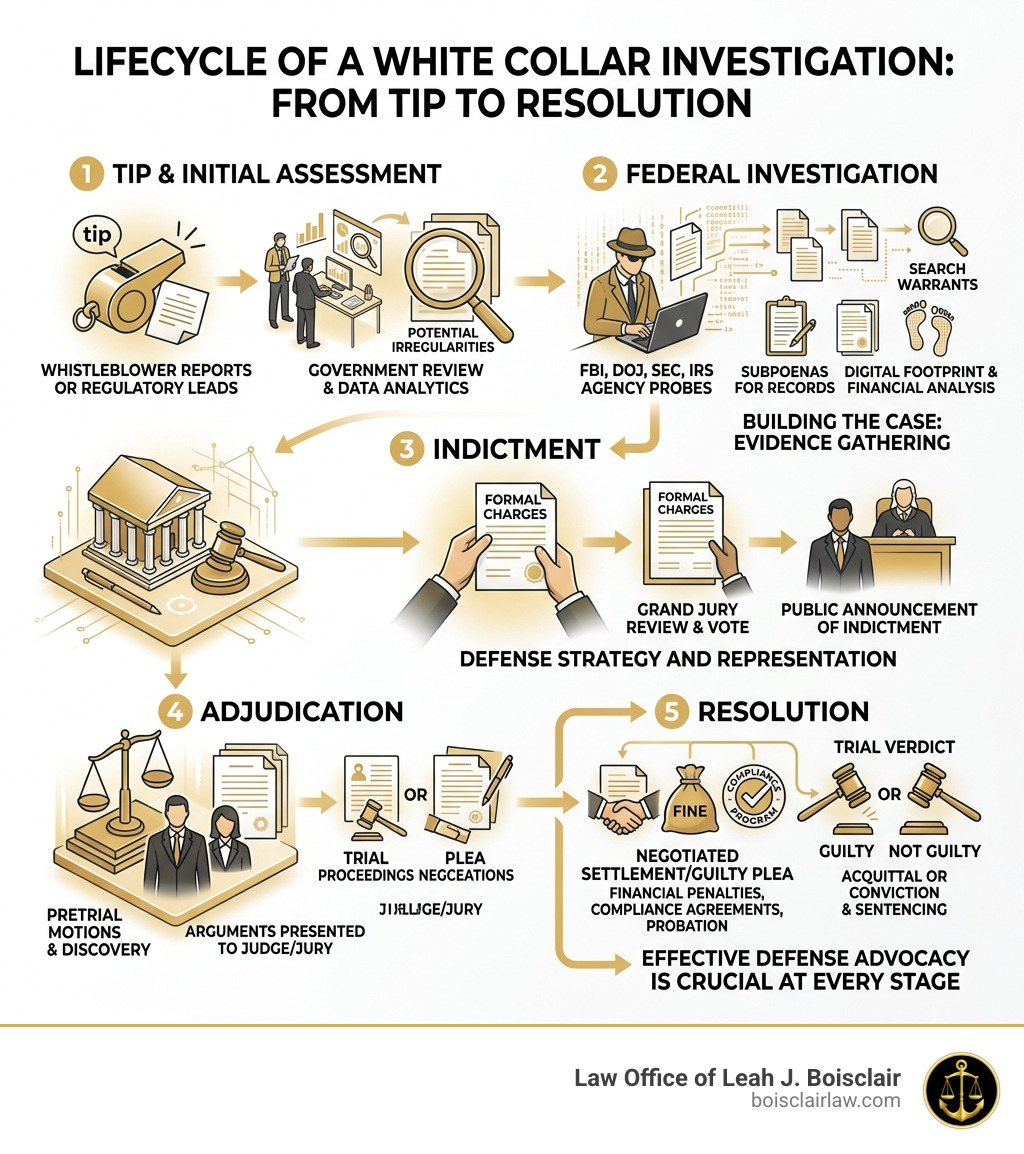
Understanding Financial Offenses and Federal Investigations
When we talk about white collar offenses, we are entering a world of paper trails, digital footprints, and complex regulatory frameworks. Unlike “street offenses,” these cases are built by highly trained agents from the FBI, the Department of Justice (DOJ), the Securities and Exchange Commission (SEC), and the IRS. These agencies don’t just look for a “smoking gun”; they look for patterns of behavior that suggest a conscious effort to bypass the law for financial gain.
In April 2026, the landscape of these investigations has become even more sophisticated. Federal agencies now use advanced data analytics to spot irregularities in healthcare billing, securities trading, and corporate accounting. Common areas of focus include:
- Corporate Fraud: This involves accounting schemes, executive self-dealing, and insider trading. The FBI prioritizes these because they can destabilize entire markets.
- Healthcare Fraud: A massive priority for the federal government. With healthcare fraud causing tens of billions of dollars in losses annually, any provider—from a local clinic in Cranston to a large hospital system—can find themselves under the microscope.
- Securities and Mortgage Fraud: Whether it’s “fraud for profit” in the real estate sector or complex investment schemes, the SEC and DOJ are quick to step in when investors are at risk.
Navigating these waters requires a deep understanding of several practice areas because a single investigation can often branch into multiple types of offenses.
Building a Robust White Collar Crimes Defense Strategy
The most powerful weapon in our arsenal for white collar crimes defense is the concept of “intent.” For the government to secure a conviction, they must prove beyond a reasonable doubt that you intended to deceive or defraud. They can’t just prove you made a mistake or that your accounting was messy; they have to prove you meant to break the law.
We often build defenses around:
- Lack of Intent: Showing that any errors were accidental or the result of negligence, not a criminal plan.
- Good Faith: Demonstrating that you believed your actions were legal and transparent.
- Reliance on Counsel: If you took specific actions based on the advice of a lawyer or a professional accountant, it can be a strong defense against the claim that you “knowingly” committed an offense.
By focusing on these elements, we have been able to achieve significant case results, often resolving matters before they ever reach a courtroom.
Why You Need a Specialized White Collar Crimes Defense Lawyer
You wouldn’t ask a general practitioner to perform heart surgery; similarly, you shouldn’t ask a general criminal lawyer to handle a federal embezzlement case. These cases involve thousands of pages of discovery, forensic accounting, and high-stakes negotiations with seasoned federal prosecutors.
When you work with us, we bring a level of personalized, compassionate advocacy that acknowledges the stress these investigations put on your life and reputation. We understand how the other side thinks—often leveraging the same types of forensic tools the government uses to find the holes in their case. You can learn more about our firm’s approach to these high-stakes matters to see how we prioritize your future.
The Critical Role of Early White Collar Crimes Defense

Time is the most valuable asset in a white collar offense. Most people think their case starts when they are arrested. In the white collar world, your legal matter starts the moment a federal agent begins looking at your bank records or an employee mentions a “concern” to a whistleblower hotline.
If you receive a target letter—a formal notice from the DOJ stating you are the target of a grand jury investigation—the clock is already ticking. Early intervention allows us to:
- Communicate with prosecutors to see if offenses can be avoided entirely.
- Conduct an internal investigation to find the facts before the government does.
- Negotiate a “proffer” agreement where you can provide information in exchange for leniency or immunity.
Our white-collar crimes defense attorney services are designed to jump in at this exact moment to prevent an indictment from ever being filed.
Immediate Steps After Federal Contact
If a federal agent knocks on your door or calls you, your heart will likely skip a beat. That’s normal. But what you do in the next five minutes can determine the next five years of your life.
- Exercise Your Right to Silence: Be polite, but do not answer questions. Simply say, “I am happy to cooperate, but I need to have my attorney present before we speak.”
- Do Not Destroy Evidence: This is critical. Deleting emails or shredding documents after you know an investigation is active can lead to “obstruction of justice” offenses, which are often easier for the government to prove than the original offense.
- Contact Counsel Immediately: We need to begin preparing your personal and legal history to present a proactive defense.
- Preserve Documents: Secure all digital and physical records immediately.
Navigating Subpoenas and Search Warrants
A subpoena is a legal demand for documents or testimony. A search warrant is an immediate authorization for agents to enter and seize property. Both are terrifying, but both have limits. We can challenge the “scope” of a subpoena if it is too broad or “burdensome.” We also ensure that your Fifth Amendment rights against self-incrimination are protected at every turn. A coordinated response means you aren’t fighting the federal government alone; you have a shield between you and the investigators.
Common Types of White Collar Offenses and Their Penalties
The penalties for these offenses are designed to be punitive. Because the “harm” is often measured in dollars, the “punishment” is often measured in years.
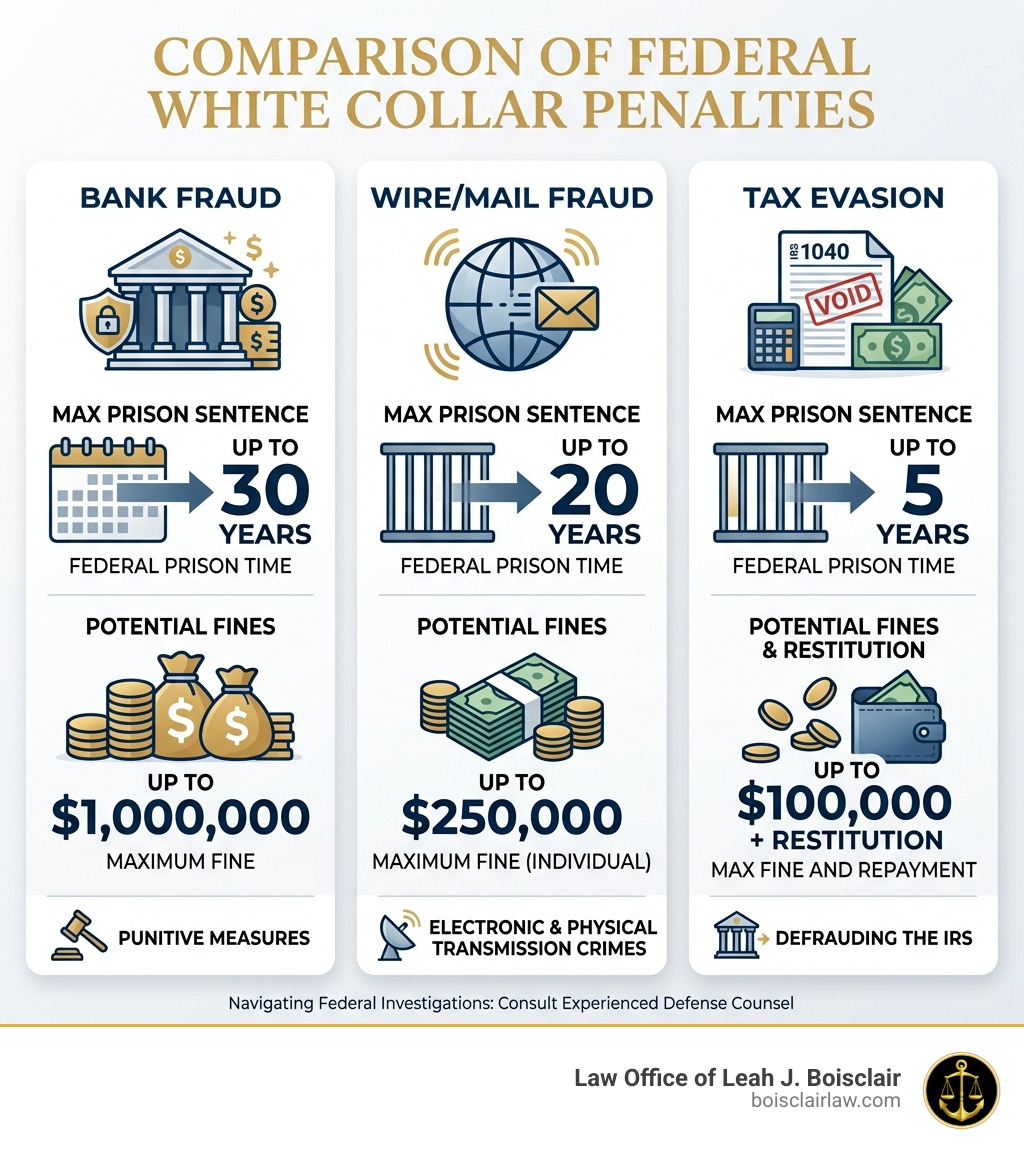
| Offense Type | Max Prison Sentence | Potential Fines |
|---|---|---|
| Bank Fraud | Up to 30 Years | Up to $1,000,000 |
| Wire/Mail Fraud | Up to 20 Years | Up to $250,000 (Individual) |
| Tax Evasion | Up to 5 Years | Up to $100,000 + Restitution |
| Money Laundering | Up to 20 Years | $500,000 or 2x Value of Property |
Money laundering is particularly tricky because it involves three stages: placement, layering, and integration. If you are caught in the middle of these complex financial flows, you need to know how to find a money laundering defense attorney who understands the nuances of the Bank Secrecy Act and Anti-Money Laundering (AML) compliance.
Healthcare Fraud and the False Claims Act
Healthcare fraud is a top-tier priority for the DOJ. In 2022 alone, federal prosecutors used the False Claims Act to recover nearly $7 million from fraud related to pandemic relief. Whether it is billing for services not rendered, “upcoding” (billing for a more expensive service than provided), or taking kickbacks for referrals, the consequences are severe.
As a RI criminal attorney, we see how these offenses impact local professionals. A single billing error can trigger an audit that spirals into a criminal investigation. We work to show that these were administrative errors rather than a scheme to defraud Medicare or Medicaid.
Computer and Intellectual Property Offenses
In 2026, intellectual property theft and economic espionage are estimated to cost the American economy hundreds of billions of dollars per year. These are high-tech offenses involving trade secrets, copyright infringement, and cyber-fraud. If you are facing allegations of unauthorized access or data theft, our computer crimes defense attorney services can help navigate the technical and legal complexities of the Computer Fraud and Abuse Act.
Strategic Defense Tactics to Prevent Indictment

The best victory in a white collar offense is the one that never makes the news. Our goal is often to resolve the matter “non-publicly.” This is achieved through:
- Internal Investigations: We conduct our own deep dive into your company’s records. If we find an issue, we can help you fix it and present a plan to the government before they come looking.
- Compliance Programs: Having a robust compliance program in place before an investigation starts is one of the best defenses. It shows the government that you take the law seriously and that any misconduct was the act of a “rogue employee,” not a corporate policy.
- Self-Reporting: Sometimes, voluntarily disclosing an error to the authorities can lead to a 75% reduction in fines and a “Deferred Prosecution Agreement,” where the government agrees to drop offenses if you remain compliant for a certain period.
If you suspect something is wrong, don’t wait for a knock on the door. Contact us today for a confidential assessment.
The Impact of Compliance and Cooperation
The DOJ has made it clear: they reward cooperation. However, “cooperation” doesn’t mean doing the government’s job for them at your own expense. It means strategic disclosure. By showing a history of compliance and a willingness to remedy mistakes, we can often secure “Non-Prosecution Agreements” (NPAs). These are gold for our clients because they protect your reputation and keep you out of the criminal justice system.
2026 Enforcement Trends and Priorities
As we move through 2026, we are seeing new priorities from the SEC and DOJ:
- Crypto Regulation: Increased scrutiny on digital assets and decentralized finance.
- Environmental Compliance: “Greenwashing” and environmental fraud are now being prosecuted as white collar offenses.
- Anti-Corruption: A renewed focus on the Foreign Corrupt Practices Act (FCPA) and cross-border bribery.
Frequently Asked Questions about White Collar Crimes Defense
What is the difference between a felony and a misdemeanor?
In Rhode Island and federal law, the main difference is the potential length of incarceration. A misdemeanor typically carries a maximum of one year in jail. A felony carries more than one year and often decades in prison. Beyond jail time, a felony conviction can strip you of civil rights, such as the right to vote or own a firearm, and make it nearly impossible to hold professional licenses or certain jobs.
What is the process of a criminal case?
It usually follows this path:
- Investigation: Agents gather evidence (this can take years).
- Arraignment: You are formally accused and enter a plea (usually “Not Guilty”).
- Discovery: We get to see the government’s evidence against you.
- Motions: We challenge the evidence, asking the judge to throw out anything obtained illegally.
- Plea Negotiations or Trial: We either reach a favorable agreement or take the case to a jury.
What types of sentences are common in white collar offenses?
While prison is always a risk, many white collar offenses result in heavy fines, restitution (paying back the money lost), and probation. Federal judges use the Federal Sentencing Guidelines, which look at the total “loss amount” and your criminal history to determine a range for your sentence. Our job is to argue for “downward departures” based on your character and mitigating circumstances.
Which court has jurisdiction over my case?
If you are accused of violating state law (like local embezzlement from a Cranston business), you will likely be in Rhode Island Superior Court. If you are accused of violating federal law (like mail fraud, tax evasion, or offenses involving interstate commerce), your case will be in the U.S. District Court for the District of Rhode Island. Federal court is generally much faster and has stricter sentencing rules.
What should I do if federal agents knock on my door?
Do not panic. Do not provide a statement. Ask for their identification and business cards. Politely state: “I am not comfortable speaking without my lawyer.” Then, call us immediately. Even if you think you are “just a witness,” your status can change to “target” in a single conversation.
Can a civil investigation turn into a criminal case?
Absolutely. Many cases begin as a simple SEC audit or an IRS tax review. If the auditor finds evidence of “willful” deceit or a “scheme to defraud,” they are required to refer the case to the DOJ for criminal prosecution. This is why you need a defense attorney even during “routine” audits if the stakes are high.
Conclusion
Facing a white collar investigation is one of the most taxing experiences a professional can endure. The weight of the federal government can feel overwhelming, but you do not have to carry it alone. At the Law Office of Leah J. Boisclair, we provide the personalized, compassionate advocacy you need to protect your future.
Whether you are in Cranston or anywhere in Rhode Island, we are ready to stand by your side in both state and federal courts. We have a track record of securing dismissals and protecting the reputations of those we represent. Don’t wait for the investigation to escalate. Protect your future with a white collar crimes defense attorney who understands how to win.