

A DUI Record Doesn’t Have to Follow You Forever in Cranston, RI
If you’re looking for a Cranston DUI expungement lawyer, here’s what you need to know right away:
Can you clear a DUI from your record in Rhode Island?
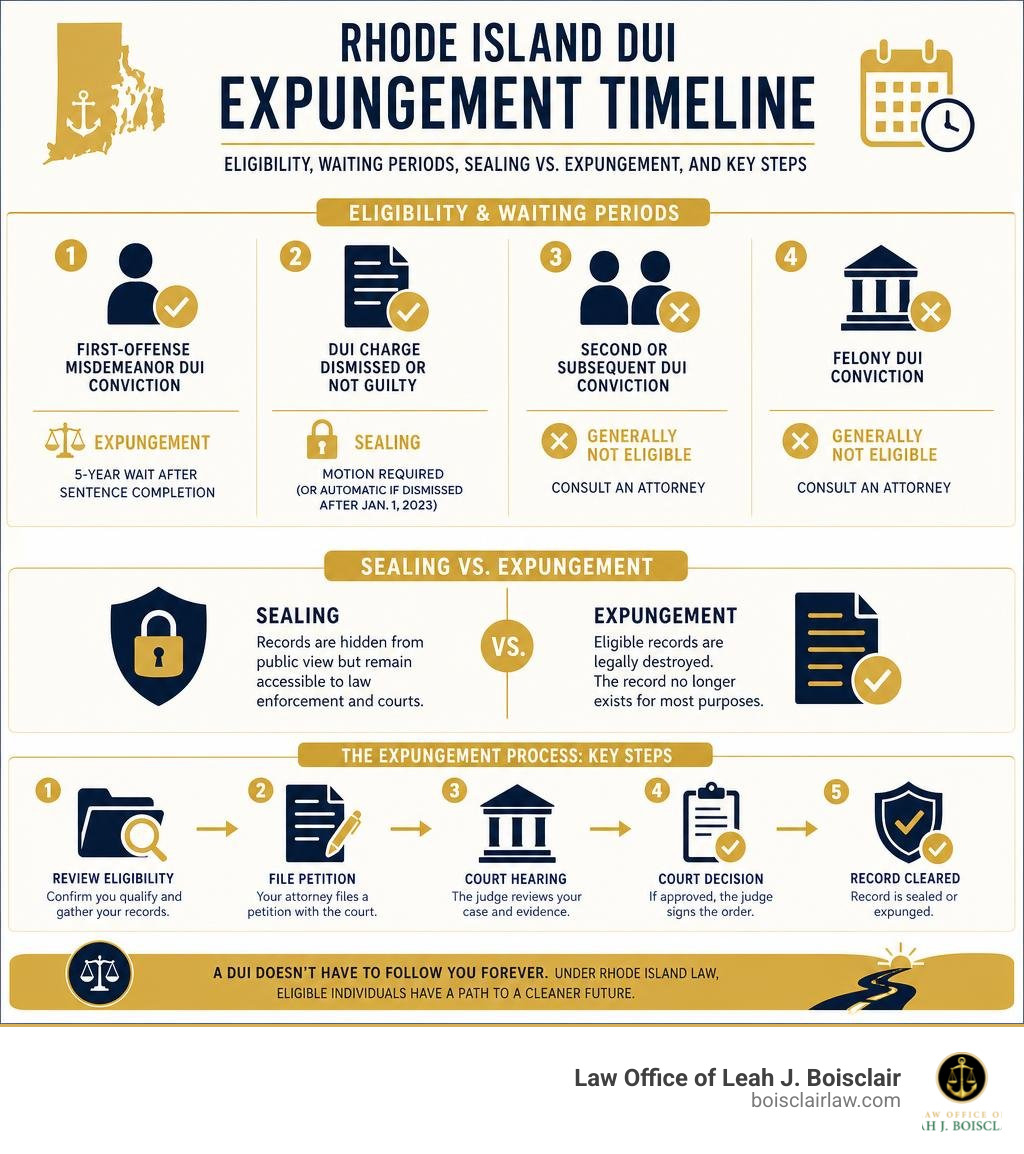
| Situation | Option | Key Requirement |
|---|---|---|
| First-offense misdemeanor DUI conviction | Expungement | 5-year wait after sentence completion |
| DUI offense dismissed or not guilty | Sealing | Motion required (or automatic if dismissed after Jan. 1, 2023) |
| Second or subsequent DUI conviction | Generally not eligible | Consult an attorney |
| Felony DUI conviction | Generally not eligible | Consult an attorney |
A DUI offense – even one from years ago – can quietly block job opportunities, housing applications, and professional licenses. Many Cranston residents don’t realize that Rhode Island law gives eligible people a real path to clear or seal their record.
But this process is not automatic. Even if your case was dismissed or you were found not guilty, you typically need to take formal legal steps. And if you were convicted, strict eligibility rules and waiting periods apply under Rhode Island law.
The good news: for many first-time offenders, clearing a DUI record is possible – and working with an experienced attorney makes the process significantly smoother and more likely to succeed.
Cranston DUI expungement lawyer terms explained:
- Providence misdemeanor defense lawyer
- RI misdemeanor record expungement
- proven misdemeanor dismissals RI
Sealing vs. Expungement for DUI and Traffic Offenses in Rhode Island
When you want to clean up your background check, the terms “sealing” and “expungement” are often tossed around as if they mean the exact same thing. While they both achieve the ultimate goal of hiding your past mistakes from public view, they are governed by different Rhode Island statutes and apply to completely different case outcomes.
In Rhode Island, the primary difference depends on whether your DUI and Traffic Offenses ended in a conviction or a non-conviction.
Expungement (R.I. Gen. Laws Chapter 12-1.3)
Expungement is the legal process used to clear a conviction from your record. Under R.I. Gen. Laws Chapter 12-1.3, a first-offense misdemeanor DUI conviction can be expunged if you meet strict eligibility criteria, including a clean record for a specific waiting period. When we successfully petition the court for an expungement, the court orders all law enforcement agencies and court clerks to destroy or isolate their records of your arrest and conviction.
Sealing (R.I. Gen. Laws Section 12-1-12)
Sealing is the legal process reserved for non-convictions. If your DUI offense was dismissed, if you were found not guilty at trial, or if the prosecution decided not to move forward with the offenses (known as a nolle prosequi), you do not have a conviction. However, without taking action, the arrest record and the court filing still show up on public databases. Sealing completely removes these files from public eyes under R.I. Gen. Laws Section 12-1-12.
To help visualize how these two paths compare, we have mapped out the core distinctions below:
| Feature | Record Sealing | Record Expungement |
|---|---|---|
| Applicability | Dismissals, Acquittals, Not Guilty verdicts | Convictions (Guilty pleas, Nolo Contendere) |
| Governing Statute | R.I. Gen. Laws Section 12-1-12 | R.I. Gen. Laws Chapter 12-1.3 |
| Waiting Period | None (Immediate for most cases) | 5 years for misdemeanor DUI |
| Court Filing Fee | Free | $100 statutory court fee |
| DMV Records | Does not clear Title 31 DMV history | Does not clear Title 31 DMV history |
Understanding whether your case requires sealing or expungement is the critical first step to Wiping the Slate Clean in Rhode Island. If you file the wrong motion, the court clerk will reject it, or the judge may deny your petition outright, forcing you to start the process over.
Eligibility and Waiting Periods for a Cranston DUI Expungement Lawyer
If you were convicted of a first-offense misdemeanor DUI in Cranston, you cannot immediately clear your record. Rhode Island law requires a waiting period to ensure you have maintained a clean record and demonstrated good behavior.

For a first-offense misdemeanor DUI conviction, the mandatory waiting period is 5 years.
However, a common point of confusion is when this 5-year clock actually starts ticking. The waiting period does not begin on the date of your arrest, nor does it begin on the day you were sentenced in court. Instead, the 5-year clock starts the moment you have fully completed every single component of your sentence.
To meet the sentence completion requirement, you must have:
- Completed any probation or suspended sentence.
- Served any active jail time or home confinement.
- Completed all court-ordered community service hours.
- Finished all mandatory alcohol education classes or substance abuse treatment programs.
- Paid all court costs, statutory fines, and restitution in full.
If you still owe even a single dollar in court fees, or if you forgot to submit proof of your completed community service to the court, the 5-year clock has not officially started.
Before we can file a petition, we must obtain your official Bureau of Criminal Identification (BCI) report from the Rhode Island Attorney General’s office. This report acts as the official record of your criminal history and proves to the court that you have remained free of any new arrests or convictions during your waiting period. If you want to dive deeper into how this waiting period applies to your specific situation, you can read our guide on how to Expunge DUI Record.
How Prior Offenses Affect Your Eligibility
Rhode Island has some of the most accommodating record-clearing laws in New England, but they are highly protective when it comes to repeat offenses. If you have more than one mark on your record, eligibility becomes significantly more complicated.
Rhode Island law provides a “multi-misdemeanor” expungement pathway for individuals who have up to five misdemeanor convictions. However, the state legislature explicitly wrote a major exception into this law: DUI convictions are completely excluded from the multi-misdemeanor path.
What does this mean for you?
- The Single-Offender Rule: You can only expunge a DUI conviction if it is your only conviction. If you have a prior or subsequent misdemeanor conviction of any kind (even a non-driving offense), you are generally barred from expunging your DUI conviction under the standard first-offender statute.
- Look-Back Periods: Rhode Island operates under a 5-year look-back period for DUI offenses. If you are arrested for a second DUI within 5 years of your first, it is charged as a second offense, carrying mandatory jail time. Even if your first DUI was successfully expunged, the prosecution and the courts can still access that sealed record to charge and sentence you as a repeat offender if you get arrested again.
- Felony Exclusions: If your DUI was charged as a felony (such as a third-offense DUI or a DUI resulting in serious bodily injury), the waiting period to expunge a felony is 10 years, and the rules are incredibly strict. Many felony DUI convictions cannot be expunged if they are classified as violent offenses or if they resulted in serious harm to others.
Sealing Dismissed or Not-Guilty DUI Offenses
If your Cranston DUI offense was dismissed, resolved through a nolle prosequi, or you won a “not guilty” verdict at trial, you do not have a conviction. This is a fantastic legal outcome, but it does not mean your record is automatically clean. The arrest record, the mugshot, and the court docket still exist as public records.
Fortunately, Rhode Island law has made great strides in simplifying this process. Under recent updates to the law, cases dismissed under Rule 48(a) on or after January 1, 2023, are subject to automatic sealing. The court clerk’s office is required to seal these records within 10 to 20 days of the dismissal without you needing to file a formal motion or pay a fee.
However, if your dismissal occurred before 2023, or if your case resulted in an acquittal (a “not guilty” verdict at trial), the record is not automatically sealed. You must file a formal motion to seal with the court that handled your case.
To make sure you don’t miss any critical requirements during this process, we recommend reviewing our checklist on how to Wipe Your Record Clean with These Expungement Steps.
The Step-by-Step Process in Cranston Courts
Navigating the court system to clear your record can feel like running an obstacle course. If you make a mistake on a single form, you could face delays of several months.

Because Cranston is located in Providence County, most DUI and Traffic Offenses are handled within the Providence County court system. If your DUI was a misdemeanor, your case was likely handled by the Third Division District Court (which occasionally sits at the Garrahy Judicial Complex in Providence). If your case involved a felony, it was handled in the Providence County Superior Court.
When you work with us, we manage the entire step-by-step process on your behalf:
- Obtain the BCI Report: We secure a certified copy of your statewide criminal history from the Rhode Island Attorney General’s Office.
- Retrieve Certified Court Dispositions: We visit the court clerk’s office where your case was resolved to get certified copies of your final judgment, proving your sentence was fully completed.
- Draft and File the Motion: We prepare the formal Motion for Expungement and the accompanying Affidavit, ensuring all dates, offense details, and statutory references are perfectly accurate.
- Serve the Parties: We serve copies of the motion to the Cranston Police Department (the arresting agency) and the Rhode Island Department of the Attorney General (the prosecution).
- Represent You at the Hearing: We present your case to the judge, demonstrating that you have met all statutory waiting periods, have maintained good moral character, and that clearing your record is in the interest of justice.
Required Documents for a Cranston DUI Expungement Lawyer
To successfully file your petition, you must gather a specific set of documents. Missing even one of these items will prevent the court clerk from scheduling your hearing:
- Statewide BCI Report: This must be a recent, certified copy from the Attorney General’s Office.
- Certified Court Disposition: A document signed by the court clerk showing how your case was resolved and confirming all financial obligations were paid.
- Motion to Expunge/Seal Form: The official court-approved form matching the specific court (District or Superior) that handled your case.
- Affidavit of Support: A signed, notarized statement swearing that you have no pending criminal offenses and have met all waiting periods.
- Filing Fee: If you are expunging a conviction, you must pay a statutory $100 filing fee to the court clerk. Sealing motions for dismissals do not require a filing fee.
Timeline and Costs of Filing in Rhode Island
How long does it take to get a clean slate? On average, the entire expungement or sealing process in Rhode Island courts serving Cranston takes between 3 and 6 months.
The timeline generally breaks down like this:
- Weeks 1–3: Gathering BCI reports and certified court records.
- Weeks 4–6: Preparing and filing the motion with the court, and serving the Cranston Police Department and Attorney General.
- Weeks 6–12: Waiting for the court to schedule a hearing date (courts typically require at least 30 to 45 days’ notice to allow the state to object).
- Post-Hearing (30–45 Days): Once the judge signs the expungement order, it takes several weeks for the court clerk, the BCI, and the arresting police department to physically destroy or seal the files in their databases.
In terms of costs, you should plan for:
- Court Filing Fee: $100 (only for convictions).
- BCI Report Fee: $5.
- Attorney Fees: This varies depending on the complexity of your record and whether the prosecution plans to object. We provide transparent, flat-rate pricing for expungements so you know exactly what to expect.
Life After Record Clearing: Impact and Limitations
Successfully clearing your record with a Cranston DUI expungement lawyer is an incredibly rewarding feeling. It feels like a weight has been lifted from your shoulders.
Once your expungement or sealing order is signed by the judge and processed by the state, you can legally state on job applications, housing forms, and credit applications that you have never been arrested or convicted of an offense.
- Employment: Most private employers rely on standard commercial background checks. Once your record is expunged, these commercial databases will show a completely clean criminal history.
- Housing: Property management companies and landlords use the same commercial background checks. Your expunged DUI will no longer stand in the way of securing an apartment or home.
- Professional Licensing: If you are pursuing a career in real estate, nursing, cosmetology, or trades, a clean BCI is crucial to getting licensed by the state.
However, it is vital to understand that a criminal expungement does not clear your Rhode Island DMV record. Your driving history is maintained separately by the Division of Motor Vehicles under Title 31 of Rhode Island law. Because criminal courts do not have jurisdiction over DMV administrative databases, your license suspensions and breathalyzer refusal history will remain on your driving record. This means your auto insurance rates may not immediately drop purely because of a criminal expungement, as insurance companies look directly at your DMV driving history.
To learn more about how to navigate these post-clearing details, read our guide on Finding the Best Providence and Cranston DUI Expungement Help.
Statutory Carve-Outs and Law Enforcement Access
While an expungement clears your record for the vast majority of public and private background checks, Rhode Island law includes five specific statutory carve-outs where your expunged DUI record must still be disclosed and will remain visible:
- Applying for a position in law enforcement (police, corrections, etc.).
- Applying for admission to the state bar to practice law.
- Applying for a teaching certificate or employment within a school system.
- Applying for a youth coaching certificate.
- Applying for employment in early childhood education or daycare facilities.
Additionally, federal agencies (like the FBI, TSA, or immigration services) maintain their own independent databases. State-level expungements do not automatically bind federal databases, meaning federal background checks may still show the original arrest. Furthermore, as mentioned earlier, the courts and prosecutors retain access to your sealed records for the purpose of look-back enhancements if you are ever charged with a subsequent DUI.
Why a Cranston DUI Expungement Lawyer is Essential to Avoid Denial
Many people assume that filing for an expungement is just a matter of filling out some paperwork. However, expungement is considered a privilege, not an absolute right.
The prosecution (the Attorney General or the Cranston city solicitor) has the right to attend your hearing and object to your petition. Common reasons for objections or denials include:
- Filing too early: Calculating the 5-year waiting period incorrectly.
- Outstanding court debt: Having unpaid fines or fees on other minor traffic tickets.
- Inconsistent dates: Errors on your petition that do not match the official court records.
- Failure to demonstrate rehabilitation: The judge must be convinced that your expungement “serves the public interest” and that you have shown good moral character.
We know exactly how to draft these petitions to anticipate and neutralize prosecutor objections. We make sure every T is crossed and every I is dotted so you can walk into court with confidence.
Frequently Asked Questions About Cranston Record Clearing
We hear many of the same questions from our clients in Cranston, Warwick, and Providence. Here are the answers to some of the most common inquiries:
Can I expunge a second-offense DUI in Rhode Island?
Generally, no. Under Rhode Island’s first-offender statute, you can only expunge a DUI if it is your first and only conviction. A second-offense DUI conviction is charged as a misdemeanor or a felony, and because repeat DUIs are excluded from the multi-misdemeanor expungement pathway, a second DUI conviction will unfortunately remain on your criminal record indefinitely. However, if your second DUI offense was dismissed or resulted in a not guilty verdict, that specific offense can be sealed.
Does expunging my criminal record clear my Rhode Island DMV record?
No. As discussed above, criminal expungement under Chapter 12-1.3 only applies to court and law enforcement (BCI) records. Your driving record is maintained by the Rhode Island DMV under Title 31. Any administrative suspensions, breathalyzer refusals, or traffic court points will remain on your DMV record according to standard DMV retention timelines.
What are the most common reasons a DUI expungement petition is denied?
The three most common reasons a judge will deny an expungement petition are:
- Unpaid court fines or fees associated with the original case or other traffic violations.
- Pending criminal offenses or recent arrests that occurred during the 5-year waiting period.
- Filing in the wrong court jurisdiction (such as filing a Superior Court case in District Court).
Conclusion
A past DUI offense does not have to dictate your future. Rhode Island law provides a clear, legal path to turn the page and reclaim your clean record, but navigating the strict statutory timelines, court rules, and paperwork requires precision.
At the Law Office of Leah J. Boisclair, we provide personalized, compassionate, and dedicated legal representation for clients seeking expungements and record-sealing services in Cranston, Providence, Warwick, Johnston, and throughout Rhode Island. We understand how stressful it is to live with a criminal record, and we are committed to helping you clear your name with minimal stress.
If you are ready to take control of your future, contact us today to schedule a confidential consultation. Let us do the heavy lifting to wipe your slate clean.
To learn more about how we can help you fight or clear driving-related offenses, visit our page on DUI and Traffic Offenses Legal Services.