
What Is Violent Charges Defense — and Why It Matters Right Now
Violent charges defense refers to the legal strategies and representation used to fight charges involving force, the threat of force, or serious bodily harm to another person. If you or someone you love is facing these charges in Rhode Island, Massachusetts, or Connecticut, here is what you need to know right away:
Quick answers:
- What counts as a violent charge? Charges involving actual or threatened physical harm — including robbery, kidnapping, arson, carjacking, extortion, murder, and manslaughter
- How serious are the penalties? From 6 months in jail for lesser charges up to life imprisonment or the death penalty for first-degree murder
- What defenses exist? Self-defense, alibi, mistaken identity, lack of intent, and constitutional violations are among the most common
- What should you do first? Contact an experienced criminal defense attorney immediately — every hour counts
As of April 2026, prosecutors across New England continue to pursue violent charges aggressively. According to the Rhode Island General Laws, convictions often mean felony status, which carries lifelong consequences — restricted employment, loss of civil rights, and a permanent criminal record.
These are not charges you want to face alone.
Understanding Violent Charges in 2026

In the current legal landscape of April 2026, the term “violent charges” serves as an umbrella for some of the most serious charges in the Rhode Island criminal justice system. When the state alleges that a person used force or the threat of force against another, the machinery of the government moves quickly and aggressively.
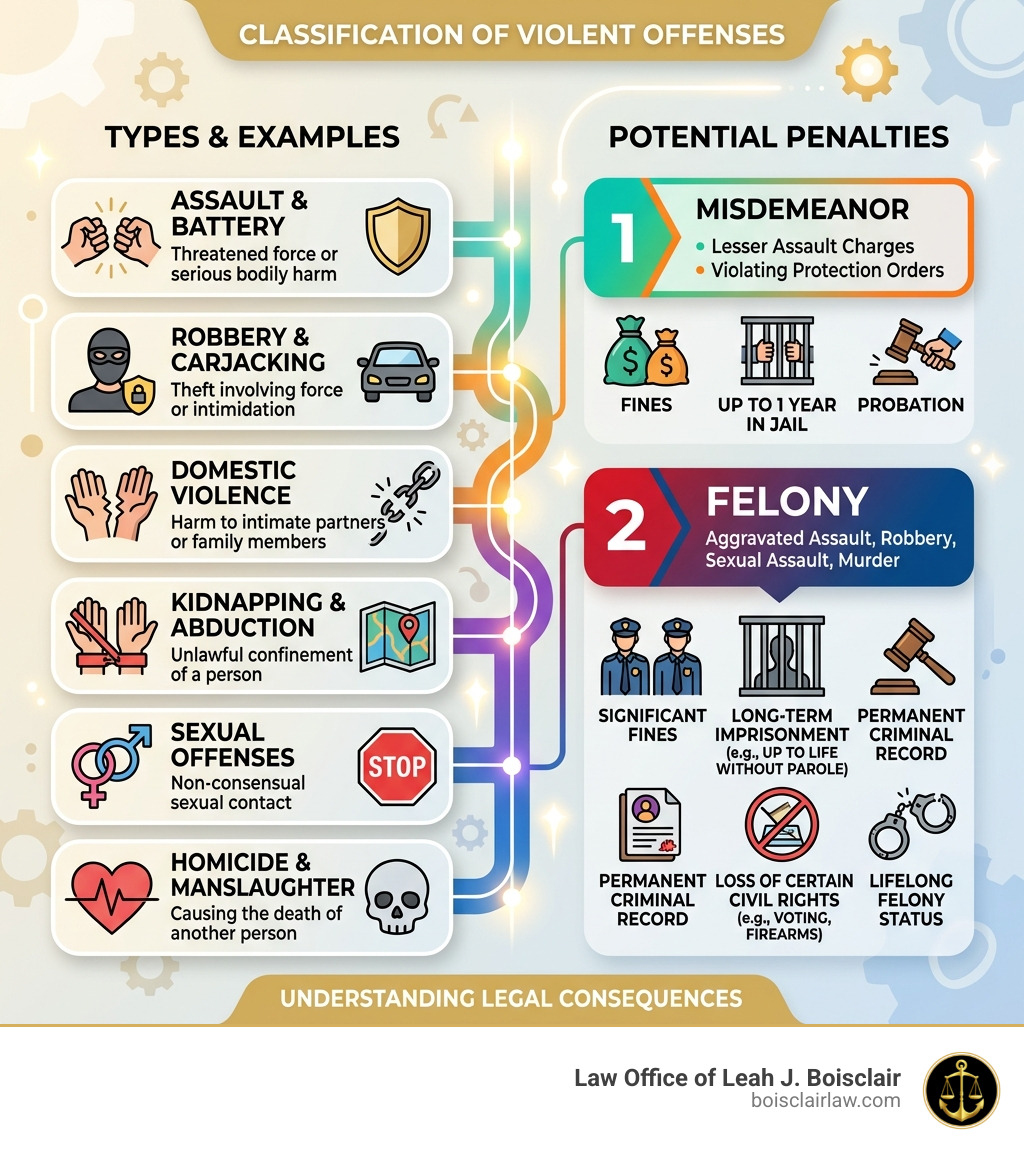
Common examples of violent charges include:
- Murder and Manslaughter: These are the most severe charges, involving the unlawful killing of another human being. Murder typically implies intent or “malice aforethought,” while manslaughter may involve reckless behavior or “heat of passion” circumstances.
- Robbery: This is often confused with theft, but the key difference is the use of force or fear to take property directly from a person.
- Kidnapping: The unlawful confinement or movement of a person against their will.
- Arson: Intentionally setting fire to property, which is classified as violent due to the extreme risk to human life.
- Carjacking: A specific form of robbery involving the forceful taking of a motor vehicle.
- Extortion: Using threats of violence or harm to obtain money, property, or services.
At the Law Office of Leah J. Boisclair, we understand that being accused of these acts is life-altering. Whether you are facing Felonies and Misdemeanors, the classification of the charge dictates the path of your defense. Most violent charges are categorized as felonies, meaning they carry the potential for more than one year in prison and significant fines. If you find yourself in this situation, securing a Violent Charges Defense Attorney is the first step toward protecting your future.
Distinguishing Violent Charges from Assault and Battery
It is a common misconception that all physical altercations fall under the same legal heading. However, in Rhode Island, we distinguish between general violent charges and specific Assault and Battery.
While “assault” involves the threat or attempt to cause physical harm, and “battery” involves the actual physical contact, these are treated as separate legal categories from crimes like robbery or kidnapping. You can find more detail on this in The Legal Lowdown on Public Brawling and Fighting.
The distinction usually boils down to:
- Intent: Was the goal to steal (Robbery) or simply to cause harm (Battery)?
- Injury Levels: Violent charges often involve “serious bodily harm,” which includes permanent disfigurement, loss of limb function, or a high risk of death.
- Simple vs. Aggravated: A simple assault might be a misdemeanor, whereas an assault with a dangerous weapon—even if no one is actually hurt—can elevate the case to a major felony.
Proven Strategies for a Violent Charges Defense

When we take on a case at the Law Office of Leah J. Boisclair, we don’t just look at what the police report says. We look for the truth. A successful violent charges defense is built on identifying the right legal “justification” or “excuse” for the alleged conduct.
Some of the most effective strategies include:
- Self-Defense: This is perhaps the most well-known defense. To succeed, we must show that you had a reasonable belief that you were in imminent danger of bodily harm and that the force you used was proportional to the threat.
- Defense of Others: Similar to self-defense, this applies if you acted to protect someone else from immediate harm.
- Alibi: Proving that you were somewhere else entirely when the incident occurred. This often involves cell phone records, GPS data, or witness testimony.
- Mistaken Identity: Eyewitnesses are notoriously unreliable. We look for flaws in line-ups or descriptions that suggest the wrong person was arrested.
- Lack of Intent: Many violent charges require the prosecution to prove you intended to cause harm or commit a crime. If the incident was a genuine accident, the charges may not hold up.
As your Violent Charges Defense Attorney, our goal is to weave these facts into a narrative that creates reasonable doubt in the minds of a jury or prosecutor.
Challenging the Prosecution’s Evidence in Violent Charges
The burden of proof lies entirely with the state. They must prove every element of the crime “beyond a reasonable doubt.” We work to chip away at that burden by:
- Hunting for Exculpatory Evidence: This is evidence that tends to prove your innocence.
- Questioning Witness Credibility: Does the witness have a motive to lie? Were they under the influence or distracted during the event?
- Forensic Analysis: We scrutinize DNA, fingerprint, and ballistics evidence to ensure it wasn’t mishandled or misinterpreted.
- Identifying Constitutional Violations: If the police obtained evidence through an illegal search or a coerced confession, we can file motions to suppress that evidence so it cannot be used against you.
This level of scrutiny is especially vital in sensitive cases, which is Why You Need a Defense Attorney for Domestic Offenses Right Now.
Protecting Your Rights During a Violent Charges Investigation
The moments following an arrest are critical. You have constitutional protections that are designed to prevent the government from overstepping.
- The Right to Silence: You are not required to explain yourself to the police. In fact, anything you say “can and will be used against you.”
- The Right to Counsel: You have the right to have an attorney present during any questioning.
- Proper Procedures: The police must follow strict rules during the booking and investigation process.
We tell all our clients: Don’t Go It Alone When Facing Domestic Offenses or any violent charge. The police are trained to get you to talk; we are trained to protect you.
The Legal Process and Sentencing Factors
Navigating the Rhode Island court system can feel like walking through a maze in the dark. Here is a simplified look at the process:
- Arraignment: This is your first appearance where the charges are read, and bail is set.
- Preliminary Hearing/Grand Jury: For felonies, the state must show there is enough evidence to proceed to trial.
- Pre-Trial Motions: We argue about what evidence should be allowed.
- Trial: A jury or judge hears the evidence and renders a verdict.
Potential Penalties: Felony vs. Misdemeanor
The consequences of a conviction are heavy. Below is a general comparison of what one might expect in the New England legal system:

| Charge Category | Potential Prison Time | Potential Fines | Long-Term Impact |
|---|---|---|---|
| Misdemeanor | Up to 1 Year | Up to $1,000 | Record, some employment limits |
| Felony | 1 Year to Life | $5,000 – $10,000+ | Felon status, loss of gun rights |
| Capital Offense | Life without Parole | Varies | Permanent loss of all civil rights |
For more specific information on lower-level charges, see The Providence Misdemeanor Defense Guide: Your Rights and Your Future.
Factors Influencing Sentencing for Violent Charges
If a case reaches the sentencing phase, the judge doesn’t just pick a number out of a hat. Several factors influence the outcome:
- Prior Criminal Record: First-time offenders are often treated more leniently than those with a history of violence.
- Use of a Weapon: Using a firearm can trigger “mandatory minimum” sentences that a judge cannot reduce.
- Victim Impact: The severity of the injury to the victim plays a massive role.
- Mitigating Circumstances: Factors that might lower the sentence, such as showing remorse or having a mental health condition.
- Aggravating Factors: Factors that increase the sentence, such as targeting a vulnerable victim.
These complexities are why specialized knowledge is required for Domestic and Family Related Offenses.
Navigating Firearm Offenses and Related Charges
In Rhode Island, violent charges and Firearm Offenses are often intertwined. If a crime is committed while in possession of a gun, the legal stakes skyrocket.
The Second Amendment provides the right to bear arms, but state and federal laws place strict limits on possession, especially for those with prior convictions. An “Armed Robbery” charge, for instance, carries much harsher penalties than a standard robbery because of the presence of a weapon.
Key points to remember:
- Sentence Enhancements: Simply having a gun during a crime can add years to a prison sentence.
- Federal vs. State Court: Some firearm offenses can be prosecuted at the federal level, where sentencing guidelines are often even more rigid.
- Mandatory Minimums: Many gun-related charges require a minimum prison stay, regardless of the circumstances.
Interestingly, we often see these charges overlap with DUI and Traffic Offenses. A routine traffic stop for a suspected DUI can quickly turn into a felony investigation if an unregistered firearm is found in the vehicle.
Frequently Asked Questions about Violent Charges
What is the difference between a felony and a misdemeanor?
The primary difference is the severity of the punishment. Misdemeanors are handled in District Court and carry a maximum of one year in jail. Felonies are more serious, handled in Superior Court, and can lead to years or decades in state prison. Beyond jail time, a felony conviction results in “felon status,” meaning you lose the right to vote (while incarcerated), the right to own a firearm, and often the ability to hold certain professional licenses. You can read more about this in Felonies and Misdemeanors.
Can violent charges be reduced or dismissed?
Yes. It happens more often than people think. Through plea bargaining, we may be able to get a felony reduced to a misdemeanor. If we can show that the evidence was obtained illegally or that the prosecution’s witnesses are unreliable, we can file a motion to have the charges dismissed entirely. Our goal for every client is a dismissal or a significantly reduced sentence.
How does the court determine jurisdiction for violent charges?
Jurisdiction usually depends on where the incident happened and the nature of the charge. Most violent charges are handled in the State Superior Court in the county where the incident occurred. However, if the crime involved crossing state lines, federal property, or specific federal laws (like certain kidnapping or weapons charges), the case might be moved to Federal Court.
What other categories of charges does the firm handle?
The Law Office of Leah J. Boisclair provides comprehensive defense across a wide spectrum of legal challenges, including:
- Firearm Offenses
- DUI and Traffic Offenses
- Assault and Battery
- Domestic Offenses
- Drug Offenses
- Public Order Offenses
- Property Offenses
- White Collar Offenses
- Sex Offenses
- Violent Charges
- Computer Offenses
Conclusion
Facing a violent charge is perhaps the most stressful experience a person can endure. The weight of the government’s resources can feel overwhelming, but you do not have to carry that burden alone. At the Law Office of Leah J. Boisclair, we provide personalized, compassionate advocacy for our neighbors in Cranston and throughout Rhode Island.
We believe that every person deserves a vigorous defense and a fair shot at justice. Our proven track record of dismissals and reduced charges speaks to our commitment to our clients. If you are under investigation or have already been charged, the time to act is now.
Contact a Violent Charges Defense Attorney today to schedule a consultation and start building the defense you deserve.