
When Fear Becomes Your Daily Reality: What Stalking Victims Need to Know About Legal Protection
If you are searching for a lawyer for stalking victim cases, here is what you need to know right now:
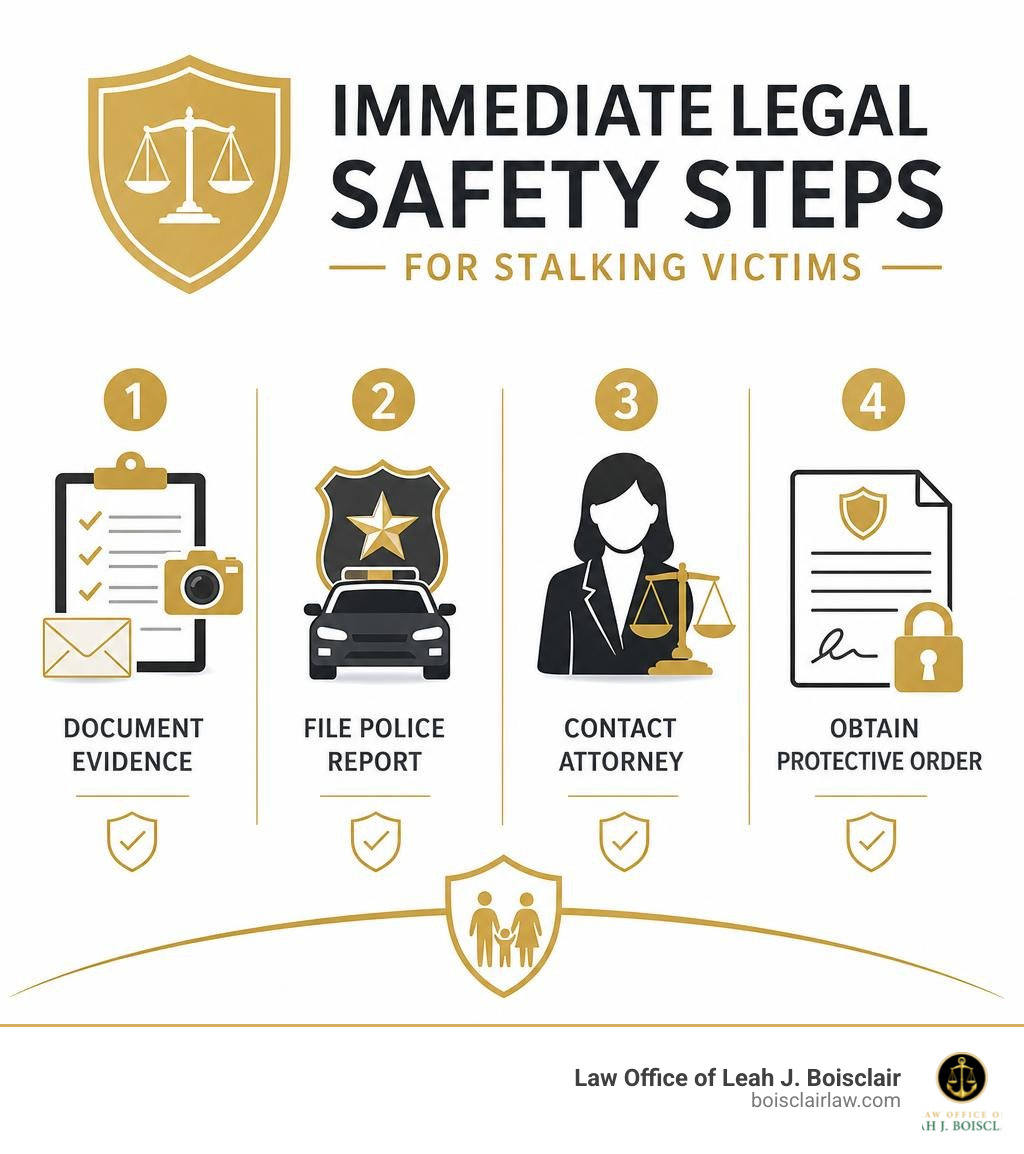
Immediate steps to protect yourself legally:
- Call law enforcement – Report every incident, even if police seem dismissive
- Document everything – Save messages, emails, voicemails, and photos; do not delete or block
- Contact a stalking victim attorney – A lawyer can file for a protective order quickly, often within days
- Apply for an emergency protective order – A court can issue a temporary restraining order without the stalker present
- Preserve digital evidence – Screenshot social media contacts, GPS pings, and any tracking attempts
Stalking is not a minor inconvenience. It is a crime — and a serious one.
Approximately 13.5 million people are stalked in the United States every year. That is not a typo. And yet, many victims spend months trying to convince police, courts, or even family members that what they are experiencing is real and dangerous.
The fear is exhausting. The hypervigilance is constant. And navigating a legal system that was not always built with victims in mind? That can feel impossible alone.
This guide is for you — whether your stalker is an ex-partner, a stranger, or someone who found you online.
A skilled attorney does more than file paperwork. They build a legal strategy around your safety, advocate with law enforcement when they are slow to act, and fight to get you enforceable protection — fast.
Lawyer for stalking victim vocab explained:
- divorce attorneys specializing in emotional abuse
- domestic abuse defense lawyer
- domestic violence lawyer texas
Understanding Stalking Offenses and Legal Classifications
Stalking is legally defined as a “course of conduct” directed at a specific person that would cause a reasonable person to feel fear, intimidation, or severe emotional distress. Unlike a single isolated incident of harassment, stalking is a pattern of repeated behavior. It is the cumulative effect of these repeated actions that makes the behavior criminal.
Under the law, a “course of conduct” means a series of two or more acts in which the stalker follows, monitors, observes, surveils, threatens, or communicates with you directly or indirectly. The law evaluates these actions objectively: would a reasonable person in your shoes feel threatened or severely distressed by this behavior?
When we evaluate stalking offenses, we look at how different jurisdictions classify these behaviors. While some states separate these behaviors into degrees (ranging from misdemeanor harassment to high-level felonies), Rhode Island takes a very strict approach to protecting victims.
To help visualize how stalking behaviors are categorized legally, consider the following general classification structure:
| Offense Classification | Common Key Elements | Typical Penalties |
|---|---|---|
| Misdemeanor Stalking | Non-violent repeated harassment, following, or contacting after being told to stop; no direct threats of physical harm. | Up to 1 year in jail, probation, and counseling programs. |
| Felony Stalking (First Offense) | Repeatedly following or harassing with malicious intent; violating existing restraining orders; cyberstalking. | Up to 5 years in prison, substantial fines, and long-term protective orders. |
| Aggravated / Violent Felony Stalking | Stalking involving a weapon, targeting a minor, or involving a direct, credible threat of death or serious bodily injury. | Up to 10+ years in state prison and permanent registration on offender databases. |
Nationally, high-profile advocates have brought these legal definitions into the spotlight. Activists like Lenora Claire, who survived a decade-long stalking ordeal, have campaigned extensively to close the gaps in how the justice system handles these cases. Similarly, prominent victim rights attorneys like Alexis Moore have used their personal experiences with stalking and domestic abuse to push for stronger legislation, demonstrating that legal definitions must evolve alongside the tactics stalkers use.
Misdemeanor vs. Felony Stalking Offenses
In Rhode Island, the legal system does not take stalking lightly. Under Rhode Island General Laws § 11-59-2, a first-time stalking conviction is actually prosecuted as a felony. If convicted, a stalker faces up to five years in prison and a fine of up to $10,000.
However, the severity of the charges escalates significantly under certain conditions:
- Prior Convictions: If the perpetrator has a prior conviction for stalking or cyberstalking, the offense carries enhanced penalties, including mandatory prison time.
- Domestic Violence Connections: When the stalking occurs between family or household members, it is classified under domestic violence guidelines. This triggers mandatory domestic abuse counseling, loss of firearm privileges, and stricter bail conditions.
- Violation of Court Orders: Stalking someone in violation of an active restraining order or no-contact order immediately elevates the criminal severity and guarantees that prosecutors will seek jail time.
Understanding how these charges interact with domestic abuse is critical. If your stalker is an ex-spouse, a former dating partner, or a co-parent, the case falls squarely into the realm of Domestic and Family Related Offenses. These cases require a specialized legal approach because the history of the relationship directly impacts how the state prosecutes the behavior.
The Impact of Modern Technology and Cyberstalking
The digital age has given stalkers a terrifying array of new tools. Today, a stalker does not need to stand on your street corner to monitor your movements. They can use GPS tracking devices, slip an AirTag into your car, install hidden spyware on your phone, or send hundreds of harassing messages through social media and encrypted apps.
Rhode Island law explicitly addresses these digital threats under its cyberstalking and cyberharassment statutes (R.I.G.L. § 11-52-4.2). Cyberstalking is a felony that involves using electronic communications to transmit words, images, or language with the sole intent to harass, abuse, threaten, or intimidate.
[Stalker Uses Tech] ---> [GPS/AirTag/Spyware/Social Media] ---> [Severe Emotional Distress]
 |
 v
 [Felony Cyberstalking]
Compounding these technological challenges is the shifting legal landscape regarding “true threats.” The U.S. Supreme Court’s ruling in Counterman v. Colorado established a higher bar for prosecuting stalking cases. The court ruled that the prosecution must prove the defendant acted with a reckless state of mind—meaning they knew their words or actions would cause fear, but chose to do it anyway.
Because of this intent requirement, proving cyberstalking requires sophisticated legal evidence. A lawyer for stalking victim cases knows how to demonstrate that the digital harassment was not an accidental misunderstanding, but a deliberate, reckless campaign of terror.
How a Lawyer for Stalking Victim Builds a Case and Navigates the System
When you are living in fear, trying to figure out how to navigate the court system can feel overwhelming. That is where we step in. As your legal advocates, we take the burden of dealing with the courts and law enforcement off your shoulders so you can focus on healing.

Navigating the criminal justice system is complex. While the state’s prosecutor handles the criminal charges against the stalker, they represent the state, not you. By hiring a dedicated victim advocate, you ensure you have someone in your corner whose sole focus is your safety, your privacy, and your peace of mind.
When choosing an attorney to guide you through this process, it is essential to select someone who understands the deep emotional and psychological dynamics of trauma. Learning How to Choose the Best Domestic Abuse Lawyer for Your Case is an important first step in finding an advocate who will treat your situation with the urgency and compassion it deserves.
Gathering Evidence and Documenting Stalking Incidents
To win a protective order or secure a criminal conviction, we must present clear, undeniable evidence of a “course of conduct.” Stalkers often rely on the hope that you will delete their messages out of disgust or fear. We advise our clients to do the exact opposite: preserve everything.
Here is how you can effectively document stalking incidents to build an airtight legal case:
- Keep a Detailed Stalking Log: Record the date, time, location, and a description of every single incident. Note any witnesses who were present and write down the police report number if law enforcement was called.
- Save All Digital Communications: Take screenshots of text messages, emails, social media comments, and direct messages. Make sure the screenshots display the sender’s username, phone number, and the timestamp.
- Preserve Voicemails and Audio: Do not delete threatening voicemails. Save them to an external drive or cloud storage.
- Photograph the Unwanted Behavior: If the stalker leaves unwanted gifts, notes, or property damage, take high-resolution photos before touching or moving them.
- Avoid “Blocking” Without Saving: While your instinct may be to block the stalker immediately, doing so can cut off your stream of evidence and make it harder to prove they are continuing to contact you. Instead, work with us to securely log the communications before taking steps to restrict their access.
Overcoming Law Enforcement Barriers with a Lawyer for Stalking Victim
One of the most frustrating challenges stalking victims face is getting law enforcement to take their complaints seriously. Because stalking rarely begins with physical violence, police officers may dismiss your concerns as a “civil matter” or tell you to “just ignore them.” They may claim there is nothing they can do because no physical harm has occurred yet.
We do not accept those excuses. When we represent a stalking victim, we act as a powerful buffer between you and the police. We compile exhaustive “evidence packets” that clearly lay out the pattern of behavior, the legal statutes violated, and the imminent threat to your safety.
When police departments see a professional legal packet backed by an experienced attorney, they are far more likely to assign an investigator, issue warrants, and make an arrest. If you are facing pushback from local authorities, remember: Don’t Go It Alone When Facing a Domestic Violence Case. Having a lawyer advocate on your behalf changes the dynamic entirely.
Securing Protective Orders and Civil Remedies
Our primary goal is to establish a legal barrier between you and your stalker. This is achieved through protective orders, restraining orders, and, in some cases, civil lawsuits for damages.
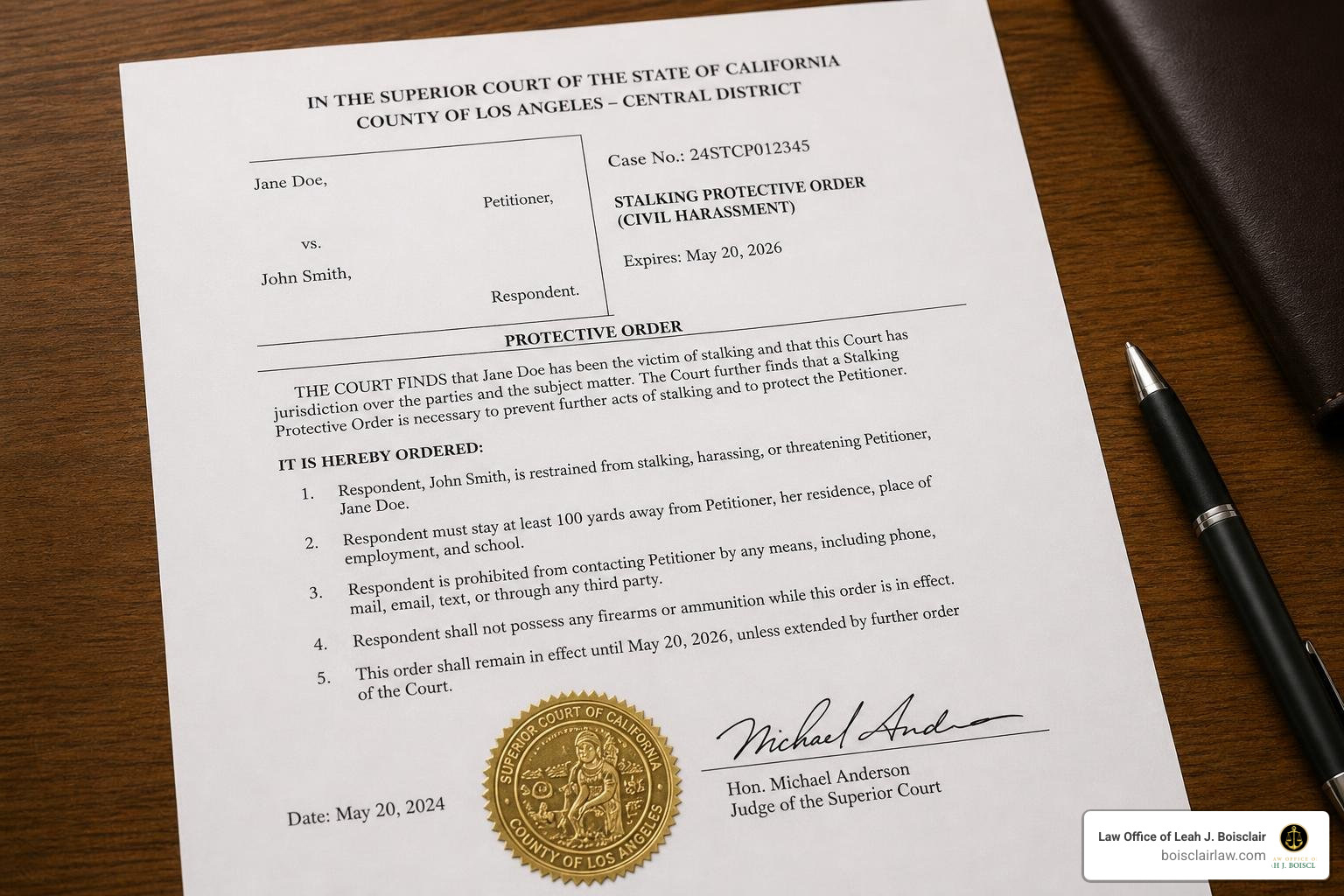
In Rhode Island, local police departments—such as the West Warwick Police Department or the Providence Police Department—are responsible for serving and enforcing these orders once they are issued by a judge. We coordinate directly with local law enforcement to ensure your protective order is served swiftly and entered into the national database.
The Process of Obtaining a Restraining Order
Obtaining a restraining order involves a two-step court process designed to give you immediate emergency protection followed by a permanent solution.
- The Temporary Restraining Order (TRO): We file an emergency petition detailing the stalking behavior. A judge reviews this petition “ex parte”—meaning the stalker does not have to be present. If the judge agrees you are in immediate danger, they will issue a temporary order directing the stalker to stay away from your home, school, and workplace.
- The Full Hearing: The temporary order is usually active for about two weeks, during which a court date is set for a full hearing. The stalker must be formally served with the court papers so they have an opportunity to appear. At the hearing, both sides present evidence. We will represent you, present your documented evidence log, question the stalker, and argue why a long-term protective order is necessary for your safety.
Navigating this courtroom battle can be incredibly stressful, especially when you have to face your stalker in person. To help you prepare mentally and logistically, we recommend reading our guide on How to Get a No-Contact Order Without Losing Your Sanity.
Enforcement and Violations of Protective Orders
A protective order is not just a piece of paper; it is a court order with teeth. Once a restraining order is served, any contact from the stalker—whether it is a text message, a third-party phone call, or showing up at your grocery store—is a criminal offense.
If your stalker violates the order:
- Call the Police Immediately: Show the responding officers a copy of your active protective order. In Rhode Island, police are required by law to make an arrest if they have probable cause to believe a domestic protective order was violated.
- Document the Violation: Screenshot the call log, text, or take a photo of their vehicle if they are near your home.
- Notify Our Office: We will contact the police prosecutors to ensure the violation is charged appropriately.
Violating a protective order carries mandatory minimum jail sentences in many jurisdictions, and we will aggressively advocate for the state to prosecute these violations to the fullest extent of the law. If your safety is compromised by a stalker who refuses to respect court boundaries, understand Why You Need a Criminal Defense Attorney for Domestic Violence Right Now to enforce your rights and keep the pressure on prosecutors.
Legal Costs, Representation, and Victim Resources
We understand that seeking legal help can bring up concerns about expenses. When you are already dealing with the emotional and physical toll of being stalked, the last thing you need is financial stress.
During our initial consultation, we will sit down with you to discuss our fees and outline a transparent billing structure. Depending on the complexity of your case, we offer hourly rates or flat-fee structures for obtaining protective orders and representing you in court hearings.
Additionally, we help our clients tap into state and local victim resources. Rhode Island offers victim compensation programs that can help cover the costs of:
- Professional mental health counseling and therapy.
- Security system installations for your home.
- Emergency relocation funding if you must move to escape a dangerous stalker.
- Lost wages if you had to miss work due to court appearances or safety concerns.
Finding the Right Lawyer for Stalking Victim and Accessing Support
When looking for a lawyer for stalking victim representation, you need someone who understands the intersection of criminal law, family law, and digital technology. General practice lawyers or attorneys who only handle corporate matters do not have the specific courtroom experience required to handle these highly sensitive, fast-moving cases.
Our team provides the personalized, compassionate advocacy you need. We know how to build comprehensive safety plans, secure your digital footprint, and present compelling cases to judges who may not be fully aware of how modern cyberstalking works.
If you cannot afford private representation, we can help connect you with local legal aid organizations, non-profit domestic violence advocacy groups, and state victim advocates who provide free or low-cost support services to ensure no victim is left undefended.
Frequently Asked Questions About Stalking Laws
What is the difference between harassment and stalking?
While both involve unwanted contact, the primary difference lies in the frequency, intent, and the level of fear induced. Harassment typically involves annoying, offensive, or alarming behavior (such as sending repetitive angry emails) but does not necessarily place the victim in fear of physical safety. Stalking is a sustained “course of conduct” that is specifically calculated to terrorize, intimidate, or create a reasonable fear of physical harm, death, or severe emotional distress.
Can I get a protective order if the stalker is a stranger?
Yes. While domestic violence restraining orders require a familial, romantic, or household relationship, Rhode Island law provides civil harassment restraining orders for victims who are being targeted by strangers, neighbors, or acquaintances. The proof requirements are similar: we must demonstrate a repeated pattern of unwanted, harassing behavior that causes you severe emotional distress and serves no legitimate purpose.
What should I avoid doing if I am being stalked?
- Do Not Delete Evidence: Never delete texts, emails, or call logs, even if they are deeply upsetting. They are the foundation of your legal case.
- Do Not Confront the Stalker: Engaging with them—even to tell them to leave you alone—often reinforces their behavior and can escalate their anger. Let your attorney do the talking.
- Do Not Keep It Secret: Tell your family, friends, employer, and neighbors. The more people who are aware of the situation, the safer you will be, and the more potential witnesses we will have to support your case.
Secure Your Peace of Mind: Contact Us Today
You do not have to live in fear, and you do not have to face this system alone. At the Law Office of Leah J. Boisclair in Cranston, Rhode Island, we provide personalized, compassionate advocacy to victims of stalking, cyberstalking, and domestic abuse.
We serve clients across the state, including Providence, Warwick, Johnston, North Providence, East Providence, West Warwick, Pawtucket, East Greenwich, Coventry, and Scituate. Whether you need to secure an emergency restraining order, coordinate with local police departments, or build a comprehensive legal strategy to stop a predator, we are here to protect you.
Contact us today to schedule a confidential consultation. Let us put a legal shield between you and your stalker so you can reclaim your life.
For more information on how we handle these cases, explore our comprehensive guide on Domestic and Family Related Offenses.