
What to Do When You’re Facing a Public Fighting Charge
If you’ve been arrested or cited for a public altercation, finding a fighting in public attorney fast can make the difference between a dismissed case and a conviction that follows you for years.
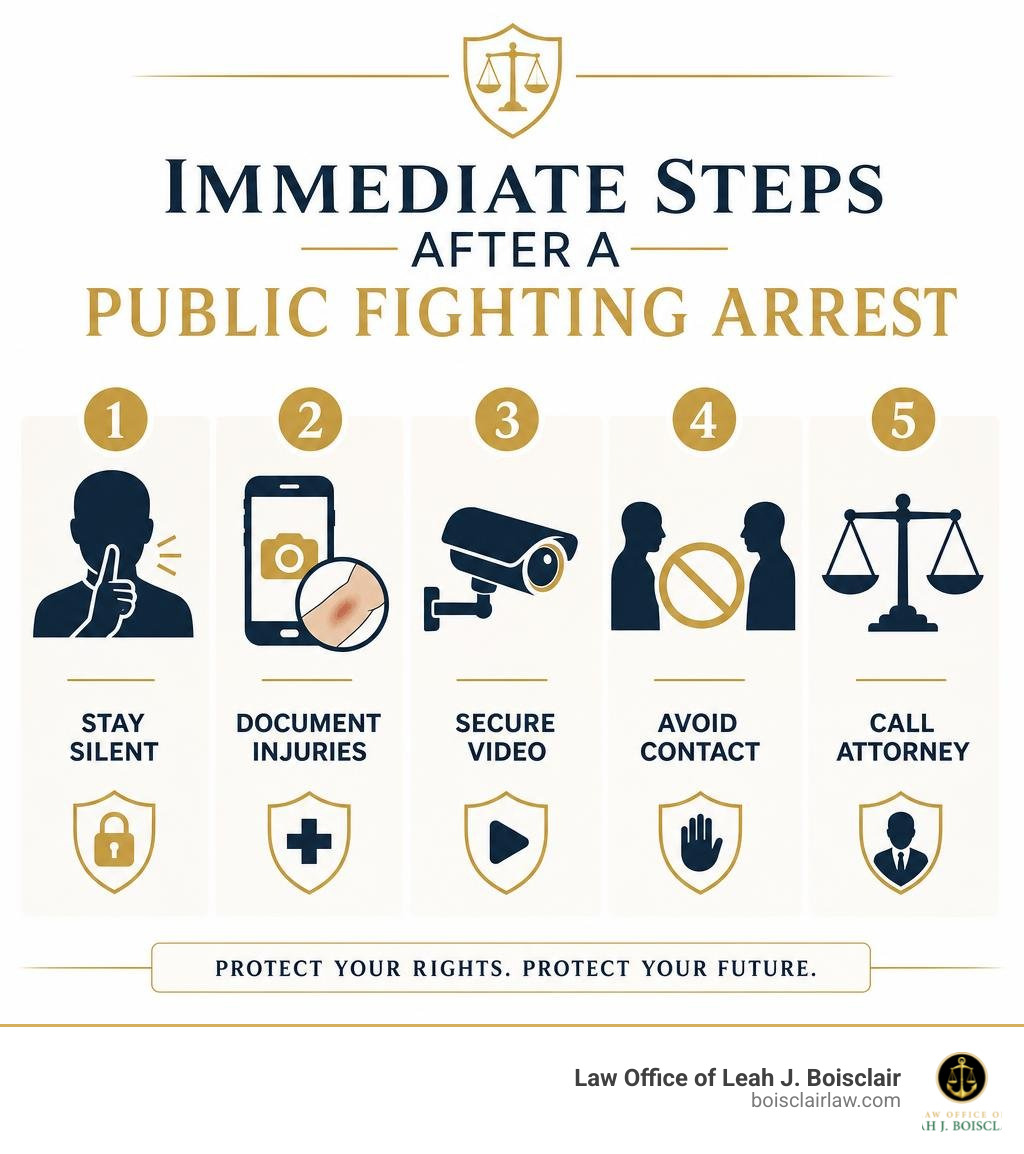
Here’s what to do right now:
- Stay silent – Do not speak to police or the other party without a lawyer present
- Document everything – Take photos of any injuries and note the names of witnesses
- Secure video evidence – Bars and venues often delete footage within days
- Avoid contacting the other person – Even friendly outreach can hurt your case
- Call a criminal defense attorney immediately – Early legal intervention protects your options
Public fighting charges go by different names depending on your state – affray, disorderly conduct, breach of peace, or disturbing the peace. But no matter what it’s called, a conviction can mean fines, jail time, and a criminal record that affects your job, housing, and professional licenses.
The stakes are real. And the legal system moves fast.
Many people assume a first-time public fighting charge is minor and easy to handle alone. It rarely is. Prosecutors have discretion to escalate charges to assault or battery depending on the circumstances. And without an attorney reviewing the evidence early, critical footage and witness accounts can disappear.
Fighting in public attorney word roundup:
Understanding Public Fighting Charges: Affray, Disorderly Conduct, and Assault
When a night out in Providence or Warwick takes an unexpected turn, the legal aftermath can be incredibly confusing. You might have left the house expecting a fun evening, only to find yourself handcuffed in the back of a police cruiser. To build a strong defense, we must first understand the specific legal definitions of the charges you are facing.
Defining Affray and Disorderly Conduct
Under Rhode Island law, public brawling is rarely charged under the archaic term “affray,” though the concept remains. Historically, an affray is a common-law offense defined as a mutual fight between two or more people in a public place that causes terror to the public. Today, prosecutors in Cranston, Johnston, and surrounding municipalities rely on modern statutory charges to address these situations.
The most common charge arising from a public altercation is Disorderly Conduct (R.I. Gen. Laws § 11-45-1). Under Rhode Island law, a person commits disorderly conduct if they intentionally, knowingly, or recklessly recruit themselves into behavior that breaches the public peace. This includes:
- Engaging in fighting, threatening, violent, or tumultuous behavior.
- Creating unreasonable, loud, or disturbing noise in a public space.
- Directing offensive or “fighting words” at another person in a public place, which are inherently likely to provoke an immediate violent reaction.
To learn more about how these scenarios play out in the real world, check out our guide on The Legal Lowdown on Public Brawling and Fighting.
It is important to understand that a physical altercation does not have to result in severe injuries for the state to file charges. In fact, a simple shove, an unwanted grab, or even a raised fist accompanied by a threat can lead to a charge of Simple Assault or Battery (R.I. Gen. Laws § 11-5-3).
While “assault” is technically the threat of imminent physical harm coupled with the apparent ability to carry it out, “battery” is the actual unlawful, unwanted physical contact. In many public fighting cases, police will charge an individual with both. If you are facing these specific allegations, you can read about our approach to defending these cases on our Assault Battery Charges Defense Attorney page.
Mutual Combat vs. Self-Defense in Public Fighting Charges
One of the biggest misconceptions about public fighting is the idea of “mutual combat.” Many defendants believe that if both parties agreed to step outside and settle their differences with their fists, neither can be charged with a crime.
This is a dangerous myth. In Rhode Island, consent is generally not a defense to a physical fight in a public space. Even if both parties willingly participated, the state can—and often will—charge both individuals with disorderly conduct or simple assault. The law views public brawling as a disturbance to the community, meaning you cannot “consent” to breaching the public peace.
However, prosecutors have significant discretion when deciding who to charge and what specific charges to file. When evaluating a case, they typically look at several factors:
- The Initial Aggressor: Who started the verbal confrontation, and who escalated it to physical violence?
- Proportional Force: If you hit someone, was it a reasonable and proportional response to a threat, or did you take things too far?
- The Imminent Threat: Did you have a reasonable fear of immediate bodily harm?
This is where the doctrine of self-defense becomes critical. To successfully argue self-defense in a Rhode Island court, we must demonstrate that:
- You did not provoke the physical altercation.
- You honestly and reasonably believed you were in imminent danger of bodily harm.
- You used only the amount of force necessary to protect yourself from that danger.
- You attempted to retreat if a safe avenue of retreat was available (as Rhode Island law generally imposes a duty to retreat in public spaces if it can be done safely).
If the evidence shows you were simply defending yourself against an unprovoked attack, we can present this proof to the prosecutor to push for a swift dismissal of your charges.
Penalties and Collateral Consequences of a Conviction
A public fighting charge is not something to take lightly. Even if it is classified as a misdemeanor, a conviction carries immediate criminal penalties and a lifetime of collateral consequences.
Criminal Penalties: Fines, Probation, and Jail Time
In Rhode Island, both disorderly conduct and simple assault are classified as misdemeanors. However, their statutory maximum penalties differ significantly.
| Charge Type | Maximum Jail Time | Maximum Fine | Typical Probation / Sentencing Elements |
|---|---|---|---|
| Disorderly Conduct | Up to 30 days | Up to $500 | Community service, anger management, restitution |
| Simple Assault / Battery | Up to 1 year | Up to $1,000 | Probation, No-Contact Order, batterer’s intervention programs |
For a first-time offender, a judge may be inclined to sentence you to probation or a “one-year filing” (a unique Rhode Island sentencing mechanism where the charge is put on hold for a year and dismissed if you stay out of trouble). However, if you are a repeat offender, or if the fight resulted in serious bodily injury, the court is much more likely to impose active jail time.
Furthermore, if the fight involved a family member, household member, or someone with whom you have a substantive dating relationship, the state will attach a Domestic Violence enhancement to the charge. This triggers mandatory domestic violence sentencing guidelines, including a weekly intervention program lasting up to a year, a mandatory No-Contact Order, and the loss of your firearm rights.
Long-Term Collateral Consequences of Public Fighting Charges
The true cost of a conviction often lies far beyond the courtroom walls. Long after you pay your fines or complete your probation, a criminal record can disrupt your life in several ways:
- Employment Background Checks: Most employers run background checks on job applicants. A conviction for a violent charge or a public order disturbance can make you look like a liability, preventing you from securing employment.
- Housing Applications: Landlords frequently reject applicants with recent criminal records, especially those involving physical violence or disorderly behavior.
- Professional Licensing: If you are a nurse, teacher, real estate agent, or contractor, a misdemeanor conviction must be reported to your licensing board, which can result in the suspension or revocation of your license.
- Immigration Status: For non-citizens, even a misdemeanor assault charge can be classified as a crime involving moral turpitude or have negative implications for visa renewals, green card applications, or naturalization.
- Security Clearances: Active-duty military personnel or government contractors in the East Greenwich or North Providence areas may face immediate revocation of their security clearances following an arrest.
Public Defenders vs. Hiring a Private Fighting in Public Attorney
If you cannot afford a private attorney, the court will assess your eligibility for a public defender under your Sixth Amendment rights. While public defenders are dedicated, licensed attorneys who fight hard for their clients, the systemic limitations of the public defense system can impact the level of personalized attention your case receives.
The Reality of Public Defender Caseloads
According to national studies, public defender offices in 27% of counties and 21% of states lack sufficient attorneys to handle their caseloads, leading to significant delays and inadequate representation in misdemeanor cases. To put this in perspective, in municipal jurisdictions like New Orleans, public defenders have been forced to handle upward of 19,000 misdemeanor cases per year. This equates to roughly seven minutes of dedicated time per client.
While the Rhode Island Public Defender office is highly respected, they still face heavy caseloads that can limit their ability to conduct immediate, exhaustive investigations. Systemic delays can also result in extended pretrial detention for defendants who cannot afford bail, which costs the U.S. an estimated $13.6 billion annually.
Furthermore, historical data shows that inadequate indigent defense resources can lead to tragic errors. For example, from 1991 to 2016, Texas paid out over $93 million to wrongfully convicted individuals, highlighting the systemic risks of underfunded legal defense. Although 66% of U.S. voters support using tax dollars to fund indigent defense, the reality in 2026 remains that public defender offices are stretched thin.
Vertical vs. Horizontal Representation in Public Defense
Another major operational difference between a public defender office and a private fighting in public attorney is the structure of representation:
- Horizontal Representation: In this system, different attorneys handle different stages of your case. One public defender might handle your arraignment, another will handle your pretrial conference, and a third might represent you if the case goes to trial. This can lead to critical details falling through the cracks, as you must repeatedly explain your case to new lawyers who only have a few minutes to read your file.
- Vertical Representation: This is the standard practice of the Law Office of Leah J. Boisclair. From the moment you retain our firm, the same attorney handles every single aspect of your case—from the initial bail hearing and evidence gathering to plea negotiations and trial. This ensures complete continuity, deep familiarity with the evidence, and a highly personalized defense strategy.
How a Fighting in Public Attorney Builds Your Defense
When we take on your case, we do not simply wait for the prosecution to hand over their files. We launch an immediate, independent investigation to uncover the truth of what happened during the altercation.

Key Evidence Used by a Fighting in Public Attorney
The outcome of a public fighting case often hinges on small, objective details that contradict the police report. We aggressively gather and analyze several types of evidence:
- Surveillance Footage: We contact local businesses, bars, and municipal departments in Cranston, Providence, or Pawtucket to secure security camera footage before it is overwritten.
- Police Body-Worn Camera (BWC) Footage: We obtain and meticulously review the arresting officers’ body-cam videos to see how they behaved at the scene and whether they properly interviewed all parties.
- Social Media and Bystander Video: In 2026, almost every public altercation is recorded by bystanders on smartphones. We search social media platforms and interview witnesses to find these videos, which often show who initiated the fight.
- Witness Statements: We track down independent witnesses who do not have a personal stake in the dispute to get their unbiased accounts of the event.
For a lighthearted yet practical look at how these dynamics play out on the streets of Rhode Island, take a look at Cranston’s Guide to Not Getting Hit in a Street Fight.
Negotiating Reductions and Infraction-Level Resolutions
An experienced defense attorney knows that taking a case to trial is not always the best or only option. Often, the most effective strategy is to negotiate a favorable resolution with the prosecutor behind the scenes.
Depending on the facts of your case, we may pursue:
- A Dismissal or “Filing”: If the evidence against you is weak, or if we can prove you acted in self-defense, we will push for an outright dismissal.
- Diversion Programs: For first-time offenders, we can often negotiate entry into a diversion program. Upon successful completion of community service or anger management classes, the state will dismiss the charges entirely.
- Reduction to an Infraction: In some cases, we can negotiate a misdemeanor charge down to a non-criminal civil infraction (similar to a traffic ticket), protecting your clean criminal record.
- Expungement: If your case is dismissed or successfully resolved, we will immediately guide you through the expungement process to erase the arrest record from public view.
Frequently Asked Questions About Public Fighting Charges
Navigating a criminal charge can leave you with many urgent questions. Below are some of the most common questions we hear from clients in our Cranston office.
What should I do immediately after being cited for fighting in public?
If you have been cited or released on bail, your immediate priority should be protecting your rights. First, exercise your right to remain silent. Do not post about the incident on social media, and do not discuss it with friends, as these statements can be subpoenaed by the prosecution.
Second, take high-resolution photographs of any physical injuries you sustained, including bruises, cuts, or torn clothing, as these serve as vital evidence of self-defense. Third, write down a detailed timeline of the event while your memory is still fresh. Finally, contact a dedicated defense attorney to begin preserving evidence.
Can I be charged with a crime if the other person started the fight?
Yes. Police officers arriving at the scene of a chaotic bar fight or street altercation rarely have the time or information needed to determine who is at fault. To clear the area and restore order, they will often arrest and charge everyone involved.
Even if the other person threw the first punch, you can still face charges if the police believe you escalated the violence or failed to retreat when it was safe to do so. Our job is to use video evidence and witness statements to prove to the court that you were the victim, not the aggressor.
How do I find a qualified fighting in public attorney fast?
When searching for legal representation, you need an attorney with deep roots and experience in the local court system where your case will be heard. Look for a firm that specializes in criminal defense and has a proven track record of securing dismissals for public order offenses.
Be sure to read client reviews on independent directories like the Justia East Providence Directory to see how the attorney handles real-world cases. Most importantly, choose a lawyer who offers an immediate, confidential consultation so you can get answers to your questions without delay.
Conclusion
A public fighting charge can turn your life upside down in an instant, but it does not have to define your future. At the Law Office of Leah J. Boisclair, we provide expert, personalized, and compassionate criminal defense representation for individuals facing misdemeanor and felony charges throughout Rhode Island.
From our office in Cranston, RI, we represent clients in state and federal courts across Providence, Warwick, Johnston, and surrounding communities. Whether you are dealing with DUI and Traffic Offenses, Firearm Offenses, or public order allegations, our firm is committed to fighting for the proven dismissals our clients deserve.
Do not leave your future to chance or an overwhelmed legal system. If you or a loved one is facing a public fighting charge, contact a skilled Public Order Offense Defense Attorney at the Law Office of Leah J. Boisclair today to schedule your confidential consultation and take control of your case.