
When You Need a Domestic Abuse Divorce Lawyer: What to Know First
If you are looking for a domestic abuse divorce lawyer, here is what you need to know right away:
Quick Answer: What a Domestic Abuse Divorce Lawyer Does
- Secures protective orders to keep you safe from your abuser during and after divorce
- Handles all court filings so you don’t have to face your abuser alone in the process
- Protects your custody rights and works to ensure your children are safe
- Fights for fair financial outcomes including alimony and property division
- Guides you through safe divorce filing to reduce risk of retaliation
Leaving an abusive relationship is one of the hardest things a person can do. Adding divorce paperwork, court dates, and legal strategy on top of that? It can feel impossible.
The numbers reflect just how common this situation is. Domestic violence is a factor in roughly half of all divorces in the United States. One in four women and one in seven men experience severe physical violence from an intimate partner in their lifetime.
Yet many survivors try to navigate the legal system alone — without knowing their rights, without protection in place, and without a plan.
That is a dangerous gap.
A domestic abuse divorce lawyer does more than file paperwork. They help you stay safe, protect your children, and make sure the abuse is taken seriously by the court — in custody decisions, in financial rulings, and in every step of the process.
This guide will walk you through everything you need to know: your legal options, how courts handle abuse in divorce cases, and how to take the first steps safely.
Easy domestic abuse divorce lawyer glossary:
- divorce attorneys specializing in emotional abuse
- domestic abuse defense lawyer
- domestic violence lawyer texas
Understanding Domestic Violence and State Law Definitions
To protect yourself legally, it helps to understand how the law defines domestic abuse. Many survivors hesitate to seek help because they believe the law only protects against physical violence. In reality, modern domestic violence statutes recognize that abuse comes in many forms.
Under California law (such as the Domestic Violence Prevention Act) and Florida law (Florida Statutes Section 741.28), domestic violence is defined broadly. It includes physical abuse, emotional abuse, financial abuse, and coercive control.
- Physical Abuse: Any physical force, including hitting, pushing, restraining, or throwing objects. Only about 34% of people injured by intimate partners receive medical care, but physical proof is not the only way to establish abuse.
- Emotional and Psychological Abuse: Threats, harassment, stalking, or destroying personal property. To learn more about navigating these complex dynamics, read A Legal Guide to Divorcing an Emotionally Abusive Partner.
- Financial Abuse: Controlling all family assets, withholding money, preventing a spouse from working, or ruining their credit score to keep them dependent.
- Coercive Control: A pattern of behavior used to dominate a partner through isolation, intimidation, and regulation of their daily life.
In places like Cranston, RI, and the broader Rhode Island area, courts look closely at these patterns of behavior. Whether you are dealing with physical violence or a spouse who uses severe emotional manipulation, the legal system has mechanisms to protect you.
At the same time, courts must evaluate the evidence carefully to address false allegations. Contentious divorces can sometimes lead to false claims of abuse as a tactic to gain custody. An experienced attorney knows how to present clear, objective evidence to show the court exactly what has occurred, ensuring the truth is brought to light.
How a Domestic Abuse Divorce Lawyer Secures Protective Orders
When you decide to file for divorce, safety must be your absolute first priority. One of the most critical steps a domestic abuse divorce lawyer will take is helping you secure a protective order (commonly known as a restraining order).
These legal orders can require your abuser to move out of your home, stay away from your workplace, surrender their firearms, and avoid all contact with you and your children.
If you are looking for local representation, you can find qualified professionals through resources like Best Domestic Violence Lawyers in Rhode Island – Justia or consult with a dedicated legal advocate in your area.
Understanding the differences between the types of restraining orders is essential for planning your next steps:
Restraining Order Comparison
| Type of Order | How It Is Obtained | How Long It Lasts | What It Can Do |
|---|---|---|---|
| Emergency Protective Order (EPO) | Issued by law enforcement 24/7 in immediate danger situations. | Typically 5 to 7 days. | Provides immediate safety while you prepare to file for a temporary order in court. |
| Temporary Restraining Order (TRO) | Filed at the courthouse; granted based on your written affidavit without the abuser present. | 15 to 21 days (until the formal hearing). | Orders the abuser to stay away, grants temporary custody, and can award temporary use of the home. |
| Permanent Restraining Order | Issued by a judge after a formal court hearing where both parties present evidence. | 1 to 5 years (can be renewed). | Provides long-term protection, establishes custody terms, and enforces strict criminal penalties for violations. |
Working with a professional is vital during this process. For tips on finding the right fit, see our guide on How to Choose the Best Domestic Abuse Lawyer for Your Case.

The Impact of Abuse on Child Custody and Financial Decisions
When domestic abuse is present, a divorce is no longer a standard negotiation. It becomes a matter of physical and financial survival. The history of abuse will heavily influence how the court handles child custody, spousal support, and property division.
If your spouse has been arrested or charged with domestic offenses, the family court will take these criminal matters into account. To understand the intersection of criminal defense and family safety, read Why You Need a Criminal Defense Attorney for Domestic Violence Right Now.
How a Domestic Abuse Divorce Lawyer Protects Child Custody Rights
In any divorce involving children, the court’s primary directive is to protect the best interests of the child. When there is a history of domestic violence, the legal landscape changes significantly:
- Rebuttable Presumption: In many jurisdictions, there is a legal presumption that awarding custody to a parent with a history of domestic abuse is detrimental to the child.
- Supervised Visitation: If the court grants visitation to the abusive parent, your lawyer can fight to ensure it is supervised by a professional or a trusted third party in a secure location.
- Parental Duties: The court will evaluate whether the abusive partner is capable of cooperative parenting. In most abuse cases, joint legal custody is completely inappropriate because it allows the abuser to continue controlling the victim.
For a deeper look at how Rhode Island courts handle these sensitive issues, it is critical to consult with an attorney who understands the local family court system. If you live in Warwick, you can also explore resources like Best Divorce Lawyers in Warwick, RI.
How a Domestic Abuse Divorce Lawyer Influences Alimony and Property Division
Financial abuse is a highly effective way to keep a survivor trapped. Many abusers will deliberately drain bank accounts, hide assets, or refuse to pay bills during a divorce to force a settlement.
Your attorney will work to expose this economic abuse and secure the financial relief you deserve:
- Exclusive Use of the Home: Your lawyer can request that you be granted exclusive possession of the marital home, forcing the abuser to find other living arrangements while continuing to pay the mortgage.
- Alimony (Spousal Support): Courts can take domestic violence into account when calculating alimony. If the abuse prevented you from working or caused physical or psychological trauma, the court may award higher support payments to cover therapy and living expenses.
- Unequal Asset Division: While many states aim for an equitable division of property, a history of financial waste, destruction of property, or severe abuse can lead judges to award a larger share of the marital assets to the survivor.
To locate family law professionals in your specific neighborhood, you can search directories such as:
- Johnston Divorce Attorneys | LII Rhode Island Attorney Directory
- Best Family Lawyers in North Providence, RI – Justia
- Best Divorce Lawyers in East Providence, RI – Justia
- Best Family Lawyers in West Warwick, RI – Justia
Practical Steps to Document Abuse and Safely Prepare for Divorce
If you are planning to leave an abusive marriage, preparation must be done with extreme care. The period immediately surrounding a divorce filing is often the most dangerous time for a survivor.
Taking steps to protect yourself and build your case without alerting your spouse is crucial. For detailed advice on why professional guidance is essential during this time, review Don’t Go It Alone When Facing a Domestic Violence Case.
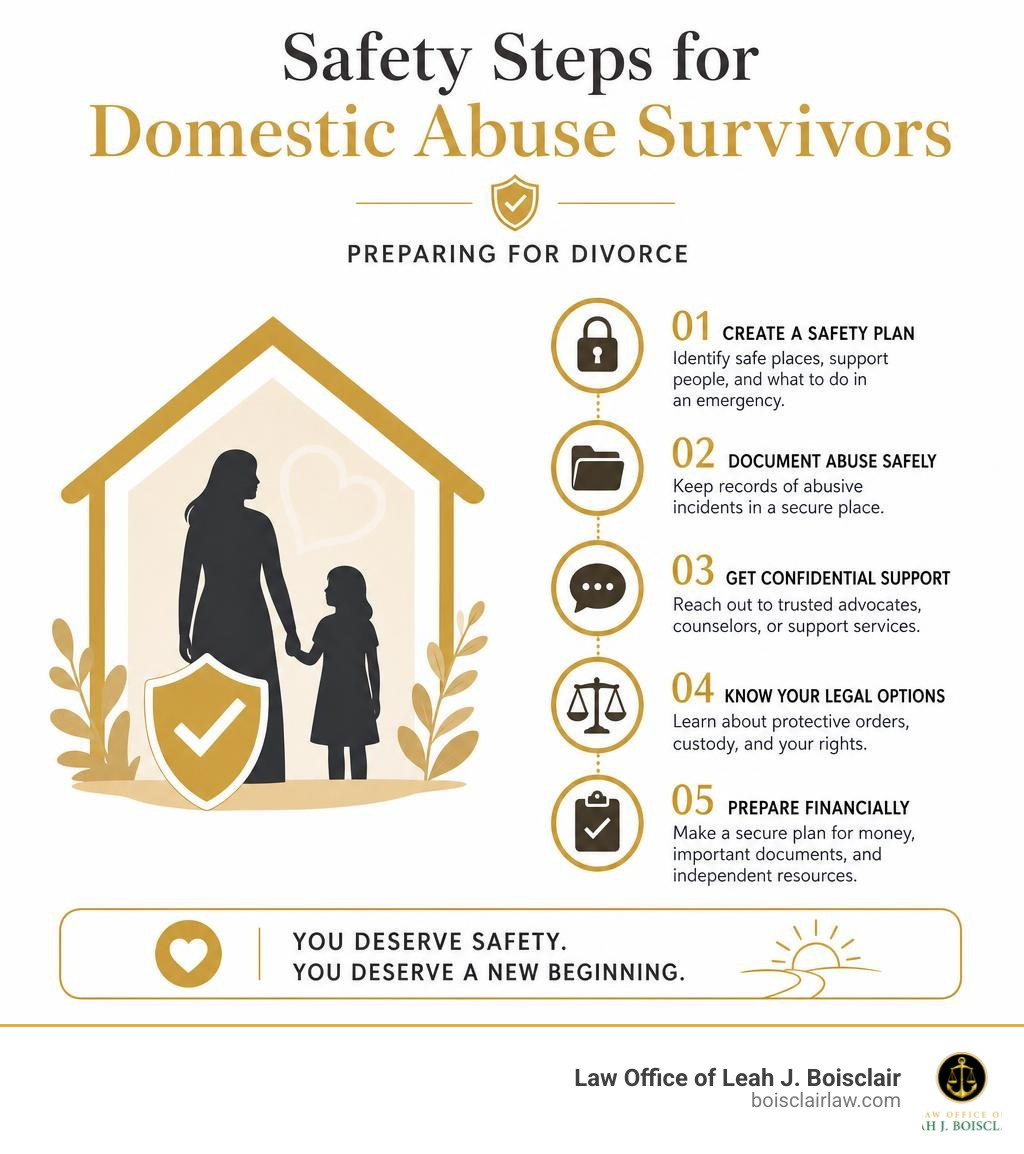
Here are the practical steps you should take:
- Document Everything Safely: Keep a detailed, hidden log of all incidents of physical, verbal, or financial abuse. Note dates, times, what was said, and any witnesses.
- Preserve Digital Evidence: Save screenshots of abusive text messages, emails, and call logs. Store these in a secure cloud folder or send them to a trusted friend. Do not keep them on a shared family device.
- Secure Your Communications: Create a new, private email address that your spouse does not know exists. Use this address to communicate with your attorney and support services.
- Gather Financial Records: If safe to do so, make copies of tax returns, bank statements, property deeds, and pay stubs. Having these documents ready will prevent your spouse from hiding assets later.
- Create a Safety Plan: Identify a safe place to go in an emergency, pack a “go-bag” with essential documents (birth certificates, passports, medications), and keep a secure backup of cash.

Frequently Asked Questions About Domestic Abuse and Divorce
Can I file for divorce without my abusive spouse knowing immediately?
Yes. You can prepare and file all of your initial divorce paperwork with the court without your spouse’s knowledge. However, the law requires that they be formally served with the divorce papers to move the case forward.
To protect your safety, your domestic abuse divorce lawyer can coordinate with professional process servers or local law enforcement to serve the papers at a time and place where you are not present, such as their workplace. Your attorney can also ensure a temporary restraining order is active before the papers are served, offering you immediate legal protection the moment they find out.
What happens if my spouse violates a protective order during the divorce?
Violating a protective order is a serious criminal offense. If your spouse contacts you, approaches your home, or violates any terms of the order:
- Call 911 immediately. Do not try to reason with them.
- Show the responding officers your copy of the protective order.
- Document the violation. Keep records of any call logs, texts, or physical appearances.
Law enforcement can arrest the abuser on the spot. These violations can lead to jail time, fines, and criminal charges. Additionally, a violation of a protective order will heavily damage their credibility in the family court, virtually guaranteeing stricter custody and visitation limitations.
Do I need physical evidence of abuse to get a restraining order?
No. You do not need physical injuries, police reports, or medical records to obtain a restraining order. While physical evidence is highly helpful, courts regularly grant protective orders based on sworn testimony and detailed written declarations.
Judges understand that emotional abuse, threats, stalking, and coercive control do not leave physical marks but still present a severe threat to your safety. Your testimony, supported by a pattern of behavior, is powerful evidence in court.
Conclusion
Navigating a divorce when domestic abuse is involved requires more than standard legal advice. It requires a dedicated strategy focused on safety, privacy, and aggressive advocacy.
At the Law Office of Leah J. Boisclair, we provide personalized, compassionate advocacy to guide you through these challenging moments. Based in Cranston, RI, we represent clients throughout Rhode Island — including Providence, Warwick, Johnston, North Providence, East Providence, and West Warwick.
Whether you need to secure a protective order, protect your children’s safety, or address complex domestic offenses, we are here to ensure you do not have to face this journey alone. To learn more about how we can help protect your rights, explore our resources on Domestic and Family Related Offenses.
Contact the Law Office of Leah J. Boisclair today to schedule a confidential consultation and take the first step toward a safer, independent future.