
A Criminal Record Doesn’t Have to Define Your Future in Rhode Island
If you’re looking for an expungement lawyer in RI, here’s what you need to know right away:
Quick Answer: Key Facts About Rhode Island Expungement (June 2026)
| Question | Answer |
|---|---|
| What is expungement? | A legal process that destroys or removes a criminal conviction from your record |
| Who qualifies? | First-time offenders and, under expanded laws, those with up to 5 misdemeanor offenses |
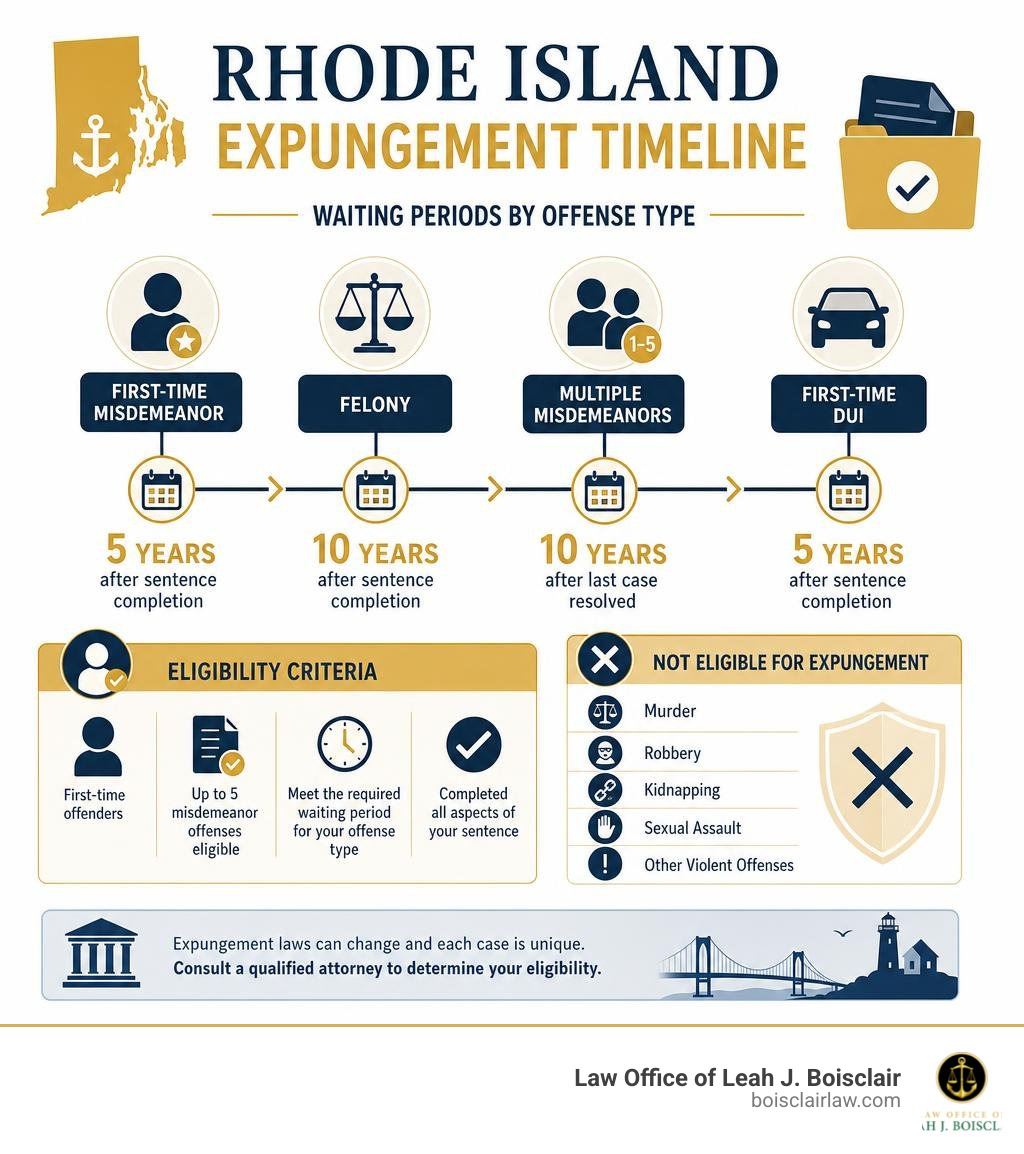
| Misdemeanor wait time | 5 years after sentence completion |
| Felony wait time | 10 years after sentence completion |
| Multiple misdemeanors wait time | 10 years after last case resolved |
| What offenses are excluded? | Murder, robbery, kidnapping, sexual assault, and other violent offenses |
| Can a DUI be expunged? | Yes, for first-time offenders after a 5-year waiting period |
One in three adults in the United States has a criminal record. That record doesn’t just sit in a filing cabinet — it shows up on background checks, job applications, housing forms, and loan requests. It follows you.
The good news? Rhode Island law gives many people a genuine second chance.
Expungement treats a conviction as if it never happened. Under Rhode Island’s recently expanded laws, even people with multiple misdemeanor offenses may now be eligible to clear their records — not just first-time offenders.
But the process isn’t simple. Eligibility rules are strict. Waiting periods vary. Certain offenses are permanently off the table. And one wrong step in the filing process can mean a denied petition and more years of waiting.
That’s why understanding what to look for before hiring an expungement lawyer matters — and why getting it right the first time is so important.
Here are 7 things you should know before moving forward.
Expungement lawyer ri word guide:
1. Expungement vs. Sealing: They Have Different Legal Meanings in Rhode Island
When people talk about clearing their criminal history, they often use the terms “expungement” and “sealing” interchangeably. However, under Rhode Island law, they are two distinct legal actions with different eligibility criteria, even though their final legal effects are very similar.
- Expungement is the process used when you have actually been convicted of an offense (or placed on probation) and want to have that record destroyed. Once expunged, the record of your conviction is physically and legally removed from public access.
- Sealing is the process used when your case was exonerated, dismissed, or you were found not guilty. If a law enforcement agency or prosecutor dismissed your offenses, or if a judge or jury acquitted you, your record can be sealed. This ensures the arrest doesn’t linger on your public record.
Both options restore your legal standing, allowing you to state under oath that you have never been arrested or convicted of that offense. However, the path to getting there depends entirely on how your case was resolved. For a deeper dive into how this works, read our guide on Wiping the Slate Clean in Rhode Island.
| Feature | Expungement | Sealing |
|---|---|---|
| Primary Target | Criminal convictions and probation | Dismissals, acquittals, and exonerations |
| Public Access | Completely blocked and records destroyed | Blocked from the public; records physically exist but are restricted |
| Waiting Period | 5 to 10 years depending on severity | Often immediate upon dismissal or acquittal |
| Violent Offense Restriction | Yes, strictly prohibited | Generally allowed since there was no conviction |
2. Eligibility Rules: First-Time Offenders vs. Multiple Misdemeanor Offenses
For a long time, Rhode Island only allowed first-time offenders to expunge a conviction. If you had more than one mistake on your record, you were out of luck.
Fortunately, the state expanded its expungement laws. Today, individuals with multiple misdemeanor offenses can seek relief, provided they meet specific criteria. Under this expanded framework, you may petition to expunge up to five misdemeanor convictions, as long as you do not have any felony convictions on your record and have maintained a clean record for a 10-year look-back period since your last sentence ended.
To understand where your record stands, check out our resource on Can You Actually Clear Your Criminal Record?.
Who Qualifies as a First-Time Offender for an Expungement Lawyer RI?
If you are applying as a first-time offender, the court looks at your entire life history. To qualify:
- You must have only a single conviction (misdemeanor or felony) on your record.
- You must have no other pending criminal offenses in any court.
- You must demonstrate to the judge that you have been successfully rehabilitated and exhibit good moral character.
An experienced expungement lawyer ri will help you gather the necessary evidence, such as character reference letters, employment history, and community involvement, to prove your rehabilitation to the court.
3. Certain Violent Offenses Are Permanently Ineligible
While Rhode Island is relatively progressive with its record-clearing laws, the state draws a hard line when it comes to public safety. If your conviction is classified as an “offense of violence,” it is permanently ineligible for expungement.
The law strictly prohibits the expungement of violent offenses, including:
- Murder and manslaughter
- First-degree arson
- Kidnapping with intent to extort
- Robbery and larceny from the person
- First- and second-degree sexual assault
- Assault with intent to commit a felony
- Burglary or entering a dwelling with intent to commit an offense
- Serious Firearm Offenses
Additionally, domestic violence offenses and DUI convictions have separate, stricter rules. If you have been convicted of a violent offense, an attorney can help you explore other avenues of post-conviction relief, but standard expungement will not be an option.
4. Waiting Periods Depend on the Severity of the Offenses
You cannot file for expungement the day after your case ends. Rhode Island enforces strict statutory waiting periods. Crucially, the clock does not start on the date of your arrest or conviction—it starts when your entire sentence has officially expired. This includes completing all probation, suspended sentences, and paying all court-ordered fines and restitution.
For example, if you received a one-year probation sentence for a misdemeanor, you must complete that year first, and then wait an additional five years before you are eligible to file. That is a total of six years from your court date.

Here is a breakdown of the standard waiting periods:
- Dismissals, Acquittals, and “Not Guilty” verdicts: Immediate eligibility for sealing.
- Juvenile Records: Generally a 3-year waiting period.
- First-Offense Misdemeanors: 5-year waiting period.
- Multiple Misdemeanors (up to 5): 10-year waiting period from the completion of your most recent sentence.
- First-Offense Felonies: 10-year waiting period (restricted to non-violent offenses).
5. How Deferred Sentences and DUI and Traffic Offenses Affect Your Case
In Rhode Island, a deferred sentence is a unique and highly beneficial arrangement. If you receive a deferred sentence, you agree to a period of probation (usually five years). If you successfully complete the terms of your probation without any new arrests, the offenses are formally dismissed.
Once dismissed, the record can be sealed. However, older cases can be tricky. If you had a deferred sentence from before July 1, 2010, changes in state law may require you to file for post-conviction relief to clear it.
Navigating DUI and Traffic Offenses with an Expungement Lawyer RI
Can you expunge a DUI in Rhode Island? Yes, but only under strict conditions.
If you were convicted of a first-offense misdemeanor DUI, you can petition for expungement after a five-year waiting period, provided you have no other criminal convictions on your record, completed all court requirements, and do not owe any outstanding fines or fees.
However, if you refused a chemical test during your arrest, or if you have multiple DUI offenses on your record, the process becomes significantly more complex. A second or third DUI is treated much more harshly, and felony DUIs require a ten-year wait. Working with an experienced expungement lawyer ri is essential to navigate these specific hurdles.
For more details on clearing these specific driving-related offenses, read about finding the best Providence and Cranston DUI expungement help or check out our guide on how to expunge DUI record.
6. The Step-by-Step Process of Filing a Motion to Expunge
Clearing your record is not as simple as filling out a single online form. It is a formal legal process that must be executed perfectly in the court where your case was originally resolved.

If you want to handle your expungement, you must follow these precise steps:
- Obtain Your BCI Record: Visit the Bureau of Criminal Identification (BCI) at the Rhode Island Attorney General’s Office to get an official copy of your criminal history record.
- Draft and File the Motion: Prepare a formal Motion to Expunge and a supporting sworn affidavit. File these documents in the clerk’s office of the District or Superior Court where your case was heard.
- Provide Notice: You must mail copy of your motion and affidavit to both the Attorney General’s Office and the local police department that arrested you at least 10 days before your scheduled hearing.
- Attend the Court Hearing: You must appear before a judge. You bear the burden of proving that you meet all statutory waiting periods, have no pending offenses, and have demonstrated good moral character.
- Distribute the Expungement Order: If the judge grants your motion, you must pay a $100 fee to obtain the certified Expungement Order. You must then mail copies of this order to the arresting police department, the BCI, and the probation department to ensure they purge their files.
To make sure you do not miss a step, review our comprehensive checklist: Wipe Your Record Clean With These Expungement Steps.
7. Why You Need an Experienced Expungement Lawyer RI
It is technically possible to file for an expungement on your own, but even minor procedural mistakes can lead to a judge denying your motion. If your petition is denied, you may have to wait years before you can try again.
An experienced expungement lawyer ri provides several critical advantages:
- Accurate Eligibility Assessment: We evaluate your BCI record to determine if you meet the strict criteria for first-time or multiple misdemeanor expungements.
- Flawless Court Document Preparation: We handle the drafting, filing, and legally mandated notifications, ensuring no technical errors delay your case.
- Persuasive Courtroom Advocacy: We stand beside you in court, presenting the strongest possible argument to the judge to prove your rehabilitation and good moral character.
- Post-Expungement Verification: We help verify that background check companies and government databases actually update their files so your past doesn’t keep showing up.
At the Law Office of Leah J. Boisclair, we provide personalized, compassionate advocacy to help you close the door on the past. To explore how we can help you clean your slate, visit our Rhode Island Expungement Attorney – Law Office of Leah J. Boisclair page to learn more about your legal rights.
Frequently Asked Questions About Rhode Island Expungements
What happens if information from an expunged record remains accessible?
Even after a judge signs an expungement order, private background check databases may still display your old record because they do not update their records in real-time. If this happens, you or your attorney must send a written notification along with a certified copy of your court order to the background check company, demanding they remove the outdated information immediately.
How does a deferred sentence affect eligibility for expungement in Rhode Island?
A successfully completed deferred sentence results in a dismissed case, making it eligible for sealing. However, if there were any probation violations, or if the case occurred before 2010, you may need to pursue post-conviction relief: your second chance in the Rhode Island justice system to clear your name.
Can a felony offense be expunged in Rhode Island?
Yes, but only if it is a non-violent felony and you are a first-time offender. You must wait a full ten years after completing all terms of your sentence (including probation and payment of all court costs) before you can file a petition.
Conclusion
A past mistake should not prevent you from securing a stable job, finding a safe place to live, or volunteering in your community. Rhode Island’s expungement laws are designed to give deserving individuals a fresh start, but navigating the court system requires precision and care.
At the Law Office of Leah J. Boisclair, we provide personalized, compassionate legal services from our office in Cranston, RI, serving clients in Providence, Warwick, Johnston, and throughout the state. We know how much is at stake, and we are committed to helping you restore your opportunities.
Don’t let your past hold you back any longer. Schedule a consultation with our legal team today, and let us help you wipe the slate clean.