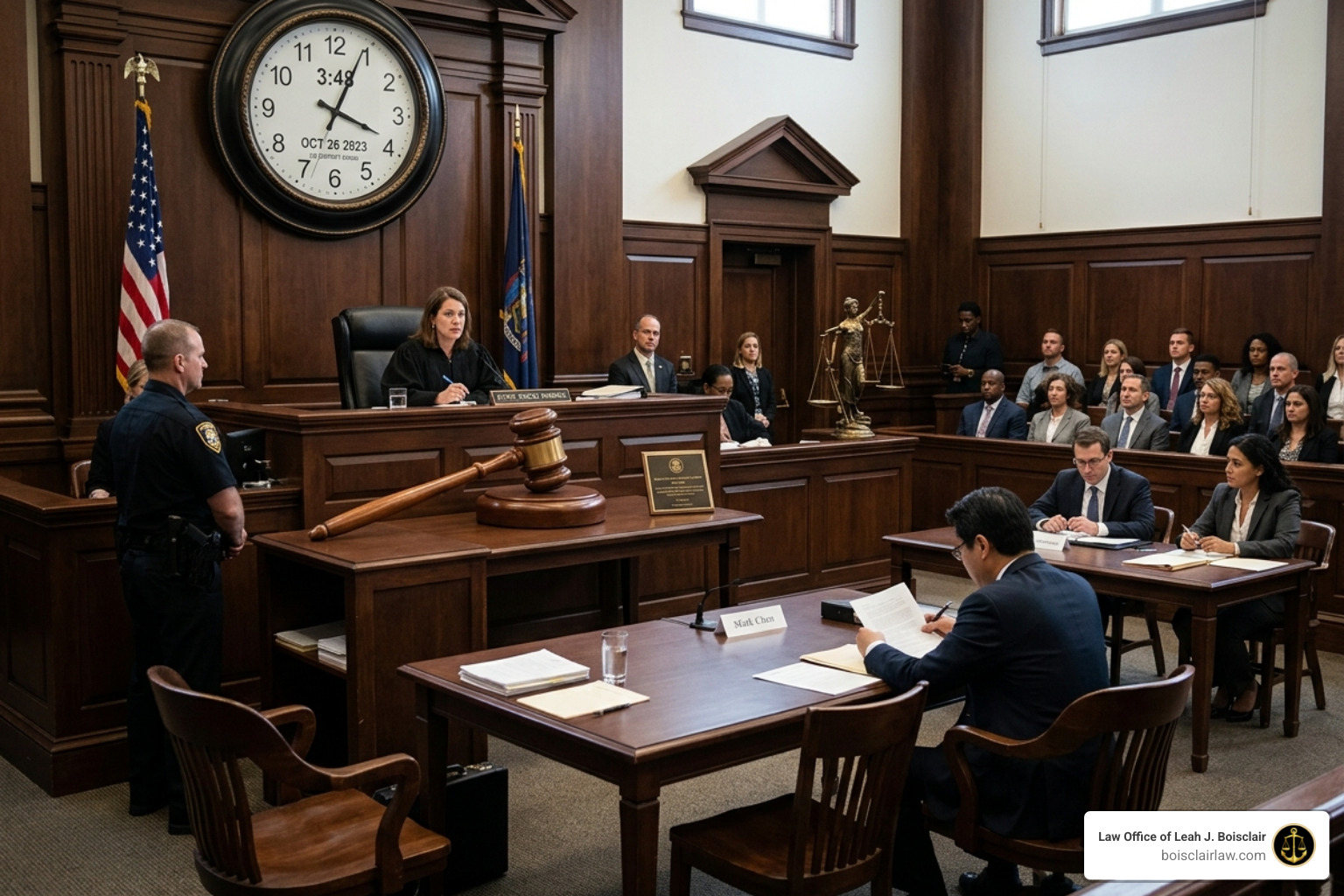

What is the Constitutional Basis for the Right to a Speedy Trial?
At the heart of the right to a speedy trial lies the Sixth Amendment to the U.S. Constitution, which declares that “In all criminal prosecutions, the accused shall enjoy the right to a speedy and public trial.” This isn’t just a suggestion; it’s a fundamental guarantee designed to protect individuals from the profound burdens of indefinite criminal charges.
The purpose of this right is multi-faceted:
- Preventing oppressive pretrial incarceration: Prolonged detention before trial can be a severe punishment in itself, regardless of guilt or innocence.
- Minimizing anxiety and public obloquy: Facing criminal charges brings immense stress, uncertainty, and potential damage to one’s reputation. A speedy trial aims to reduce this period of distress.
- Limiting the impairment of the defense: Over time, evidence can be lost, witnesses may become unavailable or forget details, and the ability to mount an effective defense can diminish significantly.
While the Sixth Amendment directly applies to federal cases, its protections were extended to state proceedings through the Fourteenth Amendment’s Due Process Clause in the landmark case of Klopfer v. North Carolina. This means that whether you are facing charges in federal court or in a state court like those in Rhode Island, your constitutional right to a speedy trial is protected.
It’s crucial to understand the distinction between constitutional speedy trial rights and statutory speedy trial rights. The Sixth Amendment provides a constitutional baseline, a flexible standard that courts evaluate on a case-by-case basis. In contrast, many federal and state laws, such as the Federal Speedy Trial Act of 1974, establish more specific, numerical deadlines. These statutory rights often provide stronger, more easily enforceable protections than the broader constitutional right.
Generally, the speedy trial clock starts running upon your arrest or when formal charges are filed against you, whichever comes first. Delays that occur before an arrest or the filing of formal charges, known as pre-accusation delays, are typically governed by statutes of limitations or Fifth Amendment due process considerations, rather than the Sixth Amendment’s speedy trial guarantee.
How Does the Sixth Amendment Define “Speedy”?
One of the most important aspects of the constitutional right to a speedy trial is its inherent flexibility. The Sixth Amendment does not define “speedy” with a specific number of days or months. Instead, it’s considered a “vague concept” that requires a functional balancing test rather than rigid numerical limits.
This flexibility means that courts must consider the unique circumstances of each case when determining if a delay has violated a defendant’s constitutional rights. There isn’t a one-size-fits-all answer; what might be considered a reasonable delay in one complex case could be an unconstitutional delay in a simpler one. This ad hoc approach allows judges to weigh various factors to ensure justice is served while accounting for the practical realities of the legal system.
Overview of the Right to a Speedy Trial | U.S. Constitution Annotated | US Law | LII / Legal Information Institute Your Sixth Amendment Right to a Speedy Trial
How Do Courts Determine if a Speedy Trial Right Has Been Violated?
When a defendant alleges that their constitutional right to a speedy trial has been violated, courts turn to a four-factor balancing test established by the U.S. Supreme Court in the landmark case of Barker v. Wingo (1972). This test requires courts to consider:
Length of Delay: This factor acts as a “triggering mechanism.” Until there is a delay that is “presumptively prejudicial,” courts will not even inquire into the other factors. What constitutes a presumptively prejudicial delay varies, but it’s often considered to be around one year for constitutional purposes. However, even significant delays don’t automatically mean a violation. For instance, in Barker v. Wingo itself, a five-year wait for trial was ultimately determined not to violate the Constitution, largely because the defendant did not assert his right and showed no prejudice. In contrast, an eight-and-a-half-year delay in Doggett v. United States (1992) did violate the Sixth Amendment, primarily due to government negligence.
Reason for Delay: The court will scrutinize why the trial was delayed. Different reasons carry different weights:
- Deliberate delay by the prosecution to hamper the defense is heavily weighted against the government.
- Government negligence (e.g., losing case files, slow processing) weighs against the prosecution, though less heavily than deliberate delay.
- Valid reasons (e.g., a missing witness, a complex case requiring extensive preparation, or a good-faith continuance to secure evidence) may be excused and weigh less heavily against the government.
- Delays caused by the defense (e.g., requesting continuances, filing numerous pretrial motions) typically do not count against the prosecution.
Defendant’s Assertion of the Right: This factor is crucial. While a defendant doesn’t have an obligation to bring themselves to trial, promptly and persistently asserting your right to a speedy trial strengthens your claim significantly. Failing to assert the right can be interpreted as a waiver or an indication that the delay was not truly prejudicial.
Prejudice to the Defendant: This is often considered the most serious and critical factor. Courts assess how the delay has harmed the defendant’s ability to prepare their defense or has caused undue hardship. The Supreme Court identified three interests the speedy trial right is designed to protect in terms of prejudice:
- Preventing oppressive pretrial incarceration: The longer a defendant is held in jail awaiting trial, the more prejudicial the delay.
- Minimizing anxiety and concern of the accused: While general anxiety is expected, extreme or prolonged anxiety due to the pending charges can contribute to prejudice.
- Limiting the possibility that the defense will be impaired: This is the most critical form of prejudice. It includes the loss of evidence, the death or disappearance of witnesses, or the fading memories of those who do testify.
All four Barker v. Wingo factors are weighed together; no single factor is determinative. The court conducts a careful balancing act to decide if the constitutional right has been infringed.
Speedy Trial Clause Speedy Trial Rights in U.S. Criminal Cases | National Criminal Law Authority
What Role Does Prejudice Play in a Speedy Trial Claim?
Prejudice is indeed the most critical factor in a constitutional speedy trial claim because it directly addresses the harm caused to the defendant by the delay. It’s not enough to simply show that a trial was delayed; you must demonstrate how that delay genuinely harmed your ability to receive a fair trial or caused you significant hardship.
The focus here is on how the delay has impacted your defense. For example:
- Inability to locate witnesses: After a lengthy delay, key witnesses may have moved, become unreachable, or even passed away.
- Fading memories: Even if witnesses are available, their recollection of events can become less precise over time, which can significantly weaken a defense.
- Loss of physical evidence: Evidence crucial to your defense might be misplaced, deteriorated, or destroyed during an extended delay.
While the anxiety and stress of facing criminal charges are undeniable, general anxiety or concern from pending charges is usually insufficient on its own to prove prejudice. Courts typically require evidence of more concrete harm. For instance, in United States v. Guyton, a 9-month delay was not found to violate speedy trial rights because there was no sufficient showing of prejudice.
However, if you are subject to oppressive pretrial incarceration, this significantly increases the weight of the prejudice factor. Being held in jail for an extended period before trial is a severe deprivation of liberty and is given serious consideration by the courts when assessing prejudice. This is why defendants who are incarcerated often have stricter statutory speedy trial deadlines.
What are the Specific Timelines and Laws Governing Speedy Trials?
While the Sixth Amendment provides a flexible constitutional right, specific laws, both federal and state, establish more concrete timelines for bringing a case to trial. These statutory provisions often offer more immediate and measurable protections.

The Federal Speedy Trial Act of 1974
The Federal Speedy Trial Act (18 U.S.C. §§ 3161–3174) sets clear deadlines for federal criminal prosecutions. Under this Act:
- An indictment or information must be filed within 30 days of your arrest or the issuance of a summons.
- Your trial must commence within 70 days of the filing of the indictment or information, or from the date of your first appearance before a judicial officer, whichever date is later.
The Act also specifies a minimum of 30 days from your first court appearance before trial can begin, allowing adequate time for defense preparation, unless you agree otherwise.
However, not every day that passes counts toward these deadlines. The Act allows for various excludable delays, which pause the speedy trial clock. Common excludable delays include:
- Periods during which pretrial motions (e.g., motions to suppress evidence, motions to dismiss) are being filed, heard, and decided.
- Delays resulting from interlocutory appeals (appeals on specific issues before a final judgment).
- Periods when you or a key witness are unavailable.
- Delays caused by the need to join co-defendants for trial.
- “Ends of justice” continuances, granted by a judge when the court determines that the ends of justice served by granting the continuance outweigh the best interest of the public and the defendant in a speedy trial. Judges must typically state their reasons for these continuances on the record.
How Do State Speedy Trial Laws Differ from Federal Standards?
State speedy trial laws vary significantly across the country. While they all aim to uphold the spirit of the Sixth Amendment, they often provide more specific, numerical deadlines than the constitutional right itself. These deadlines can differ based on several factors:
- Severity of the Charges: Many states have different time limits for felonies versus misdemeanors.
- Custody Status: Whether you are in custody (incarcerated) or out on bail can significantly impact the statutory deadlines, with incarcerated defendants often having stricter timeframes.
Many states also employ “ready rules,” which require the prosecution to declare their readiness for trial within a certain period. For example:
- Louisiana’s CCRP 701: For felonies where the defendant is in custody, an indictment must be filed within 60 days of arrest. If a speedy trial motion is filed, the trial must commence within 120 days after that motion.
- New York’s “Ready for Trial” Rule: The prosecution must be ready for trial within six months for most felonies (excluding murder).
These examples from other states illustrate the diversity in state-level speedy trial laws. In Rhode Island, where our firm practices, specific statutes and court rules govern speedy trial timelines. These local rules are paramount for anyone facing charges in Cranston or elsewhere in the state. Understanding these precise local regulations is critical, as they can be more stringent than the federal constitutional standard.
How pretrial incarceration or release status affects speedy trial calculations is a significant consideration. Defendants who are held in jail awaiting trial often benefit from shorter statutory deadlines, reflecting the greater prejudice associated with their continued loss of liberty. Courts recognize the heightened impact of delay on those who are not free.
Speedy Trial Act Speedy Trial Rights Louisiana Code of Criminal Procedure Art. 701. Right to a speedy trial
What are the Consequences of a Speedy Trial Violation, and Can the Right Be Waived?
The consequences of violating a defendant’s speedy trial rights are severe, reflecting the fundamental importance of this protection in our justice system.
What Happens if a Speedy Trial Violation Occurs?
If a constitutional speedy trial violation is found under the Barker v. Wingo test, the remedy is unequivocal: the charges against the defendant must be dismissed with prejudice. This means the charges cannot be refiled, and the prosecution is permanently barred from pursuing the case. Courts cannot impose lesser remedies, emphasizing the gravity of denying an individual their Sixth Amendment right.
For statutory speedy trial violations (e.g., under the Federal Speedy Trial Act or Rhode Island’s specific rules), the consequences can vary. While dismissal is often a possible remedy, courts have more discretion to decide whether the dismissal should be “with prejudice” or “without prejudice.” If dismissed without prejudice, the prosecution may be able to refile the charges. When making this decision, courts consider factors such as:
- The seriousness of the offense.
- The facts and circumstances that led to the dismissal.
- The impact of reprosecution on the administration of justice.
In some cases, a statutory violation might lead to release from custody rather than outright dismissal of the charges, especially if the delay is still within constitutional bounds but exceeds a statutory limit for pretrial detention.
It’s also important to consider the broader context of the U.S. criminal justice system. Statistics show that approximately 97% of convictions are obtained by plea bargain. Furthermore, studies indicate that around 64% of defendants face extra punishment for refusing a plea deal. These figures highlight the immense pressure on defendants to resolve their cases quickly, sometimes leading to plea agreements even when a speedy trial violation might exist. This underscores the critical importance of understanding and asserting your speedy trial rights, as they can be a powerful tool in advocating for a just outcome.
Can a Defendant Waive Their Right to a Speedy Trial?
Generally, yes, a defendant can waive their constitutional right to a speedy trial. However, this waiver must be knowing, intelligent, and voluntary. This means you must fully understand the right you are giving up and the potential consequences of doing so.
Interestingly, the U.S. Supreme Court ruled in Zedner v. United States (2006) that a defendant cannot expressly waive their rights under the Federal Speedy Trial Act. The Court reasoned that the Act protects not only the defendant but also the public’s interest in prompt justice, and therefore, its specific timelines cannot be simply waived away by the defendant. However, delays caused by defense actions (like requesting continuances) can still be excluded from the Act’s calculation.
There are often strategic considerations for waiving the right to a speedy trial, especially for the constitutional right. For instance, you might choose to waive the right to allow your defense attorney more time to:
- Investigate the case thoroughly.
- Review complex evidence.
- Negotiate a more favorable plea agreement.
- Prepare for trial.
However, such a decision should never be made lightly. It requires careful consultation with experienced legal counsel who can assess the specific details of your case, the potential benefits of delay, and the risks involved.
Actionable steps for defendants to protect their speedy trial rights include:
- Promptly asserting the right: Clearly and formally notifying the court and prosecution that you demand a speedy trial.
- Objecting to continuances: If the prosecution requests a delay, your attorney can object, especially if it appears the delay is unwarranted or prejudicial.
- Filing a speedy trial motion: If you believe your rights have been violated, your attorney can file a formal motion with the court to seek dismissal of the charges.
Your Sixth Amendment Right to a Speedy Trial
How Do Speedy Trial Rights Apply in Specialized Legal Contexts?
The application of speedy trial rights can differ depending on the specific legal context, such as military or juvenile proceedings. While the core principles remain, the rules and standards may be adapted to fit the unique nature of these systems.
Military Proceedings
For military personnel, the Sixth Amendment’s speedy trial protections are triggered upon the preferral of charges or the imposition of pretrial restraint (like confinement or restriction). However, military law also includes its own specific provisions that often impose even stricter requirements.
Article 10 of the Uniform Code of Military Justice (UCMJ), for example, imposes a more exacting speedy trial standard than the Sixth Amendment alone. It states that “when any person subject to this chapter is placed in arrest or confinement prior to trial, immediate steps shall be taken to try him or to dismiss the charges and release him.” This reflects the military’s emphasis on discipline and the unique impact of prolonged detention on military readiness.
Cases like United States v. Danylo, where a 116-day delay after pretrial confinement was not deemed unreasonable due to investigative needs, illustrate the specific considerations within the military justice system. Factors like the need for immunity for co-accused witnesses, ongoing investigations, and hearings can justify delays that might otherwise raise concerns in a civilian context.
Juvenile Proceedings
Juvenile proceedings are often treated differently under speedy trial laws. For instance, they are typically excluded from the Federal Speedy Trial Act. However, this does not mean that juveniles lack speedy trial protections. Instead, due process considerations under the Fifth and Fourteenth Amendments ensure that juvenile proceedings are conducted in a timely manner. The unique goals of the juvenile justice system, which often prioritize rehabilitation, can influence the interpretation of what constitutes a “speedy” resolution, but undue delays are still prohibited.
Pre-Accusation and Post-Conviction Delays
It’s important to reiterate that the Sixth Amendment’s speedy trial right generally applies from the point of arrest or formal charge until conviction.
- Pre-accusation delays: Delays that occur before you are arrested or formally charged are typically not covered by the Sixth Amendment. Instead, these delays are usually scrutinized under statutes of limitations (which set deadlines for when charges can be brought) or the Fifth Amendment’s Due Process Clause, especially if the delay was extreme and prejudiced your ability to defend yourself.
- Post-conviction delays: Once you have been convicted, the Sixth Amendment right to a speedy trial generally detaches. However, if there are significant delays in sentencing or appellate processes, these might still raise concerns under the Due Process Clause of the Fifth or Fourteenth Amendment, ensuring that even after conviction, the state acts with reasonable promptness.
MISCELLANEOUS MATTERS: Speedy Trial: Sixth Amendment Right to a Speedy Trial
Conclusion
The right to a speedy trial is a cornerstone of American justice, designed to protect individuals from the profound burdens of indefinite criminal charges. It serves as a vital safeguard against oppressive incarceration, reduces the anxiety faced by those accused, and, most critically, preserves the ability of a defendant to present a robust defense.
Understanding the nuances of constitutional and statutory protections, the four-factor Barker v. Wingo test, and the specific timelines involved is critical for anyone navigating the criminal justice system. As we’ve seen, what constitutes a “speedy” trial is not always straightforward, relying on a careful balancing of various factors and often differing between federal and state jurisdictions, including here in Rhode Island.
Given the complexity of these laws and the severe consequences of delays – or the potential for dismissal if your rights are violated – asserting your rights effectively requires experienced legal counsel. If you or a loved one are facing criminal charges in Cranston, RI, or elsewhere in the state, and believe your right to a speedy trial may be at risk, seeking immediate legal guidance is paramount. The Law Office of Leah J. Boisclair provides personalized, compassionate advocacy for a range of criminal charges, including DUI and Traffic Offenses, Firearm Offenses, Assault and Battery, Domestic Offenses, Drug Offenses, and more, in both state and federal courts. We are here to help you understand your rights and fight for the best possible outcome.