

Why Hiring a Rhode Island Lawyer for Expungement Could Change Your Life
If you’re searching for a Rhode Island lawyer expungement specialist, here’s what you need to know right away:
Quick Answer: How to Clear Your Record in Rhode Island
- Misdemeanors: Eligible for expungement after a 5-year waiting period (first offenders)
- Felonies: Eligible after a 10-year waiting period (first offenders, non-violent only)
- Multiple misdemeanors (up to 5): Eligible after a 10-year lookback period with no felonies
- Deferred sentences: May be expunged upon successful completion (if completed after July 1, 2010)
- Violent crimes: Not eligible — ever
- Cost to file: $100 per case with the court
- Timeline: Most cases resolve in 30 to 90 days after filing
An old charge on your record can quietly wreck your future. It shows up when you apply for a job. It pops up on a rental application. It can block access to loans, professional licenses, and even volunteer opportunities.
Rhode Island law gives many people a real path to clearing that record — but the process has strict rules, waiting periods, and deadlines that are easy to get wrong.
Filing incorrectly or missing a step can delay your case or get your motion denied entirely.
That’s exactly why working with an experienced expungement attorney matters. The Law Office of Leah J. Boisclair helps people in Rhode Island understand their options and navigate the process from start to finish — so you don’t have to figure it out alone.
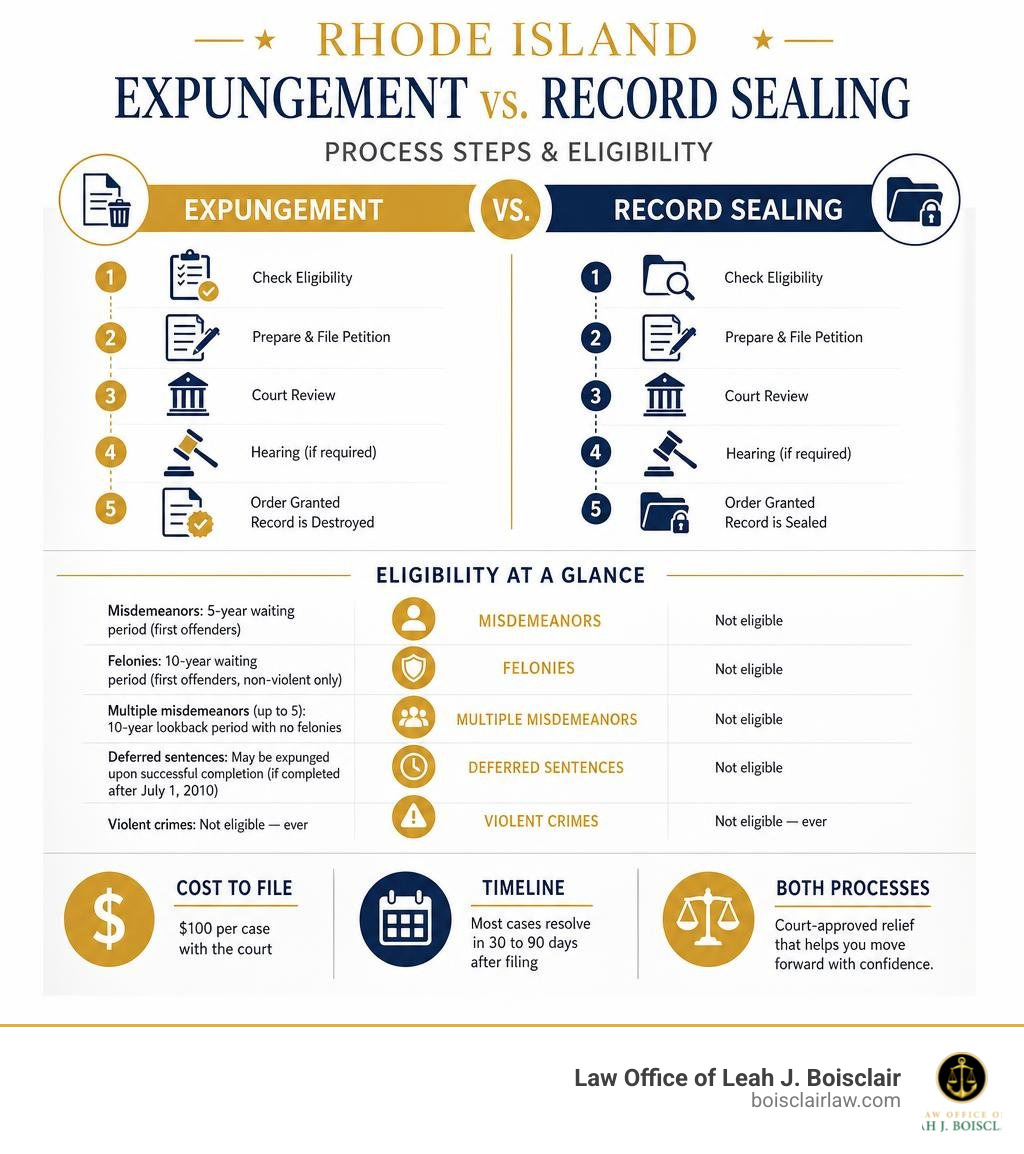
Rhode island lawyer expungement terms you need:
Expungement vs. Sealing Under Rhode Island Law
Many people use the terms “expungement” and “record sealing” interchangeably, but under Rhode Island law, they have distinct legal definitions and applications. Understanding the difference is crucial when you are trying to clean up your background check profile.
In Rhode Island, expungement is the process by which a record of a criminal conviction is entirely removed from the court record and destroyed. The law directs the court and other holding agencies to treat the conviction as if it had never occurred. Once your record is expunged, you can legally state on most job and housing applications that you have never been convicted of a crime.
Record sealing, on the other hand, typically applies to charges that did not result in a conviction—such as cases that were dismissed, resulted in a “not guilty” verdict, or where the prosecution decided not to proceed (known as a nolle prosequi or “no information” filing). Sealing limits public access to these records. While the general public, landlords, and standard employers cannot see a sealed record, certain government and law enforcement databases may still retain access to this information for specific background checks or future sentencing enhancements.
| Feature | Expungement | Record Sealing |
|---|---|---|
| Primary Target | Criminal convictions and guilty pleas | Dismissed charges, acquittals, and non-convictions |
| Record Status | Legally destroyed and removed from public view | Restricted from public view but remains in some government databases |
| Standard Waiting Period | 5 years (misdemeanors) or 10 years (felonies) | Immediate (for most dismissed charges) |
| Job Application Disclosure | Can legally answer “No” (with minor exceptions) | Can legally answer “No” |
No matter which path applies to your situation, the ultimate goal is to restrict public access so that old mistakes stop interfering with your life. For a deeper dive into how this legal distinction plays out in real life, check out our guide on Wiping the Slate Clean in Rhode Island.
Who is Eligible for Record Clearing in Rhode Island?
Determining your eligibility is the first major hurdle in the expungement process. Rhode Island is relatively forgiving compared to other states when it comes to non-violent offenses, but you must fit into specific statutory boxes to qualify.
Generally, record clearing is designed for:
- First Offenders: If you have only one conviction on your record, you are highly likely to qualify for expungement once you complete your sentence and wait the required period.
- Those with Multiple Misdemeanors: Thanks to expanded state laws, individuals with multiple misdemeanor convictions (fewer than six) and no felony convictions may now file for expungement after a 10-year lookback period from the completion of their last sentence.
- Decriminalized Offenses: If you were convicted of an offense that has since been decriminalized—such as certain marijuana possession charges—you may be eligible for a streamlined, no-cost expungement.
To find out where you stand, you can read our detailed breakdown on Can You Actually Clear Your Criminal Record?.
Misdemeanor and Felony Waiting Periods
You cannot simply walk into court the day after your probation ends and ask for an expungement. Rhode Island law enforces strict waiting periods that begin only after you have fully completed your sentence, including all probation, suspended sentences, and payment of court-ordered fines.
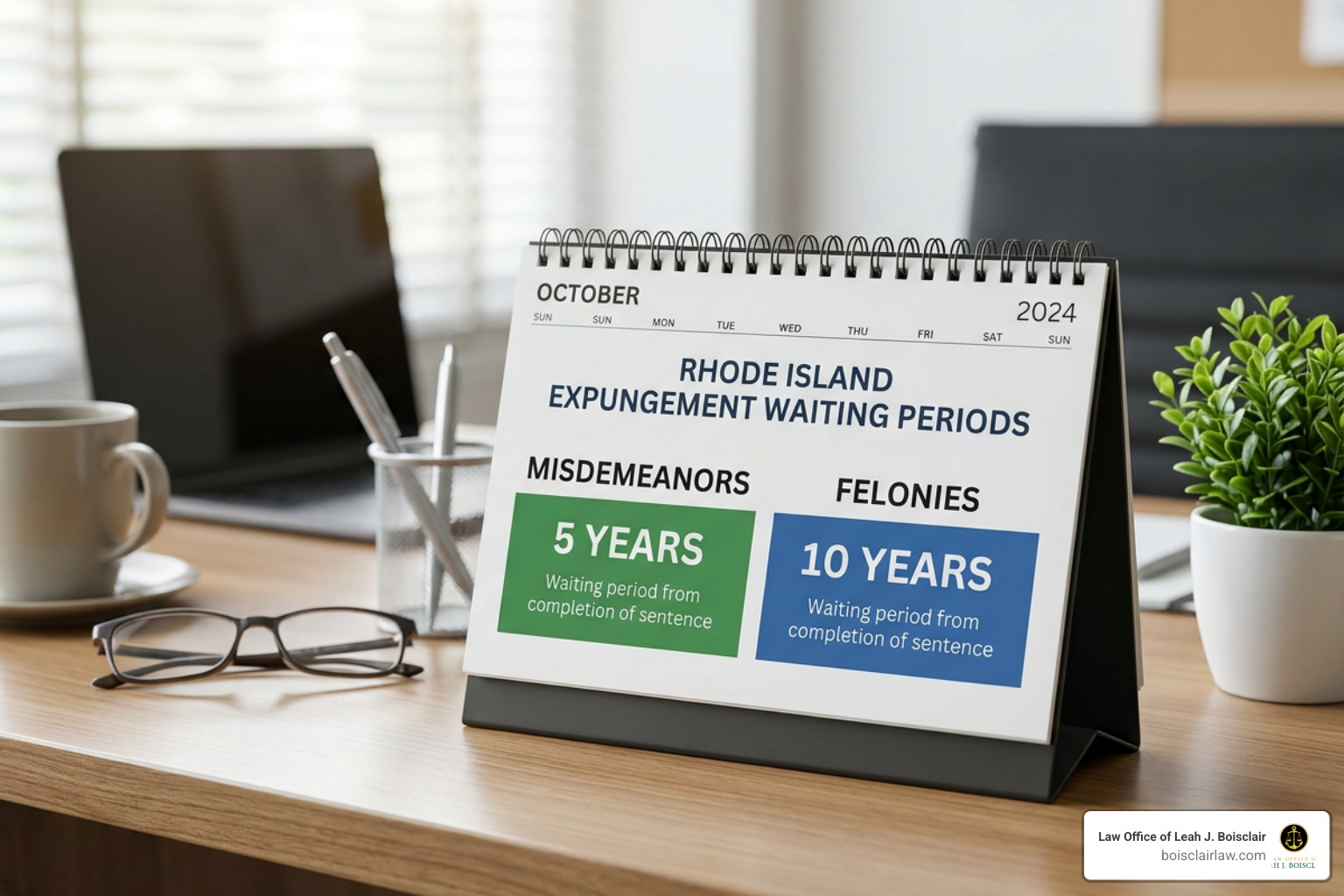
- Misdemeanor Convictions: Eligible first offenders must wait 5 years with a clean, arrest-free record before filing.
- Felony Convictions: Eligible first offenders of non-violent crimes must wait 10 years with a clean, arrest-free record before filing.
- Multiple Misdemeanors: If you have up to five misdemeanor convictions, you must wait 10 years from the date your last sentence was fully completed.
Ineligible Offenses and the Crime of Violence Bar
Not all charges can be wiped clean. Rhode Island law explicitly bars certain serious offenses from ever being expunged. Chief among these are crimes of violence, which are completely ineligible for expungement under any circumstances.
Ineligible violent offenses include:
- Murder and manslaughter
- First-degree arson
- Kidnapping
- Robbery
- Sexual assault
- Burglary
Additionally, specific restrictions apply to other categories:
- Assault and Battery: Simple assault charges may be expunged if they meet standard misdemeanor criteria, but domestic assault and felony assault charges face much steeper legal hurdles and are often excluded if they involve significant violence.
- DUI and Traffic Offenses: While a first-offense DUI conviction may sometimes be eligible for expungement after 5 years, subsequent DUIs or chemical test refusals are generally ineligible.
- Firearm Offenses: Convictions involving certain licensing violations or carrying a stolen firearm can severely complicate or entirely block your eligibility.
How Deferred Sentences Affect Eligibility
A deferred sentence is a unique legal arrangement in Rhode Island where a defendant enters a plea, but the formal sentencing is delayed for a probationary period (usually five years). If you successfully complete the probation without any new legal issues, the charges are dismissed.
How a deferred sentence affects your expungement eligibility depends heavily on when it was completed:
- Completed After July 1, 2010: These are eligible for expungement immediately upon successful completion, subject to a court hearing. You do not have to wait the standard 5- or 10-year period.
- Completed Before July 1, 2010: These older cases are governed by prior laws and often require filing for post-conviction relief to vacate the original plea before you can clear your record.
Navigating these older cases can be incredibly complex, which is why understanding Post Conviction Relief: Your Second Chance in the Rhode Island Justice System is so important for those with pre-2010 records.
Step-by-Step Guide to the Rhode Island Expungement Process
Clearing your record involves navigating the Rhode Island court system, which requires precision and attention to detail. If you want to put your past behind you, you must follow a structured path. To see the overview of these steps, read our guide Wipe Your Record Clean With These Expungement Steps.

Step 1: Gathering Documents and BCI Records
Before you file any paperwork, you need to know exactly what is on your official record. You must obtain a certified copy of your criminal record, known as a Bureau of Criminal Identification (BCI) report.
To get your BCI record:
- Contact the BCI Unit at the Rhode Island Department of Attorney General, located at 4 Howard Avenue in Cranston, RI.
- Provide a valid government-issued photo ID and pay the nominal processing fee.
- Review the report carefully.
When you consult with us, we will use this BCI report alongside our client intake form to verify your arrest dates, the exact charges filed against you, the arresting agency, and the final outcomes of your cases to confirm your eligibility.
Step 2: Filing the Motion and Serving Notice
Once your eligibility is confirmed, the formal legal process begins:
- Draft the Motion: Prepare a Motion for Expungement or a Motion to Seal for the specific court where your case was resolved (such as the District Court in Providence, Cranston, or Warwick).
- Pay the Court Fee: The court charges a standard filing fee of $100 per case.
- Serve Notice: Under Title 12 Criminal Procedure, you must provide at least 10 days’ notice of your motion and the scheduled hearing date to both the Rhode Island Attorney General’s office and the local police department that originally arrested you.
Step 3: The Court Hearing and Final Order
The final step is the court hearing, where a judge will review your motion. You (or your attorney) must present evidence to satisfy the legal criteria for expungement:
- You must prove that you have met all waiting periods and have no pending criminal charges.
- You must demonstrate “good moral character” and show that your rehabilitation is consistent with the public interest.
If the judge approves your motion, they will sign a formal court order. This order must then be distributed to all relevant agencies—including the arresting police department, the BCI Unit, and the court administration—directing them to destroy or seal their copies of your records.
Why You Need a Rhode Island Lawyer Expungement Specialist
While it is legally possible to file for an expungement on your own, the process is full of procedural traps. A single mistake on your petition, a failure to serve proper notice, or an inability to convince a skeptical judge can result in a denial, forcing you to start all over again.
Hiring a dedicated Rhode Island lawyer expungement specialist ensures that:
- Your paperwork is filed accurately and in the correct jurisdiction.
- All statutory notice periods are strictly met.
- You have a professional advocate to argue your “good moral character” in front of the judge.
To learn more about the advantages of professional representation, read our article on Why Hire a Rhode Island Criminal Defense Attorney?.
Navigating Complex DUI and Traffic Offenses
DUI charges are among the most heavily litigated offenses in Rhode Island, and expunging them is notoriously difficult. If you were convicted of a misdemeanor DUI or faced a chemical breath-test refusal, the state has strict limits on when and how these records can be cleared.
Because a DUI conviction can affect your driver’s license, employment prospects, and auto insurance rates for years, navigating this process requires specialized experience. We understand the local court systems in Cranston and Providence and can help you identify if your specific charge qualifies for relief. For tailored advice, check out our resources on Finding the Best Providence and Cranston DUI Expungement Help and how to Expunge DUI Record.
What to Do If Expunged Information Remains Accessible
Getting a judge to sign your expungement order is a major victory, but your battle might not end there. Private background check companies regularly purchase public court data. If they bought your records before they were expunged, they might still show your old charges on their private databases.
If you find that expunged information is still showing up on background checks:
- Obtain a certified copy of your signed expungement order from the court clerk.
- Send a formal dispute letter along with the court order to the major background check providers.
- Demand that they update their databases to reflect the court’s order.
If a private database refuses to correct your file, an experienced Rhode Island Criminal Attorney can help you explore further legal remedies to protect your privacy and enforce your rights.
Frequently Asked Questions About Rhode Island Lawyer Expungement
How long does the rhode island lawyer expungement process take?
The expungement process in Rhode Island typically takes between 30 and 90 days from the date your motion is filed. This timeline depends heavily on the court’s current schedule, how quickly the BCI Unit processes your records, and the time required to serve the mandatory 10-day notice to the Attorney General and the arresting police department.
Can multiple misdemeanor offenses be expunged in Rhode Island?
Yes. Under Rhode Island’s expanded laws, you can expunge up to five misdemeanor convictions, provided you have never been convicted of a felony. To qualify, you must wait a full 10 years from the completion of your last sentence without any new arrests or charges.
Do I need a rhode island lawyer expungement expert to clear my record?
While you are allowed to represent yourself, working with an experienced expungement attorney is highly recommended. A lawyer ensures that your waiting periods are calculated correctly, files the motions in the proper courts, handles the mandatory notifications, and represents you at the hearing so you don’t have to face the judge alone.
Conclusion
A past mistake shouldn’t have to follow you around forever. Whether you are trying to land a new job, secure an apartment, or simply regain your peace of mind, clearing your criminal record is one of the most impactful decisions you can make for your future.
At the Law Office of Leah J. Boisclair, we provide personalized, compassionate advocacy to help individuals in Cranston, Providence, Warwick, and throughout Rhode Island wipe the slate clean. We understand the local court systems, and we are ready to guide you through every step of the expungement process.
Don’t let your past dictate your future. Get started with our legal services today and take the first step toward a true fresh start.