
When a Digital Offense Puts Your Future on the Line in Providence
If you need a cybercrime attorney in Providence, RI, here is what you should know right away:
Quick answers for anyone facing computer offense charges in Providence:
- Hire an attorney immediately — before speaking to investigators or consenting to any device search
- Exercise your right to silence — anything you say can be used against you
- Do not delete or alter data — this can result in additional charges
- Computer offenses can be charged at the state or federal level, with penalties ranging from fines to years in prison
- A skilled defense attorney can challenge digital evidence, IP attribution, and how evidence was obtained
A single accusation involving a computer or smartphone can unravel your career, your reputation, and your freedom — often before you fully understand what you are being accused of.
Rhode Island law prohibits a wide range of digital conduct, from unauthorized computer access and identity theft to cyberstalking and online fraud. Many of these offenses are prosecuted as felonies. Some trigger federal charges under laws like the Computer Fraud and Abuse Act. The stakes are high, and the technology involved makes these cases unusually complex.
What makes computer offense cases especially difficult is that digital evidence is easy to misread. An IP address linked to your home network does not always mean you committed the offense. Shared devices, open Wi-Fi, and malicious software can all point investigators in the wrong direction.
That is exactly why having the right legal advocate — one who understands both Rhode Island law and the technical realities of digital evidence — makes all the difference.
Quick look at cybercrime attorney providence ri:
Common Computer Offenses Prosecuted in Providence County

In Rhode Island, technology has evolved far faster than our general understanding of how digital actions translate into criminal accusations. When the state brings charges under Chapter 11-52 of the Rhode Island General Laws, they are targeting what the public broadly refers to as cybercrime. However, in our local courts, these are formally classified as computer offenses.
The range of conduct prosecuted under these laws is incredibly broad. From our central office in Cranston, RI, we represent clients facing accusations all across the state, from the East Side of Providence to Warwick and West Warwick. Whether you are accused of accessing a system without authorization or using digital communication to settle a personal dispute, understanding the specific offense you face is the first step toward building an effective defense. For a comprehensive overview of how we handle these complex cases, you can read more about our approach as a dedicated Computer Crimes Defense Attorney.
The most common computer offenses prosecuted in Providence County include:
- Identity Theft: Misusing another person’s identifying information to obtain credit, goods, or services.
- Cyberstalking and Cyberharassment: Using electronic communications to repeatedly harass, threaten, or intimidate someone.
- Computer Fraud: Accessing a computer system with the intent to scheme, defraud, or wrongfully obtain money or property.
- Online Impersonation: Creating fake profiles or using another person’s digital persona without their consent to harm or defraud.
- Computer Trespass: Accessing a computer, network, or data system without authorization, even if no files were stolen or altered.
Understanding Identity Theft and Fraud Offenses
Identity theft and digital fraud offenses are among the most aggressively pursued computer offenses in Rhode Island. Under state law, identity theft occurs when someone knowingly transfers or uses another person’s personal identifying information without authorization, intending to commit any unlawful activity.
First-time convictions for identity theft carry up to 3 years in prison and $5,000 in fines. However, if a person is convicted of a third identity theft offense in Rhode Island, the penalties escalate drastically, carrying up to 10 years in prison and $15,000 in fines.
These state offenses often overlap with financial fraud schemes, including:
- Credit Card Fraud: Using stolen credit card numbers online or possessing software designed to generate counterfeit card data.
- Bank Fraud: Accessing online banking portals using stolen credentials to initiate unauthorized wire transfers.
- Wire Fraud: Utilizing the internet to execute a scheme to defraud victims of money or property across state or municipal lines.
These offenses almost always involve complex digital footprints, such as bank login records, email communication trails, and electronic wire receipts. If you are facing allegations of digital fraud in the local area, finding legal resources through directories like the North Providence Attorneys | LII Rhode Island Attorney Directory can help you understand your local representation options.
Cyberstalking and Online Harassment Offenses
Cyberstalking is a highly serious offense under Rhode Island law. It is defined as using the internet, social media, email, or other electronic means to follow, harass, intimidate, or cause substantial emotional distress to another person. Because the legal definition of “harassment” can be highly subjective, innocent online interactions, heated debates, or repetitive messages can easily be misconstrued as criminal behavior.
In many cases, cyberstalking and cyberharassment offenses are charged as domestic violence offenses. This occurs when the communication is between former or current romantic partners, family members, or cohabitants. A domestic violence designation triggers immediate, severe consequences:
- Immediate Protective Orders: The court may issue a restraining order that bars you from contacting the complaining party or returning to a shared residence.
- Loss of Firearm Rights: Under both federal and Rhode Island law, a domestic violence conviction or active protective order can strip you of your right to own or possess firearms.
- Mandatory Counseling: Defendants convicted of domestic-related computer offenses are often ordered to complete costly, multi-week domestic abuse intervention programs.
Because digital communications lack tone and context, a series of text messages or social media comments can easily be presented out of order by the prosecution to paint a picture of relentless harassment. An experienced attorney knows how to contextualize these communications to show a lack of criminal intent.
State vs. Federal Jurisdiction in Rhode Island Computer Offenses

One of the most confusing aspects of facing computer offense allegations is determining which court system will handle your case. A single digital act can violate both Rhode Island state laws and federal statutes simultaneously.
State prosecution typically handles local offenses. If the alleged activity occurred entirely within Rhode Island—such as accessing a local business’s network in Johnston or sending harassing messages to someone in Coventry—the case will be prosecuted by the Rhode Island Attorney General’s Office in the Providence County Superior Court or local District Courts.
Federal prosecution, on the other hand, is triggered when an offense crosses state lines or impacts federal interests. Because the internet is inherently an interstate network, almost any digital activity can technically be classified as interstate commerce. The federal government, through agencies like the FBI, Secret Service, or Homeland Security Investigations (HSI), will step in if the offense involves:
- Systems or servers located in multiple states or countries.
- The theft of large-scale proprietary data or intellectual property.
- Severe financial losses exceeding hundreds of thousands of dollars.
- Violations of the Computer Fraud and Abuse Act (CFAA), which targets unauthorized access to “protected computers” (which practically includes any computer connected to the internet).
If you are worried about the immense power of federal investigators, it is vital to learn how to Byte Back Against Federal Cybercrime Charges by understanding how federal prosecutors build their cases.
| Offense Type | Rhode Island State Court Penalties | Federal Court Penalties |
|---|---|---|
| Hacking / Unauthorized Access | Up to 5 years in prison and/or $5,000 fine (Felony) | Up to 10 years in prison for a first offense (CFAA) |
| Identity Theft (First Offense) | Up to 3 years in prison and up to $5,000 fine | Up to 15 years in prison (Identity Theft Act) |
| Cyberharassment / Cyberstalking | Misdemeanor: Up to 1 year in prison / $500 fine. Felony: Up to 2 years / $6,000 fine | Up to 5 years in prison (Interstate Stalking) |
| Child Pornography (Possession) | Up to 5 years in prison and up to $5,000 fine | 5 to 20 years in prison (Mandatory Minimums apply) |
| Child Pornography (Delivery) | Up to 15 years in prison and up to $5,000 fine | 15 to 40 years in prison (Mandatory Minimums apply) |
Penalties and Collateral Consequences of a Conviction
The consequences of a computer offense conviction extend far beyond immediate court-imposed sentences. While jail time and heavy financial fines are daunting, the long-term collateral consequences can permanently alter your life.
For felony computer offenses in Rhode Island, standard penalties include up to 5 years in state prison and up to $5,000 in fines. Misdemeanors, such as a first-time cyberharassment offense, carry up to 1 year in jail and a $500 fine. However, the true damage often begins after the court case ends:
- Professional Licensing: A conviction for a crime of dishonesty, such as computer fraud or identity theft, can prevent you from obtaining or keeping professional licenses in nursing, law, real estate, or finance.
- Employment Impact: In our modern digital economy, employers are highly hesitant to hire individuals with a history of unauthorized computer access or data theft. A background check showing a computer offense conviction can make finding employment in IT, corporate environments, or government sectors nearly impossible.
- Immigration Consequences: For non-citizens, fraud-based computer offenses are often classified as crimes of moral turpitude, which can trigger deportation proceedings or bar you from obtaining citizenship.
- Sex Offender Registration: Certain online offenses involving minors or child exploitation carry mandatory registration on the Rhode Island Sex Offender Registry, severely restricting where you can live and work.
Given these life-altering consequences, securing local representation from directories like the Best Lawyers in East Providence, RI – Justia or working with a dedicated defense firm is essential to protecting your future.
How Providence Law Enforcement Investigates Digital Offenses
Investigating computer offenses requires specialized technical skills. In Rhode Island, local municipal police departments in towns like Scituate, Pawtucket, or East Greenwich often partner with the Rhode Island State Police Computer Crimes Unit. This specialized unit consists of three primary branches:
- Internet Crimes Against Children (ICAC) Task Force
- Computer Forensic Laboratory
- Cyber Disruption Task Force
These units rely on sophisticated digital forensics to gather evidence. When an offense is reported, investigators do not simply look at what is visible on a screen; they dig deep into the metadata, system registries, and network logs. They typically obtain search warrants to seize physical devices—such as laptops, smartphones, hard drives, and routers—and use specialized software to create exact, bit-stream forensic images of the media.
To link a digital action to a specific physical location, law enforcement relies heavily on subpoenas sent to Internet Service Providers (ISPs) like Cox or Verizon. These subpoenas request the subscriber information associated with a specific IP address at a precise date and time.
However, IP attribution is notoriously unreliable. An IP address only identifies a gateway to the internet, not the specific human being sitting at the keyboard. In a typical household in Warwick or Providence, multiple family members, roommates, and guests share the same Wi-Fi network. Furthermore, if a router is poorly secured, neighbors or passersby can access the network without the owner’s knowledge. Malicious software, such as Trojan horses or Remote Access Tools (RATs), can also allow hackers to hijack an innocent person’s computer, making it appear as though the illegal activity originated from that device.
Maintaining a strict chain of custody is legally required for digital evidence. If investigators fail to document every hand that touched a seized device, or if they perform “live triage” that alters file timestamps before a forensic image is secured, the integrity of the evidence is compromised.
Effective Defense Strategies with a Cybercrime Attorney Providence RI
To fight back against complex digital evidence, you need a defense strategy that is as technically sophisticated as the prosecution’s case. Simply standing in court and saying “I didn’t do it” is not enough. We must actively dismantle the technical foundation of the state’s allegations.
By working with network security experts and digital forensic consultants, we can reconstruct the digital timeline, analyze file metadata, and identify alternative explanations for how the activity occurred. If you are facing charges in Rhode Island, consulting an experienced Rhode Island Criminal Attorney who understands how to dissect technical evidence is your best path to a dismissal or reduction of charges.
Challenging IP Attribution and Device Sharing
The cornerstone of many digital defense strategies is challenging the prosecution’s assumption of identity. Prosecutors often present an IP address as definitive proof of guilt. We counter this by exposing the technical gaps in IP attribution:
- Shared Networks: We can demonstrate that the Wi-Fi network associated with the IP address was open, had a weak password, or was shared among numerous residents and visitors in a multi-family home.
- Device Sharing: If a computer or tablet was located in a common area of a home or workplace, we can establish that multiple individuals had physical access to the device, creating reasonable doubt as to who was logged in at the time of the offense.
- Malware and Hijacking: Our forensic experts can scan your seized devices for evidence of malware, viruses, or unauthorized remote access tools. If your computer was compromised, we can argue that a third party executed the illegal actions remotely without your knowledge or authorization.
- Lack of Intent: Many computer offenses require the state to prove that you acted with specific criminal intent. If you accessed a system or data by mistake, or under the genuine belief that you had authorization to do so, the statutory requirements for a conviction are not met.
Suppressing Evidence and Constitutional Violations
Another highly effective defense route involves analyzing how law enforcement gathered their evidence. The Fourth Amendment protects you against unreasonable searches and seizures. In digital cases, officers frequently overstep these boundaries:
- Overbroad Search Warrants: A warrant must describe the items to be seized with particularity. If police obtain a warrant to search for financial documents but end up searching through your personal photos, private chat logs, or unrelated applications, we can move to suppress that unlawfully obtained evidence.
- Stale Probable Cause: Digital data changes rapidly. If a warrant was issued based on information that is weeks or months old, the search may be deemed unconstitutional.
- Consent Issues: If police officers pressured you into handing over your phone or signing a consent form without fully explaining your rights, we can challenge the validity of that consent in court.
- Fifth Amendment Protections: Law enforcement cannot force you to provide your passcode or decryption keys to unlock your phone if doing so would lead to self-incrimination. If officers coerced you into providing your password, we will fight to have any evidence found on that device thrown out.
What to Do If You Are Under Investigation or Arrested
Finding out that you are the target of a computer offense investigation is a terrifying experience. You may receive a knock on your door from investigators holding a search warrant, or you might receive a letter from an internet service provider warning you that your records have been subpoenaed.
How you react in these initial moments will heavily dictate the outcome of your case. To understand why early intervention is so critical, read our guide on Why Hire a Rhode Island Criminal Defense Attorney.
Protecting Your Rights During a Cybercrime Attorney Providence RI Investigation
If you suspect or know that you are under investigation, you must take immediate, deliberate steps to protect yourself:
- Exercise Your Right to Silence: If investigators contact you, whether at your home in Johnston or via phone, politely but firmly state: “I am choosing to remain silent, and I want to speak with my attorney before answering any questions.” Do not try to explain your way out of the situation or offer “helpful” context. Investigators are trained to use your statements to build a case against you.
- Do Not Consent to Searches: If officers ask to look at your phone, laptop, or online accounts, do not give them consent. Force them to obtain a search warrant. If they already have a warrant, step aside and let them conduct their search, but do not assist them or volunteer passwords.
- Preserve Your Devices and Data: While it is tempting to delete files, clear browser histories, or factory-reset your phone out of panic, do not do this. Deleting data during an active investigation can be prosecuted as destruction of evidence or obstruction of justice—separate, severe felony offenses that are often easier for the state to prove than the original computer offense.
- Secure Your Accounts Safely: From a completely clean, separate device, update the passwords and enable multi-factor authentication on your personal, financial, and email accounts to prevent unauthorized access or further security breaches.
Immediate Steps After an Arrest for a Cybercrime Attorney Providence RI Case
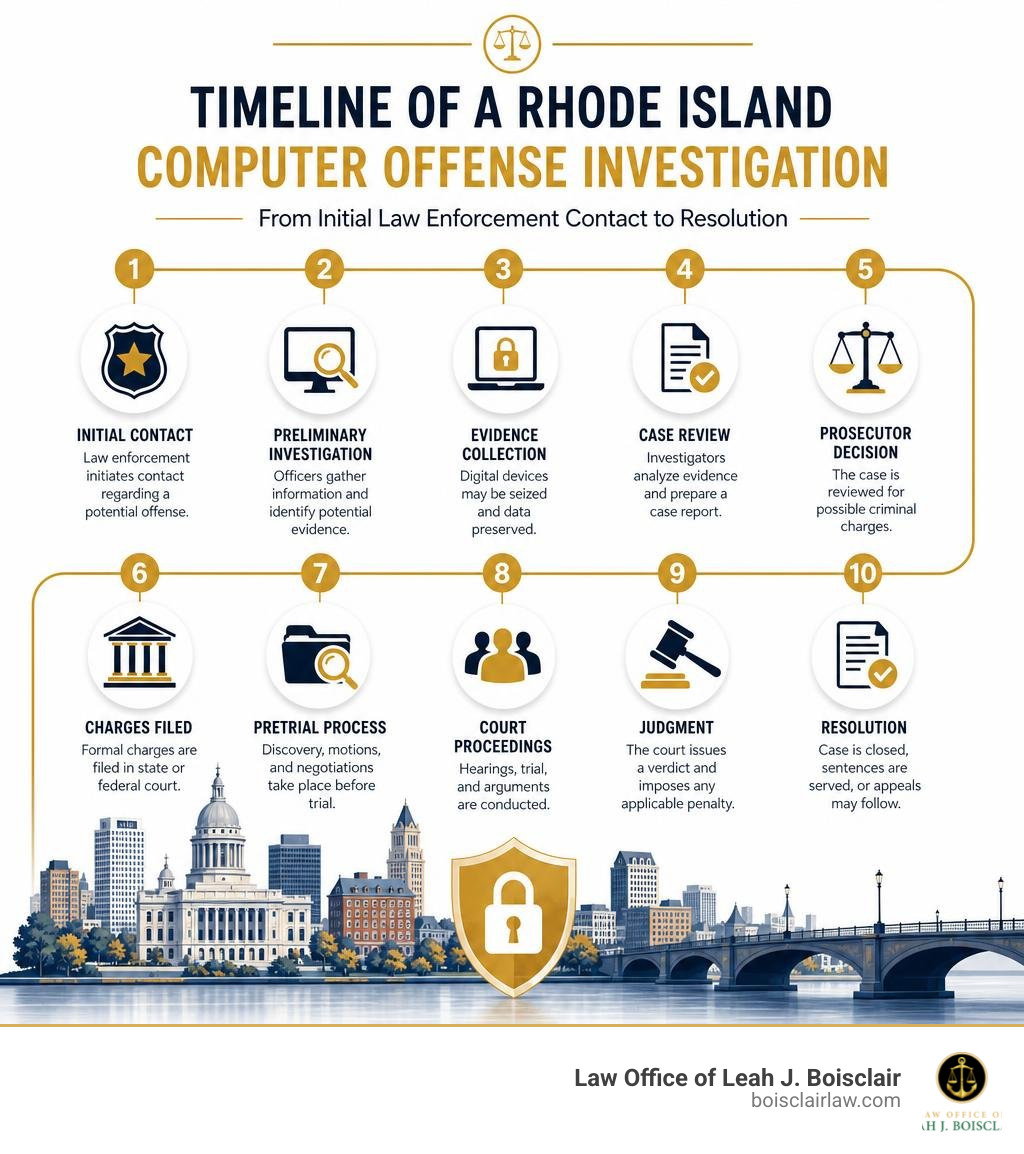
If you are arrested for a computer offense in Rhode Island, the legal process moves quickly:
- Booking: You will be taken to a local police station or the State Police barracks to be fingerprinted, photographed, and processed.
- Arraignment: This is your first formal court appearance, where the judge will read the charges against you and address bail. For misdemeanors, this may happen at the police station before a bail commissioner. For felonies, you will be brought to the District or Superior Court.
- Bail Conditions: The court will set bail. In many computer offense cases, especially those involving harassment or alleged fraud, the judge may impose specific bail conditions, such as a “No Contact Order” with the complaining witness or restrictions on your internet use.
- Securing Counsel: Contact our office immediately. We can represent you at your arraignment, argue for reasonable bail conditions, and begin requesting the prosecution’s evidence (discovery) to find weaknesses in their case.
Frequently Asked Questions about Computer Offenses in Rhode Island
How long does a computer offense case take to resolve in Rhode Island?
Because digital evidence is highly technical, computer offense cases generally take longer to resolve than standard criminal offenses. A straightforward misdemeanor case may be resolved within a few months. However, complex felony cases—especially those involving extensive forensic drive analysis or federal agencies—frequently take anywhere from six months to over a year to resolve.
The primary bottleneck is the digital forensic backlog. State and local forensic labs are constantly overwhelmed with devices waiting to be analyzed. While waiting for these lab reports, your attorney will use the time to file pretrial motions, challenge the state’s evidence, and negotiate with prosecutors.
Can I be charged with a computer offense if I didn’t know my actions were illegal?
Yes. Under Rhode Island law, “mistake of law” (not knowing a law exists) is generally not a valid defense. However, criminal intent (or mens rea) is a critical element of most computer offenses.
To convict you of computer fraud or identity theft, the prosecution must prove that you acted knowingly and with the intent to defraud. If you accessed a network because you made an honest mistake, or if a coworker gave you login credentials that they were not authorized to share, your lack of criminal intent can serve as a powerful defense to have the charges dismissed.
What is the difference between a felony and a misdemeanor computer offense in Rhode Island?
The classification of a computer offense in Rhode Island depends on the specific statute violated and the severity of the alleged conduct:
- Misdemeanors: Punishable by up to 1 year in jail and up to $1,000 in fines (or $500 for certain harassment offenses). These are typically handled in the District Courts. Examples include first-time cyberharassment or low-value computer trespass where no damage occurred.
- Felonies: Punishable by more than 1 year in state prison (often up to 5 or 10 years) and substantial fines. These cases are prosecuted in the Superior Courts. Examples include computer fraud, identity theft, child pornography, and unauthorized access that results in significant financial damage or system disruption.
Conclusion
Facing a computer offense charge can make you feel like the entire digital world is stacked against you. But remember: digital evidence is only as good as the prosecution’s ability to prove that you were the one behind the screen.
At the Law Office of Leah J. Boisclair, we provide the personalized, compassionate, and technically fluent advocacy you need to navigate these complex charges. Based in Cranston, RI, we represent clients throughout Rhode Island—including Providence, Warwick, Johnston, and East Greenwich—delivering dedicated defense strategies aimed at securing dismissals, reducing charges, and protecting your future.
Do not let a digital misunderstanding define the rest of your life. Contact us today to discuss your case and learn how we can help you debug your legal troubles. Explore our full range of legal support on our Practice Areas page.