
When a Knock at the Door Could Change Everything: What to Do If You’re Facing Cybercrime Charges
If you’re looking for a computer crime defense attorney, here’s what you need to know right now:
Your most important next steps:
- Say nothing to law enforcement without an attorney present
- Do not consent to a search of your computer or devices
- Contact a criminal defense attorney immediately — even if you’re only under investigation, not yet charged
- Early legal intervention can sometimes prevent charges from being filed at all
- Both state and federal prosecutors may pursue the same case simultaneously
Federal cybercrime investigations move fast. By the time agents contact you, they may have already been building a case for months.
And the stakes are serious. Computer offenses can carry years in federal prison, heavy fines, mandatory sex offender registration, and permanent damage to your career and reputation.
What makes these cases especially dangerous? You don’t have to be guilty to get caught up in one. Shared devices, infected computers, spoofed IP addresses, and roommates or family members using the same network have all led to innocent people facing federal charges.
In 2026, cybercrime prosecutions are at an all-time high — and the Law Office of Leah J. Boisclair is here to help residents of Rhode Island, Massachusetts, and Connecticut fight back.
Understanding Common Computer Offenses and Federal Charges

In the digital landscape of April 2026, the term “computer offenses” has become a broad catchall for a variety of activities that the government views as threats to security, privacy, and commerce. Whether the allegations involve a simple unauthorized login or a complex international scheme, federal and state authorities are more aggressive than ever in their pursuit of convictions.
Common types of computer offenses include:
- Hacking and Unauthorized Access: Gaining entry into a computer system, network, or private account without permission.
- Wire Fraud: Using electronic communications (including the internet) to carry out a scheme to defraud others of money or property.
- Identity Theft: Stealing personal information to commit financial fraud or other crimes.
- Cyberstalking and Harassment: Using the internet or electronic devices to harass, intimidate, or threaten an individual.
- Child Pornography: The possession, distribution, or manufacture of illicit materials involving minors. These cases often carry the harshest mandatory minimum sentences.
- Online Solicitation: Using the internet to communicate with minors for illegal purposes, often involving undercover stings.
If you are facing any of these allegations, you need a Computer Offenses Defense Attorney who understands the technical nuances of digital evidence.
The Scope of the Computer Fraud and Abuse Act (CFAA)
Most federal computer prosecutions are rooted in the Computer Fraud and Abuse Act (CFAA). Originally passed in the 1980s, the CFAA has been expanded multiple times and is often criticized by legal experts for being overly broad and vague.
Under the CFAA, “unauthorized access” can sometimes be interpreted so broadly that even violating a website’s Terms of Service could theoretically be treated as a criminal act. Because federal law is complex and varies by jurisdiction, navigating a CFAA case requires a computer crime defense attorney with specific experience in federal court. Data tampering, the transmission of viruses, and the theft of trade secrets are all high-priority targets for the Department of Justice.
Penalties for Computer Offenses in State and Federal Courts
The consequences of a conviction are life-altering. Unlike some other “white-collar” offenses, computer offenses are treated by Congress and state legislatures with the same severity as violent crimes.
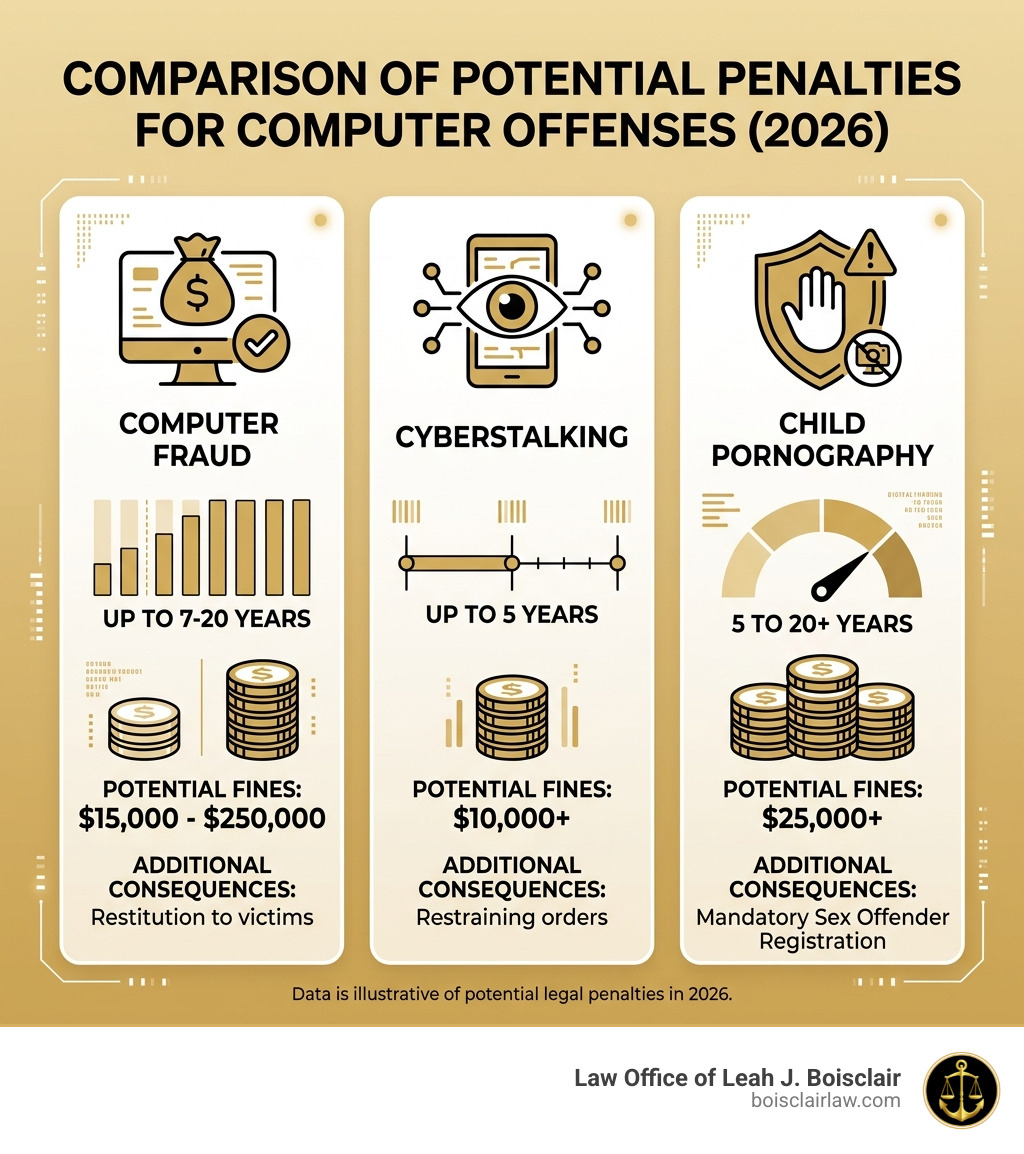
| Offense Type | Potential Prison Time | Potential Fines | Additional Consequences |
|---|---|---|---|
| Computer Fraud | Up to 7-20 Years | $15,000 – $250,000 | Restitution to victims |
| Cyberstalking | Up to 5 Years | $10,000+ | Restraining orders |
| Child Pornography | 5 to 20+ Years | $25,000+ | Mandatory Sex Offender Registration |
| Data Theft | Up to 10 Years | Variable | Civil lawsuits for damages |
Beyond prison and fines, a felony conviction creates a permanent criminal record that can prevent you from working in the tech industry, securing housing, or even owning a firearm. In cases involving internet sex offenses, the requirement to register as a sex offender can publicly label you for life, regardless of the specific circumstances of the case.
Why You Need a Computer Crime Defense Attorney Immediately

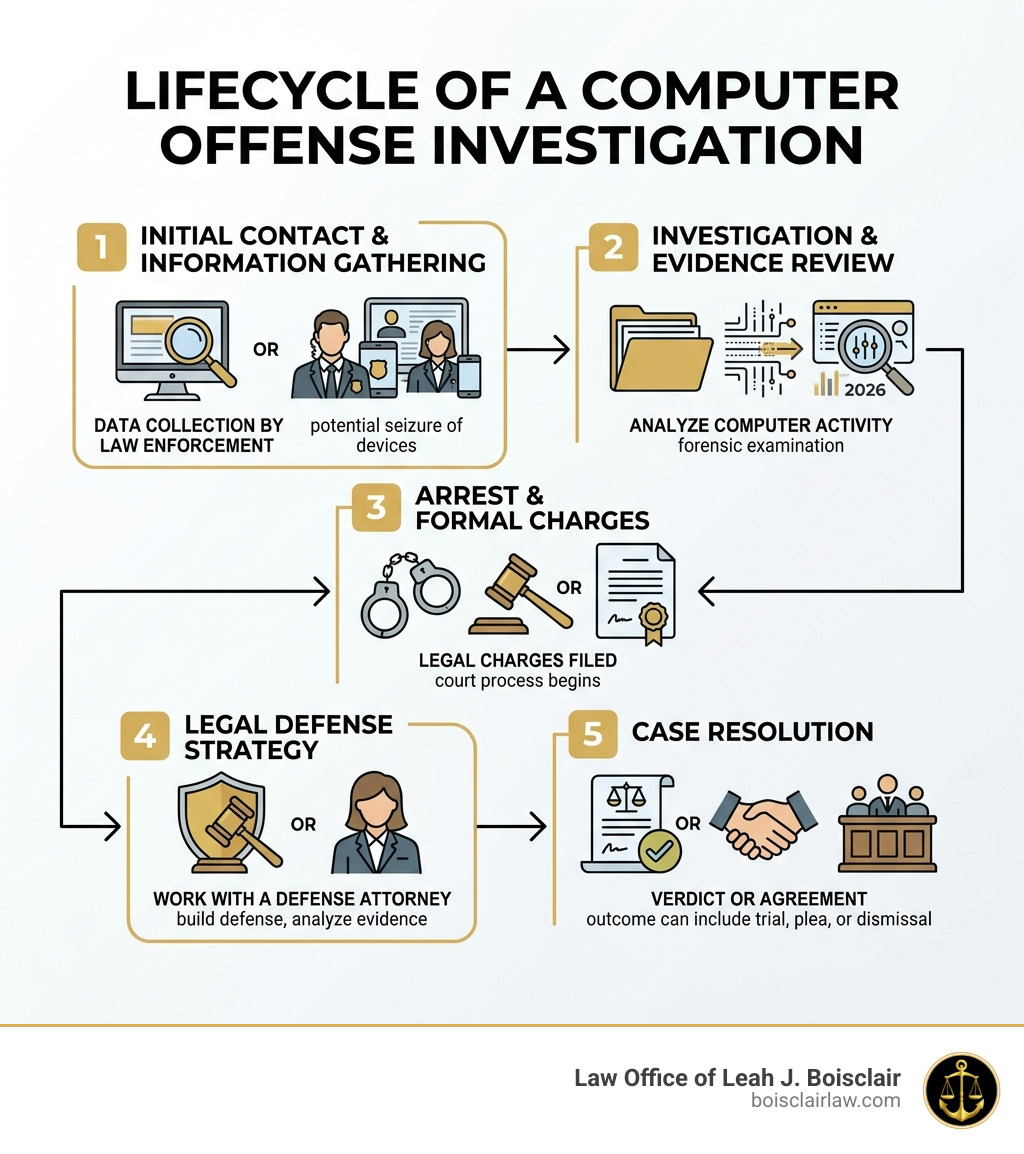
The moment you suspect you are under investigation—perhaps you noticed unusual activity on your accounts or federal agents stopped by your home—you must act. Waiting until you are formally arrested is a mistake.
Early intervention by a computer crime defense attorney can be the difference between a dismissed investigation and a decade in prison. We can often step in to negotiate with prosecutors before an indictment is even handed down.
It is vital to remember your constitutional rights. You have the absolute right to remain silent. Law enforcement officers are trained to be friendly and helpful to get you to “clarify” things, but in a digital investigation, anything you say can and will be used to connect you to an IP address or a specific device.
If you’re in Cranston or anywhere in Rhode Island, knowing Why Hire A Rhode Island Criminal Defense Attorney is the first step toward protecting your future. Our team at the Law Office of Leah J. Boisclair serves as your Ri Criminal Attorney, standing between you and the power of the government.
How a Computer Crime Defense Attorney Challenges Illegal Searches
The Fourth Amendment protects you against unreasonable searches and seizures. In computer offense cases, this usually involves the seizure of laptops, smartphones, and hard drives.
Authorities often take “shortcuts” to get to your data. They may try to coerce you into giving consent to search your phone or demand your passwords without a warrant. A skilled computer crime defense attorney will scrutinize every detail of how the evidence was obtained:
- Was the search warrant specific enough?
- Did the officers exceed the scope of the warrant?
- Was consent given freely, or was it the result of illegal pressure?
If we can prove that the evidence was obtained illegally, we can file a motion to suppress, which may lead to the entire case being thrown out.
Protecting Innocent Individuals from Wrongful Accusations
In cybercrime, the “owner” of a device is not always the person who committed the offense. We have seen many cases where innocent individuals are wrongly accused due to:
- Shared Computers: Multiple people in a household or office using the same machine.
- Unsecured Wi-Fi: Neighbors or passersby using your internet connection to conduct illegal activity.
- Malware and Botnets: Hackers “remotely controlling” your computer to send spam or store illicit files without your knowledge.
- IP Spoofing: Criminals making it look like their traffic is coming from your digital address.
Proving your innocence requires more than just your word; it requires a technical defense that shows you were not the person at the keyboard when the alleged computer offense occurred.
Proven Defense Strategies for Cybercrime Allegations
Defending against a computer offense requires a blend of traditional legal skill and high-tech investigative work. We don’t just look at the law; we look at the code.
Common defenses include:
- Lack of Knowledge: Proving you had no idea that illegal files were on your device or that a program you were using was performing illegal functions.
- Accidental Access: Showing that you clicked a link or accessed a database by mistake, without the “willful and knowing” intent required for a conviction.
- Authorization Disputes: Arguing that you actually had permission to access the data in question, or that the boundaries of that permission were unclear.
- Coercion: In some cases, individuals are forced or blackmailed into participating in digital schemes.
For a deeper look at how we approach these cases, see The Ultimate Guide To Ri Criminal Attorneys.
The Role of a Computer Crime Defense Attorney in Digital Forensics
Digital forensics is the backbone of any computer crime defense. Just as the government uses experts to analyze your hard drive, we use our own forensic experts to challenge their findings.
We look for:
- Metadata: Information about when files were created or accessed that might provide an alibi.
- Chain of Custody: Ensuring the government didn’t tamper with or corrupt the data after seizing it.
- Exculpatory Evidence: Finding files or logs that the prosecution “missed” which prove your innocence.
Successful Outcomes: Dismissals and Conviction Reversals
At the Law Office of Leah J. Boisclair, we focus on results. Whether it’s getting charges reduced from a felony to a misdemeanor or securing a full dismissal before trial, our goal is to protect your liberty.
Our Case Results reflect our commitment to aggressive advocacy. In the complex world of federal appeals, we also work to reverse convictions where legal or technical errors occurred during the original trial.
Frequently Asked Questions about Computer Offense Defense
What should I do if law enforcement wants to search my computer?
Unless they have a valid search warrant signed by a judge, you should politely but firmly refuse. Do not provide passwords or encryption keys without speaking to an attorney first. If they do have a warrant, step aside and let them perform their duty, but do not answer any questions while they are doing so. Call us immediately.
Can I be charged for a computer offense I didn’t know was happening?
Unfortunately, yes. Prosecutors often work on the assumption that if it happened on your computer, you did it. This is why a computer crime defense attorney is essential to prove a lack of intent or to show that another party (or a virus) was responsible.
How do jurisdictions handle cybercrime prosecutions differently?
While federal law is national, state laws vary wildly.
- Oregon and Wisconsin have specific statutes requiring “willful and knowing” access, which can be a higher bar for prosecutors.
- New York and Florida are known for being incredibly aggressive, often using specialized cybercrime task forces.
- Rhode Island handles these cases with a mix of state statutes and federal cooperation, meaning you could face charges in either (or both) court systems.
Conclusion
Facing a computer offense charge is one of the most stressful experiences a person can go through. The digital world moves fast, and the legal system can feel like it’s weighted against you from the start.
At the Law Office of Leah J. Boisclair in Cranston, RI, we provide personalized, compassionate advocacy. We understand that behind every “user ID” is a real person with a family, a job, and a future worth fighting for.
Our firm handles a wide range of matters, including:
- Firearm Offenses
- DUI and Traffic Offenses
- Assault and Battery Offenses
- Domestic Offenses
- Drug Offenses
- Disorderly Conduct Offenses
- Property Offenses
- White Collar Offenses
- Sex Offenses
- Violent Offenses
- Computer Offenses
Don’t let a digital mistake or a wrongful accusation define the rest of your life. If you’re under investigation or have already been charged, Contact Us today for a confidential consultation. We are ready to help you byte back.