Understanding RI Misdemeanor Record Expungement
RI misdemeanor record expungement is the legal process of sealing your conviction from public court records — so it no longer shows up on most background checks, and you can legally say it never happened.
Here’s what you need to know at a glance:
| Your Situation | Waiting Period | Key Requirement |
|---|---|---|
| 1 misdemeanor conviction (first offender) | 5 years after sentence completion | No arrests or convictions during that time |
| 2–5 misdemeanor convictions (no felonies) | 10 years after last sentence completion | Clean record, no felony history |
| DUI or domestic violence misdemeanor | Not eligible | Cannot be expunged under RI law |
| Dismissed charges or acquittals | No waiting period | Seal under a separate process |
A misdemeanor conviction can follow you for years — blocking jobs, housing, and professional licenses. Rhode Island law gives many people a real path to clear that record. But the process involves specific eligibility rules, waiting periods, court filings, and a hearing before a judge.
This guide walks you through every step.
In Rhode Island, expungement is more than just “hiding” a mistake; it is a statutory right for those who have stayed out of trouble. Under Title 12 Criminal Procedure, expungement is defined as the sealing and retention of all records of a conviction or probation. This means the records are removed from “active files” and public view.
When we talk about Felonies and Misdemeanors, it is important to understand that a misdemeanor is generally an offense punishable by no more than one year in jail and a fine of up to $1,000. While less severe than a felony, a misdemeanor on your BCI (Bureau of Criminal Identification) record can still be a major roadblock to your future.

Defining the First Offender Status
The most common path to clearing a record is through “first offender” status. According to R.I. Gen. Laws § 12-1.3-1, a first offender is someone who has been convicted of a single felony or misdemeanor but has no other prior convictions or probations on their record.
To qualify as a first offender for RI misdemeanor record expungement:
- You must have only one conviction or probation on your record.
- You must not have any criminal proceedings currently pending against you.
- You must have successfully completed your sentence (including probation).
If you have a complicated history, The Ultimate Guide to RI Criminal Attorneys can help you understand how the court views “nolo contendere” pleas and “straight probation,” which are often misunderstood by those trying to file on their own.
Expungement vs. Sealing for Non-Convictions
It is a common misconception that if your case was dismissed, it automatically disappears. It doesn’t. In Rhode Island, we distinguish between “expungement” (for convictions/probation) and “sealing” (for non-convictions).
According to Judicial-Records-Expungement-Information – Rhode Island Judiciary, you are eligible to seal your record if:
- Your case was dismissed (Rule 48A).
- You were found Not Guilty at trial.
- The grand jury returned a “No True Bill.”
- The police department “exonerated” you after a wrongful arrest.
Sealing non-convictions usually has no waiting period, but you still must file a motion to ensure the records are destroyed or moved to inactive status.
Eligibility and Waiting Periods for Misdemeanor Offenses
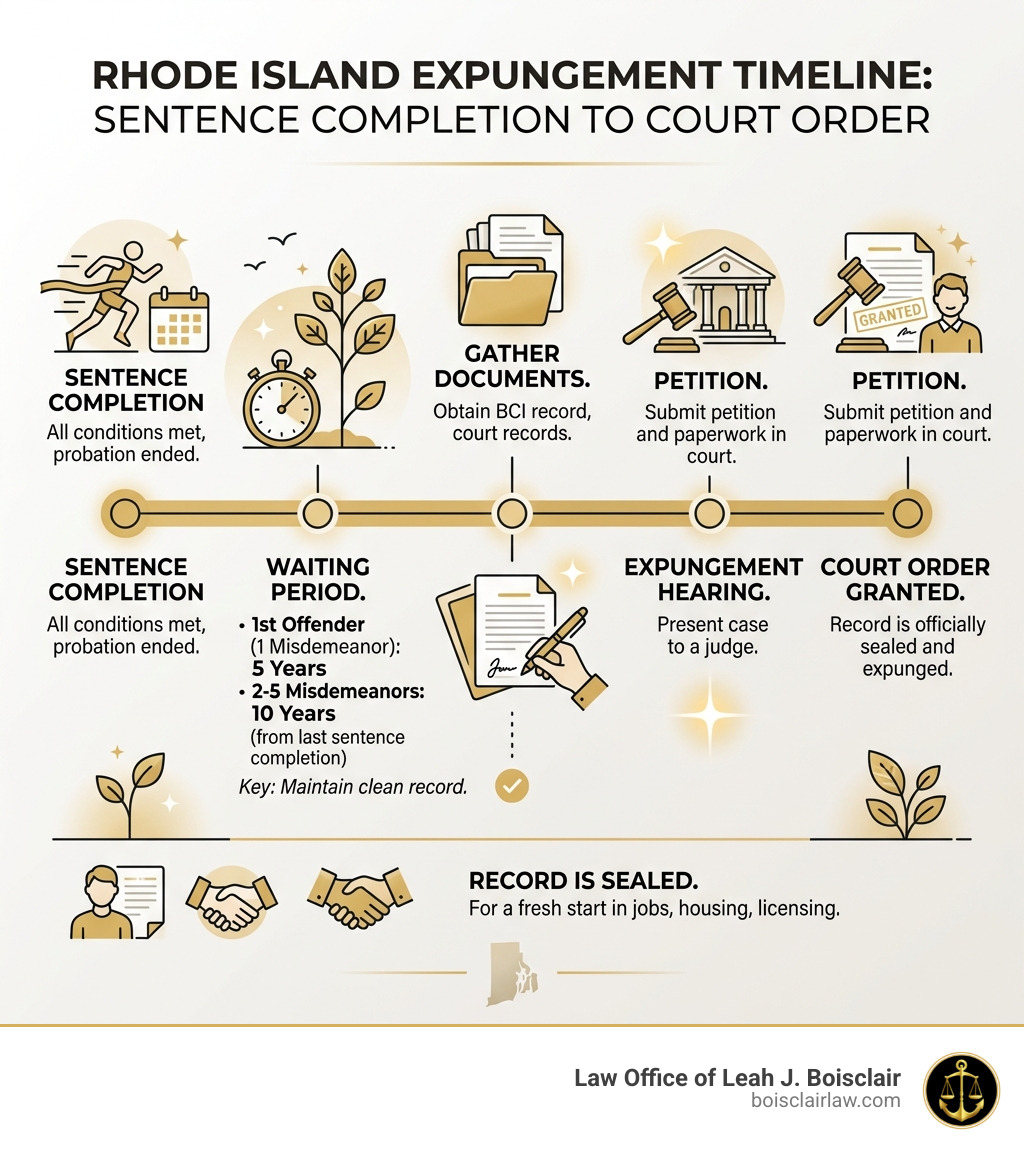
Timing is everything. You cannot simply walk into court the day after your probation ends. Rhode Island law requires a “rehabilitation period” to prove you have stayed on the right path. We often help clients calculate these dates, as the clock starts from the day you complete your sentence, not the day you were convicted.
| Offense Type | Waiting Period |
|---|---|
| First-time Misdemeanor | 5 Years |
| 2 to 5 Misdemeanors | 10 Years |
| Non-Violent Felony | 10 Years |
| Dismissed / Acquitted | Immediate |
To Wipe Your Record Clean with These Expungement Steps, you must ensure that during this waiting period, you haven’t been arrested or convicted of any other crimes. Even a small slip-up can reset the clock.
Can I Expunge Multiple RI Misdemeanor Record Expungement Cases?
For a long time, Rhode Island only allowed first offenders to clear their records. However, recent changes in the law now allow individuals with multiple misdemeanors to seek relief. Under 2024 Rhode Island General Laws Section 12-1.3-3, if you have more than one but fewer than six misdemeanor convictions (and no felonies), you can petition for expungement after a 10-year waiting period.
This is a massive opportunity for those who had a rough patch in their younger years but have been law-abiding for over a decade. Our Practice Areas include helping clients navigate these “multiple offense” petitions, which often require a more detailed showing of “good moral character” to the judge.
Ineligible Misdemeanor Charges and Crimes of Violence
Not every record can be wiped clean. Rhode Island law is very strict about certain Offenses. You generally cannot expunge:
- Crimes of Violence: This includes murder, first-degree arson, robbery, and first-degree sexual assault.
- Domestic Violence: Most domestic violence convictions are ineligible for expungement unless you are a first offender and meet very specific criteria.
- DUI and Traffic Offenses: If you are looking to Expunge DUI Record, be aware that Rhode Island specifically excludes DUI convictions and “Refusal to Submit to a Chemical Test” from the expungement statutes.
How to File Your Motion: A Step-by-Step Guide
Filing for RI misdemeanor record expungement is a formal legal process. It is not a simple letter to the court; it requires specific forms and strict adherence to notice requirements.
- Obtain your BCI: Go to the Attorney General’s Office in Cranston to get your official state background check. It costs $5.
- Identify the Court: You must file your motion in the exact court where you were sentenced (e.g., 3rd Division District Court in Warwick or 6th Division in Providence).
- Complete the Forms: You will need a “Motion to Expunge” and an “Affidavit” form, which can be found in the Expungement and Sealing of Criminal Records Resource Guide.
- Notarization: Your signature on the affidavit must be notarized.
- File with the Clerk: Submit your paperwork to the criminal clerk’s window. They will assign you a hearing date, usually at least 10 to 30 days out.
Filing Locations and Required Documentation
If you are unsure where to go, we recommend checking What to Do if You’ve Been Arrested in RI for a breakdown of the court system. Generally, misdemeanors are handled in the District Court, while felonies are handled in the Superior Court.
When you file, make sure you have:
- The Case Number (found on your BCI).
- The Date of Conviction.
- Proof that all fines and fees have been paid.
Notice Requirements for RI Misdemeanor Record Expungement
This is where many people fail when filing “pro se” (without an attorney). Rhode Island law requires that you give at least 10 days’ notice of your hearing to two specific parties:
- The Department of the Attorney General.
- The Police Department that originally arrested you.
Failure to provide this notice can result in your motion being dismissed or delayed. You can find detailed instructions on serving notice through the Expunge My Criminal Record Under Rhode Island Law portal.
The Court Hearing and Finalizing the Order
On the day of your hearing, you will stand before a judge. The judge has “discretionary power,” meaning they don’t have to grant the expungement just because you waited the five years. They must find that:
- You are a person of good moral character.
- You have been successfully rehabilitated.
- Expunging your record is in the public interest.
If the Attorney General objects to your motion, you may need to argue why your rehabilitation outweighs the state’s interest in keeping the record public. This is a primary reason Why Hire a Rhode Island Criminal Defense Attorney is beneficial; we know how to present your life story in a way that resonates with the court.
Financial Obligations and the $100 Filing Fee
Before a judge signs your order, they will check to ensure you don’t owe the state any money. According to the Rhode Island: Adult Convictions (RI-C-3) | National Reentry Resource Center, you must pay all:
- Court costs and filing fees.
- Restitution to victims.
- Fines and assessments.
Once the judge grants the motion, there is a $100 fee payable to the court to finalize the expungement. If you are indigent (low-income), you can ask the court to waive this fee, but you must provide proof of financial hardship.
What Happens After the RI Misdemeanor Record Expungement is Granted?
Winning in court is the biggest hurdle, but the paperwork isn’t finished yet. You must take the certified copies of the court order and deliver them to:
- The Attorney General’s BCI unit.
- The arresting police department’s records division.
This ensures they actually pull your file from the “active” system. As a RI Criminal Attorney, we typically handle these administrative follow-ups for our clients to ensure the record is truly gone.
Life After Expungement: Rights and Disclosure
The greatest benefit of RI misdemeanor record expungement is the peace of mind during a job interview. Under Rhode Island’s “Ban the Box” law, employers generally cannot ask about arrests on initial applications.
Once your record is expunged, R.I. Gen. Laws § 12-1.3-4 states that you are released from all penalties and disabilities resulting from the conviction. In most cases, you can honestly answer “No” if asked if you have ever been convicted of a crime.
Restoring Firearm Rights and Voting Privileges
For non-violent misdemeanors, your right to vote is typically restored as soon as you are no longer incarcerated. However, Firearm Offenses and gun rights are more complex.
While a state expungement treats the conviction as if it never occurred, federal law (the Lautenberg Amendment) may still prohibit firearm possession if the misdemeanor involved domestic violence. We always review Case Results with our clients to determine if an expungement will satisfy federal NICS background checks.
Recent Legislative Changes and the Clean Slate Act
As of April 2026, Rhode Island has made significant strides in record reform. The state has already implemented automatic expungement for certain marijuana possession Offenses that were decriminalized.
Furthermore, the proposed Rhode Island Clean Slate Act aims to automate the expungement process for approximately 77,000 Rhode Islanders. While we wait for full automation, the current process remains motion-based. Stay updated with the Expungement and Sealing of Criminal Records Resource Guide for any mid-year shifts in 2026 legislation.
Frequently Asked Questions about RI Expungement
How long does the misdemeanor expungement process typically take?
The entire process usually takes between 30 and 90 days. This includes the time to get your BCI, file the motion, wait the mandatory 10-day notice period, and attend the hearing. If the court calendar is backed up, it may take slightly longer.
Do I have to disclose my expunged record on a job application?
In 95% of cases, no. However, there are specific exceptions. If you are applying for a job in:
- Law Enforcement (Police, DOC).
- The State Bar (becoming a lawyer).
- Teaching or Early Childhood Education.
- Coaching youth sports. You may still be required to disclose the record, though the expungement shows the court has recognized your rehabilitation.
How do I check if my record has been successfully expunged?
We recommend waiting about 45 to 60 days after the court order is signed, then requesting a new BCI from the Attorney General. You can also check the Rhode Island Judiciary Public Portal, though the BCI is the only “official” confirmation.
Conclusion
A mistake from five or ten years ago shouldn’t define your life in 2026. Whether you are dealing with a single lapse in judgment or a few minor Property Offenses from your past, RI misdemeanor record expungement offers a way to move forward.
At the Law Office of Leah J. Boisclair, we provide personalized, compassionate advocacy for those seeking a fresh start. Based in Cranston, RI, we understand the local court systems and the nuances of Rhode Island law. We don’t just file paperwork; we fight to ensure your “good moral character” is recognized by the court.
If you’re ready to clear your name, Contact a DUI and Traffic Offense Defense Attorney or reach out to us for a consultation on your expungement eligibility today. Let us help you wipe the slate clean.