

When a Digital Accusation Can Change Everything: What You Need to Know About Computer Crimes Defense
Computer crimes defense is the legal practice of protecting individuals and businesses accused of offenses involving computers, networks, or the internet — under both federal and state law.
If you’ve been contacted by the FBI, had your devices seized, or been charged with hacking, data theft, or fraud, here’s what matters most right now:
- Get an attorney immediately — federal investigations often begin long before charges are filed
- Do not speak to law enforcement without a lawyer present
- Do not delete files or alter data — this can be charged as obstruction
- The primary law used against you is likely the Computer Fraud and Abuse Act (18 U.S.C. § 1030)
- Penalties can be severe — up to 20 years in federal prison, plus fines, restitution, and lasting collateral consequences
The internet has made life more connected — and more legally complicated. Nearly every professional action, financial transaction, and personal message now leaves a digital footprint. That footprint can become evidence.
Federal agencies like the FBI Cyber Division, the U.S. Secret Service, and the DOJ’s Computer Crime and Intellectual Property Section have dedicated units — and significant resources — focused entirely on investigating and prosecuting computer-related offenses. They often build cases for months before making contact.
And here’s the critical reality: the window between when an investigation begins and when charges are filed is often the most important moment in your entire case. Acting early can mean the difference between charges being filed or not.
Whether you’re facing accusations of unauthorized access, ransomware, identity theft, or email fraud — in Rhode Island, Massachusetts, Connecticut, or federal court — understanding your rights and your options is the first step.
Federal and State Computer Offenses and Investigations

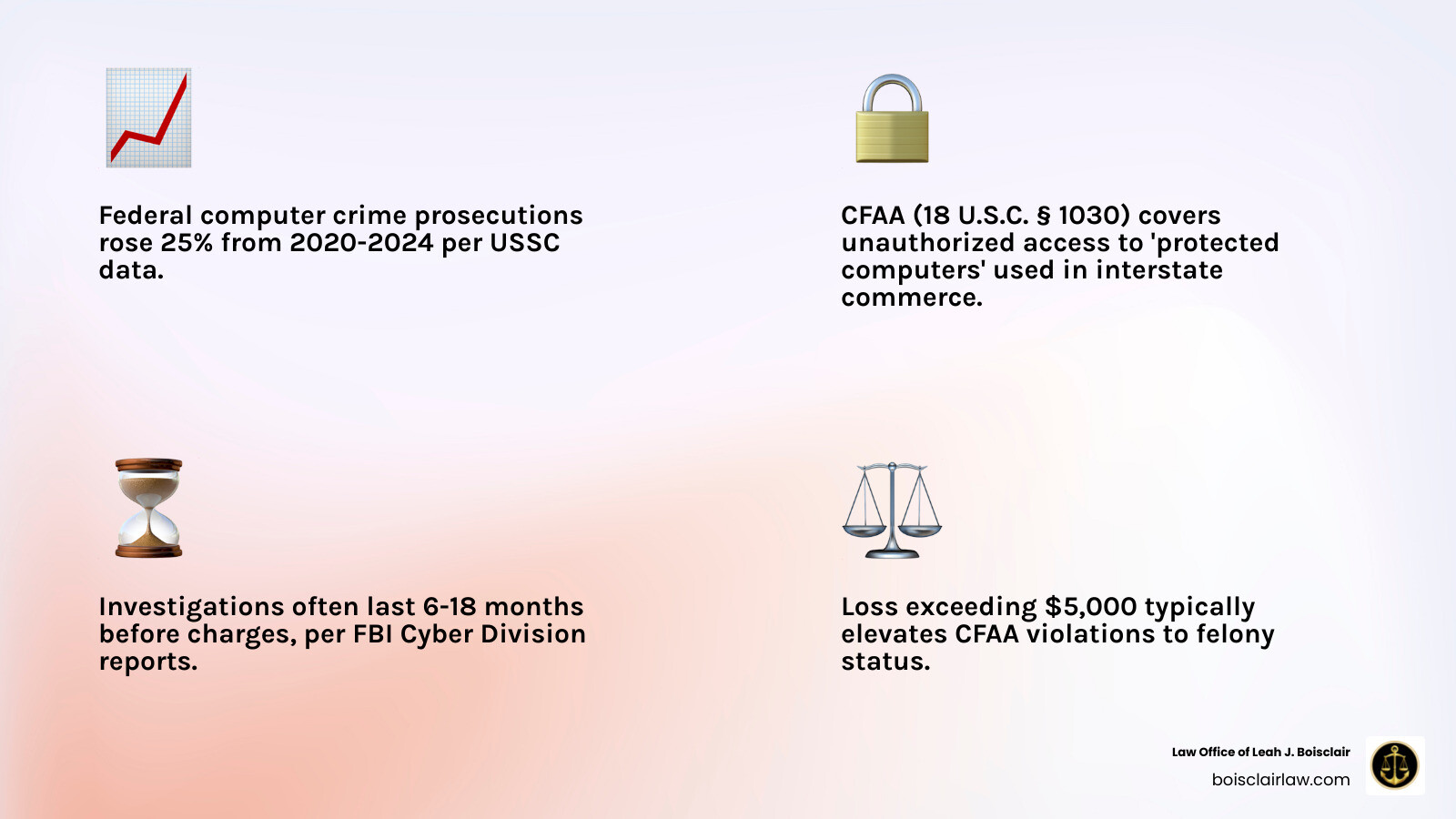
Navigating the landscape of computer-related legal issues requires an understanding of the heavy hitters in the prosecution world. As of May 2026, the primary weapon used by federal prosecutors remains the Computer Fraud and Abuse Act (CFAA), codified at 18 U.S.C. § 1030. Originally enacted in 1984, this law has been expanded numerous times to keep pace with technology, though many argue it remains broad enough to catch unintended conduct in its net.
Under the CFAA, the government focuses on “protected computers.” While that sounds like it might only refer to high-security government servers, the legal definition is much wider. A “protected computer” effectively includes any device connected to the internet, as its use affects interstate or foreign commerce. This means your smartphone, laptop, or even a smart appliance could technically fall under this umbrella.
Common offenses we see investigated include:
- Hacking and Unauthorized Access: Entering a system without permission.
- Ransomware: Deploying malicious code to lock data until a payment is made.
- Data Theft: Exfiltrating proprietary information or trade secrets.
- Email Fraud and Phishing: Using deceptive electronic communications to obtain money or sensitive information.
Federal investigations are typically spearheaded by the FBI Cyber Division, the Secret Service, and the DOJ. These agencies don’t play around; they use advanced machine learning and AI pattern recognition to trace IP addresses and analyze metadata. If you are facing these agencies, you need an experienced Ri Criminal Attorney who understands the technical nuances of the 2024 Primer on Computer Crimes.
Jurisdiction and State Statutes
While federal agencies handle massive, multi-state breaches, state-level law enforcement is equally active. In Rhode Island, the Rhode Island State Police Computer Crimes Unit handles local digital offenses.
Every state has its own specific statutes. For example, while Florida and Wisconsin have robust legislation protecting consumers from unauthorized access, Rhode Island law specifically addresses computer trespassing, tampering, and the use of computers for fraudulent purposes. Whether your case is in state or federal court determines which rules of evidence apply and what the potential penalties look like. Our team at the Law Office of Leah J. Boisclair handles a wide range of Practice Areas across these jurisdictions.
Felony vs. Misdemeanor Classifications
How do prosecutors decide if a case is a minor slip-up or a major felony? Often, it comes down to the “loss amount.” Under 18 U.S.C. § 1030, a common threshold for a felony charge is a loss of at least $5,000 within a one-year period. If the loss is below this, it may be charged as a misdemeanor.
However, other factors can bump a charge into felony territory regardless of the dollar amount, such as:
- Intent: Was the goal to obtain commercial advantage or private financial gain?
- Prior Convictions: Repeat offenders face much harsher classifications.
- Nature of Data: Accessing sensitive government or national security information is almost always a high-level felony.
Understanding these distinctions is vital for your defense. You can learn more about our commitment to protecting your rights on our About page.
Strategic Computer Crimes Defense and Legal Protections
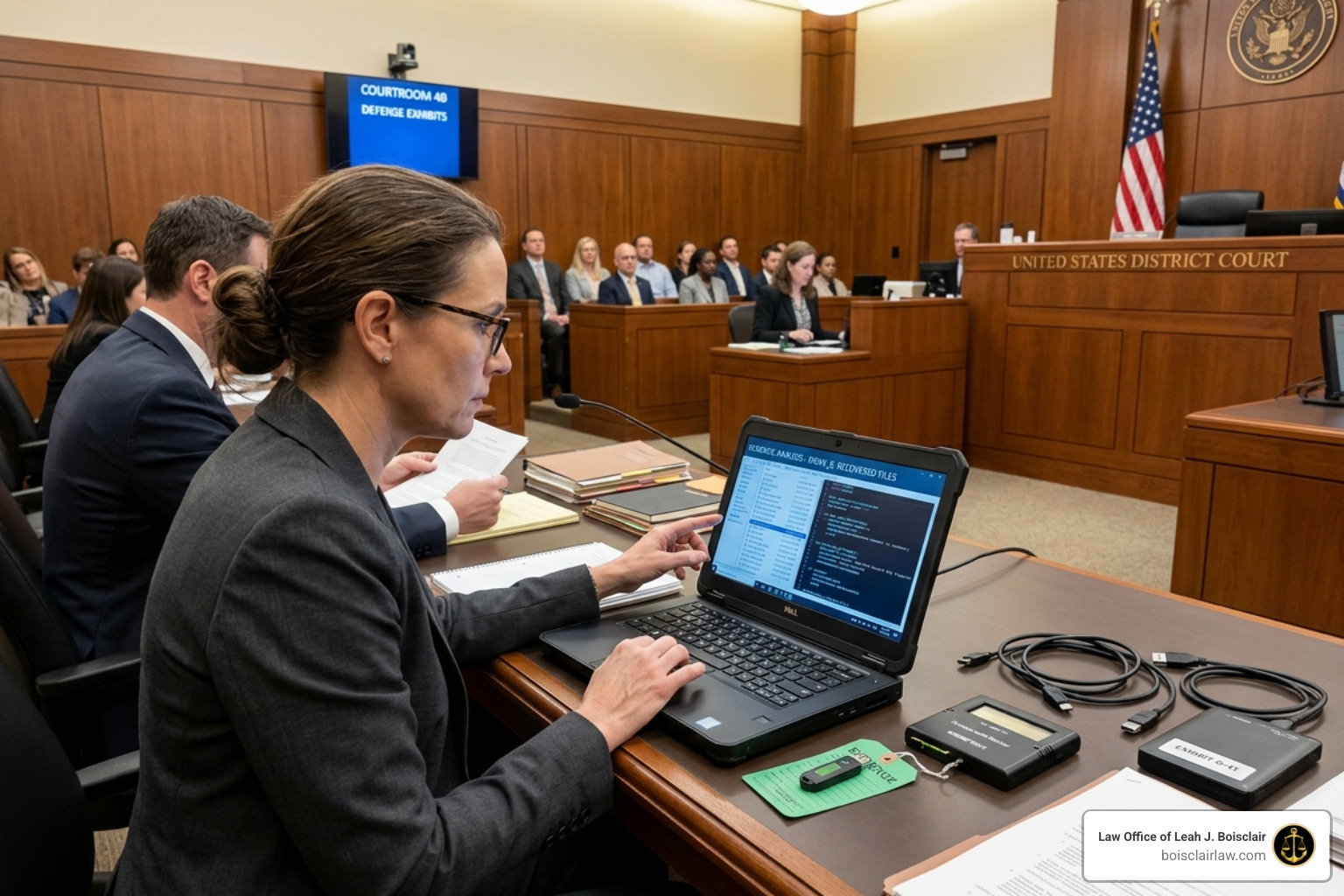
A digital accusation is not a conviction. Building a robust computer crimes defense requires more than just knowing the law; it requires understanding how the law applies to specific technical actions.
One of the most significant legal shifts in recent years came with the Supreme Court case Van Buren v. United States. This ruling clarified the definition of “exceeding authorized access.” The court decided that if you have technical authorization to access a file, but you do so for an improper reason (like a police officer looking up a license plate for a personal bribe), you haven’t necessarily violated the CFAA’s provision against “exceeding authorized access.” This has become a cornerstone defense for individuals accused of “insider threats” or employment-related data disputes.
Common defense strategies we employ include:
- Lack of Intent: Proving that the access was accidental or that there was no “mens rea” (guilty mind) to commit a crime.
- Authorization: Demonstrating that the user had a reasonable belief they were authorized to access the system.
- Entrapment: In cases involving “sting operations,” we may argue that the government induced the individual to commit a crime they otherwise wouldn’t have committed.
For more technical insights, the National Criminal Defense Authority provides extensive resources on how these defenses play out nationwide. If you find yourself in the crosshairs of an investigation, contacting a Computer Crimes Defense Attorney is your most critical move.
Challenging Evidence in Computer Crimes Defense
The Fourth Amendment protects you against “unreasonable searches and seizures.” In the digital world, this means law enforcement generally needs a warrant to search your phone, laptop, or cloud accounts.
We look for “low-hanging fruit” in the prosecution’s case:
- Search Warrant Scope: Did the police search files they weren’t authorized to look at?
- Probable Cause: Was the warrant based on stale or unreliable information?
- Suppression Motions: If we can prove the evidence was gathered illegally, we can ask the judge to “throw it out,” meaning the prosecution cannot use it against you.
Knowing What To Do If Youve Been Arrested In Ri can help preserve your ability to make these challenges later.
The Role of Forensics in Computer Crimes Defense
Digital evidence is fragile. It can be easily altered, and timestamps can be misleading. This is where digital forensics becomes the star of the show. We often work with expert witnesses to challenge the prosecution’s narrative.
Key forensic issues include:
- IP Attribution: Just because an action came from your IP address doesn’t mean you were the person behind the keyboard. We investigate Network Address Translation (NAT) and shared Wi-Fi possibilities.
- Metadata Analysis: Examining the “data about the data” to determine when a file was actually created or modified.
- Chain of Custody: If the police didn’t handle your device correctly, the integrity of the evidence is compromised.
Our history of Case Results often hinges on our ability to dismantle the technical “proof” presented by the government.
Penalties and Sentencing Guidelines for Computer Offenses
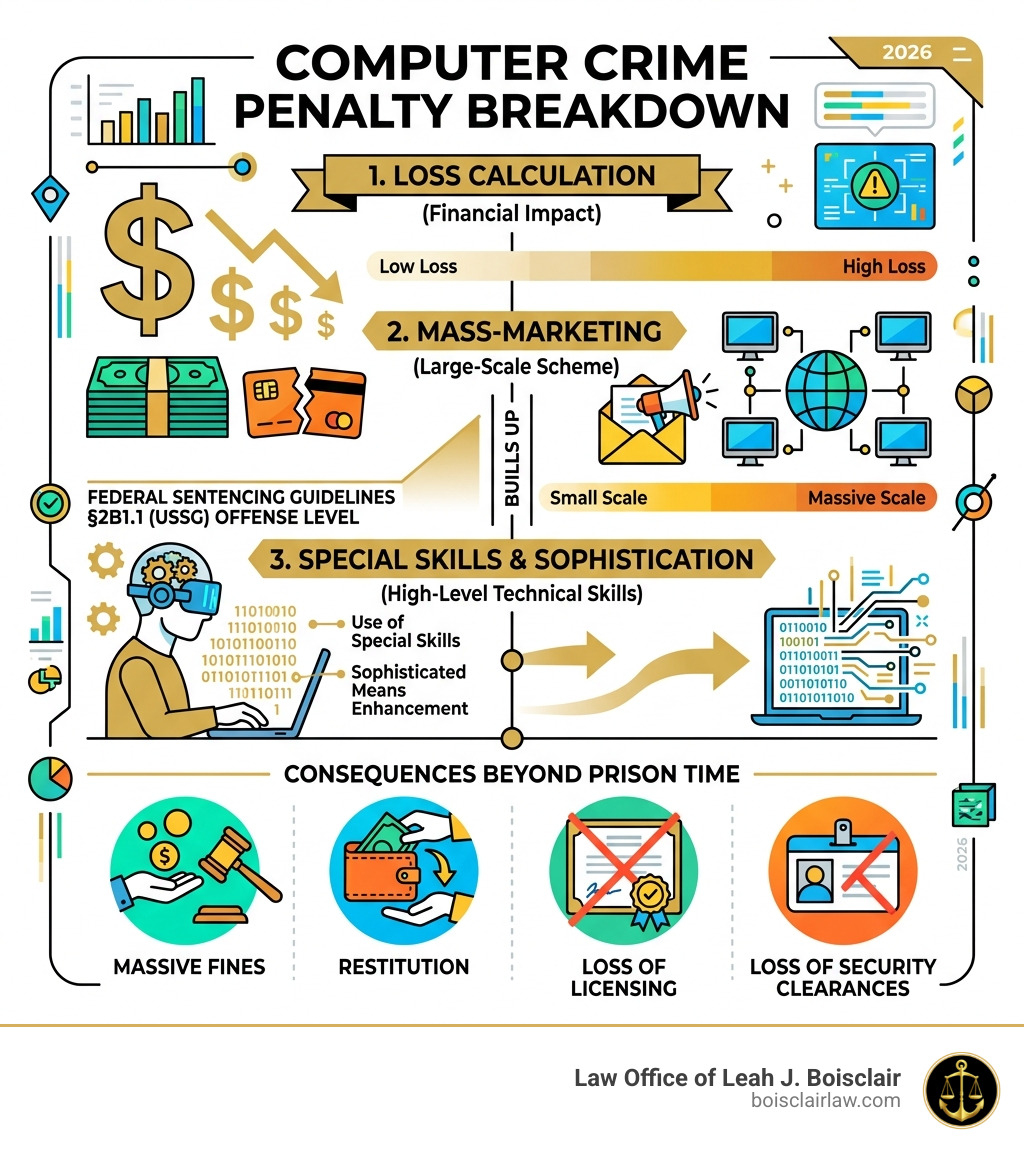
If a case moves toward sentencing, the U.S. Sentencing Guidelines (USSG) §2B1.1 become the roadmap. Federal sentencing is a complex math problem where “offense levels” are added based on specific characteristics.
Factors that increase your sentence include:
- Loss Calculation: The financial impact on the victim (including the cost of responding to the breach).
- Mass-Marketing: Was the offense committed through a large-scale scheme?
- Special Skills: Did the defendant use high-level technical skills to commit the crime? This can lead to a “sophisticated means” enhancement.
The consequences go beyond prison time. You may face massive fines, restitution (paying back the victims), and collateral effects like the loss of professional licensing or security clearances. This is why having a Ri Criminal Attorney who can argue for downward departures or alternative sentences is so important.
Frequently Asked Questions about Computer Crimes Defense
Why do I need an attorney immediately if under investigation?
The government starts building its case long before you are ever arrested. Early intervention by an attorney allows us to:
- Control the Narrative: We can speak to investigators on your behalf to prevent you from making self-incriminating statements.
- Negotiate Pre-Charge: Sometimes, we can provide context that leads to the investigation being closed without charges ever being filed.
- Protect Your Assets: We can work to prevent or mitigate the seizure of your business or personal property.
Why Hire A Rhode Island Criminal Defense Attorney? Because the resources of the federal government are virtually unlimited, and you need someone in your corner with the experience to push back.
What should I do if contacted by federal law enforcement?
If an FBI agent knocks on your door, remain calm but firm. You have the right to remain silent and the right to an attorney. You should:
- Ask for a Lawyer: Simply state, “I am not answering any questions without my attorney present.”
- Verify Warrants: If they want to search your home or seize a device, ask to see the warrant. Read it to see exactly what they are allowed to take.
- Avoid Obstruction: Do not delete anything from your computer or phone after you become aware of an investigation. This can lead to additional charges that are often easier to prove than the original offense.
Review our guide on What To Do If Youve Been Arrested In Ri for more step-by-step advice.
How does the process of a criminal case work for cyber offenses?
The process generally follows these steps:
- Arraignment: Your first official court appearance where charges are read and bail is set.
- Discovery: Your attorney receives the evidence the government has against you (this is where we dig into the forensics).
- Pre-trial Motions: We file motions to suppress evidence or dismiss charges.
- Plea Negotiations: Many cases are resolved through a deal that reduces the potential penalties.
- Trial: If no deal is reached, the case goes before a judge or jury.
- Sentencing: If there is a conviction, the judge determines the penalty based on the guidelines.
An experienced Ri Criminal Attorney can guide you through each of these phases, ensuring your rights are protected at every turn.
Conclusion
At the Law Office of Leah J. Boisclair, we believe that every digital accusation deserves a sophisticated and compassionate defense. We understand that being accused of a computer crime can be humiliating and terrifying, potentially threatening your “once-good name” and your professional future.
Based in Cranston, RI, we provide personalized advocacy for clients across Rhode Island in both state and federal courts. Our team is equipped to handle a wide variety of matters, including:
- Firearm Offenses
- DUI and Traffic Offenses
- Assault and Battery
- Domestic Offenses
- Drug Offenses
- Public Order and Property Crimes
- White Collar and Sex Offenses
- Violent Crimes
- Computer Offenses
Don’t navigate the complexities of a digital investigation alone. Whether you are facing a misdemeanor in state court or a high-stakes federal felony, we are here to provide the aggressive, data-driven defense you need.
Contact Us today for a consultation and let us start protecting your future.