

When You’re Facing a Firearm Offense, Every Hour Counts
If you need a firearm charge defense attorney, here is what you need to know right away:
Quick Answer: What Does a Firearm Charge Defense Attorney Do?
| What They Do | Why It Matters |
|---|---|
| Review the legality of your arrest and search | Illegally obtained evidence can be suppressed or thrown out |
| Challenge possession claims | Prosecutors must prove you actually controlled the firearm |
| Negotiate with prosecutors | Offenses can often be reduced or dismissed before trial |
| Raise constitutional defenses | Fourth and Second Amendment challenges can be powerful tools |
| Fight mandatory minimum sentences | Strategic plea or trial work can reduce or avoid harsh minimums |
Being arrested for a firearm offense is one of the most serious situations you can face in the criminal justice system. The stakes are high — and they move fast.
In states like New York, a first-time conviction for possessing a loaded firearm carries a mandatory prison sentence of 3.5 to 15 years. Florida’s 10-20-Life law means a firearm used during a felony triggers a mandatory 10-year minimum — no exceptions, no judicial wiggle room. Even in states considered more gun-friendly, a felony firearm conviction can cost you your freedom, your job, and your right to ever legally own a firearm again.
Many people facing firearm offenses are not hardened criminals. They are everyday people — travelers who crossed state lines without knowing the licensing rules changed, domestic violence survivors who kept a firearm for protection, or individuals caught in the wrong place at the wrong time. The law, however, does not always make room for context on its own.
That is exactly why having the right legal advocate matters.
The Law Office of Leah J. Boisclair serves individuals in Rhode Island, Massachusetts, and Connecticut who are facing firearm offenses and need a skilled, compassionate defense attorney in their corner — someone who understands both the law and the very real human consequences behind every case.
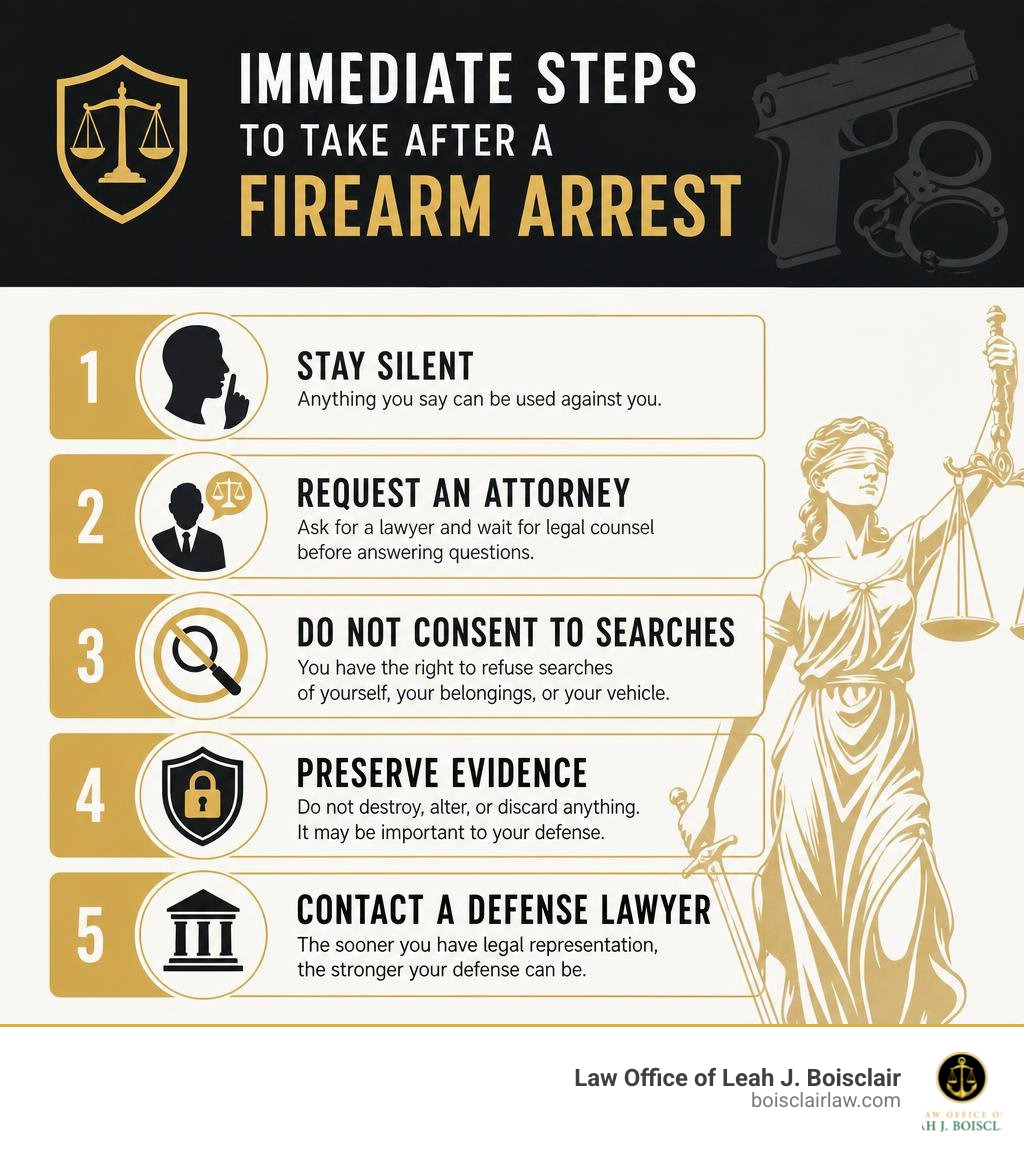
State vs. Federal Firearm Offenses and Jurisdictional Differences
When you are arrested on a firearm offense, one of the first and most critical details to establish is whether your case will be prosecuted in state or federal court. The jurisdictional line dictates everything from the rules of evidence to the severity of the potential penalties.
State Jurisdiction
Most firearm arrests begin at the state level. If a local police department–such as the Cranston, Providence, or Warwick Police–arrests you, the state of Rhode Island will initially handle the offenses. State offenses typically involve violations of local safety laws, such as carrying a concealed weapon without a license, possessing an altered firearm, or carrying a firearm while under the influence.
State courts offer unique avenues for relief, including local diversion programs, drug courts, or negotiated plea agreements that focus on rehabilitation over incarceration. However, state laws still carry heavy penalties, and local prosecutors are often under intense public pressure to secure convictions in gun-related cases.
Federal Jurisdiction
A state-level arrest can quickly escalate into a federal case if certain conditions are met. Federal agencies, such as the Bureau of Alcohol, Tobacco, Firearms and Explosives (ATF), work closely with local law enforcement. Under federal law–specifically 18 U.S.C. § 922(g)–it is illegal for “prohibited persons” to possess firearms or ammunition. You can review the federal statutory language through the Legal Information Institute’s page on 18 U.S.C. § 922(g). Prohibited persons include:
- Convicted felons (offenses punishable by imprisonment exceeding one year)
- Individuals unlawful users of or addicted to controlled substances
- Those subject to certain domestic restraining orders
- Anyone convicted of a misdemeanor offense of domestic violence
The legal hook that allows the federal government to step in is interstate commerce. Because almost all firearms are manufactured in one state and shipped to another, the federal government asserts jurisdiction by claiming the firearm traveled across state lines at some point in its history.
Federal prosecutions for unlawful firearm possession have risen dramatically, increasing by over 50% since 2016, with average sentences exceeding five years in federal prison. Unlike state systems, the federal justice system has no parole; if you are sentenced to federal prison, you must serve at least 85% of your time.
| Feature | State Firearm Offenses | Federal Firearm Offenses |
|---|---|---|
| Investigating Agency | Local Police, State Police | ATF, FBI, Homeland Security |
| Prosecuting Authority | State Attorney General / Local DA | United States Attorney’s Office |
| Jurisdiction Hook | Violations of state safety statutes | Interstate commerce connection |
| Average Sentence | Varies widely; probation is possible | Often exceeds 5 years; no parole |
| Common Offense | Carrying without a permit, carrying under influence | Felon in possession (18 U.S.C. § 922(g)) |
Common Firearm Offenses and Penalties Across Key States
Firearm laws are a complex patchwork that changes instantly when you cross state borders. What is perfectly legal in one jurisdiction can carry a mandatory prison sentence just a few miles away.
Rhode Island Firearm Laws
In Rhode Island, the law strictly regulates how firearms are transported, carried, and possessed. Under state law, carrying a handgun without a valid license is a major felony. If you are stopped in Warwick, Johnston, or North Providence with an unlicensed firearm in your vehicle or on your person, you face up to 10 years in state prison. To understand the nuances of these regulations, you can read about the Carrying or Possession of Firearm Without License Permit RI.
Comparing Other States
Understanding how other states handle these offenses highlights why traveling with a firearm is so risky:
- New York (Penal Law 265): New York has some of the strictest gun regulations in the country. Under Penal Law Section 265, possessing a loaded firearm without a New York-specific permit is a Class C violent felony. First-time offenders face a mandatory minimum of 3.5 years up to 15 years in prison. Even out-of-state permit holders who fly into JFK or LaGuardia airport with a legally checked firearm can be arrested on the spot if they take possession of the weapon in New York.
- Michigan: Michigan prosecutors aggressively pursue “felony firearm” offenses. If a firearm is possessed or used during the commission of another felony, it triggers a mandatory consecutive sentence of 2 years for a first offense and 5 years for subsequent offenses. This sentence must be served before and in addition to the sentence for the underlying felony.
- Pennsylvania: Under the Uniform Firearms Act (VUFA), carrying a concealed firearm without a license is a felony of the third degree, carrying up to 7 years in prison. In Philadelphia, VUFA § 6108 makes it a misdemeanor to carry any firearm on public streets without a license, regardless of whether it is concealed.
- Florida: Florida’s famous “10-20-Life” law imposes strict mandatory minimums for offenses involving firearms. Simply possessing a firearm during certain felonies triggers a mandatory 10-year prison sentence. Discharging the weapon carries a mandatory 20 years, and injuring or killing someone results in 25 years to life.
- Maryland: Under Section 4-203, carrying a handgun in a vehicle or on your person without a highly restrictive permit is illegal. Maryland also enforces a mandatory 5-to-20-year enhancement for using a firearm in an offense of violence under Section 4-204.
If you are facing local offenses, consulting a specialized firearm charge defense attorney can help you navigate these complex state-specific statutes.
Why You Need a Firearm Offenses Defense Attorney for State Offenses
State prosecutors have immense power, and local courts operate under their own distinct rules. Facing a state gun offense without an experienced firearm charge defense attorney is an incredible risk.
Local sentencing guidelines often dictate harsh penalties even for individuals with clean records. For example, a conviction for carrying a firearm while intoxicated can have devastating consequences on your personal and professional life. You can read more about the specific penalties and legal elements of this offense in our guide on Carrying Firearm Under Influence RI.
An attorney who knows the local court systems in Cranston, Scituate, or East Greenwich understands how local judges view firearm offenses. They know which prosecutors are open to negotiation, how to present mitigating evidence to secure a reduced offense, and how to navigate the administrative processes of state licensing boards. Working with a local advocate ensures your defense strategy is tailored to the specific court handling your case.
Key Defenses and Constitutional Challenges in Firearm Offenses
Just because a firearm was found does not mean the prosecution has an open-and-shut case. A skilled defense attorney will meticulously analyze the circumstances of your arrest to identify constitutional violations and factual weaknesses.

Fourth Amendment Violations (Unlawful Search and Seizure)
The Fourth Amendment protects you from unreasonable searches and seizures. In many firearm cases, the weapon is discovered during a traffic stop, a street frisk, or a home search. Your attorney will ask critical questions:
- Did the officer have reasonable suspicion to pull your car over in Pawtucket or East Providence?
- Did they have probable cause to search your glove box or trunk?
- Was a search warrant properly obtained and executed?
If the police violated your constitutional rights, your attorney can file a Motion to Suppress. If the judge rules that the search was unlawful, the firearm itself is excluded from evidence. Without the physical weapon, the prosecution’s case almost always collapses.
Second Amendment Challenges (The Post-Bruen Era)
The legal landscape surrounding gun ownership changed dramatically following the U.S. Supreme Court’s ruling in New York State Rifle & Pistol Association v. Bruen. The court established that gun regulations must align with the historical tradition of firearm regulation in the United States.
Today, defense attorneys are successfully challenging state licensing requirements, age restrictions, and bans on certain types of firearms by arguing they violate the Second Amendment. If you are facing offenses, your attorney can evaluate whether a constitutional challenge is a viable path for your defense.
Self-Defense and Defense of Others
If you are charged with an offense involving the use or brandishing of a firearm, self-defense may be your strongest option. Under Rhode Island law, you have the right to use reasonable force to protect yourself or others from imminent harm. Your attorney will gather witness statements, surveillance footage, and forensic evidence to demonstrate that your actions were a justified response to a threat.
How a Firearm Offenses Defense Attorney Challenges Constructive Possession
To convict you of a possession offense, the state must prove beyond a reasonable doubt that you “possessed” the firearm. In the legal world, possession is divided into two categories: actual possession and constructive possession.
- Actual Possession: The firearm is physically on your person—in your hand, your pocket, or your waistband.
- Constructive Possession: The firearm is not on your person, but it is in an area over which you have “dominion and control.” This is common when a gun is found under a passenger seat, in a shared apartment, or in a glove box.
Constructive Possession Challenges (Firearm Found in Shared Space):
- Knowledge: Did the defendant actually know the firearm was there?
- Dominion & Control: Did the defendant have exclusive control over the area where the firearm was found?
Prosecutors often rely on constructive possession to charge multiple people in a vehicle or home. However, simply being near a firearm is not enough to convict you.
Your attorney can challenge constructive possession by showing a lack of knowledge or a lack of exclusive control. For example, if a firearm is found in a vehicle with four passengers, the state cannot simply assume the gun belongs to the driver. If the firearm in question is alleged to be stolen, the legal hurdles for the prosecution increase significantly, as they must also prove you knew or had reason to believe the weapon was stolen. You can learn more about how we fight these specific allegations by reading our article on the Possession of Stolen Firearm RI.
To protect your rights in these complex scenarios, consult with an experienced firearm charge defense attorney to evaluate the specific facts of your stop.
How a Firearm Offenses Defense Attorney Protects Your Future
A firearm conviction does not just threaten your immediate freedom; it can alter the entire trajectory of your life. It can prevent you from securing housing, obtaining employment, holding a professional license, or ever exercising your Second Amendment rights again.

At the Law Office of Leah J. Boisclair, we provide personalized, compassionate advocacy to individuals facing firearm offenses in Cranston, Johnston, Coventry, and throughout Rhode Island. We don’t view you as a case number or a police report; we view you as a human being who deserves a powerful, strategic defense.
Our approach begins with a comprehensive review of the evidence, from body camera footage to police dispatch logs. We look for the procedural errors, constitutional violations, and factual inconsistencies that others might miss. Whether we are negotiating for a complete dismissal of offenses, a reduced misdemeanor offense, or fighting for your innocence at trial, we are relentless in our pursuit of the best possible outcome.
If you are looking for alternatives or want to understand your options, check out our guide on Cranston Gun Offense Attorney Alternatives: Everything You Need to Know. For a comprehensive look at how we defend these cases across the state, visit our dedicated Firearm Offenses Defense Attorney page.
Frequently Asked Questions About Firearm Offenses
What is the difference between actual and constructive possession?
Actual possession means the firearm was found physically on your body (such as in your pocket or hand). Constructive possession means the firearm was found in a place you had access to and control over (like your car’s center console or a shared bedroom closet), even if you weren’t holding it at the time of the search.
Can an out-of-state concealed carry permit protect me from prosecution?
Generally, no. Rhode Island does not have automatic reciprocity with most other states’ concealed carry permits. If you travel into Rhode Island with a concealed firearm and do not possess a permit issued by a Rhode Island authority (such as the local police chief or the Attorney General), you can be charged with a felony, regardless of whether your home state permit is valid.
How do mandatory minimum sentences affect my firearm offense?
Mandatory minimum sentences strip judges of their discretion. If you are convicted of an offense that carries a mandatory minimum, the judge must sentence you to at least that amount of prison time, regardless of your clean record, character letters, or personal circumstances. A skilled defense attorney fights to have these offenses dismissed, reduced to non-mandatory offenses, or challenged on constitutional grounds before sentencing.