

Why a Felony Firearm Possession Attorney in Rhode Island Can Make All the Difference
If you need a felony firearm possession attorney in Rhode Island, here is what you need to know right now:
Quick Answer: What to Do If You’re Facing This Charge
- Stay silent — do not talk to police without an attorney present
- Contact a criminal defense attorney immediately — the first 48-72 hours are critical
- Do not discuss the firearm or where it came from with anyone
- Understand the charges — you may face both state charges under R.I. Gen. Laws § 11-47-5 and federal charges under 18 U.S.C. § 922(g)
- Know that defenses exist — unlawful searches, lack of knowledge, and constructive possession challenges can all lead to dismissal
A firearm charge as a convicted felon is one of the most serious criminal situations you can face in Rhode Island. The consequences are not just about prison time — a conviction can permanently strip away your rights, your job prospects, and your housing options.
The numbers tell the story. In 2025 alone, 498 new firearm cases were charged statewide in Rhode Island, with a striking 84% of those cases occurring in Providence County. That same year, prosecutors charged 384 large-capacity magazine cases and 81 ghost gun cases across the state.
Under R.I. Gen. Laws § 11-47-5, any person convicted of a felony is prohibited from possessing a firearm. And if federal prosecutors get involved under 18 U.S.C. § 922(g), the stakes get even higher — including the possibility of a 15-year mandatory minimum under the Armed Career Criminal Act.
The good news? These charges can be fought. The right defense strategy — built early and built well — can mean the difference between prison and walking free.
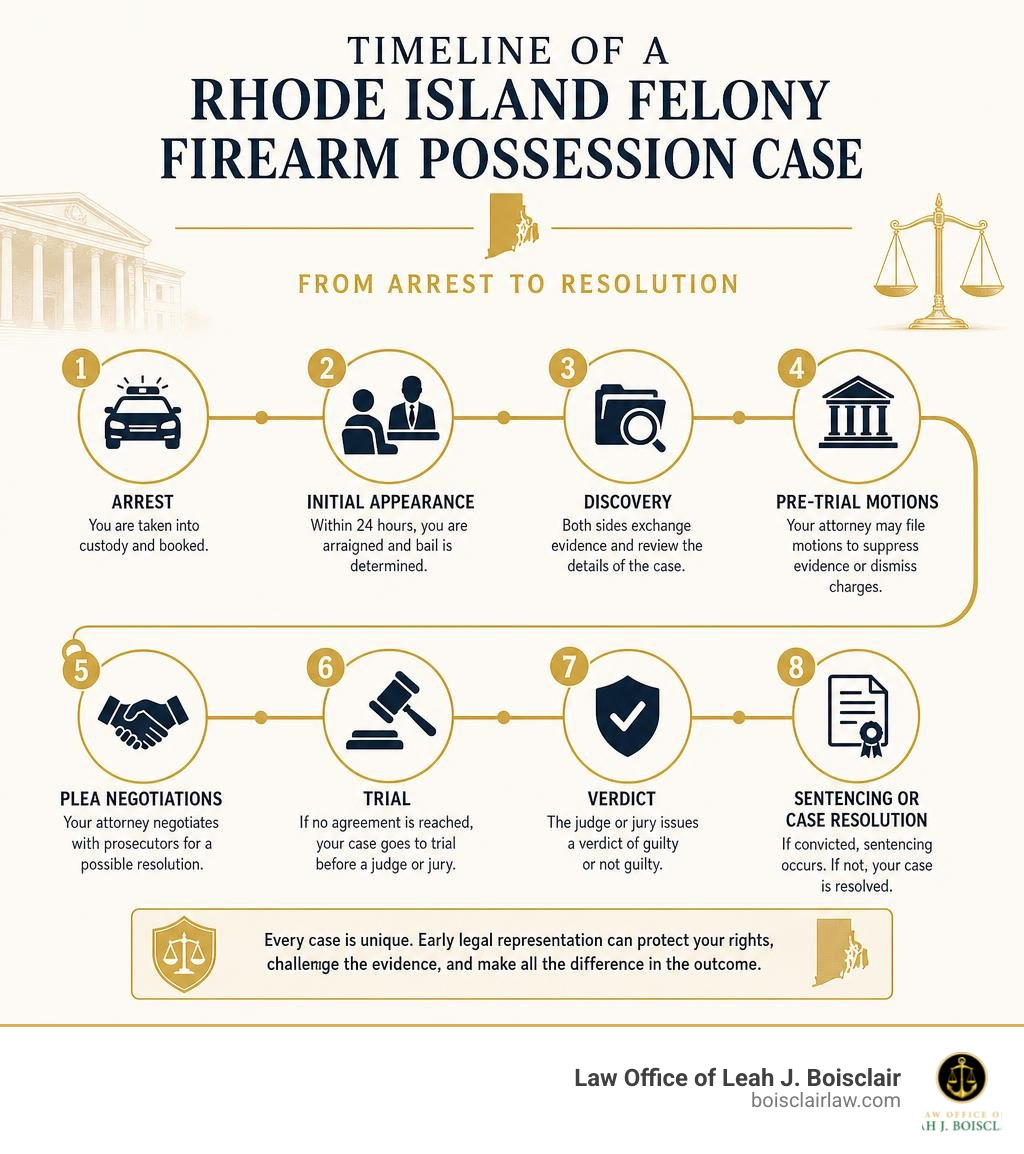
Understanding R.I. Gen. Laws § 11-47-5 and State vs. Federal Offenses
When it comes to firearm laws, Rhode Island does not play around. But to build a strong defense, we first have to understand exactly what the state and federal governments are accusing you of.
Under Rhode Island state law, specifically R.I. Gen. Laws § 11-47-5, it is unlawful for any person who has been convicted of a “crime of violence” to purchase, own, carry, transport, or have in their possession any firearm.
But what exactly is a “crime of violence” under state law? Rhode Island defines this category specifically, and it includes offenses like murder, manslaughter, rape, robbery, kidnapping, felony assault, and certain domestic violence offenses. If your prior felony falls under this definition, you are strictly prohibited from possessing a firearm.
Meanwhile, the federal government operates under a completely different, much broader standard. Under 18 U.S.C. § 922(g)(1), anyone convicted of any crime punishable by imprisonment for a term exceeding one year (which is the standard definition of a felony) is barred from possessing a firearm that has traveled in interstate commerce.
To help visualize how these two jurisdictions stack up, let’s look at a quick comparison:
| Feature | Rhode Island State Law (R.I.G.L. § 11-47-5) | Federal Law (18 U.S.C. § 922(g)) |
|---|---|---|
| Who is prohibited? | Felons convicted of a “crime of violence” or specific domestic offenses | Anyone convicted of any felony (punishable by > 1 year in prison) |
| Standard Penalty | 2 to 10 years in state prison | Up to 10 years in federal prison |
| Mandatory Minimum | 2 years (must be served, cannot be suspended) | No standard mandatory minimum, but strict guidelines apply |
| Severe Enhancements | Consecutive sentencing for firearm use during a felony | 15-year mandatory minimum under the Armed Career Criminal Act (ACCA) |
Understanding the distinction between felonies and misdemeanors is crucial here, as a prior misdemeanor conviction might not trigger these severe prohibitions, whereas a felony conviction almost certainly will.
Actual vs. Constructive Possession
To convict you, the prosecution must prove that you actually “possessed” the firearm. In legal terms, possession comes in two flavors:
- Actual Possession: The firearm was physically on your person—in your hand, in your pocket, or tucked into your waistband.
- Constructive Possession: The firearm was not on your person, but the prosecution argues you knew it was there and had both the power and the intent to exercise control over it. For example, if a gun is found under the driver’s seat of a car you are driving, or in a bedside drawer in your bedroom, the state will argue constructive possession.
Furthermore, possession can be sole (only you had control over it) or joint (multiple people had access and control over it, such as a firearm sitting on a coffee table in a shared apartment). Defending against constructive and joint possession is one of the most common battlegrounds for a skilled firearms offenses defense attorney.
Why You Need a Felony Firearm Possession Attorney Rhode Island: 5 Best Defense Alternatives to Conviction
If you are facing these charges, the worst thing you can do is sit back and hope for the best. Prosecutors are aggressive, and the court system can feel like a meat grinder. You need an experienced felony firearm possession attorney in Rhode Island to identify weaknesses in the government’s case and build a custom defense strategy.

At the Law Office of Leah J. Boisclair, we look at every case through a critical lens. We don’t just accept the police report as truth; we tear it apart to find constitutional violations and evidentiary gaps. For a deeper look at your options, check out our guide on Cranston gun charge alternatives.
Below, we break down the five best defense alternatives and strategies we use to fight these charges.
Alternative 1: Challenging Unlawful Search and Seizure with a Felony Firearm Possession Attorney Rhode Island
The Fourth Amendment of the U.S. Constitution protects you from unreasonable searches and seizures. If the police obtained the firearm by violating your constitutional rights, that firearm cannot be used as evidence against you.
This is known as the exclusionary rule. If we can successfully argue a Motion to Suppress Evidence, and the judge agrees the search was illegal, the firearm is thrown out. Without the firearm, the prosecution’s case almost always collapses entirely.
We look for several common law enforcement errors, including:
- Illegal Traffic Stops: Did the police have reasonable suspicion to pull you over in the first place? If they stopped you on a “hunch” without a valid traffic violation, everything that followed—including the discovery of a firearm—is tainted.
- Warrantless Home Searches: Did the police enter your home without a warrant, without your genuine consent, and without an emergency (exigent circumstances)?
- Defective Search Warrants: If the police did have a warrant, was it based on false information, or did they exceed the scope of what the warrant allowed them to search?
Alternative 2: Attacking Constructive and Joint Possession Claims
As we mentioned earlier, constructive possession is a favorite tool of prosecutors. If they find a gun in a car with four passengers, they will often arrest everyone and let the courts sort it out.
But mere proximity to a firearm does not equal legal possession. To prove constructive possession, the state must prove beyond a reasonable doubt that you:
- Knew the firearm was there.
- Had the power to take control of it.
- Intended to exercise control over it.
If you were a passenger in a friend’s car, and police found a gun hidden deep inside the glove compartment, we can argue that you had no knowledge of the weapon and no intention to control it. This is especially true in shared apartments where roommates, family members, or guests have equal access to common areas.
For more information on how Rhode Island handles carrying issues, read our detailed breakdown of carrying without a license in Rhode Island.
Alternative 3: Proving Lack of Knowledge or Insufficient Evidence
Sometimes, the simplest defense is the truest one: you simply did not know the gun was there.
If you borrowed a family member’s vehicle to run an errand, or if you bought a used couch and a previous owner left a weapon slipped between the cushions, the element of “knowing possession” is entirely missing.
We also challenge the physical and scientific evidence the state relies on. Police officers love to assume a gun belongs to the nearest person, but we ask the hard questions:
- Did the state perform DNA testing on the firearm?
- Are there fingerprints on the weapon, the magazine, or the ammunition?
- If forensic testing comes back negative or inconclusive, the prosecution’s case rests on pure speculation.
Additionally, we carefully scrutinize any co-defendant or witness testimony. If someone else is pointing the finger at you, they may be doing so to secure a favorable plea deal for themselves. We expose these motives on cross-examination to show the jury that the state’s witnesses cannot be trusted. If the firearm itself is suspected of being stolen, we also look closely at the origin of the weapon—learn more about possession of stolen firearms in Rhode Island.
Alternative 4: Seeking Rights Restoration and Expungement with a Felony Firearm Possession Attorney Rhode Island
If you have a prior felony conviction on your record, you might wonder if there is a way to clean up your past to avoid these severe firearm restrictions entirely.
Under Rhode Island law, certain non-violent offenses can be expunged after a specific period of crime-free living. If your prior conviction is successfully expunged, you may no longer be considered a prohibited person under state law.
However, this process is highly complex and has strict limitations:
- Violent Offenses: If your prior felony is classified as a “crime of violence,” it is generally excluded from expungement.
- Sealing Drug Convictions: There are special legal provisions that allow certain past drug offenses to be sealed, which can help restore your standing.
- Licensing Review Board Petitions: In some cases, individuals can petition the state for a restoration of rights, but this is a high-stakes, one-shot opportunity that requires meticulous preparation.
Working with an experienced Rhode Island criminal attorney is the best way to determine if you are eligible for expungement or rights restoration.
Alternative 5: Negotiating Reduced Offenses or Diversion Programs
If the evidence against you is strong and a trial is too risky, we turn our focus to strategic negotiation. We don’t just accept the first plea deal the prosecutor throws our way. Instead, we compile a comprehensive mitigation package to show the prosecutor and the judge who you really are—beyond the charges on the paper.
Depending on your background and the specific facts of your case, we may negotiate to:
- Reduce the Felony to a Misdemeanor: Removing the “felony” label can save you from a mandatory prison sentence and protect your future employment.
- Challenge Predicate Classifications: We carefully review your prior record to ensure the prosecution isn’t incorrectly treating a non-qualifying prior offense as a “crime of violence” or a federal predicate felony.
- Explore Diversion Programs: While diversion is difficult to obtain for firearm offenses, we exhaust every possible avenue to keep your record clean.
To better understand the overall landscape of criminal representation in our state, consult the ultimate guide to RI criminal attorneys.
Common Arrest Scenarios, Bail, and Pretrial Detention
Most felony firearm arrests don’t happen during high-profile raids. They happen during everyday, routine encounters with law enforcement that quickly spiral out of control.
- Traffic Stops: A broken taillight in Providence or a minor speeding infraction in Cranston leads to a vehicle search, and a firearm is discovered in the console or under a seat.
- Domestic Disputes: Police respond to a loud argument at a home, conduct a safety sweep, and locate a firearm in a closet.
- Joint Possession Arrests: You are visiting a friend’s house when police execute a search warrant. Because you are a convicted felon and a firearm is found in the living room, you are arrested alongside the homeowner.
Bail and the Pretrial Detention Battle
Once you are arrested, the very first battle is getting out of jail while your case is pending. In Rhode Island, the court takes firearm offenses incredibly seriously when deciding bail. Under the state’s bail guidelines and the federal Bail Reform Act, there is often a strong push by prosecutors to keep firearm defendants detained without bail, arguing they pose a danger to the community.
This is why the first 48 to 72 hours after an arrest are absolutely critical. We immediately begin building a comprehensive “release package” to present to the judge. This package may include:
- Proof of stable employment and housing in Cranston, Warwick, or surrounding areas.
- Letters of support from family, employers, and community members.
- Proposals for strict bail conditions, such as home confinement, GPS monitoring, or mental health counseling.
If you or a loved one has been arrested, do not wait. Read more about why to hire a Rhode Island criminal defense attorney immediately to protect your freedom from day one.
Frequently Asked Questions About Felony Firearm Possession in Rhode Island
What are the penalties for a felon-in-possession conviction in Rhode Island?
Under R.I. Gen. Laws § 11-47-5, a conviction carries a mandatory minimum sentence of 2 years and up to 10 years in state prison. This mandatory minimum cannot be suspended or deferred by the judge—you must serve it.
On the federal side, a conviction under 18 U.S.C. § 922(g) carries up to 10 years in federal prison. However, if you have three or more prior convictions for violent felonies or serious drug offenses, the Armed Career Criminal Act (ACCA) triggers a massive 15-year mandatory minimum sentence.
Additionally, if a firearm is used during the commission of another felony, Rhode Island’s enhancement statute (R.I.G.L. § 11-47-3.2) mandates an extra 10-year consecutive sentence that must be served after your primary sentence ends. You can access more information about these complex laws through specialized Rhode Island firearms defense resources.
Can a prior felony conviction be expunged to restore my firearm rights?
It depends entirely on the nature of your prior felony. If your prior conviction was for a non-violent offense, and you have completed all terms of your sentence and remained trouble-free for the legally required timeframe, you may be eligible for expungement.
However, if your prior conviction is legally classified as a “crime of violence,” Rhode Island law generally prohibits it from being expunged. Furthermore, even if state rights are restored, federal law has extremely strict hurdles because the federal program to restore individual firearm rights has been defunded for years.
To explore if your specific past offense can be cleared, we invite you to review our comprehensive list of legal practice areas.
What are the long-term collateral consequences of a conviction?
The damage of a felony firearm conviction extends far beyond the prison walls:
- Employment: Most employers run background checks, and a felony firearm conviction is an immediate red flag that can disqualify you from professional licenses, trade work, and corporate jobs.
- Housing: Finding a place to live becomes incredibly difficult, as many landlords strictly refuse to rent to individuals with felony weapons convictions.
- Loss of Civil Rights: You will lose your right to vote (while incarcerated), serve on a jury, and hold public office.
- Permanent Loss of Second Amendment Rights: You will be permanently barred from legally owning or possessing any firearm for the rest of your life.
These consequences are even more severe if companion issues are involved, such as allegations of carrying a firearm under the influence in Rhode Island.
Conclusion
A felony firearm possession charge in Rhode Island is a life-altering event, but it does not have to mean the end of your future. The key to a successful outcome is early, aggressive, and highly personalized legal representation.
At the Law Office of Leah J. Boisclair, we provide compassionate, relentless defense advocacy for clients throughout Cranston, Providence, Warwick, Johnston, and across Rhode Island. We know how the state builds its cases, and we know exactly where to look for the cracks in their evidence.
From the moment you contact us, we focus on your goals—whether that means fighting for a complete dismissal of charges, challenging an illegal police search, or negotiating a resolution that keeps you out of prison.
If you or a loved one is facing a firearm charge, do not wait for the prosecution to take the lead. Contact a Rhode Island Firearm Offenses Defense Attorney today at the Law Office of Leah J. Boisclair, and let’s start building your defense together.