Your Speedy Trial Rights: What Every Criminal Defendant Needs to Know
Speedy trial rights are one of the most powerful – and most misunderstood – protections in the U.S. Constitution. If you or someone you love is facing criminal charges, these rights could mean the difference between a case that drags on for years and one that gets dismissed entirely.
Here is a quick overview of what speedy trial rights mean in practice:
- Constitutional basis: The Sixth Amendment guarantees every person accused of an offense the right to a speedy and public trial.
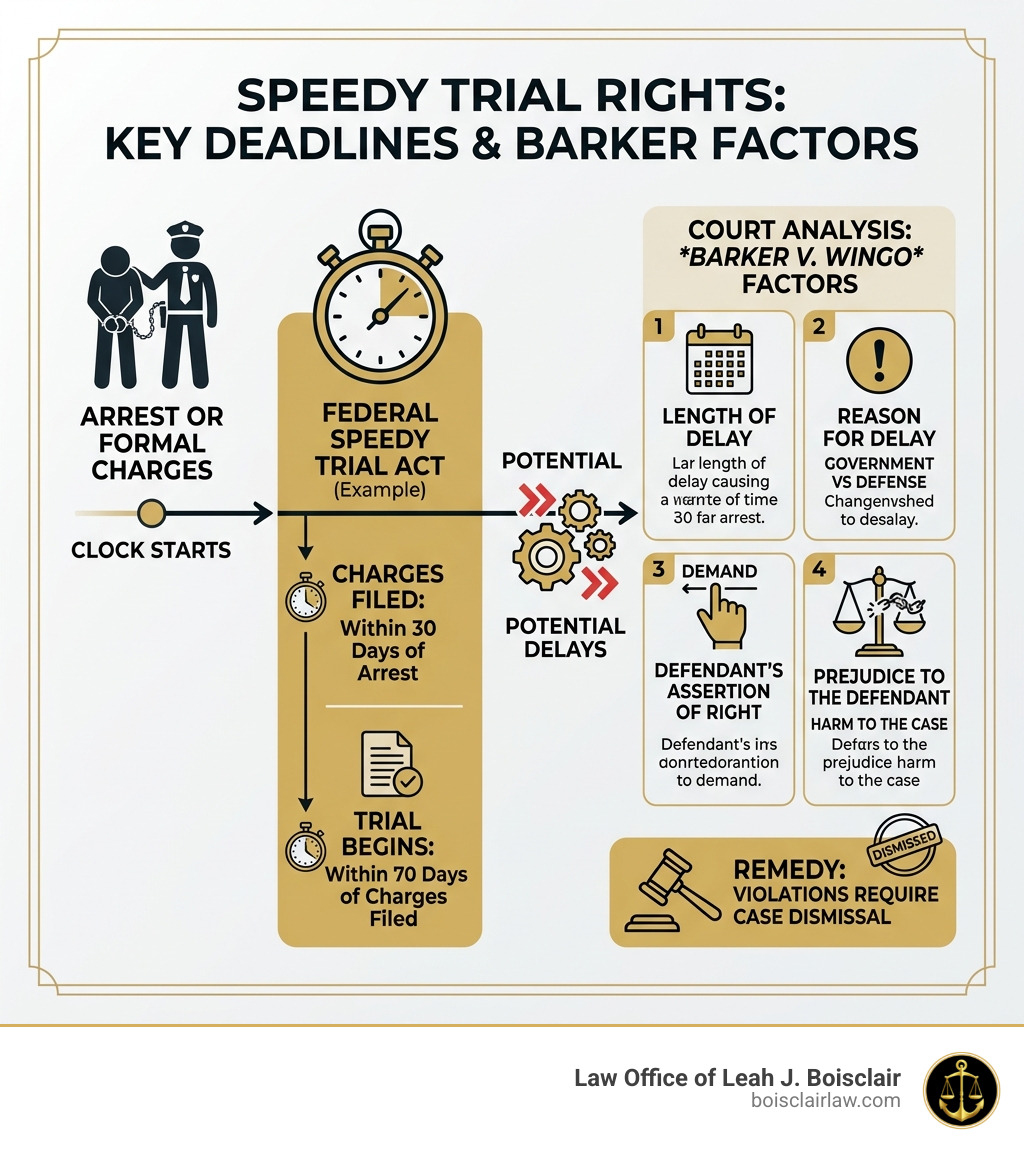
- When the clock starts: Generally at the point of arrest or formal charges, whichever comes first.
- Federal time limits: Under the federal Speedy Trial Act, charges must be filed within 30 days of arrest, and trial must begin within 70 days of charges being filed.
- How violations are judged: Courts use the four-factor Barker v. Wingo test – looking at the length of delay, the reason for it, whether you asserted your right, and whether the delay hurt your case.
- The remedy: If your speedy trial rights are violated, the charges against you must be dismissed – often permanently.
The Sixth Amendment reads simply that “in all criminal prosecutions, the accused shall enjoy the right to a speedy and public trial.” But as courts have noted over the decades, this right is anything but simple. It has been described as both fundamental and “amorphous” – meaning it is critically important, yet its exact boundaries are not always clear.
That uncertainty is exactly why it matters so much to have an attorney who understands how to identify, assert, and protect these rights on your behalf.
The Constitutional Basis for Speedy Trial Rights
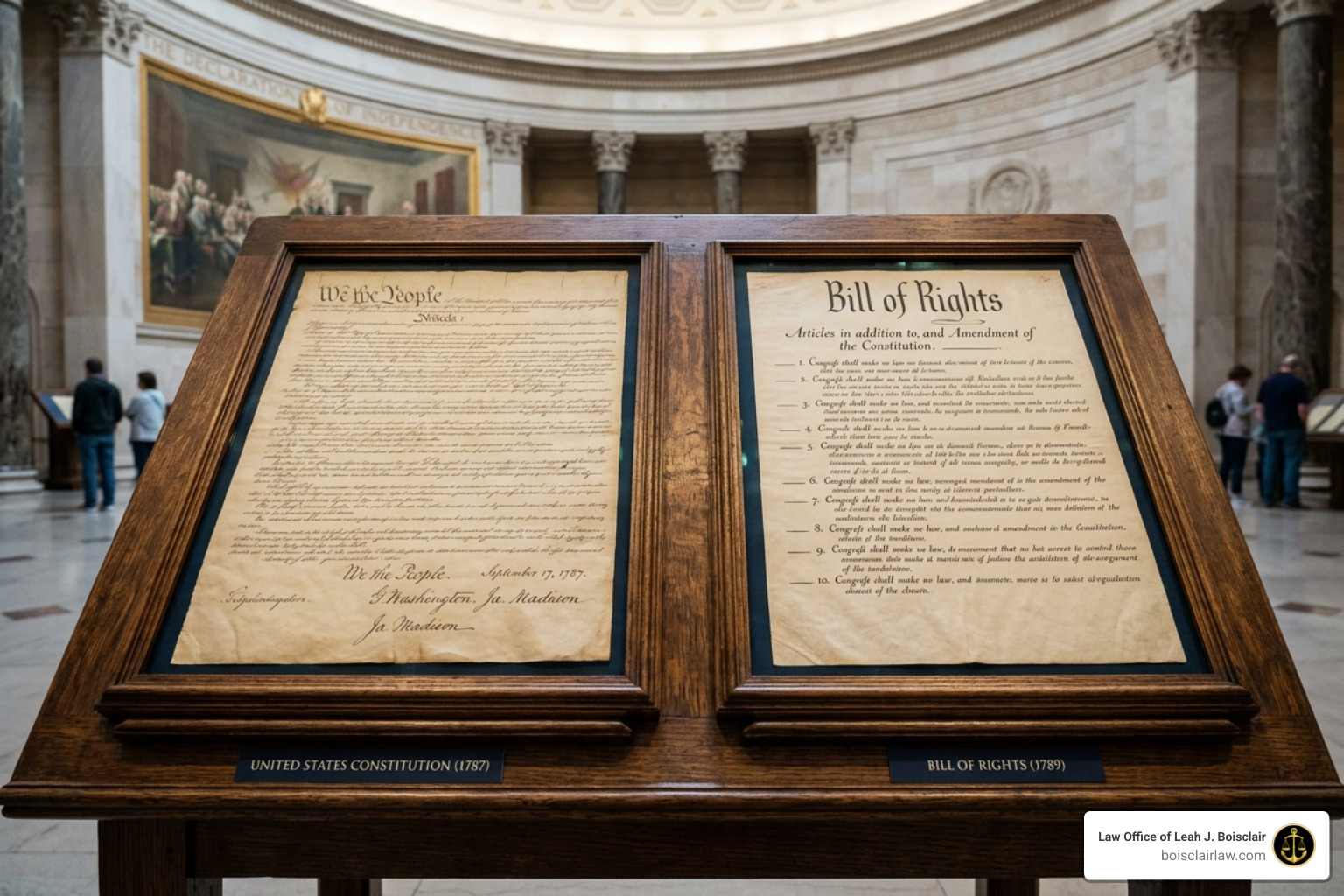
At the Law Office of Leah J. Boisclair, we believe that understanding your history is the first step toward defending your future. The right to a speedy trial isn’t just a modern legal technicality; it is a pillar of justice that dates back centuries, eventually being enshrined in the Sixth Amendment of the U.S. Bill of Rights.
The primary purpose of this right is threefold:
- To prevent oppressive pretrial incarceration.
- To minimize the anxiety and concern that naturally accompanies a public accusation.
- To limit the possibility that a long delay will impair the ability of the accused to defend themselves (such as witnesses dying or memories fading).
According to the Overview of the Right to a Speedy Trial | U.S. Constitution Annotated | US Law | LII / Legal Information Institute, this protection applies to all criminal prosecutions. However, it is important to note that the “speedy trial clock” doesn’t start ticking just because the police are looking at you.
Triggering Events: When Does the Clock Start?
The Sixth Amendment protection is triggered by either a formal indictment or an actual arrest – whichever happens first. If the government is investigating you for two years but hasn’t arrested or charged you, your Sixth Amendment speedy trial rights haven’t technically kicked in yet (though you might have protections under the Fifth Amendment’s Due Process Clause regarding pre-indictment delay).
For those of us here in Rhode Island, knowing What to Do If You’ve Been Arrested in RI is essential. Once that arrest occurs, the government is officially on notice: the clock is running, and they have a constitutional obligation to bring you to justice without “undue delay.”
The Barker v. Wingo Test: How Courts Evaluate Delays
Since the Constitution doesn’t give us a specific number of days that counts as “speedy,” the Supreme Court had to create a way to measure it. In the landmark 1972 case Barker v. Wingo, the Court established a four-factor balancing test. We use these factors today in April 2026 to argue for dismissals when the government drags its feet.
1. Length of Delay
This is the “triggering mechanism.” If the delay isn’t long enough to be “presumptively prejudicial,” the court won’t even look at the other factors. As a general rule of thumb, a delay of one year or more is considered presumptively prejudicial. However, for a simple misdemeanor, a shorter delay might trigger the test, whereas a complex white-collar case might allow for more time.
2. Reason for the Delay
Not all delays are treated equally. We look at who is at fault:
- Deliberate Government Delay: If the prosecutor delays the trial to hamper the defense, this weighs very heavily against the government.
- Negligence: If the court is overcrowded or the prosecutor is overworked, it still weighs against the government, but not as heavily.
- Valid Reasons: If a key witness goes missing or the defendant is the one requesting continuances, the delay is usually considered “excused.”
3. The Defendant’s Assertion of the Right
How hard did you push for your trial? If a defendant sits quietly for three years and then suddenly complains about a delay on the eve of trial, the court might not take the claim seriously. This is why we emphasize the importance of formally demanding a speedy trial early and often.
4. Prejudice to the Accused
This is often the most critical factor. Did the delay actually hurt you? Courts look at whether you spent those years in jail, the level of mental “anguish” you suffered, and – most importantly – whether your defense was weakened. In Doggett v. United States, an 8.5-year delay was found to be a violation even without specific proof of a lost witness, simply because the delay was so excessive. You can read more about the nuances of this clause at the Speedy Trial Clause Wikipedia page.
Federal vs. State Protections: The Speedy Trial Act and Local Rules
While the Sixth Amendment provides the “floor” for your rights, statutes often provide even stricter timelines. It is a bit like the difference between the minimum wage and a union contract – the contract gives you much better specific protections.
The Federal Speedy Trial Act
If you are facing federal charges, the Speedy Trial Act (18 U.S.C. § 3161) is your best friend. It sets very specific deadlines:
- Indictment: Must be filed within 30 days of your arrest.
- Trial: Must begin within 70 days of the indictment or your first court appearance.
However, the law allows for “excludable time.” This includes time spent on pretrial motions, mental competency exams, or “ends of justice” continuances granted by the judge.
Rhode Island and ABA Standards
In Rhode Island, we don’t have a statutory “70-day rule” that mirrors the federal act exactly, but our courts are bound by the Barker factors and our own state constitutional protections. Furthermore, many jurisdictions look to the American Bar Association (ABA) Standards for guidance.
| Provision | Federal Speedy Trial Act | ABA Standards |
|---|---|---|
| Arrest to Charge | 30 Days | 30 Days |
| Charge to Trial (Detained) | 70 Days | 90 Days |
| Charge to Trial (Released) | 70 Days | 180 Days |
| Remedy for Violation | Dismissal (With or Without Prejudice) | Dismissal with Prejudice |
As you can see, the standards vary, but the goal remains the same: keeping the system moving. If you’re navigating these waters, The Ultimate Guide to RI Criminal Attorneys can help you understand how local Cranston and Providence courts handle these timelines.
Strategic Considerations: When to Assert or Waive Your Rights
Here is a little secret from the defense side: sometimes, “speedy” isn’t actually what you want. While the right is yours, using it is a matter of strategy.
Why You Might Waive Your Rights
In many cases, we need time to build a rock-solid defense. If you are facing Firearm Offenses or complex Drug Offenses, we might need months to:
- Hire expert witnesses or forensic analysts.
- Conduct our own investigation into the police’s conduct.
- Track down witnesses who have moved.
- Negotiate for a dismissal or a reduced charge.
If we demand a trial in 70 days and the prosecution is ready but we aren’t, we are doing you a disservice. This is why Why Hire a Rhode Island Criminal Defense Attorney is such a vital question – you need someone who knows when to floor it and when to tap the brakes.
When to Push the Issue
On the flip side, if the prosecution’s case is falling apart – maybe their star witness is unreliable or their evidence is weak – pressing for a speedy trial can force them to either drop the charges or go to trial unprepared. This is especially true in DUI and Traffic Offenses, where police officers might move or evidence like blood samples might be mishandled over time.
For more sensitive matters, such as those discussed in Your Guide to Picking a Criminal Defense Attorney for Sex Offenses, the strategy around timing is even more delicate, as public perception and victim availability play huge roles in the courtroom.
Frequently Asked Questions about Speedy Trial Rights
When does the speedy trial clock start running?
As we mentioned earlier, the clock starts at the moment of arrest or when formal charges are filed (like an indictment or information), whichever comes first. If you received a summons in the mail to appear in court, that usually counts as the start date too. Just remember: being a “person of interest” doesn’t start the clock. You have to be officially “accused” in the eyes of the law.
Understanding the Remedy for a Violation of Speedy Trial Rights
What happens if we win a speedy trial motion? The remedy is surprisingly powerful. Under the Sixth Amendment, the only remedy for a violation is dismissal of the charges.
In federal court, a judge can choose between:
- Dismissal with Prejudice: The charges are gone forever. The government can never refile them. This usually happens if the delay was the government’s fault and it severely hurt your case.
- Dismissal without Prejudice: The current case is dismissed, but the government can “try again” by refiling the charges. While this feels like a loss, it often gives us a second chance to negotiate or find flaws in the new filing.
For Serious Offenses, judges are often more reluctant to dismiss with prejudice, but prosecutorial negligence can still tip the scales in our favor.
Protecting Your Speedy Trial Rights in Rhode Island
If you are in the Rhode Island court system, you can’t just wait for the judge to notice the delay. You have to be proactive. This involves:
- Asserting the Right: We often file a “Demand for Speedy Trial” early in the case.
- Objecting to Continuances: If the prosecutor asks for more time without a good reason, we make sure our objection is on the record.
- Filing a Motion to Dismiss: If the delay becomes unreasonable, we file a formal motion citing the Barker v. Wingo factors.
Working with a dedicated RI Criminal Attorney ensures that these procedural steps are handled correctly. We don’t let the government “forget” about your case while you sit in pretrial detention or live under the cloud of a pending trial.
Conclusion
Navigating the legal system can feel like being stuck in a maze where the walls keep moving. Your speedy trial rights are there to ensure that the maze doesn’t become a permanent residence. Whether you are dealing with Assault and Battery Offenses, Domestic Offenses, White Collar Offenses, or other Violent Offenses, the timing of your case is just as important as the evidence within it.
At the Law Office of Leah J. Boisclair, we provide personalized, compassionate advocacy. We don’t just see a case number; we see a person whose life is on hold. We have a proven track record of securing dismissals by holding the government accountable to the standards of the law.
If you’re in Cranston or anywhere in Rhode Island and you feel like your case is moving too slowly – or if you’ve just been arrested and want to make sure your rights are protected from day one – reach out to us. Let’s make sure your right to a speedy trial is more than just words on a page.
Protect Your Rights Today by scheduling a consultation with our team. We are here to help you move forward.