

When Every Hour Behind Bars Counts: What to Know About Getting Released in Providence
If you need a bail hearing attorney in Providence, here is what you should do right now:
- Call a criminal defense attorney immediately – before your arraignment if possible
- Do not speak to police about your case without a lawyer present
- Gather information about your employment, family ties, and residence to support your release
- Ask your attorney to argue for personal recognizance or the lowest possible bail at arraignment
- Know your rights – the Rhode Island Constitution guarantees bail for most offenses under Article 1, Section 9
Being arrested is frightening. Every hour in custody feels like a lifetime.
In Rhode Island, courts handle over 40,000 criminal cases every year. A bail hearing happens at arraignment in nearly every single one. What happens at that hearing can determine whether you go home that day – or wait behind bars until trial.
The stakes are real. In Providence County, roughly 30 to 40 percent of felony defendants are either held without bail or face bail amounts too high to pay. But defendants who have an attorney fighting for them at that hearing are significantly more likely to walk out the door.
This guide explains exactly how the Rhode Island bail process works – and how the right legal representation can make all the difference.
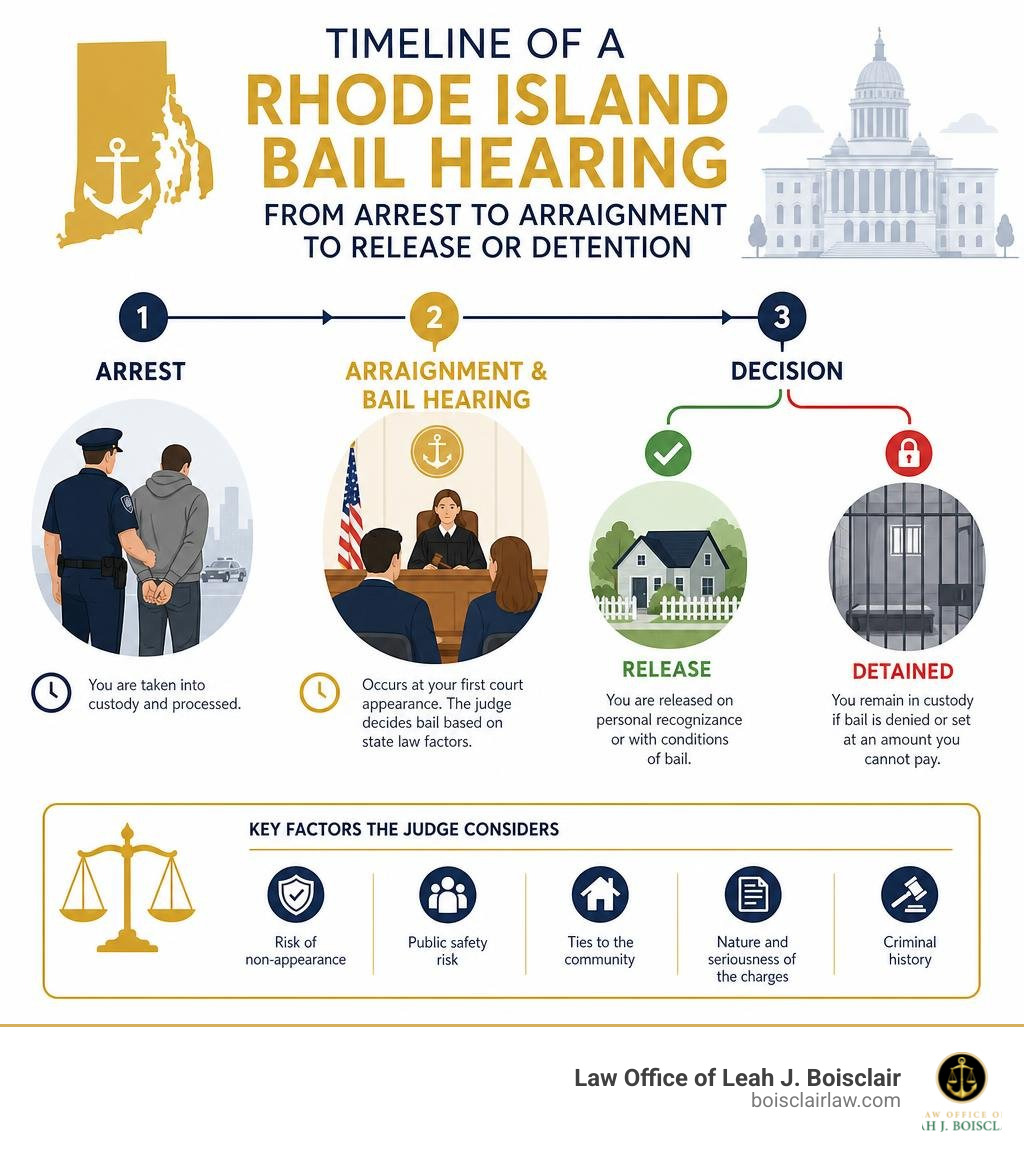
Quick bail hearing attorney providence definitions:
What is a Rhode Island Bail Hearing and When Does It Occur?
In Rhode Island, bail is not meant to be a punishment. Instead, it is a set of conditions designed to ensure that you show up for your future court dates and remain on good behavior while your case is pending.
A bail hearing is the formal court proceeding where a judge or bail commissioner decides whether you can be released from custody and, if so, under what specific conditions. In our June 2026 legal landscape, where Rhode Island courts process over 40,000 criminal cases annually, these hearings are the vital gatekeepers of personal liberty.
Most of these hearings occur during your arraignment, which is your very first appearance before a judge. Depending on the severity of the charges and the timing of your arrest, this initial step will take place in either the District Court (for misdemeanors and initial felony appearances) or the Superior Court (for formal felony arraignments).
If you are arrested during the evening, over the weekend, or on a holiday when the courts are closed, you will not have to wait in a cell until Monday morning. A bail commissioner can conduct a special arraignment directly at the police station. The commissioner will set your temporary bail conditions, allowing you to secure your release immediately, though you must still appear in District Court on the next business day. Knowing What to Do If You’ve Been Arrested in RI can help you keep your cool during this fast-moving window.
The Timeline of Pretrial Detention and Arraignment
Time moves differently when you are wearing handcuffs. Generally, Rhode Island law operates under a strict timeline to prevent prolonged, unauthorized detention:
- The 24-Hour Window: Following your arrest, the police must bring you before a judge or a bail commissioner within 24 hours for booking and an initial appearance.
- The Booking Process: During this time, the police will photograph you, take your fingerprints, and run a background check to look for outstanding warrants or active probation statuses.
- The Justice of the Peace / Bail Commissioner: If you are arrested on a Friday night in Johnston or Scituate, a bail commissioner will visit the police station to review the police report and set temporary conditions. The small administrative fee paid to a bail commissioner is non-refundable and does not count toward your actual bail amount.
- The Formal Court Arraignment: If you are held overnight, you will be transported to the nearest District Court (such as the 6th Division District Court in Providence) the following morning to have your charges formally read and your bail conditions established or reviewed.
How Judges Determine Bail: Flight Risk vs. Community Danger
When you stand before a judge at your bail hearing, the court is balancing two primary concerns: flight risk and danger to the community.
 [JUDICIAL BALANCING ACT]
 /
 /
 [Flight Risk] <-----/---------> [Community Danger]
 - Lack of local ties - Severity of offense
 - History of default - Past violent record
 - Financial resources - Threat to victims
To tip the scales in your favor, your bail hearing attorney in Providence must present a compelling narrative showing that you are neither. In Providence County, approximately 60% to 70% of felony defendants successfully secure some form of pretrial release. The remaining 30% to 40% are held because the court deems them too dangerous or too likely to flee.
To determine where you fall on this spectrum, judges look closely at your community ties, which include:
- How long you have lived in Rhode Island (specifically in local communities like Cranston, Warwick, or East Providence).
- Your current employment status and work history.
- Your family relationships and caretaking responsibilities.
- Your character, mental health, and any history of substance abuse.
- Your past criminal record, especially any history of failing to appear in court.
| Type of Pretrial Release | Financial Requirement | Best Suited For | Key Advantages |
|---|---|---|---|
| Personal Recognizance | $0 (Signature only) | First-time offenders, minor misdemeanors, strong local ties | Immediate release, no financial burden |
| Surety Bail | 10% of total set amount | Moderate to serious offenses, minor criminal record | Allows release on high amounts via a bondsman |
| Cash Bail | 100% of set amount (Refundable) | Flight risks, specific court-ordered conditions | Fully refundable upon case completion |
The Two-Tiered Evidentiary Standard for Capital Offenses
For extremely serious charges—often called capital offenses (such as murder, first-degree sexual assault, or major drug distribution offenses)—the right to bail is not guaranteed. In these high-stakes scenarios, the state may request that you be held without bail.
To do this, the court applies a strict two-tiered evidentiary standard:
- Tier One (The Proof is Evident): The prosecutor must present evidence showing that the “proof of guilt is evident, or the presumption great.” This is a lower standard than “beyond a reasonable doubt,” but it still requires the state to show a highly credible, strong case against you.
- Tier Two (Discretionary Factors): If the state meets that initial burden, the judge then exercises their judicial discretion. Your attorney can present mitigating evidence—such as deep family roots in Pawtucket or Scituate, an excellent employment record, or evidence of self-defense—to convince the judge that you can still be safely released under strict conditions (like home confinement or electronic monitoring).
Types of Pretrial Release and Monetary Bail Guidelines
If the judge agrees to grant you bail, they will choose one of several release types. Understanding these options is essential for planning your immediate release:
- Release on Personal Recognizance (Personal R.O.G.): This is the gold standard of pretrial release. You do not have to pay any money. You simply sign a written promise to appear at all future court dates. This is highly common for first-time, non-violent offenses in areas like West Warwick or Coventry.
- Surety Bail: The judge sets a financial amount (for example, $10,000). Under Rhode Island law, you do not need to pay the full amount to get out. Instead, you must post 10% of the total amount (in this case, $1,000) in cash to the court, or work with a licensed bail bondsman who will post the bond for a non-refundable fee.
- Cash Bail: In some cases, the judge may require a straight cash bail, meaning the entire amount must be paid in full to secure release. This money is held by the court and is refundable at the end of your case, provided you attend every single hearing.
- Double Surety: For highly sensitive cases, the court may require two separate property owners to put up their real estate as collateral to guarantee your appearance.
If you need to coordinate property bonds or find local resources, consulting with West Warwick Attorneys – Rhode Island – Lawyers – Cornell University or other local directories can help you locate licensed professionals quickly.
How a Bail Hearing Attorney in Providence Prepares Your Defense
A successful bail hearing does not happen by accident. It requires fast, meticulous preparation. Behind the scenes, we work tirelessly to build a comprehensive “release package” to present to the judge:
- Verifying Employment: We gather pay stubs, tax records, or letters from employers in East Greenwich or Johnston to prove that you have a stable job you cannot afford to lose.
- Mobilizing Family Support: We encourage family members to attend the hearing. Having a courtroom gallery filled with supportive parents, spouses, or siblings sends a powerful message to the judge that you have a strong safety net.
- Drafting Character Letters: We compile letters from community leaders, neighbors, or clergy members vouching for your reliability and character.
- Proposing Alternatives to Incarceration: If the judge is hesitant to grant simple release, we proactively propose middle-ground solutions, such as electronic GPS tracking, daily check-ins, or substance abuse counseling.
To understand how this preparation fits into the broader timeline of your case, check out The Ultimate Guide to RI Criminal Attorneys.
Securing Pretrial Release: Why You Need a Bail Hearing Attorney in Providence
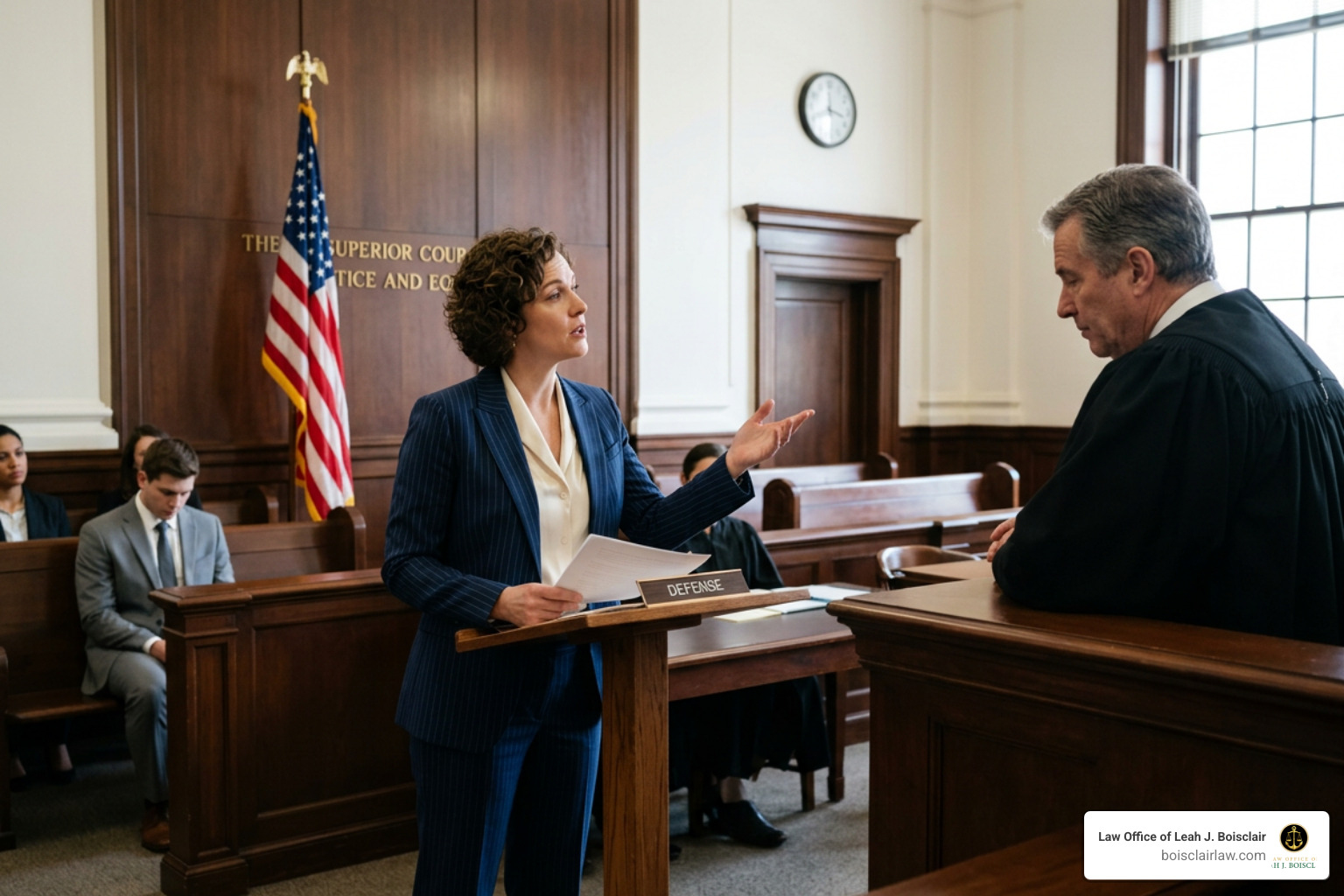
The moments immediately following an arrest are chaotic. While prosecutors are focused on the details of the police report, an experienced bail hearing attorney in Providence is focused entirely on you and your freedom.
Having professional legal representation at this exact moment is critical. Studies and local court data consistently show that represented defendants are far more likely to secure personal recognizance or obtain significantly lower cash bail amounts.
An attorney knows how to cross-examine police officers or state witnesses during an emergency bail hearing, pointing out inconsistencies in their stories or highlighting a lack of concrete evidence. We know how to speak the court’s language, turning a highly stressful arraignment into a structured, persuasive argument for your immediate release. If you or a loved one is currently held, securing a dedicated RI Criminal Attorney should be your absolute top priority.
Choosing the Right Bail Hearing Attorney in Providence for Your Case
Not all lawyers are created equal when it comes to the environment of a bail hearing. You need an advocate who possesses:
- Deep Local Knowledge: Every courtroom in Rhode Island has its own unique flow. An attorney who regularly practices in the Providence, Cranston, and Warwick courts understands the specific expectations of local judges and bail commissioners.
- Immediate Responsiveness: Bail emergencies do not keep business hours. You need a firm that can react instantly, call the police station, and stand by your side at a moment’s notice.
- A Personalized Strategy: Your defense should not be a copy-and-paste template. Your attorney must take the time to learn your personal story, your career goals, and your family situation to present the most humanizing defense possible.
To learn more about the long-term benefits of early legal intervention, read our guide on Why Hire a Rhode Island Criminal Defense Attorney.
Bail Violations, Revocations, and Requesting a Reduction
Once you are released on bail, you must walk a very straight line. The court will impose specific conditions, such as staying away from a certain location, abiding by a No Contact Order, or remaining within the state.
If you violate any of these conditions, the consequences are swift and severe. Under R.I. Gen. Laws § 12-13-1.2, committing a new offense while out on bail triggers mandatory consecutive sentencing:
- For Felonies: An additional consecutive prison sentence of 2 to 10 years, plus fines up to $5,000.
- For Misdemeanors: An additional consecutive sentence of 90 days to 1 year, plus fines up to $1,000.
Bail violation hearings in Rhode Island result in revocation in approximately 25% to 35% of cases. If your bail is revoked, you will be held at the Adult Correctional Institutions (ACI) in Cranston without bail until your case is resolved.
However, if your initial bail was set too high, you do not have to accept defeat. Your attorney can file a motion to reduce bail. If we can demonstrate a change in circumstances—such as new evidence coming to light, or proof of extreme financial hardship—we can secure a bail review hearing to ask the judge to lower the amount to something you can reasonably afford. If a District Court judge refuses, we can appeal the decision directly to the Rhode Island Superior Court.
Impact of Specific Charges on Bail Conditions
The nature of the allegations against you heavily influences the bail conditions a judge will set. Here is how different offenses are typically approached:
- Firearm Offenses: Because of the safety risks associated with firearms, judges almost always require surety bail, clean drug screens, and the immediate forfeiture of all personal firearms as a condition of release.
- DUI and Traffic Offenses: For a first-time DUI in Warwick or Johnston, personal recognizance is common, but it often comes with conditions like alcohol monitoring, random testing, or the installation of an ignition interlock device.
- Assault and Battery Offenses: These charges typically trigger mandatory No Contact Orders protecting the alleged victim. The judge may also require anger management classes as a condition of remaining free.
- Domestic Offenses: Under Rhode Island law, domestic charges carry an automatic, non-negotiable No Contact Order at arraignment. Violating this order will result in immediate arrest and bail revocation.
- Drugs Offenses: Simple possession of small amounts may result in personal recognizance. However, possession with intent to deliver can carry incredibly high surety amounts or hold-without-bail orders, often requiring proof of placement in a certified drug treatment program to secure release.
- Disorderly Conduct and Public Peace Offenses: These minor misdemeanors are usually resolved with personal recognizance and a simple warning to stay away from the location of the incident.
- Property Offenses: Charges like shoplifting, vandalism, or breaking and entering generally result in personal recognizance or low surety bail, often paired with “no-trespass” orders for the businesses involved.
- White Collar Offenses: Because violent danger is low, white-collar defendants are often released on personal recognizance, though the court may restrict out-of-state travel or require the surrender of a passport.
- Sex Offenses: These highly sensitive charges carry strict supervision requirements. Even if bail is granted, it is often accompanied by GPS monitoring, computer monitoring, and strict stay-away orders from schools or parks.
- Violent Offenses: Charges like robbery, kidnapping, or domestic felony assault carry a high risk of preventive detention. If bail is set, it is typically a substantial surety or cash amount.
- Computer Offenses: Pretrial release for cybercrimes often includes strict prohibitions on using computers, smartphones, or accessing the internet while the charges are pending.
Frequently Asked Questions About Providence Bail Hearings
Can a judge deny bail entirely in Rhode Island?
Yes. Under Article 1, Section 9 of the Rhode Island Constitution, a judge can deny bail for capital offenses (like murder or first-degree sexual assault) if the proof of guilt is evident. Additionally, the state can request preventive detention for non-capital felony offenses if they can prove you pose an extreme danger to the community or an absolute flight risk. A formal preventive detention hearing must take place within 10 days of your initial court appearance.
What happens if I violate my bail conditions?
If you violate your conditions—such as contacting someone protected by a No Contact Order or missing a court date—the court will issue an immediate bench warrant for your arrest. You will be brought back before a judge for a bail revocation hearing. If the state proves you violated your terms, you could be held at the ACI without bail for up to 90 days (or longer) while your case proceeds.
How can I get my bail amount reduced?
If the initial bail set by the judge or bail commissioner is financially impossible for your family to pay, your attorney can file a formal motion to reduce bail. At the review hearing, we will present evidence of your financial limitations, your deep roots in local Rhode Island communities, and any new mitigating facts about your case to convince the judge to lower the financial requirement.
Conclusion
A bail hearing is the single most critical moment of a newly active criminal case. It represents the thin line between sleeping in your own bed or spending weeks—even months—inside a jail cell while awaiting trial. You do not have to face this frightening process alone.
At the Law Office of Leah J. Boisclair, we provide expert, personalized, and compassionate criminal defense representation for clients facing misdemeanors, felonies, DUI, and more in state and federal courts. Operating out of Cranston, RI, we proudly serve individuals throughout Providence, Warwick, Johnston, and all surrounding areas. Our ultimate goal is to secure your freedom, protect your rights, and pursue proven dismissals.
If you or a loved one needs immediate help with an upcoming bail hearing or a bail reduction, contact us today to learn how we can advocate for you. Explore our Practice Areas to see how we can build a strong defense for your future.