
What Is White Collar Crime — and Why Should You Care?
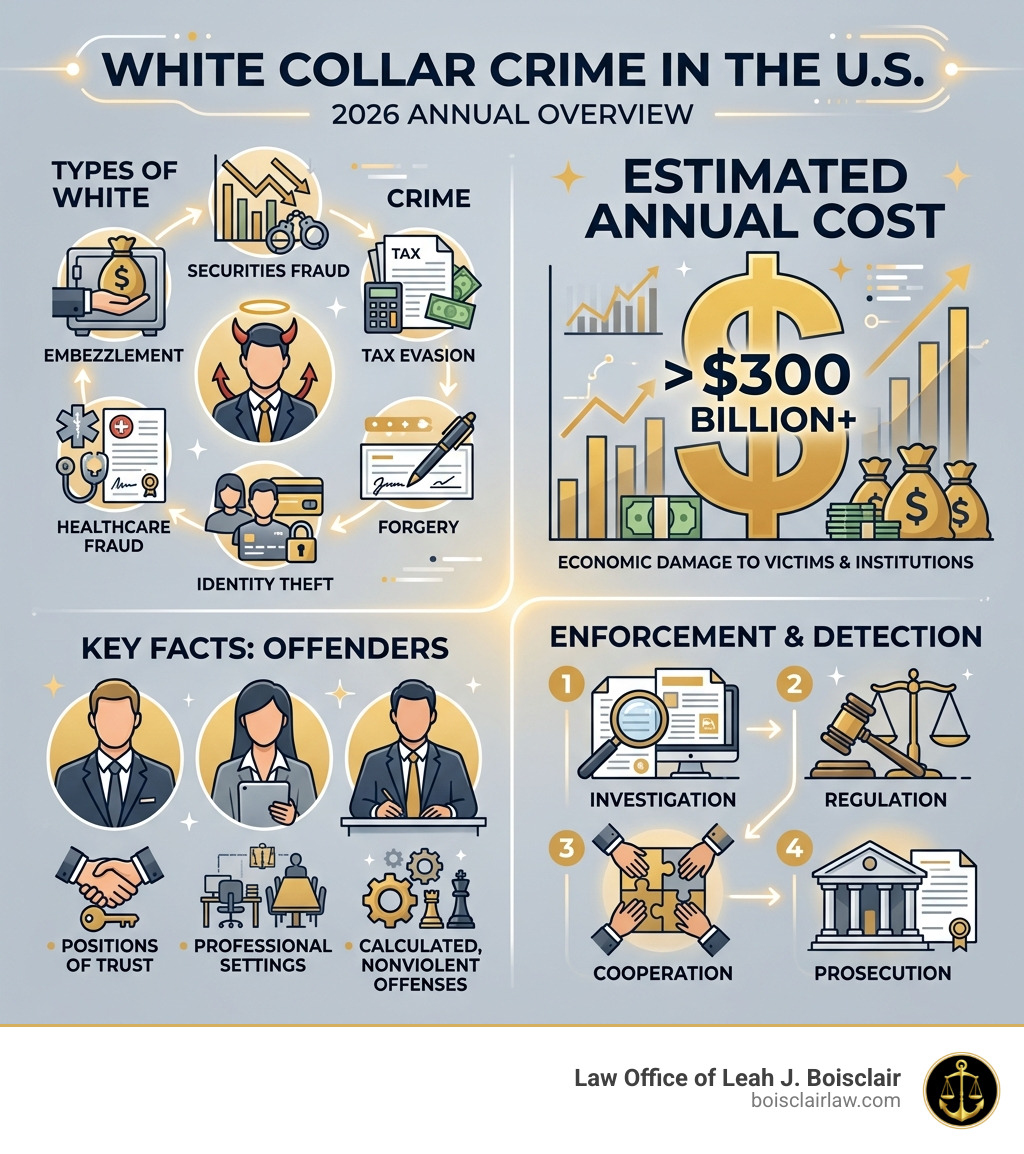
White collar crime refers to nonviolent offenses committed in professional or business settings for financial gain. These aren’t crimes of passion or desperation. They’re calculated — carried out by people in positions of trust, often over months or years.
Here’s a quick breakdown:
- What it is: Fraud, embezzlement, tax evasion, securities fraud, and similar financial offenses
- Who commits it: Business professionals, corporate executives, and government officials
- Where it happens: In offices, boardrooms, financial institutions, and online
- What it costs: The FBI estimates white collar crime costs the U.S. more than $300 billion every year
- Is it violent? No — but the damage to victims can be devastating and long-lasting
The term was first used in 1939, when criminologist Edwin Sutherland defined it as crime committed by “a person of respectability and high social status in the course of his occupation.” That definition still holds up today.
These offenses destroy companies, wipe out life savings, and shake public trust in institutions. And because they’re often hidden behind complex paperwork and professional facades, they can be surprisingly hard to detect — and hard to fight, whether you’re a victim or someone facing charges.
If you or someone you know is facing a white collar charge in Rhode Island, Massachusetts, or Connecticut, understanding what these offenses are — and what’s at stake — is the first step.
The Evolution and Definition of White Collar Crime
When we think of crime, we often think of “street crime”—theft, burglary, or physical altercations. However, white collar crime operates in a different sphere entirely. As we noted in the introduction, Edwin Sutherland revolutionized the field of criminology in 1939 by pointing out that people in suits and ties could be just as dangerous to society as those in back alleys.
At the Law Office of Leah J. Boisclair, we see how these cases often involve “occupational crime”—where an individual steals from their employer—or “organizational crime,” where a business as a whole engages in illegal practices to boost its bottom line. These white collar crime activities occur in commercial situations where the primary weapon isn’t a firearm, but a spreadsheet or a deceptive contract.
According to the white-collar crime definition from Wex at Cornell Law, these are nonviolent offenses usually committed for financial gain. While they lack physical violence, the “paper-based” nature of these offenses does not make them any less serious in the eyes of the law.

Common Types of White Collar Offenses
In our practice as a RI criminal attorney, we encounter a wide variety of financial allegations. Some of the most common include:
- Embezzlement: This occurs when someone who is trusted with another person’s or company’s money takes it for their own use. Think of a bookkeeper slowly diverting funds into a personal account.
- Securities Fraud: This involves deceiving investors or manipulating financial markets. Insider trading—using non-public info to trade stocks—is a classic example.
- Mortgage Fraud: This can be “fraud for profit” (industry insiders stealing equity) or “fraud for housing” (borrowers lying on applications). Federal agencies like the FBI prioritize “fraud for profit” because of the massive losses it causes to the banking system.
- Health Care Fraud: This is a massive issue in the U.S., costing tens of billions annually. It includes medical providers billing for services never rendered or “upcoding” to get higher payments from insurance or Medicare.
Demographics of White Collar Offenses
Who is the typical defendant in a white collar crime case? While anyone can be charged, statistics from April 2026 show that these offenders often share certain traits. They are frequently middle-aged (often in their late 30s to mid-40s) and are statistically more likely to be Caucasian men.
Unlike many other types of criminal defendants, those facing white collar charges often have higher education levels and strong ties to their community. They are corporate executives, doctors, lawyers, or local business owners. This “respectable” status is often what allows them to access the funds or information necessary to commit the crime in the first place.
Economic Impact and Federal Enforcement Agencies
The cost of white collar crime is staggering. While the FBI estimates the annual cost to the U.S. economy at over $300 billion, some experts believe that when you factor in intellectual property theft and economic espionage, the number could be even higher. Intellectual property theft alone costs American businesses billions every year, while economic espionage—stealing trade secrets for foreign entities—drains hundreds of billions from our economy.
In our local area, the White Collar Crime Unit of the Rhode Island Attorney General’s Office works to protect residents from these financial predators. At the federal level, agencies like the FBI, IRS, and SEC (Securities and Exchange Commission) use the Commerce Clause of the Constitution to regulate and prosecute these crimes across state lines.

Investigating Sophisticated White Collar Crime
Investigating these offenses is like putting together a 10,000-piece puzzle where half the pieces are hidden. The FBI and other agencies use forensic accounting to track digital footprints. One of the primary focuses of these investigations is money laundering, which generally happens in three stages:
- Placement: Getting the “dirty” money into the legitimate financial system.
- Layering: Moving the money through complex transactions to hide its source.
- Integration: Returning the money to the offender so it looks like “clean,” legitimate income.
The Role of Whistleblowers in Investigations
Because these crimes are so well-hidden, the government often relies on “insiders” to come forward. Whistleblowers play a massive role in exposing corruption. To encourage this, the SEC has a robust program that has awarded over $2.2 billion to more than 440 individuals since 2011.
In 2015 alone, the SEC received nearly 4,000 tips regarding bribes and corruption. These tips are vital for corporate accountability. If you are interested in learning more about how we handle various legal defenses, you can explore our practice areas.
Legal Doctrines and Supreme Court Precedents
One of the most unique—and frightening—aspects of white collar crime law is that you can sometimes be held responsible for a crime you didn’t even know was happening. This is known as the Responsible Corporate Officer (RCO) doctrine.
Established through Supreme Court cases like United States v. Dotterweich (1943) and United States v. Park (1975), this doctrine suggests that high-ranking officers are presumed to be aware of wrongdoing within their company. In the Park case, a food chain president was held liable for a rodent infestation in a warehouse, even though he had delegated the cleanup to others.
| Feature | Standard Criminal Intent | RCO Doctrine (Strict Liability) |
|---|---|---|
| Knowledge | Must prove the person knew of the crime | Knowledge is often presumed |
| Action | Must prove the person committed the act | Can be liable for failing to prevent the act |
| Typical Use | Theft, Assault, DUI | Public welfare, FDA, Environmental crimes |
| Defense | “I didn’t do it/know” | “I took every possible step to prevent it” |
Key Supreme Court Cases Shaping White Collar Crime Law
The legal landscape is constantly shifting. For example, the Stolen Valor Act (which made it a crime to lie about military honors) was originally struck down in United States v. Alvarez because it violated the First Amendment. However, it was later revised in 2013 to focus on those who lie with the specific intent to obtain a tangible benefit—bringing it firmly into the realm of white collar crime.
Other cases, like Loughrin v. United States, have clarified intent requirements in bank fraud, making it easier for prosecutors to secure convictions even if the defendant didn’t specifically intend to defraud a bank, as long as the scheme involved bank property.
Challenges in Prosecuting White Collar Offenses
Prosecuting these offenses is difficult because defendants often use “elaborate tricks” to hide their intentions. Unlike a robbery where the intent is clear, a complex financial transaction might look perfectly legal on the surface. Prosecutors must prove an “intent to defraud,” which requires digging through years of emails, bank statements, and witness testimony.
Because of these hurdles, law enforcement must use creative strategies. We have seen how these cases evolve, and you can view some of our case results to see how we navigate complex legal challenges.
Penalties, Punishments, and Defense Strategies
The penalties for white collar crime can be surprisingly harsh. While these are nonviolent offenses, federal judges often use the Federal Sentencing Guidelines to hand down significant prison terms, especially if the financial loss to victims is high.
Common punishments include:
- Restitution: Paying back the victims every cent lost.
- Asset Forfeiture: The government seizing property, cars, or bank accounts believed to be linked to the crime.
- Home Detention and Supervised Release: Strict monitoring that limits a person’s freedom even if they aren’t behind bars.
Sentencing for High-Profile White Collar Offenses
In some extreme cases, sentences for white collar offenses exceed those for violent crimes. For example, some individuals involved in massive racketeering or investment schemes have received sentences of 150 to over 800 years. The goal of these long sentences is deterrence—sending a message to other professionals that the “reward” of fraud isn’t worth the risk.
Effective Defense Against White Collar Offenses
If you are facing white collar crime allegations, all hope is not lost. There are several effective defense strategies we employ:
- Lack of Intent: If we can prove that the error was a mistake or a result of negligence rather than a deliberate plan to defraud, the charges may not hold.
- Proximate Cause: Arguing that the financial loss was caused by market factors or third parties rather than the defendant’s actions.
- Constitutional Protections: Ensuring that the government didn’t violate your rights during their investigation (such as illegal searches of your digital data).
For more specific information on how we handle these cases, visit our page on white collar crimes defense attorney services.
Frequently Asked Questions about White Collar Offenses
What is the difference between white-collar crime and organized crime?
While they can overlap, white collar crime is generally non-violent and occurs within a legitimate professional setting (like a bank or corporation). Organized crime typically involves a structured group dedicated to illegal activities like trafficking or extortion. However, many white collar schemes, such as money laundering, are used by organized crime groups to hide their tracks.
Can a corporate officer be held liable for crimes they didn’t personally commit?
Yes, under the Responsible Corporate Officer doctrine. If an officer has the authority to prevent a “public welfare” offense (like selling contaminated food or violating environmental laws) and fails to do so, they can be prosecuted even if they didn’t personally handle the illegal items.
What are the most common penalties for first-time white-collar offenders?
For a first-time offender, a judge may consider probation, community service, or a shorter prison sentence. However, heavy fines and full restitution are almost always required. The specific sentence depends heavily on the amount of money involved and the number of victims.
Conclusion
At the Law Office of Leah J. Boisclair, we understand that being accused of a white collar crime can feel like your entire world is collapsing. These charges don’t just threaten your freedom; they threaten your reputation, your career, and your family’s future.
Our firm, located in Cranston, RI, provides personalized and compassionate advocacy for those facing state and federal charges. We pride ourselves on our proven track record of dismissals and our ability to navigate the most complex financial litigation. You don’t have to face the government’s investigators alone.
If you need a defense that is as sophisticated as the charges against you, Contact a White Collar Crimes Defense Attorney at our office today for a consultation. We are here to protect your rights and help you move forward.