

What an Early Release Petition in Providence Actually Means (And Which Type Applies to You)
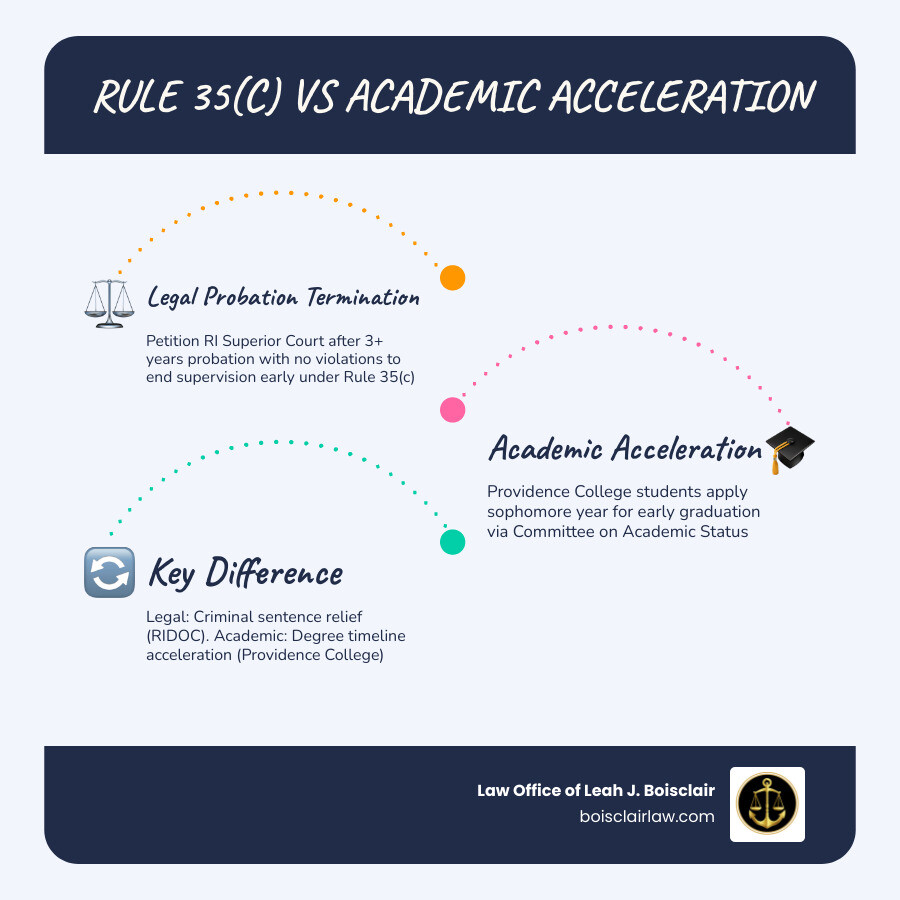
Early release petition Providence covers two very different situations — and knowing which one applies to you is the first step.
Here’s a quick breakdown:
| Type | Who It’s For | Governing Body |
|---|---|---|
| Legal probation termination | People on probation in RI after a criminal sentence | Rhode Island Superior Court (Rule 35(c)) |
| Academic acceleration | Providence College students seeking early graduation | Committee on Academic Status |
If you are on probation and want to end your supervision early, this article will walk you through the legal process step by step.
Rhode Island has some of the longest probation terms in the country. The average term runs six years — three times the national average. More than 62% of people on probation in Rhode Island have already served more than three years, which is the point at which recidivism drops significantly.
That means many people are supervised far longer than public safety requires.
The good news: Rhode Island law gives you a path out. Rule 35(c) of the Rhode Island Superior Court Rules allows eligible probationers to petition the court for early termination — without needing a lawyer.
But the process has real steps, real deadlines, and real consequences if done wrong.
Filing a Legal Early Release Petition Providence
When we talk about a legal early release petition providence, we are usually referring to the process of ending a probation sentence before its original expiration date. In Rhode Island, this is governed by Rule 35(c) of the Superior Court Rules of Criminal Procedure. This rule was specifically designed to help reduce the “banked” probation population in our state, which has historically been one of the highest in the nation.
Navigating the court system can feel like trying to read a map in a different language. However, the Early Termination From Probation Rule 35(c) | Department of Corrections provides a structured path for those who have shown they no longer require active supervision. This process is a vital tool for moving forward with your life, much like how many of our clients look into Wipe Your Record Clean with These Expungement Steps once their supervision ends.
Eligibility for a Legal Early Release Petition Providence
Not everyone on probation is immediately eligible to file. The state has set specific “gatekeeper” requirements to ensure that only those who have demonstrated consistent rehabilitation can apply. To be considered for an early release, you must meet the following criteria:
- The 3-Year Rule: You must have served at least three (3) continuous years of probation in the community.
- Clean Record: You cannot have been declared a violator at any point during those last three years.
- No Pending Issues: You cannot have any pending criminal charges in any jurisdiction (state or federal) or any active probation/parole in another state.
- Safety First: There must be no active no-contact orders associated with your case.
If you are unsure if your specific charges or history meet these marks, consulting a RI Criminal Attorney can provide the clarity you need before you start the paperwork.
Criteria for Successful Termination
Meeting the time requirement is only half the battle. The court wants to see that you have fulfilled the “spirit” of your sentence. This means:
- Financial Obligations: All court costs, fines, and fees must be paid in full.
- Restitution: If you were ordered to pay back a victim, that balance must be zero.
- Special Conditions: If your sentence required substance abuse counseling, domestic violence programs, or community service, you must have completed every single hour and session.
Think of it as a final exam for your probation. If you haven’t done the homework, the judge is unlikely to let you graduate early. We often see that successfully completing this process makes a person much better candidate for future expungement services, as it proves to the court that you are committed to a law-abiding life.
Understanding Rule 35(c) and Probation Termination
The process doesn’t start at the courthouse; it starts with the Rhode Island Department of Corrections (RIDOC). Before you can even ask a judge for help, you need a “Certificate of Eligibility.”

You should contact the Early Termination Supervisor at RIDOC (currently Jenn Donovan) to request a file review. They will verify that you’ve hit your three-year mark and haven’t had any violations. If you pass their internal check, they issue the certificate. Without this piece of paper, your motion in Superior Court will likely be rejected immediately. You can find more details on the official Early Termination From Probation Rule 35(c) page.
While the law allows you to do this yourself, many choose to seek professional help. Understanding Why Hire a Rhode Island Criminal Defense Attorney becomes clear when you realize that the Attorney General’s office may still object to your release, even if you have your certificate.
The Role of the Court and Attorney General
Once you file your Rule 35(c) motion with the certificate attached, the court will schedule a hearing. This is where things get serious.
- Judicial Discretion: Even if you meet all the technical requirements, a judge doesn’t have to let you off. They must be convinced that you no longer require supervision and that releasing you is in the interest of justice.
- Victim Notification: The law requires that victims in your case be notified. They have the right to show up and tell the judge why they think you should stay on probation.
- The AG’s Stance: The Attorney General’s office will conduct their own investigation. They might argue that the nature of the original offense was too severe for early termination.
We take pride in our Case Results, where we help clients present the strongest possible evidence of their growth to counter these objections.
Offenses Eligible for Review
Whether you are dealing with Felonies and Misdemeanors, most standard probation sentences are eligible for Rule 35(c) review after the three-year mark. This includes:
- Firearm Offenses: Carrying without a license or possession by a prohibited person.
- DUI and Traffic Offenses: Repeated offenses or those involving serious injury.
- Assault and Battery Offenses: Simple assault or felony battery.
- Domestic Offenses: Domestic assault or violation of no-contact orders.
- Drug Offenses: Possession or delivery of controlled substances.
- Public Order and Safety Offenses: Disorderly conduct or obstruction of justice.
- Property Offenses: Larceny, breaking and entering, or vandalism.
- White Collar Offenses: Embezzlement or identity theft.
- Sex Offenses: (Note: These often have much stricter supervision requirements).
- Violent Offenses: Robbery or felony assault.
- Computer Offenses: Online fraud or unauthorized access.
Academic Acceleration at Providence College
Switching gears entirely, an early release petition providence might not involve a courtroom at all — it might involve a classroom. At Providence College (PC), the standard requirement for a degree is eight semesters of full-time attendance. However, some students wish to “accelerate” their program to graduate in seven semesters.
This isn’t just about taking extra classes; it’s a formal petition process through the Committee on Academic Status.
| Timeline Element | Standard Graduation | Accelerated Graduation |
|---|---|---|
| Semesters Required | 8 | 7 |
| Full-Time Status | Required every term | Required for 7 terms |
| Petition Deadline | N/A | End of Sophomore Year |
| Summer/Winter Work | Optional | Often Mandatory |
If you are a student or parent navigating this, you know it requires the same level of precision as a legal filing. While our firm focuses on legal Practice Areas, we understand the importance of following institutional procedures to reach your goals.
Requirements for an Academic Early Release Petition Providence
The window for this petition is narrow. Students must submit their request no later than the last official day of their second semester of sophomore year. If you miss this deadline, the committee typically will not hear the case until the following semester, which may be too late to adjust your credits.
The key contact for these submissions is the Associate Provost for Academic Policy & Mission Support (currently Rev. Mark Nowel, O.P., Ph.D.). You can reach his office at mnowel@providence.edu.
Materials for Academic Submission
To be successful, your petition must be exhaustive. You can’t just say “I want to finish early to save money.” You need a concrete plan.
- Explanatory Letter: A detailed letter from the student explaining the “extraordinary reasons” for wanting to abbreviate the eight-semester requirement.
- Degree Completion Plan: A spreadsheet or document showing exactly which courses (Major, Core, and Credit requirements) will be taken and when. This usually includes Summer or Winter sessions at PC.
- Dean’s Support: You must obtain a letter of support from your school’s advising dean. This letter must state that the dean has reviewed your plan and is confident you can complete all degree requirements by the proposed date.
Parole Eligibility and Sentence Aggregation
For those serving time inside the Adult Correctional Institutions (ACI), “early release” means parole. This is a very different animal than probation termination. Parole is a privilege, not a right, and is decided by the Rhode Island Parole Board.
In Rhode Island, most inmates become eligible for parole after serving one-third (1/3) of their sentence. However, things get complicated when a person has multiple sentences. Under R.I.G.L. § 13-8-10, sentences are supposed to be “aggregated” (added together) to determine a single parole eligibility date. You can find the official guidelines at Parole Consideration | State of Rhode Island: Parole Board and Sex Offender Community Notification Unit.
Understanding these nuances is why we created The Ultimate Guide to RI Criminal Attorneys, to help families understand how the system calculates time.
Juvenile Offender Provisions
A major shift occurred in 2021 with new laws regarding individuals who committed crimes when they were under the age of 22. If a person was a juvenile or young adult at the time of the offense and was sentenced to life (or a very long term), they are now generally eligible for a parole hearing after serving 20 years.
This recognizes that the brain is not fully developed until the mid-20s, and someone who committed a crime at 17 is not the same person at 37. However, the state often fights these releases, especially if there are consecutive sentences involved.
Aggregation vs. Disaggregation
There has been a significant legal battle in Providence courts regarding how the Department of Corrections calculates parole.
- Aggregation: If you have a life sentence plus a 5-year consecutive sentence, the law says you add them (e.g., 15 years for life + 20 months for the 5-year).
- Disaggregation: Sometimes, the DOC tries to treat them as separate “blocks,” meaning you have to be paroled from one sentence to the next, effectively keeping you in prison much longer.
In several cases, prisoners have had to file a Petition for Writ of Habeas Corpus to force the state to follow the law and aggregate their sentences. If you or a loved one are facing this kind of administrative hurdle, it is vital to know What to Do If You’ve Been Arrested in RI and how to challenge unlawful detention.
Frequently Asked Questions about Providence Early Release
How long must I be on probation before I can petition for early release?
In Rhode Island, you must serve a minimum of three (3) years on probation in the community without any violations to be eligible for a Rule 35(c) petition. This time must be “clean,” meaning no new arrests or technical violations. You can verify your eligibility through the Early Termination From Probation Rule 35(c) guidelines.
What is the deadline for an academic acceleration petition at Providence College?
You must submit your petition to the Committee on Academic Status by the last official day of your second semester of sophomore year. Submissions are made electronically to the Associate Provost.
Do I need a lawyer to file a Rule 35(c) motion in Providence?
Technically, no. The law allows for self-representation, and the RIDOC provides a path to get your certificate of eligibility on your own. However, if the Attorney General objects or if your case involves complex victim issues, having professional legal counsel is highly recommended. Why Hire a Rhode Island Criminal Defense Attorney often comes down to having someone who can effectively argue your rehabilitation to a judge who has the final say.
Conclusion
Whether you are a student at Providence College looking to start your career a semester early or a Rhode Island resident looking to leave the shadow of probation behind, the “early release” process is about demonstrating that you are ready for the next chapter.
At the Law Office of Leah J. Boisclair, we understand that a criminal sentence shouldn’t be a life sentence of supervision if you’ve done the work to change. We provide personalized, compassionate advocacy for those navigating the Providence Superior Court system. From handling complex early release petition providence filings to securing proven dismissals, we are here to help you move forward.
If you are ready to take the first step toward ending your probation or clearing your record, we invite you to Contact Us today for a consultation. You can also explore more info about our practice areas to see how we can assist with your specific legal needs in Cranston and throughout Rhode Island.