
When the Justice System Gets It Wrong: Understanding Post-Conviction Relief in RI
Post conviction relief ri is a legal process that allows someone already convicted of a crime to challenge that conviction or sentence after the trial is over.
Here’s a quick overview of what you need to know:
- What it is: A formal legal petition asking a court to review — and potentially reverse or modify — a criminal conviction or sentence
- Who it’s for: People who believe their trial involved errors, rights violations, ineffective counsel, or newly discovered evidence
- Where it’s filed: Rhode Island District Court or Superior Court, depending on the case
- Key grounds: Constitutional violations, excessive sentences, new material evidence, lack of jurisdiction, or unlawful custody
- Possible outcomes: New trial, sentence reduction, or release
- Important deadline: If you want to appeal a PCR decision, you have 60 days to file a petition for writ of certiorari with the Rhode Island Supreme Court
We all want to believe the justice system is fair. But courts are run by human beings — and human beings make mistakes. A juror misunderstands instructions. A defense attorney fails to investigate key evidence. A non-English-speaking defendant signs a plea agreement without truly understanding what they’re agreeing to.
These aren’t rare hypotheticals. They happen. And when they do, a conviction can follow someone for the rest of their life — affecting their job, their housing, their family, and in some cases, their ability to remain in the country.
That’s exactly why post-conviction relief exists in Rhode Island. It’s not a loophole. It’s a safeguard — a mechanism built into the legal system to catch and correct serious errors after the fact.
If you or someone you love is living with a conviction that may not have been just, this guide explains what Rhode Island’s post-conviction relief process looks like, who qualifies, and what to expect.
What is Post-Conviction Relief and Why Does It Exist?
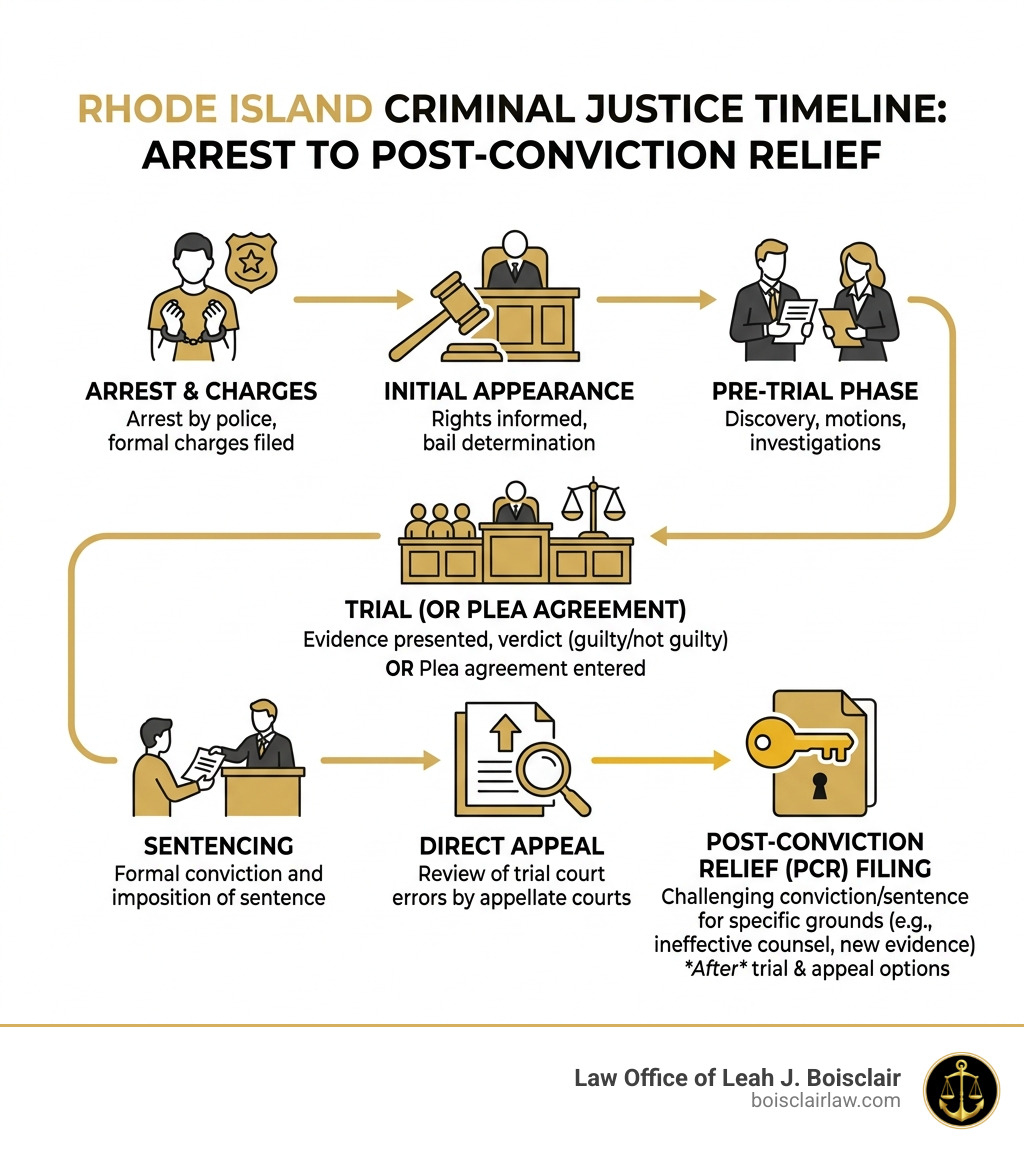
In the simplest terms, Post-Conviction Relief (PCR) is a legal remedy available to individuals after they have been convicted and sentenced. Think of it as a “last resort” safety net. While the justice system aims for finality—meaning once a case is closed, it stays closed—PCR recognizes that the integrity of a conviction is only as good as the process that created it.
We often see PCR used when a direct appeal has already been denied or when the time for an appeal has long passed. It exists to ensure that no person remains in custody or carries the weight of a criminal record if their fundamental rights were trampled during the legal process. Whether it is a misdemeanor or a felony, the consequences of a conviction are too high to allow human error to go unchecked.
If you believe your trial was fundamentally unfair, working with an experienced RI Criminal Attorney is the first step in identifying whether your case qualifies for this specific type of relief.

The Purpose of PCR in April 2026
As of April 2026, the purpose of PCR remains rooted in the protection of the innocent and the unfairly treated. It serves three primary functions:
- Correcting Trial Errors: Addressing mistakes made by judges, prosecutors, or defense counsel that impacted the outcome.
- Upholding Judicial Integrity: Ensuring that the Rhode Island court system operates according to the constitutions of both the United States and the State of Rhode Island.
- Providing a Path to Justice: Offering a way to introduce evidence that wasn’t available during the initial trial, such as DNA results or a witness who has finally come forward.
Statutory Grounds for Post Conviction Relief RI
In Rhode Island, you cannot file for PCR just because you are unhappy with the verdict. You must meet specific legal “grounds” defined by state law. According to the 2024 Rhode Island General Laws Title 10, there are six primary conditions that allow a person to seek relief:
- Constitutional Violations: Your conviction or sentence violated the Constitution of the United States or the laws/constitution of Rhode Island.
- Lack of Jurisdiction: The court that sentenced you didn’t actually have the legal authority (jurisdiction) to do so.
- Excessive Sentences: The sentence imposed was greater than the maximum authorized by law.
- New Material Evidence: There are facts that were not previously presented and heard that require vacation of the conviction or sentence in the interest of justice.
- Unlawful Custody: Your sentence has expired, or your probation, parole, or conditional release was unlawfully revoked.
- Collateral Attacks: The conviction or sentence is otherwise subject to collateral attack under any common law or statutory remedy previously available.
If your situation fits one of these categories, you may have a valid claim for post conviction relief ri.
Post-Conviction Relief vs. Direct Appeals
Many people confuse PCR with a direct appeal, but they are very different legal tools. An appeal is a request for a higher court to review the record of your trial to see if the judge made legal mistakes. PCR, on the other hand, is a separate civil proceeding that can look at things outside the original trial record.
| Feature | Direct Appeal | Post-Conviction Relief (PCR) |
|---|---|---|
| Deadline | Must file within 10 days of sentencing | Usually filed 1 to 2 years after conviction |
| Evidence | Restricted to the original trial record | Can introduce new evidence/facts |
| Scope | Legal errors made by the judge | Constitutional issues, ineffective counsel, new facts |
| Court | RI Supreme Court | Original sentencing court (District or Superior) |
Key Differences in Evidence and Timing
The most significant difference is the “window of opportunity.” In Rhode Island, if you want to appeal your conviction, you must act fast—usually within 10 days. If you miss that window, or if your appeal fails, PCR becomes your primary option.
Furthermore, a direct appeal is “record-restricted.” The higher court only looks at what was said and done during the trial. In a post conviction relief ri case, we can bring in new information. For example, if we discover that a key witness was coerced by the police, or if we find that your previous lawyer failed to interview a witness who could have cleared your name, that information can be presented in a PCR petition even though it wasn’t part of the original trial.
Navigating the Application and Hearing Process
The road to relief begins with a formal application. In Rhode Island, these petitions are generally heard in the court where the original conviction took place. If you were convicted of a misdemeanor, your case might be handled through the District Court. If it was a felony, it would be filed in the Superior Court.
Typically, the original sentencing judge will hear the PCR petition. If that judge is no longer on the bench, the case is assigned to the courtroom associated with the charging police department. This can be intimidating, but it is a necessary step to ensure the court that knows the case best can review the new claims.
Filing Your Post Conviction Relief RI Application
The contents of your application are strictly governed by R.I. Gen. Laws § 10-9.1-4. To be successful, your application must include:
- Identification of Proceedings: Specific details about the judgment and sentence you are challenging.
- Specific Grounds: A clear statement of the legal reasons you are seeking relief.
- Relief Sought: Exactly what you want the court to do (e.g., vacate the conviction, reduce the sentence).
- Verification of Facts: You must separate facts within your personal knowledge from other allegations, and these must be verified.
- Supporting Evidence: You must attach affidavits, records, or other evidence that supports your claims. If you don’t have them, you must explain why.
- Prior Proceedings: A list of all previous appeals or petitions you have filed regarding this conviction.
It is important to note that you should not include long legal arguments or citations in the application itself; those come later in the process.
Potential Outcomes and Reasons for Denial
If we are successful in proving that an error occurred, the court has several options. The goal is to put you back in the position you would have been in if the error hadn’t happened. Outcomes can include:
- A New Trial: The original conviction is vacated, and you get a fresh start with a fair trial.
- Sentence Modification: The conviction stands, but the sentence is reduced to something lawful or fair.
- Release: If the court finds you were held unlawfully or that the conviction cannot stand, you may be released from custody.
However, obtaining post conviction relief ri is an uphill battle. This is why hiring a Rhode Island Criminal Defense Attorney is so critical—the court will not grant relief just because you ask for it.
Why Petitions Are Often Denied
The most common reason for denial is a failure to prove that a significant error actually occurred. Other reasons include:
- Waiver of Claims: If you knew about a problem during your trial but didn’t bring it up then (or in your direct appeal), the court may rule that you “waived” your right to challenge it now.
- Procedural Bars: Rhode Island law (R.I. Gen. Laws § 10-9.1-8) generally requires you to raise all your claims in your first PCR application. If you try to file a second or third petition later with new claims, they will likely be denied unless you can prove it is in the “interest of justice.”
- Ineffective Counsel Claims: These are hard to prove. You must show not only that your lawyer made a mistake, but that the mistake was so bad it actually changed the outcome of your case.
Frequently Asked Questions about Post-Conviction Relief
Who hears a Post Conviction Relief RI petition?
In Rhode Island, the petition is usually heard by the same judicial officer who sentenced you. If that judge is unavailable, the case is heard in the courtroom that handles cases for the police department that originally charged you. This ensures the court has the necessary context of the local jurisdiction.
Are there deadlines for reviewing a Post Conviction Relief RI judgment?
Yes. If the court denies your PCR petition and you want to challenge that decision, you must act quickly. Under R.I. Gen. Laws § 10-9.1-9, an aggrieved party must file a petition for a writ of certiorari with the Rhode Island Supreme Court within 60 days of the final judgment. If you miss this 60-day window, you lose your right to have the Supreme Court review the decision.
Is legal representation necessary for PCR?
While you are technically allowed to file for PCR on your own (pro se), we strongly advise against it. PCR is a complex civil-procedural hybrid. You must navigate strict evidentiary rules and present compelling legal arguments. For those who cannot afford an attorney, Rhode Island law provides for the appointment of counsel for indigent applicants, recognizing that the stakes are simply too high for someone to navigate this alone.
Conclusion
A criminal conviction doesn’t have to be the end of your story. If your rights were violated, if your lawyer failed you, or if new evidence has come to light that proves your innocence, post conviction relief ri offers a path forward.
At the Law Office of Leah J. Boisclair, we provide personalized, compassionate advocacy for those seeking a second chance. Whether you are dealing with the fallout of DUI and Traffic Offenses, Firearm Offenses, or complex felonies, we are here to help you identify errors and fight for your rights.
If you aren’t eligible for PCR, we can also help you explore whether you can wipe your record clean with these expungement steps. Our office in Cranston is dedicated to helping Rhode Islanders navigate the toughest moments of their lives with proven results.
Don’t let a past mistake—or a court’s mistake—define your future. Contact our team for a consultation on RI Practice Areas today, and let’s see if we can secure the second chance you deserve.