When Safety and Mental Health Collide: What You Need to Know About No Contact Orders
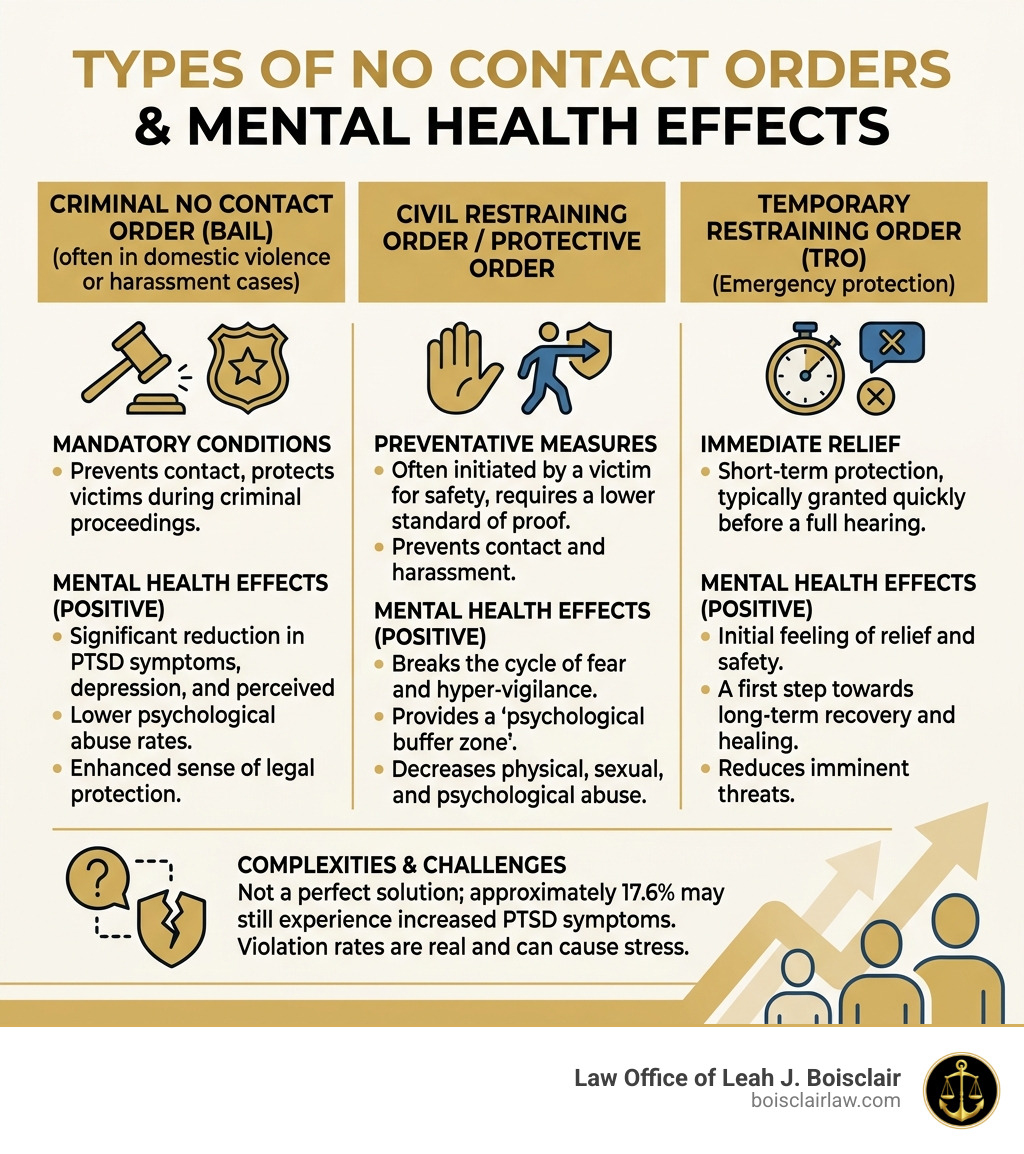
No contact order mental health outcomes are closely linked — and the research backs this up strongly. Studies show that victims who receive criminal protective orders experience significant reductions in PTSD symptoms, depression, and perceived stress after the order is issued.
Here is a quick overview of what no contact orders can do for your mental health:
- Reduce PTSD symptoms — One study found PTSD scores dropped from an average of 21.92 to 13.60 after a full no-contact order was issued
- Lower depression — Depression symptom scores fell from an average of 26.72 to 14.06 in the same group
- Cut perceived stress — Stress scores dropped from 21.95 to 14.94 on average
- Reduce psychological abuse — Full no-contact orders produced the greatest reduction in psychological domestic violence compared to less restrictive orders
- Protect against revictimization — All levels of protective orders were linked to reduced physical, sexual, and psychological abuse
But no contact orders are not a perfect solution. About 17.6% of victims still reported increased PTSD symptoms after an order was issued, and violation rates are real. Understanding how these orders work — and how to use them strategically — matters enormously for your recovery.
If you are in Rhode Island, Massachusetts, or Connecticut and dealing with a domestic violence situation, knowing your legal options is the first step toward both safety and healing.
Understanding the No Contact Order Mental Health Connection
When we discuss the legalities of domestic violence, we often focus on physical safety. However, the connection between a no contact order mental health stability is profound. For many survivors in Rhode Island, the constant state of hyper-vigilance—waiting for the next text, the next unexpected knock, or the next social media notification—creates a cycle of trauma that is difficult to break without legal intervention.
Scientific research into no-contact order outcomes suggests that the law can act as a “therapeutic agent.” This concept, known as therapeutic jurisprudence, views legal rules and procedures as social forces that can produce therapeutic or anti-therapeutic consequences. When a judge issues a no-contact order, they aren’t just signing a piece of paper; they are creating a “psychological buffer zone” that allows a victim’s nervous system to finally step out of “fight or flight” mode.
Reducing PTSD and Depression Through a No Contact Order Mental Health Strategy
The data from April 2026 shows a clear trend: the more restrictive the order, the better the mental health outcome for the victim. In studies of female victims, those with “full no-contact” orders experienced the most significant drops in PTSD and depression symptom severity. Specifically, PTSD scores plummeted from a mean of 21.92 down to 13.60.
This reduction in symptom severity is directly tied to the decrease in psychological domestic violence. When the abuser is legally barred from all forms of communication, the “residual change” in the victim’s mental state is often one of profound relief. If you are struggling with these symptoms, it is important to understand the legal nuances of domestic and family related offenses and how a specific court order can be tailored to your psychological needs.
Managing Clinical Depression and No Contact Order Mental Health Outcomes
For individuals entering the legal system with a pre-existing condition like clinical depression, the stakes are even higher. Depression can make the process of seeking help feel insurmountable. It can also increase a victim’s vulnerability, as abusers often exploit emotional low points to maintain control.
However, having a pre-existing mental health condition does not disqualify you from protection. In fact, we find that the court often views this vulnerability as a reason for swifter, more decisive action. By securing an order through a Rhode Island Criminal Attorney, you create the space necessary for emotional resilience to grow. The order serves as a foundational tool for recovery, allowing you to focus on therapy and healing rather than constant defense.
Criminal Protective Orders vs. Civil Restraining Orders
Navigating the different types of orders can feel like alphabet soup: EPO, TRO, CPO. In Rhode Island, it is vital to distinguish between a criminal protective order (often called a No Contact Order or NCO) and a civil restraining order.
A Criminal Protective Order (CPO) is typically issued during a criminal case—for example, following an arrest for Domestic Assault and Battery. These are often “prosecutor-driven,” meaning the state requests the order as a condition of the defendant’s bail. On the other hand, a Civil Temporary Restraining Order (TRO) is “victim-initiated” in Family or District Court.
| Feature | Civil Restraining Order (TRO) | Criminal Protective Order (NCO) |
|---|---|---|
| Initiated By | The victim (Petitioner) | The State/Prosecutor |
| Standard of Proof | Preponderance of Evidence | Probable Cause (at start) |
| Duration | Usually 1-3 years (if permanent) | Until case ends or sentence finishes |
| Cost | Usually free for DV victims | No cost to the victim |
| Relationship | Specific (Family/Household) | Any (if criminal charge exists) |
For more information on the specific legal paths available, you can review the basics of restraining orders for sexual assault and other non-domestic scenarios.
Differences in Legal Initiation
The way an order starts changes your role in the process. In a criminal case, you are a witness for the state. The Deputy Attorney General or local prosecutor takes the lead. This can be less stressful for your no contact order mental health journey because the “burden of proof” and the confrontation are handled by the state. In a civil TRO, you must present the evidence yourself (or through your own attorney) to convince a judge that you are in immediate danger.
Levels of Restriction
Not all orders are created equal. We generally see three levels of restriction in the Rhode Island court system:
- Full No-Contact: Prohibits all contact—in person, by phone, through social media, or via third parties.
- Residential Stay-Away: Allows for some communication (often regarding children) but prohibits the defendant from coming to the victim’s home.
- Limited Contact: May allow contact for specific purposes, such as “peaceful contact” or mediation.
Research indicates that “Full No-Contact” orders are the gold standard for reducing psychological DV. When we represent clients in various practice areas, we emphasize that the clearest boundaries lead to the fewest “grey area” violations, which in turn protects the victim’s peace of mind.

Proving Emotional Abuse and Psychological DV
One of the most common questions we hear is: “Can I get an order if they haven’t hit me yet?” The answer is yes. While physical violence is a clear-cut reason for an order, Rhode Island law recognizes that emotional and psychological abuse—including gaslighting, verbal threats, and stalking—can be just as damaging.
Proving this in court requires a different strategy. Since there are no physical bruises to photograph, we rely heavily on digital evidence and behavioral patterns. The FAQs for No Contact Orders and Orders of Protection often highlight that verbal threats and “harassing behavior” are valid grounds for seeking protection.
Evidence Required for Mental Health Protection
To successfully obtain a no contact order mental health protection, you should gather:
- Message Logs: Screenshots of texts, DMs, and emails that show a pattern of harassment or threats.
- Audio/Video Recordings: In some contexts, recordings of outbursts can provide powerful evidence of the abuser’s volatility.
- Witness Testimony: Friends, family, or coworkers who have witnessed the behavior or the emotional aftermath.
- Medical Records: Documentation from a therapist or doctor showing an increase in PTSD or depression symptoms following incidents of abuse.
Building this case can be complex, which is why hiring a Rhode Island criminal attorney who understands the nuances of domestic cases is essential. We help you organize this evidence so the judge sees the full picture of the psychological toll.
Navigating the Court for Psychological Safety
The process usually begins with a “sworn petition.” You will describe the abuse under oath. If the judge finds an immediate danger, they will issue an ex parte (temporary) order immediately. A full hearing will follow, usually within 20 days.
During this time, safety planning is crucial. A no-contact order is a powerful legal tool, but it is not a physical shield. We encourage all our clients to work with victim advocates to create a comprehensive safety plan while navigating domestic and family related offenses in the court system.
Risks, Limitations, and the Legal Process
While the statistics are overwhelmingly positive, we must address the risks. For a small percentage of victims (about 17.6%), PTSD symptoms may actually increase after an order is issued. This can happen because the act of filing the order can feel like an “escalation” to a volatile abuser.
Research shows that revictimization rates (25-35%) are often higher than recidivism rates (10-20%) because many violations go unreported. If a victim is afraid that reporting a “minor” text will lead to more violence, the abuser is emboldened.
Potential Anti-Therapeutic Outcomes
Some individuals—particularly those with “brittle” personalities or certain mental health conditions like Borderline Personality Disorder—respond poorly to the “public rejection” of a court order. This can lead to an escalation of stalking or unwanted pursuit.
Furthermore, inadvertent contact can occur. If you both frequent the same grocery store or gym in a small town like Cranston, you might cross paths. It is vital to understand how no-contact orders affect day-to-day life to avoid accidental violations that could complicate your legal standing.
Steps to Secure Protection in Rhode Island
If you are seeking protection through the criminal justice system in RI, the process typically follows these steps:
- Arrest/Arraignment: When a defendant is charged with a domestic offense, the judge will almost always issue a No Contact Order as a condition of bail.
- RONCO System: Rhode Island uses the Restraining Order No-Contact Order (RONCO) system. This is a statewide database that allows any police officer in RI to instantly see if an order is active.
- Bail Conditions: If the defendant violates the order, they aren’t just committing a new crime; they are violating their bail, which can lead to them being held without bail until their trial.
If you find yourself in the middle of this process, knowing what to do if you’ve been involved in a RI arrest—whether as a victim or a defendant—is the key to protecting your future.
Frequently Asked Questions about Mental Health Orders
Can I get a no contact order for emotional abuse without physical violence?
Yes. Rhode Island law allows for protective orders based on a “credible threat of violence” or a pattern of harassment that causes significant emotional distress. You do not need to wait for a physical strike to seek help.
How does a no contact order impact my PTSD symptoms?
For the majority of survivors, an NCO leads to a significant reduction in PTSD severity. By removing the source of the trauma (the contact), your brain can begin the process of “unlearning” the fear response. However, it is important to pair legal action with professional mental health support.
What happens if the abuser violates the order through social media?
A violation is a violation, regardless of the medium. Tagging you in a post, commenting on your photos, or even sending a “friend request” through a fake account can be considered a criminal violation of a no-contact order. Document everything with screenshots and report it to the police immediately.
Conclusion
At the Law Office of Leah J. Boisclair, we believe that the legal system should be a tool for healing, not just punishment. Balancing your no contact order mental health needs requires a compassionate, personalized approach. We have seen how a well-crafted protective order can provide the safety and “breathing room” necessary for a survivor to reclaim their life.
If you are facing a domestic violence situation, you don’t have to navigate this complex system alone. From the initial arraignment to the final resolution of the case, having expert advocacy ensures your voice is heard and your safety is prioritized. Don’t go it alone when facing a domestic violence case; reach out to us today for a consultation. Whether you need help enforcing an order or understanding your rights, we are here to provide the support you need to move forward.
Contact us for domestic and family related offenses and take the first step toward a safer, more stable future.