
When You Need a Money Laundering Defense Attorney
A money laundering defense attorney is a criminal defense lawyer who fights charges related to disguising illegally obtained funds as legitimate income. If you or your business is under investigation — or already facing charges — here is what you need to know right away:
Quick answers:
- Money laundering is a federal offense under 18 U.S.C. §1956 and §1957, as well as a serious offense under state law
- A conviction can mean up to 20 years in federal prison and fines up to $500,000
- The best time to contact a defense attorney is before charges are filed — even during the investigation stage
- Common defenses include lack of knowledge, lack of intent, and lawfully-derived funds
- Asset forfeiture — the government seizing your property — is a real risk even before conviction
Money laundering charges can feel overwhelming. The cases are complex, the stakes are high, and the government has powerful tools to investigate financial activity. As one legal resource puts it, these cases are “often complex and tedious” — and that is exactly why having the right legal defense matters from day one.
Most people picture offshore shell companies and stacks of cash when they hear the term. But in reality, ordinary individuals, small business owners, and people in cash-heavy industries like restaurants or cannabis dispensaries can find themselves facing these charges — sometimes without even realizing they crossed a legal line.
Whether you are in Rhode Island, Massachusetts, or Connecticut, understanding what money laundering charges actually involve — and what defenses exist — is the first step to protecting your future.
Understanding Money Laundering Offenses and the Legal Framework
Money laundering is essentially the process of making “dirty” money look “clean.” In legal terms, it involves taking proceeds from a “specified unlawful activity”—such as drug trafficking, fraud, or embezzlement—and conducting financial transactions to hide the source, ownership, or control of those funds.
At the federal level, two primary statutes govern these white collar offenses defense efforts:
- 18 U.S.C. §1956: This is the broader statute. It prohibits financial transactions involving proceeds of unlawful activity with the specific intent to promote the offense, conceal the nature of the funds, or avoid taxes and reporting requirements.
- 18 U.S.C. §1957: This applies to anyone who knowingly engages in a monetary transaction in “criminally derived property” valued at more than $10,000. Unlike §1956, the government doesn’t necessarily have to prove you were trying to hide anything—just that you knew the money came from an offense and moved more than $10k.
In April 2026, federal and state authorities in Rhode Island are more interconnected than ever. Prosecutors must prove specific intent—meaning you didn’t just accidentally handle the money, but that you did so with a specific purpose in mind.
The Three Stages of Money Laundering
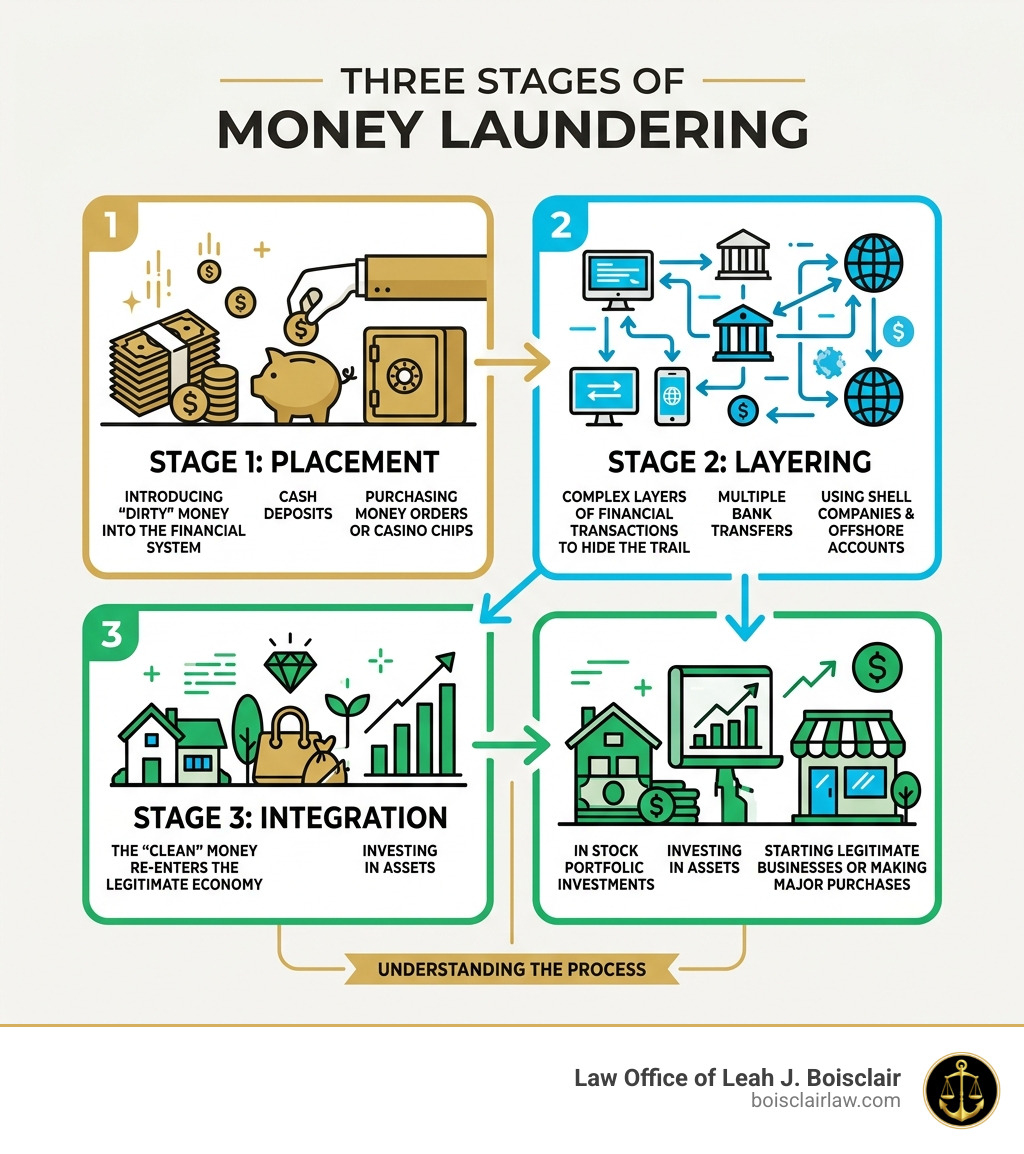
To understand how a money laundering defense attorney builds a case, we have to look at how the government views the process. It is typically broken down into three distinct stages:
- Placement: This is the initial entry of “dirty” cash into the financial system. This might look like making multiple small bank deposits (often called “structuring”) to avoid the $10,000 reporting threshold.
- Layering: This is the most complex stage. It involves moving funds through a series of transactions (wire transfers, purchasing assets, offshore accounts) to distance the money from its original criminal source.
- Integration: The final stage where the money “re-enters” the legitimate economy. The funds appear clean and can be used to buy real estate, luxury items, or invest in legitimate businesses.
Cash-heavy industries, such as restaurants or laundromats, are often scrutinized because they provide an easy “front” for the placement stage.
Federal vs. State Jurisdiction
In Rhode Island, you can be charged under both federal and state law. While federal agencies like the FBI or IRS handle massive interstate schemes, the Ri Criminal Attorney often sees state-level charges brought by local authorities.
| Feature | Federal (18 U.S.C. §1956) | Rhode Island State Law |
|---|---|---|
| Prison Time | Up to 20 years | Varies by felony class (up to 20+ years) |
| Max Fine | $500,000 or 2x the property value | Based on amount laundered |
| Threshold | Any amount (under §1956) | Often aggregated over 12 months |
| Key Agency | DOJ, FBI, IRS | RI Attorney General, State Police |
Key Strategies Used by a Money Laundering Defense Attorney
Fighting these charges requires more than just a “not guilty” plea; it requires a deep dive into financial records to find where the government’s narrative falls apart. When we represent clients, we look for several key defenses.
- Lack of Knowledge: This is one of the strongest defenses. If you truly did not know that the funds were derived from criminal activity, you cannot be convicted of money laundering.
- Lack of Intent: Even if you knew the money was “suspect,” the government must prove you intended to promote an offense or conceal the source. If your goal was simply a legitimate business transaction, the “specific intent” element may be missing.
- Duress: In rare cases, individuals are forced to launder money under threat of harm.
- Lawfully-Derived Property: Sometimes, the government gets it wrong. We work to prove that the funds in question actually came from legal sources, such as an inheritance, a loan, or legitimate business profits.
Challenging the Prosecution’s Evidence in Money Laundering Offenses
The prosecution relies on a paper trail—or a digital one. A skilled money laundering defense attorney will often use forensic accounting to challenge this trail. According to The Ultimate Guide To Ri Criminal Attorneys, the goal is to create reasonable doubt.
We ask: Can the prosecutor actually link these specific dollars to a specific offense? Or are they just guessing based on high cash volume? We challenge wire transfers, bank records, and the testimony of “cooperating witnesses” who may be lying to get a lighter sentence for themselves.
Constitutional Protections and Evidence Suppression
Your rights don’t disappear just because an offense involves a computer or a bank. We scrutinize every step of the investigation:
- Fourth Amendment Violations: Did the police have a valid search warrant to seize your records?
- Probable Cause: Was there enough evidence to justify the initial seizure of your assets?
- Illegal Seizures: If the government exceeded the scope of their warrant, we may be able to suppress that evidence, making it unusable in court. You can see how these tactics work in our Case Results.
Potential Penalties and Collateral Consequences
The consequences of a conviction in April 2026 remain devastating. Beyond the immediate threat of prison, a money laundering conviction is a “scarlet letter” for your financial future.
- Prison Time: Federal convictions under §1956 carry up to 20 years. If the laundering is linked to terrorism, that can jump to 35 years.
- Staggering Fines: You could be fined up to $500,000 or twice the value of the property involved—whichever is greater.
- Asset Forfeiture: The government can seize your home, your cars, and your bank accounts if they believe they are connected to the offense.
- Collateral Damage: You will likely lose professional licenses (like a CPA or Law license), your right to own a firearm, and your ability to get credit or a mortgage. This is why understanding the difference between Felonies And Misdemeanors is so vital.
Asset Forfeiture and Seizures
One of the most aggressive tools the government uses is asset forfeiture. They don’t even need a conviction to freeze your accounts; they only need “probable cause” to believe the property has a nexus (connection) to criminal activity.
This is where “government overreach” often happens. Law enforcement agencies sometimes seize assets that have nothing to do with the alleged offense. We fight to recover these assets by proving they were legally obtained. This is a primary reason Why Hire A Rhode Island Criminal Defense Attorney who understands both the criminal and civil sides of forfeiture.
Modern Challenges: Cryptocurrency and Cash-Heavy Industries
As we move through 2026, the “old school” methods of laundering are being replaced by digital ones. However, the myth that Bitcoin is anonymous is just that—a myth.
The DOJ and FBI have become experts at tracking blockchain transactions. We are seeing an increase in Coinbase subpoenas and IRS investigations targeting digital wallets. If you are a high-volume crypto trader or run a “peer-to-peer” exchange, you could be flagged for laundering even if you are just a hobbyist.
Why You Need a Money Laundering Defense Attorney for Crypto Investigations
Digital transactions leave a permanent record on the blockchain. While you might think you are anonymous, the moment you move crypto to a “centralized” exchange (like Coinbase or Kraken), your identity is linked to those coins.
A money laundering defense attorney helps by:
- Analyzing transaction histories to prove “good faith” trading.
- Defending against “unlicensed money transmitter” charges.
- Challenging the government’s interpretation of complex blockchain data.
Frequently Asked Questions about Money Laundering Defense
What are the key elements prosecutors must prove in a money laundering case?
To get a conviction, a prosecutor generally must prove four things beyond a reasonable doubt:
- You conducted or attempted to conduct a financial transaction.
- You knew the property involved was the proceeds of some form of unlawful activity.
- The property was, in fact, derived from a specified unlawful activity.
- You acted with the intent to promote the offense, conceal the source, or avoid a reporting requirement.
Can businesses in the cannabis industry face money laundering charges?
Yes. Because marijuana remains illegal at the federal level, any money generated by a dispensary is technically “criminally derived” in the eyes of the federal government. This creates a massive risk for owners who move large amounts of cash or try to secure traditional banking. We help these businesses implement rigorous compliance programs to show “good faith” efforts to follow the law.
When is the best time to contact a defense lawyer?
The absolute best time is during the investigation stage. If you receive a “target letter” from a U.S. Attorney or find out the FBI is asking questions about your business, call us immediately. We can often intervene before an indictment is ever handed down, potentially resolving the issue without you ever being formally charged.
Conclusion
Facing money laundering allegations is a life-altering event. The government has nearly unlimited resources to track your finances, but they are not infallible. At the Law Office of Leah J. Boisclair, we provide the personalized, compassionate advocacy you need to navigate these complex waters.
Based in Cranston, RI, we represent clients in both state and federal courts, bringing a track record of proven dismissals and a dedication to protecting our clients’ reputations. We don’t just look at the numbers; we look at the person behind them.
If you are concerned about an investigation or are already facing charges, don’t wait for the government to make the first move. Contact a defense attorney for your practice areas today and let us start building your defense.
External Resources for Further Reading:
- IRS Criminal Investigation: Money Laundering
- United States Department of Justice: Asset Forfeiture
- Financial Crimes Enforcement Network (FinCEN)
- 18 U.S.C. § 1956 – Money Laundering Statute