Your License Is at Risk — Here’s What a Suspension Lawyer Can Do Right Now
A license suspension lawyer can be the difference between keeping your driving privileges and losing them — sometimes for years. If you’re facing a suspension in Rhode Island, Massachusetts, or Connecticut, here’s what you need to know right away:
Quick answers for common situations:
- DUI/OUI arrest — You may have only days to request a hearing before an automatic suspension kicks in
- Too many DUI and Traffic Offenses — A lawyer can challenge surchargeable offenses before they trigger mandatory suspensions
- Chemical test refusal — Refusing a breathalyzer triggers an automatic suspension, but it can be challenged
- Out-of-state offense — Other states share offense data, and a conviction elsewhere can suspend your license at home
- Driving on a suspended license — This is a criminal offense that can add jail time, fines, and more points on top of your existing suspension
Most people don’t realize how much they depend on their driver’s license until it’s gone. Getting to work, taking kids to school, attending medical appointments — all of it stops the moment your driving privileges are suspended.
And the consequences go beyond inconvenience. A suspended license can cost you your job. It can affect your housing, your custody arrangements, and your ability to stay out of further legal trouble.
What makes this even harder is that license suspension law is complicated. The rules differ by state, by offense type, and even by how many prior offenses are on your record. A single traffic stop can trigger multiple surchargeable offenses at once — stacking up consequences faster than most drivers expect.
That’s where the Law Office of Leah J. Boisclair comes in. Whether you’re dealing with a DUI offense, a habitual offender designation, or an immediate threat suspension, having the right legal advocate in your corner matters — especially if you only get one shot at a reinstatement hearing.
Understanding License Suspensions and Common Offenses

When we talk about losing your driving privileges, it is important to distinguish between a suspension and a revocation. While both mean you cannot legally drive, the path back to the driver’s seat differs. A suspension is usually a temporary loss of your license for a set period, while a revocation is a more serious, often indefinite, termination of your driving rights that requires a much more rigorous re-application process.
In our region, many drivers find themselves in trouble due to DUI and Traffic Offenses. Whether it is a first-time mistake or a series of unfortunate events, the legal system moves quickly to pull you off the road.
Common Reasons for Losing Driving Privileges
There are several ways a driver can lose their license, and not all of them involve a steering wheel. We frequently see clients facing loss of privileges due to:
- DUI/OUI: Operating under the influence is the most common trigger for immediate suspension.
- Reckless Driving: High-speed maneuvers or endangering others can lead a judge to pull your license.
- Chemical Test Refusal: In states like Rhode Island and Massachusetts, refusing a breathalyzer results in an automatic administrative suspension, regardless of whether you are eventually convicted of a DUI.
- Point Accumulation: Every ticket adds up. In many jurisdictions, hitting a certain point threshold (like 10 points in D.C. or specific surchargeable counts in MA) triggers an automatic “stop” on your license.
- Non-Driving Offenses: Believe it or not, things like unpaid child support or even certain drug distribution offenses can lead the registry to suspend your right to drive.
For more details on how we handle these cases, check out our guide on driving offense defense.
Habitual Traffic Offenders and Surchargeable Offenses
In Massachusetts, the rules are particularly strict. A “surchargeable offense” is any at-fault accident or traffic violation that results in an insurance premium increase. If you rack up three of these in a two-year window, you’re looking at mandatory retraining.
However, the real danger lies in the “Habitual Traffic Offender” status.
- 7 surchargeable offenses within 3 years: Results in a mandatory 60-day suspension.
- 12 surchargeable offenses within 5 years: You are labeled a habitual offender, which carries a staggering four-year license suspension.
The Impact of Out-of-State Offenses
If you think a ticket in another state won’t follow you home to Rhode Island, think again. Thanks to the National Driver Register and interstate compacts, states share data constantly. If your license is suspended in New York or Texas, the Rhode Island DMV or Massachusetts RMV will likely catch wind of it and suspend your local license until the out-of-state issue is cleared.
This is especially tricky with outstanding warrants. An unresolved warrant in another state can block your license renewal right here in Cranston. If you find yourself in this situation, knowing what to do if you’ve been arrested in RI is the first step toward clearing your name and your driving record.
How a License Suspension Lawyer Protects Your Rights
Navigating the Registry of Motor Vehicles (RMV) or the Department of Motor Vehicles (DMV) is often more frustrating than going to criminal court. These are administrative bodies with their own sets of rules and “hearing officers” who act as both judge and jury.
A license suspension lawyer understands how to speak the language of these agencies. We don’t just show up; we build a narrative. We gather evidence to show that the suspension was based on faulty data or that you meet the strict criteria for relief. If you’re wondering why hire a Rhode Island criminal defense attorney, the answer is simple: we know the local systems and the people running them.
Challenging Immediate Threat and Habitual Offender Status
One of the most aggressive “weapons” used by police today is the Immediate Threat Suspension. This allows the registry to pull your license indefinitely based solely on a police officer’s report that your continued operation of a vehicle poses a danger to the public. There is no trial first—your license is just gone.
We fight these by:
- Requesting an immediate hearing before a regulatory officer.
- Presenting medical evidence or expert testimony to counter the “threat” claim.
- Appealing to the Board of Appeals if the initial hearing doesn’t go our way.
For habitual offenders, we focus on “striking” old offenses from the record or proving that the math used by the RMV is incorrect. If you have 12 offenses in 5 years, you are facing a 4-year wait. We work to get you eligible for a hardship license after just one year of that term.
Fighting DUI and Traffic Offenses with a License Suspension Lawyer
Whether it is a hit-and-run, reckless driving, or even identity fraud involving a license, these are serious criminal offenses. At the Law Office of Leah J. Boisclair, we provide comprehensive RI criminal attorney services to ensure that a single mistake doesn’t snowball into a lifetime of walking. We look for technical mistakes in police reports and negotiate behind the scenes to get offenses reduced or dismissed.
Navigating Hardship Licenses and Reinstatement
If your license is suspended, you might be eligible for what is colloquially known as a “Cinderella license” or a hardship license. This isn’t a “get out of jail free” card; it is a restricted license that allows you to drive during a specific 12-hour window, seven days a week, typically for work, medical, or educational purposes.
Applying for a Hardship License with a License Suspension Lawyer
Getting a hardship license is not automatic. In Massachusetts, for example, the Registry only considers hardship for two types of suspensions: OUI convictions and Habitual Traffic Offender status. For anything else, you have to go to the Board of Appeals.
To win a hardship hearing, we help you prepare:
- Employment Verification: A letter from your boss proving you need to drive to keep your job.
- Education Impact: Proof that you cannot get to school or vocational training via public transport.
- DAE Enrollment: For DUI offenses, proof that you are enrolled in the required alcohol education programs.
- The “One Shot” Rule: In many cases, you only get one chance to ask for a hardship. If you go in unprepared and get denied, you may be stuck for the duration of your suspension.
For a deeper dive into these strategies, see our ultimate guide to RI criminal attorneys.
The Reinstatement Process and Documentation
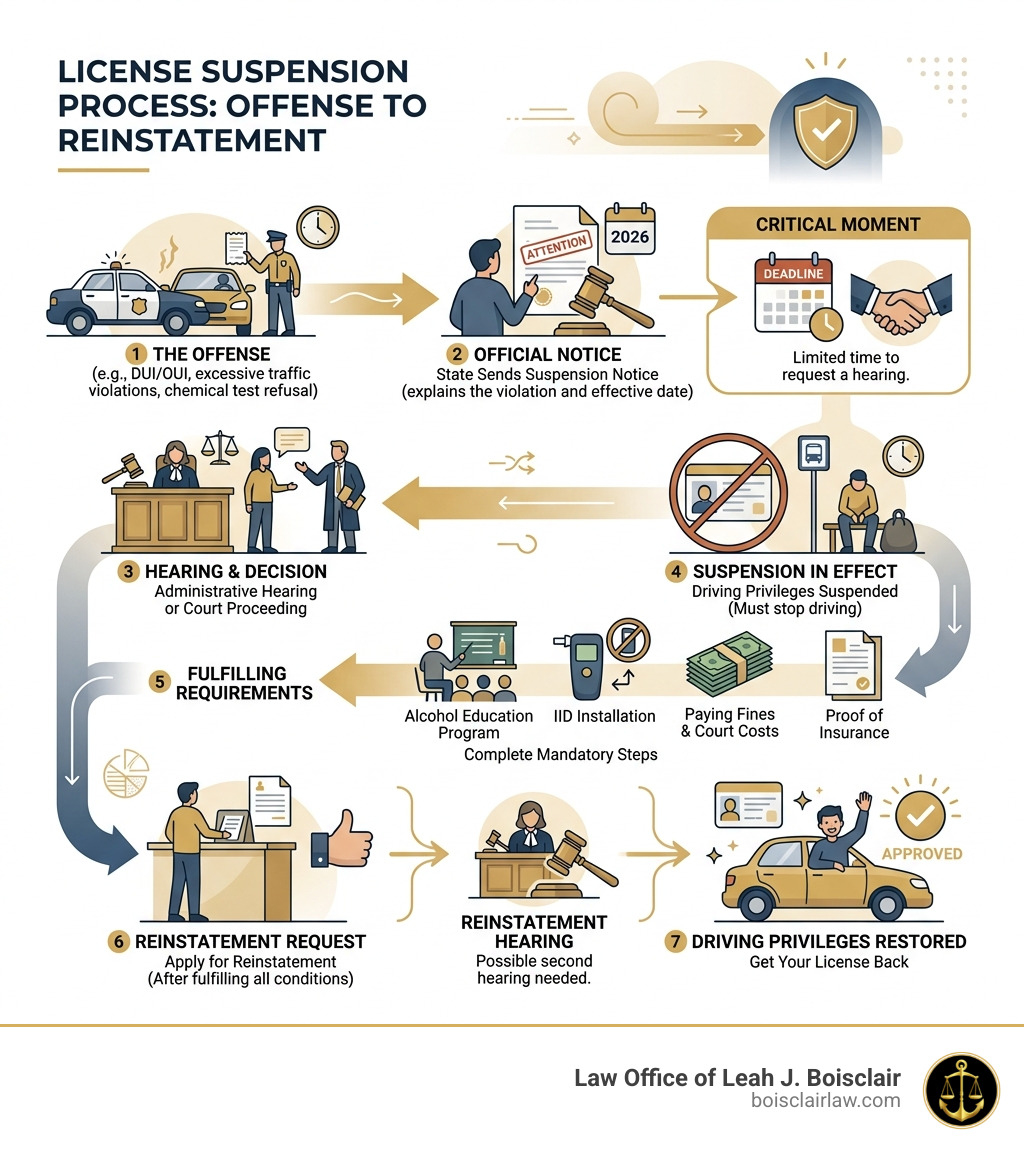
Once your suspension period is over, you don’t just start driving again. You must formally reinstate your license. This involves:
- Paying Reinstatement Fees: These can range from $100 to $1,200 depending on the offense.
- SR-22 Insurance: Some states require you to carry a special high-risk insurance certificate.
- Resolving Warrants: Any outstanding legal issues must be cleared first.
We assist our clients with the paperwork, including the expunging of a DUI record where possible, to ensure their driving record is as clean as it can be for the future.
State-Specific Penalties and Legal Strategies
While we are based in Cranston, RI, we know that our clients often drive across state lines into Massachusetts. The laws change the moment you cross the border.
Rhode Island vs. Massachusetts Penalties
In Rhode Island, a first-offense chemical test refusal is handled in the Traffic Tribunal and results in a 6-month to 1-year suspension. In Massachusetts, that same refusal results in an automatic 180-day suspension (or longer if you are under 21).
If you are caught Driving on a Suspended License (known in New York as Aggravated Unlicensed Operation or AUO), the penalties are severe:
- AUO 3rd Degree: A misdemeanor that can lead to 30 days in jail and $500 in fines.
- AUO 1st Degree: A felony often involving alcohol-related suspensions, carrying up to 4 years in prison.
Strategic Defense for Chemical Test Refusals
Most states operate under Implied Consent laws. This means that by having a license, you have already agreed to provide a breath or blood sample if a police officer has probable cause to suspect a DUI.
However, we can challenge these suspensions by looking at:
- Statutory Warnings: Did the officer read you the required legal warnings correctly?
- Probable Cause: Did the officer have a valid reason to pull you over in the first place?
- Officer Non-Appearance: If the officer fails to show up for the administrative hearing, the suspension may be dismissed entirely.
Frequently Asked Questions about License Restoration
How much does a license suspension lawyer cost?
The cost varies based on the complexity of the offense—a simple speeding ticket appeal costs less than a multi-year Habitual Offender hearing. Most firms, including ours, offer a free initial consultation to evaluate your options and provide a clear fee structure.
Can I get a hardship license for a first-offense DUI?
Yes, in both Rhode Island and Massachusetts, first-offense DUI/OUI defendants are often eligible for a hardship license after serving a portion of their suspension (usually 3 months in MA) and proving a legitimate need to drive.
What are the “Magic Words” when dealing with police?
If you are pulled over and suspect you are being investigated for an offense, the “Magic Words” are: “I am going to remain silent. I want to see a lawyer.” Police are trained to get you to volunteer information that can be used to suspend your license. Using these words protects your rights immediately.
Conclusion
Losing your license feels like losing your freedom, but it doesn’t have to be permanent. At the Law Office of Leah J. Boisclair, we provide the personalized, compassionate advocacy you need to navigate the maze of the RMV and the courts. Based in Cranston, RI, we have a proven track record of securing dismissals and getting our clients back on the road.
Don’t wait for the registry to send you a final notice. If you’re facing a suspension or have been charged with a DUI and Traffic Offense, contact a license suspension lawyer today for a free consultation. We are here to keep you moving forward.