When a Federal Firearm Charge in Rhode Island Changes Everything
A federal firearm charge in Rhode Island is not the same as a state gun offense — and the difference matters enormously.
Quick answer: What you need to know right now
- Federal firearm charges are prosecuted by the U.S. Attorney’s Office in U.S. District Court, not state court
- Federal conviction rates exceed 90% — far higher than the 70–80% rate in state court
- Many charges carry mandatory minimum sentences with no possibility of parole
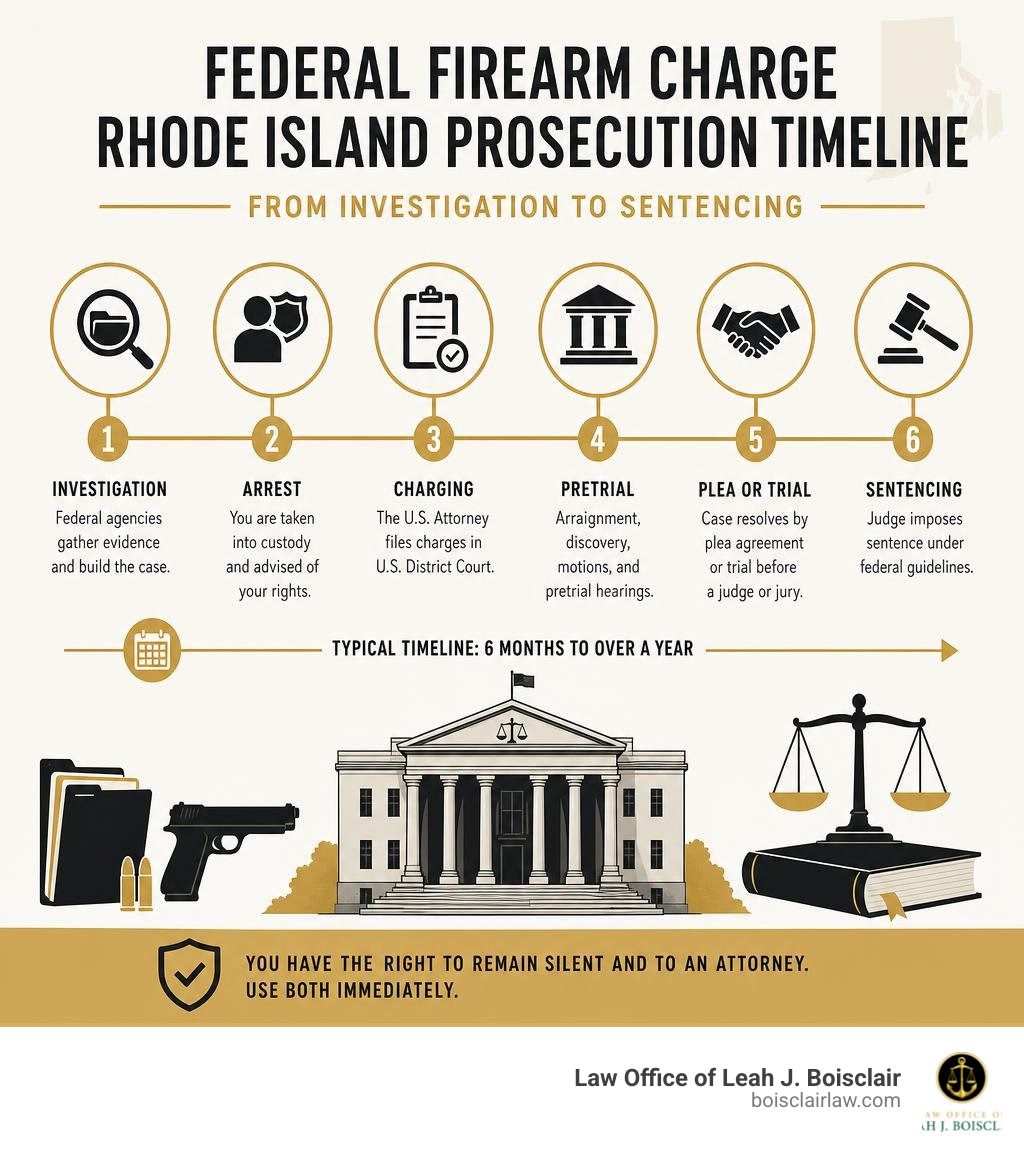
- Cases typically take 6 months to over a year to resolve
- You have the right to remain silent and to an attorney — use both immediately
Federal firearm cases move fast, and the stakes are severe. A conviction can mean years in federal prison, permanent loss of your right to own a firearm, and a record that follows you for life.
Unlike state charges — where plea deals, diversionary programs, and shorter sentences are more common — the federal system operates under strict sentencing guidelines. Judges have limited flexibility. Prosecutors have powerful tools, including surveillance, confidential informants, and ATF tracing that may have been building a case against you for months before any arrest.
Whether you are facing a felon-in-possession charge under 18 U.S.C. § 922(g), an allegation involving an unregistered machine gun or silencer, or a firearm offense tied to drug trafficking, understanding the federal system is the first step to protecting yourself.
Understanding the Federal Firearm Charge Rhode Island Landscape
To understand how a federal firearm charge in Rhode Island works, we must first look at the jurisdictional line dividing state and federal law.
In Rhode Island, state gun charges are handled under the Rhode Island General Laws (such as R.I.G.L. § 11-47) and prosecuted by the Rhode Island Attorney General’s Office in the state Superior Court. Federal charges, however, are brought by the United States Attorney’s Office for the District of Rhode Island and heard by federal judges in the federal courthouse in Providence.
How does a local gun arrest end up in federal court? The answer lies in the Gun Control Act of 1968 and the legal concept of interstate commerce. Under federal law, the United States government has jurisdiction over any firearm or ammunition that has traveled across state lines or international borders. Because Rhode Island does not host major commercial firearm manufacturing plants, virtually every gun found in our state was originally manufactured elsewhere (such as Massachusetts, Connecticut, Austria, or Brazil). This simple fact of manufacturing allows federal prosecutors to claim jurisdiction over almost any gun case in Rhode Island.
As of June 2026, federal prosecutors in Rhode Island are aggressively targeting firearm offenses. The federal government prioritizes these cases because they carry a conviction rate exceeding 90%. In the federal system, there is no parole. If you are sentenced to 10 years, you will serve the vast majority of that time.
| Feature | Rhode Island State Court | U.S. District Court (Federal) |
|---|---|---|
| Prosecuting Agency | Rhode Island Attorney General | United States Attorney’s Office |
| Conviction Rate | Approximately 70% – 80% | Exceeds 90% |
| Bail/Pretrial Release | Governed by state law; cash bail or personal recognizance common | Governed by the Bail Reform Act; high rate of pretrial detention |
| Parole Eligibility | Yes (eligible after serving a portion of sentence) | No (parole was abolished in the federal system) |
| Key Jurisdictional Basis | Local possession or use within state borders | Interstate commerce (the gun crossed state lines at some point) |
If you or a loved one is facing federal prosecution, navigating this complex environment requires specialized knowledge. We recommend starting with our comprehensive Federal Criminal Defense Complete Guide to understand how federal cases progress from investigation to trial.
Prohibited Persons and Constructive Possession Under Federal Law

In many federal gun cases, the prosecution does not need to prove that you were caught holding a gun in your hand. Federal law looks closely at both who you are and how you had access to the weapon.
Under federal law, specifically the Firearm Possession Prohibition – District of Rhode Island guidelines, there are strict rules regarding actual, constructive, and joint possession.
- Actual Possession: You have direct physical control over the firearm (e.g., it is in your pocket, waistband, or hand).
- Constructive Possession: You do not have the weapon on your person, but you have the power and the intention to exercise dominion and control over it, or over the area where the weapon is located (e.g., in your glove compartment, under your mattress, or in a safe to which you have the key).
- Joint Possession: Multiple people can possess the same firearm. If a gun is sitting on a coffee table in a shared apartment, federal prosecutors may argue that everyone living in that apartment had joint constructive possession of the weapon.
Who is Prohibited from Possessing Firearms Under a Federal Firearm Charge Rhode Island?
Under 18 U.S.C. § 922(g), federal law lists several categories of “prohibited persons” who are banned from possessing firearms, ammunition, or explosives. Violating this statute is commonly referred to as a “felon in possession” charge.
The prohibited categories include:
- Anyone convicted of a crime punishable by imprisonment for a term exceeding one year (felonies).
- Fugitives from justice.
- Unlawful users of or those addicted to controlled substances (including marijuana, even though it is legal or decriminalized under Rhode Island state law).
- Anyone adjudicated as mentally defective or committed to a mental institution.
- Illegal aliens or those admitted under non-immigrant visas.
- Individuals dishonorably discharged from the U.S. Armed Forces.
- Citizens who have renounced their U.S. citizenship.
- Anyone subject to a qualifying domestic violence restraining order.
- Anyone convicted of a misdemeanor crime of domestic violence.
A key legal distinction exists regarding hate crime offenders. Because Rhode Island state misdemeanors are generally not punishable by more than one year in prison, hate crime offenders in Rhode Island are typically only subject to federal firearm restrictions if their underlying convictions were classified as felonies.
Additionally, lying on a federal background check form (ATF Form 4473) to bypass these restrictions is a serious federal offense. For instance, the state has seen cases where individuals were prosecuted after attempting to buy weapons for prohibited persons, such as the case involving a Pawtucket man prohibited from receiving firearms charged with lying on purchase applications.
How Constructive Possession Applies to a Federal Firearm Charge Rhode Island
Constructive possession is one of the most common battlegrounds in federal firearm cases. Federal agents frequently charge individuals based on guns found during search warrants executed at shared residences or during vehicle stops.
To secure a conviction for constructive possession, the government must prove beyond a reasonable doubt that you had knowing possession of the firearm. If you are driving a friend’s car and a gun is hidden deep inside the dashboard, we can argue that you had no knowledge of its existence, meaning you lacked the required intent to exercise control over it.
However, if agents find your DNA or fingerprints on the weapon, or if they retrieve text messages where you discuss the gun, the prosecution’s constructive possession argument becomes much stronger. Understanding these nuances is critical, as state licensing laws also play a role in how local possession is viewed; you can read more about how local permits intersect with these concepts in our guide on Carrying or Possession of Firearm Without License Permit RI.
Federal Firearm Offenses, NFA Violations, and Project Safe Neighborhoods

Federal law places strict regulations on specific types of weapons under the National Firearms Act (NFA). Possessing, manufacturing, or importing unregistered NFA items is a severe federal crime.
These highly regulated items include:
- Unregistered Silencers/Suppressors: Under federal law, a silencer is legally treated as a firearm. Making or possessing one without filing an ATF Form 1, paying a $200 tax stamp, and obtaining prior approval violates 26 U.S.C. § 5861(d).
- Machine Guns and Conversion Devices: Any weapon that fires more than one shot automatically with a single pull of the trigger is a machine gun. This includes semi-automatic handguns or rifles modified with “auto sears,” “Glock switches,” or “lightning links.” The ATF classifies these conversion devices as machine guns themselves, even before they are installed.
- Ghost Guns: Privately made firearms (PMFs) that lack commercial serial numbers or manufacturer markings are heavily scrutinized by federal law enforcement.
Federal investigations in Rhode Island often involve joint operations between the Bureau of Alcohol, Tobacco, Firearms and Explosives (ATF) and Homeland Security Investigations (HSI). These agencies use international mail tracking, electronic surveillance, and confidential informants to intercept illegal weapon parts (such as auto sears ordered from overseas) before executing coordinated searches.
These efforts are heavily amplified by Project Safe Neighborhoods (PSN), a Department of Justice initiative designed to curb violent crime by coordinating local, state, and federal law enforcement. In Rhode Island, PSN operations have led to major sweeps, resulting in the seizure of Machineguns, Long and Short-Barrel Rifles, Handguns, Ammunition Seized in Project Safe Neighborhoods Investigations and Arrests. Under this framework, even possessing ammunition as a prohibited person can lead to substantial prison time, as demonstrated when a Providence Gang Member Sentenced for Possessing Ammunition was prosecuted and sentenced to two years in federal prison.
Penalties, Sentencing Guidelines, and Defense Strategies
The penalties for a federal firearm charge in Rhode Island are among the most severe in the criminal justice system.
The most feared statute in federal gun prosecution is 18 U.S.C. § 924(c), which penalizes carrying or using a firearm during and in relation to a crime of violence or a drug trafficking crime. The penalties under § 924(c) are mandatory minimums that must run consecutively (meaning in addition) to any sentence received for the underlying drug or violent crime:
- 5 years mandatory minimum for simple possession of a firearm in furtherance of the crime.
- 7 years mandatory minimum if the firearm is brandished.
- 10 years mandatory minimum if the firearm is discharged.
- 30 years mandatory minimum if the firearm is a machine gun, short-barreled rifle, shotgun, or equipped with a silencer.
- 25 years mandatory minimum for subsequent § 924(c) convictions.
For standard felon-in-possession charges under 18 U.S.C. § 922(g), the statutory maximum is 10 to 15 years in prison, depending on your prior criminal record.
While the Federal Sentencing Guidelines are technically advisory following historic Supreme Court rulings, they still anchor every sentencing hearing. These guidelines calculate a “score” based on your criminal history and specific offense characteristics (such as whether the gun was stolen, had an altered serial number, or was used in connection with another felony).
Defense Strategies
Defending against federal charges requires a meticulous, aggressive approach. Some of the most effective defenses we employ include:
- Fourth Amendment Challenges: If federal agents or local police obtained the firearm through an illegal search and seizure, we can file a motion to suppress the evidence. If the search warrant was based on stale information, lacked probable cause, or if a vehicle search exceeded legal limits, the court may throw out the firearm evidence entirely.
- Challenging Possession: In constructive possession cases, we aggressively challenge the government’s link between you and the firearm. Simply being in the same room or car as a gun is not enough to prove guilt.
- Interstate Commerce Defense: We can verify whether the firearm actually traveled in interstate commerce. While rare, if a weapon was entirely manufactured and kept within Rhode Island borders, it may lack the federal jurisdictional hook.
- Lack of Knowledge: Proving that you did not know the firearm was present or did not know you belonged to a prohibited category (such as not knowing a prior conviction qualified as a felony under federal standards).
If you believe your rights were violated during an arrest or investigation, you may need to explore options like our guide on How to Challenge Unlawful Imprisonment in Federal Court. Additionally, if the charge involves a weapon that was allegedly stolen, it is helpful to understand how state-level charges compare by reading about the Possession of Stolen Firearm RI.
Frequently Asked Questions About Federal Firearm Offenses
What is the difference between state and federal firearm offenses in Rhode Island?
The primary differences lie in the prosecuting agency, court venue, bail rules, and sentencing severity. State charges are prosecuted by local authorities in Rhode Island courts, where bail is more easily secured and parole remains an option. Federal charges are prosecuted in the U.S. District Court, where the Bail Reform Act makes pretrial detention highly common for gun offenses, and convictions carry mandatory minimums with zero chance of parole.
Furthermore, state and federal laws handle the intersection of firearm possession and other offenses differently. For example, carrying a firearm while operating a vehicle under the influence is heavily penalized at the state level; you can read about these specific state penalties in our article on Carrying Firearm Under Influence RI, as well as our broader resources on state-level DUI and Traffic Offenses.
What should I do if contacted by ATF or HSI agents?
If federal agents knock on your door, hand you a target letter, or stop you in public, you must protect yourself immediately:
- Remain Silent: Politely but firmly state: “I am exercising my right to remain silent, and I want to speak with my attorney before answering any questions.”
- Refuse Consent to Searches: Do not consent to a search of your home, car, or phone without a signed search warrant. If they have a warrant, do not physically resist, but clearly state that you do not consent to the search.
- Do Not Lie: Lying to a federal agent is a separate federal felony under 18 U.S.C. § 1001. Saying nothing is legal; lying is a crime.
- Contact an Attorney immediately: Do not try to “explain things” or cut a deal on your own.
How long do federal firearm cases typically take to resolve?
Federal firearm cases generally take much longer than state cases. While a state misdemeanor or minor felony might resolve in a few months, a federal firearm case typically takes six months to over a year from the time of arrest or indictment to final resolution. This timeline is due to extensive pre-arrest investigations, the high volume of discovery (surveillance footage, forensic reports, phone downloads), and the complex motion practice required in federal court.
Protect Your Future with Experienced Federal Defense
A federal firearm charge in Rhode Island is a life-altering event. The federal government has virtually unlimited resources, highly trained investigators, and a legal system designed to secure maximum prison sentences. You cannot afford to face them alone or with a lawyer who only handles state-level traffic tickets.
At the Law Office of Leah J. Boisclair, we provide personalized, compassionate, and aggressive criminal defense representation. From our office in Cranston, Rhode Island, we defend clients facing serious federal indictments and state Firearm Offenses across the state, including Providence, Warwick, Johnston, North Providence, East Providence, West Warwick, Pawtucket, East Greenwich, Coventry, and Scituate.
When you contact us, we begin by evaluating your complete legal history and analyzing every detail of your case. We can assist you with our detailed client intake process, gathering crucial details such as:
- Personal & Employment Information to build a strong argument for bail and pretrial release.
- Arresting Agency & Incident Location to pinpoint jurisdictional issues or search warrant defects.
- Prior Legal History to accurately calculate potential sentencing guidelines and identify defenses.
- Case Strategy & Goals to determine whether we should fight for a dismissal, negotiate a favorable plea, or prepare for trial.
If you or a loved one is under investigation or has been arrested, do not wait. Contact a dedicated Weapons Charges Defense Attorney at our firm today.
Let us stand between you and the federal government. Visit us online at boisclairlaw.com/weapons-charges-defense-attorney/ or call our Cranston office to schedule your confidential consultation.