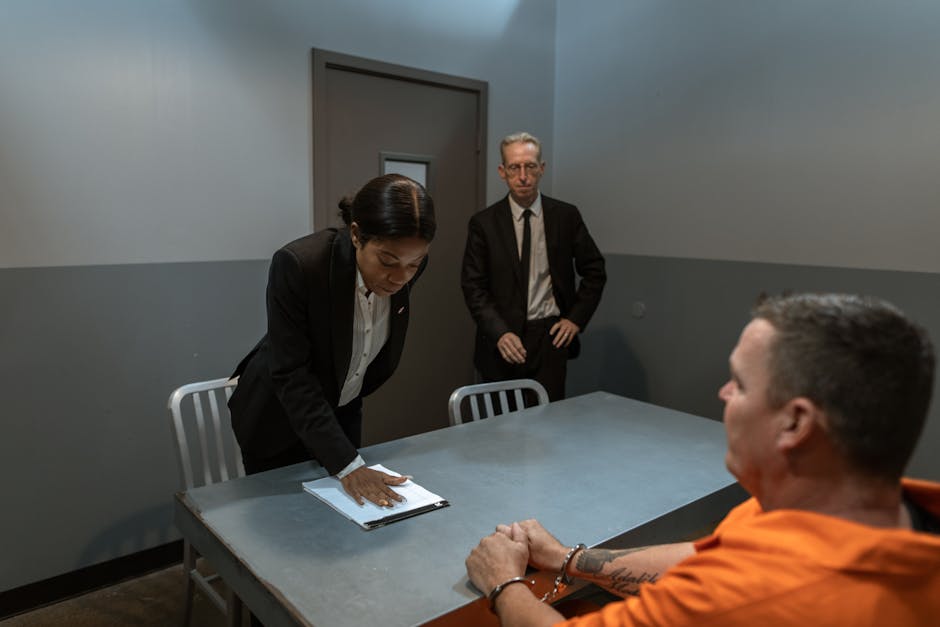

What a Miranda Rights Attorney Does — and Why It Matters
A Miranda rights attorney is a criminal defense lawyer who protects your constitutional right to remain silent and your right to counsel — especially when police fail to follow the law before questioning you.
If you’ve been arrested or questioned by police in Rhode Island, Massachusetts, or Connecticut, here’s what you need to know right away:
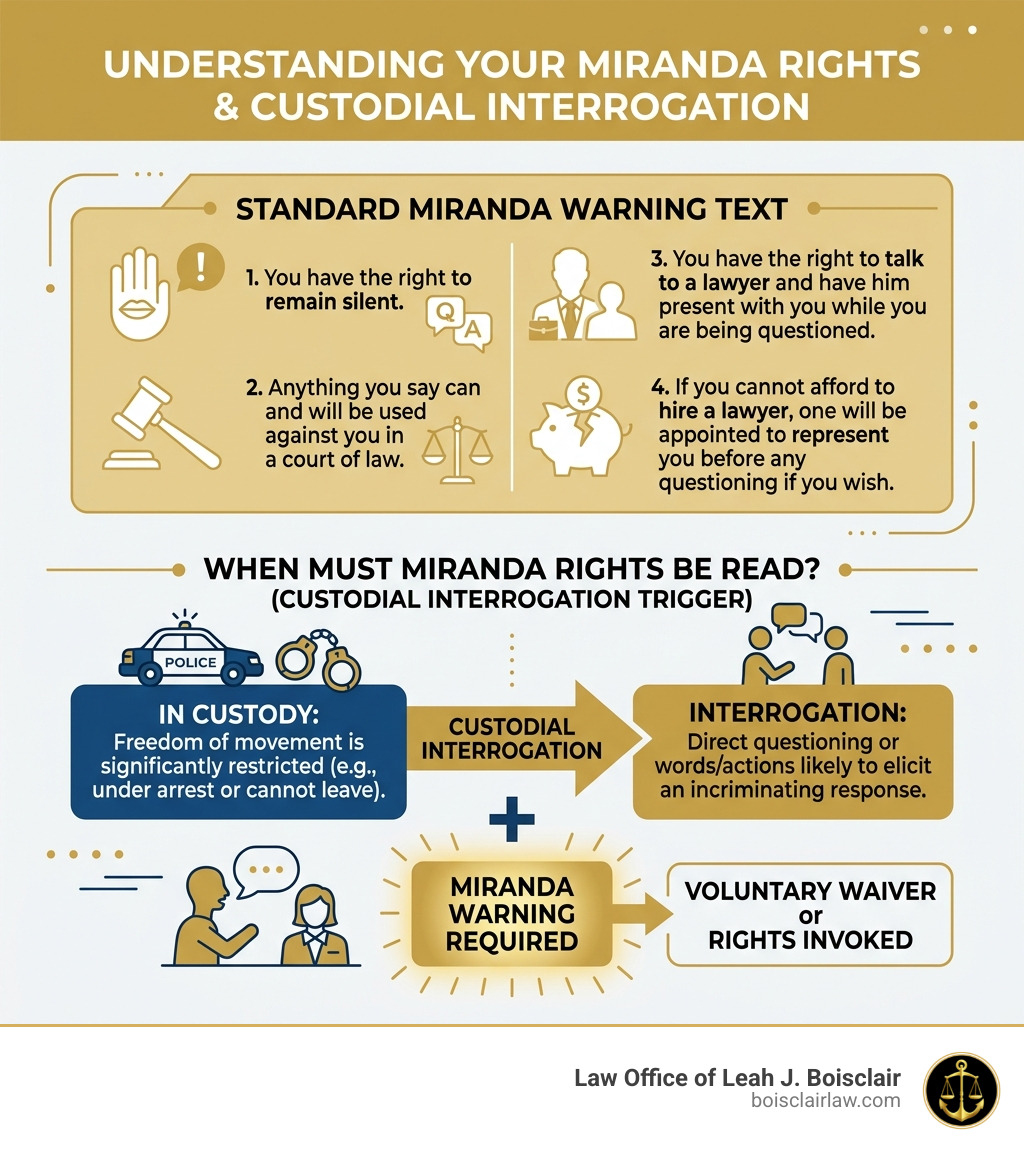
- You have the right to remain silent. Anything you say can and will be used against you in court.
- You have the right to an attorney — before and during any questioning.
- Police must inform you of these rights before a custodial interrogation, or your statements may be thrown out.
- A Miranda rights attorney can file a motion to suppress statements or evidence obtained in violation of your rights.
- Invoking your rights is not an admission of guilt. It’s how you protect yourself.
We’ve all heard the Miranda warning on TV. But what plays out in real courtrooms is far more complicated than what you see on screen.
The truth is, police don’t have to read you your rights the moment they put handcuffs on you. The legal trigger is more specific — and more nuanced — than most people realize. That gap between what people believe and what the law actually requires is exactly where cases are won and lost.
If you said something to police before speaking to a lawyer, you may already be in trouble. But you may also have more legal options than you think.
Understanding the Origin and Purpose of Your Miranda Rights
The history of your right to remain silent isn’t just a dry legal footnote; it’s a dramatic story of power and protection. In 1966, the U.S. Supreme Court decided the landmark case of Miranda v. Arizona. This 5-4 decision changed American policing forever.
The case involved Ernesto Miranda, who was arrested for kidnapping and rape. During a two-hour interrogation, he signed a written confession. However, he was never told he had the right to an attorney or the right to stay silent. While he was initially convicted, the Supreme Court eventually overturned that conviction, ruling that the coercive nature of police custody requires specific safeguards to protect a person’s Fifth Amendment right against self-incrimination and Sixth Amendment right to counsel.
As many Miranda Rights experts will tell you, the goal was to ensure “due process” and a fair trial. The Court recognized that when you are locked in a room with officers who hold all the power, you might feel forced to say things that aren’t true or that hurt your case. Interestingly, after his initial confession was suppressed, Ernesto Miranda was actually retried and reconvicted based on other evidence, proving that Miranda rights don’t just “let people go”—they simply ensure the rules are followed.
When the Law Requires Police to Read Your Rights
One of the biggest misconceptions we hear at the Law Office of Leah J. Boisclair is that a case should be dismissed because “the cop didn’t read me my rights at the scene.” In reality, police are only required to read the Miranda warning during a custodial interrogation.
This is a two-part legal “trigger”:
- Custody: You are under formal arrest or in a situation where a reasonable person would not leave.
- Interrogation: The police are asking express questions or engaging in actions likely to elicit an incriminating response.
If you are just chatting with an officer on the sidewalk, they don’t have to Mirandize you. If you are sitting in the back of a squad car but they haven’t asked you a single question yet, they don’t have to Mirandize you.
Comparison: Custody vs. Interrogation
| Scenario | Is it Custody? | Is it Interrogation? | Miranda Required? |
|---|---|---|---|
| Handcuffed in an interview room | Yes | Yes (Questions asked) | Yes |
| Routine Traffic Stop | No (Usually) | Yes | No |
| Voluntary station visit | No | Yes | No |
| Booking (Name, DOB) | Yes | No | No |
There are exceptions, such as the “public safety exception,” where police can ask about the location of a discarded weapon without a warning. However, for most DUI and Traffic Offenses or more serious criminal charges, the timing of the warning is critical. If you’ve been detained, knowing What to Do If You’ve Been Arrested in RI starts with staying silent until you speak with us.
The Role of a Miranda Rights Attorney in Defining Custody
Determining if you were “in custody” is often the most heated battle in a criminal case. A Miranda rights attorney looks at objective factors:
- Were you in handcuffs?
- How long was the detention?
- How many officers were present?
- Was the door to the room locked?
If the environment was coercive enough that you felt you couldn’t walk away, we argue you were in custody. This is vital because if we can prove you were in custody and questioned without a warning, your statements can be suppressed.
Identifying Interrogation Tactics with a Miranda Rights Attorney
Interrogation isn’t always a direct question like, “Did you do it?” The law also covers the “functional equivalent.” This includes psychological ploys where officers might talk to each other about how “it would be a shame if a kid found that gun” just to get you to speak up. Our team at the Law Office of Leah J. Boisclair acts as an experienced RI Criminal Attorney to review body cam footage and police reports to see if officers used these sneaky tactics to bypass your rights.
How a Miranda Rights Attorney Protects You During Interrogation

When you are facing the “good cop, bad cop” routine, it is easy to crack. One officer might act like your best friend, saying, “Just tell me your side so I can help you out.” Don’t fall for it. Police are allowed to lie to you during an interrogation. They can claim they have your DNA or a witness when they don’t.
This is Why Hire a Rhode Island Criminal Defense Attorney is the most important decision you can make. When we represent you, we ensure that:
- You Invoke Properly: You must be clear. Saying “I think I might need a lawyer” is often not enough. You must say, “I want a lawyer” or “I am invoking my right to remain silent.”
- Questioning Stops: Once you ask for an attorney, the police must stop questioning you immediately.
- Waivers are Scrutinized: If you signed a waiver, we check if it was “knowing and intelligent.” If you were under the influence, injured, or exhausted, that waiver might not hold up in court.
The Impact of Miranda Violations on Criminal Offenses
If a judge finds that your rights were violated, the primary remedy is a Motion to Suppress. This means the prosecution cannot use your confession as evidence of your guilt.
But the protection goes further. Under the “Fruit of the Poisonous Tree” doctrine, if your un-Mirandized statement led the police to physical evidence (like a hidden stash of drugs), that evidence might also be thrown out. This can lead to a complete Case Dismissal if the prosecution no longer has enough “fruit” to prove their case. However, be aware that even suppressed statements can sometimes be used for “impeachment”—meaning if you take the stand and tell a different story, the prosecutor can bring up your old statement to show you are lying.
Defending Against Serious Charges with a Miranda Rights Attorney
Whether you are facing a felony or a misdemeanor, your rights remain the same. Our firm handles a wide range of cases where Miranda issues often arise:
- Firearm Offenses: Often involve questions about ownership or location of a weapon.
- Drug Offenses: Police frequently try to get “consent” or confessions during searches.
- Assault and Battery: Statements about who started a fight are often taken in the heat of the moment.
- Domestic Offenses: Emotions run high, and “spontaneous utterances” made to police can be used against you.
- Violent Crimes & Sex Offenses: These carry the heaviest penalties, making a The Ultimate Guide to RI Criminal Attorneys essential for your defense.
Frequently Asked Questions about Miranda Rights
Does a failure to read my rights mean my charges are automatically dropped?
Unfortunately, no. This is one of the biggest myths. If the police have other evidence—like fingerprints, video footage, or independent witnesses—the case can still move forward. A Miranda violation only knocks out the specific statements you made and the evidence directly derived from them. It is a powerful tool, but not a “get out of jail free” card.
Can I invoke my right to silence after I have already started talking to police?
Yes! You can change your mind at any time. If you started talking but realize the questions are getting dangerous, you can say, “I’m not answering anything else without my lawyer.” At that point, the police must stop. Any statements you made before you invoked can still be used, but everything after must be suppressed. Check our Practice Areas for more on how we handle these mid-interrogation shifts.
Are physical items found because of an un-Mirandized statement admissible?
This is a complex area of law. In many cases, if the police found a physical item (like a car or a weapon) solely because of a statement taken in violation of Miranda, it can be suppressed. However, if the police can prove they would have found it anyway (“inevitable discovery”), it might still be allowed. This is why you need to Contact Us immediately to analyze the specific facts of your search and seizure.
Conclusion
The legal system is designed to be adversarial, but you shouldn’t have to fight it alone. At the Law Office of Leah J. Boisclair, we provide personalized, compassionate advocacy for clients in Cranston and throughout Rhode Island. We understand that an arrest is one of the most stressful moments of your life, and we are here to ensure that a single mistake or a pushy police officer doesn’t define your future.
If you suspect your rights were ignored, or if you’re worried about what you said after an arrest, don’t wait. Whether you’re dealing with a felony, a misdemeanor, or a Public Order Offense Defense Attorney, we have the experience to challenge the prosecution’s evidence and fight for a dismissal.
Don’t talk your way into a conviction. Let us do the talking for you.