What a Firearm Possession Felony in Warwick Really Means for You
Firearm possession felony Warwick charges can change your life fast — and the clock starts the moment you are arrested.
Here is what you need to know right away:
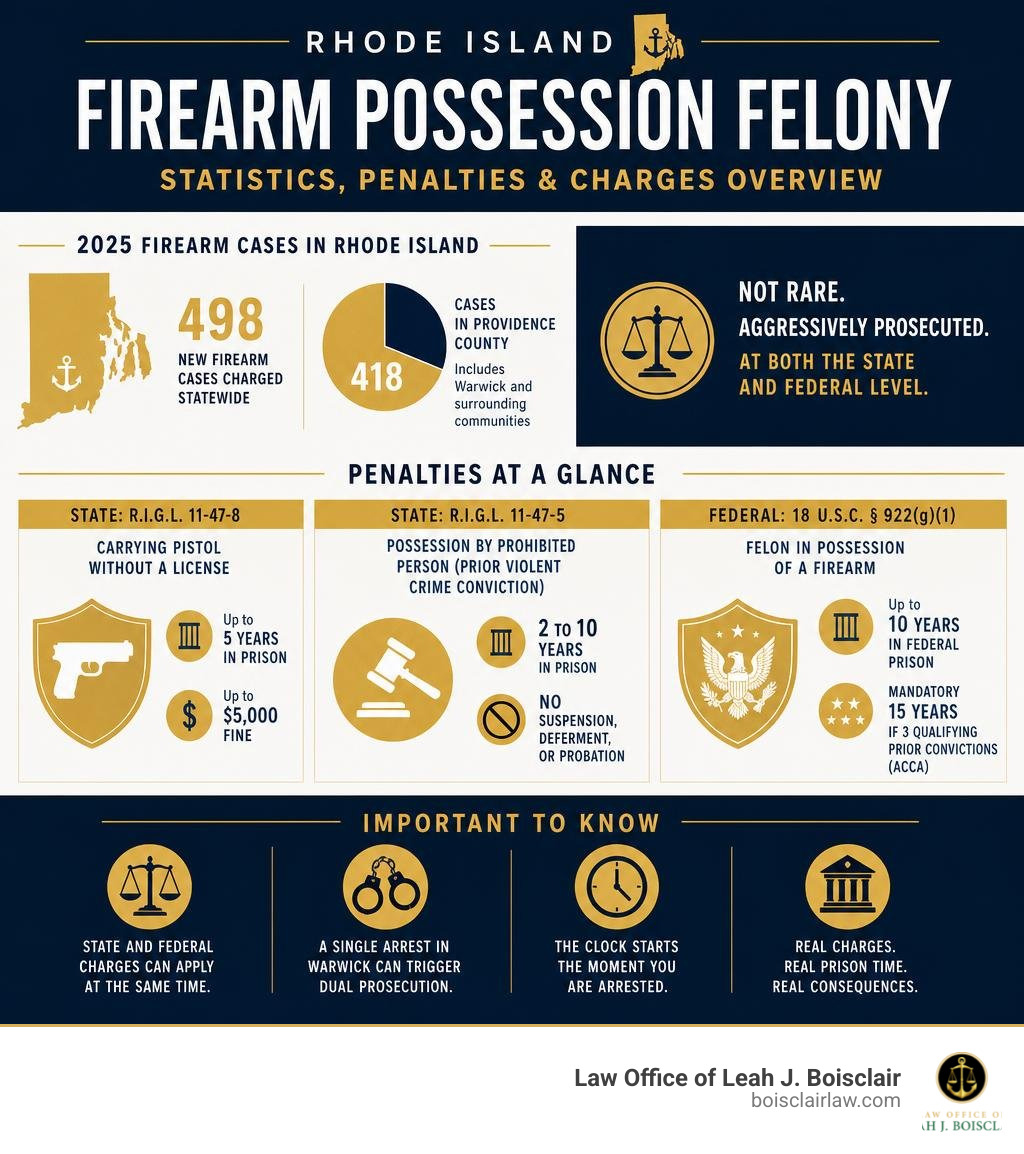
- State charge (R.I.G.L. 11-47-8): Carrying a pistol without a license is a felony. Up to 5 years in prison and a $5,000 fine.
- State charge (R.I.G.L. 11-47-5): Possession of a firearm by a prohibited person (prior violent crime conviction) carries 2 to 10 years — with no possibility of suspension, deferment, or probation.
- Federal charge (18 U.S.C. § 922(g)(1)): Felon in possession of a firearm. Up to 10 years in federal prison — or a mandatory 15 years if you have three qualifying prior convictions under the Armed Career Criminal Act.
- Both charges can apply at the same time. A single arrest in Warwick can trigger state and federal prosecution simultaneously.
In 2025, Rhode Island saw 498 new firearm cases charged statewide. The vast majority — 418 of those cases — originated in Providence County, which includes Warwick and surrounding communities. These are not rare charges. They are aggressively prosecuted at both the state and federal level.
A firearm found during a routine traffic stop. A weapon discovered in a shared apartment. An out-of-state permit that Rhode Island does not recognize. Any of these situations can lead to felony offenses with real prison time attached.
What happens next matters enormously — and so does how quickly you act.
Understanding Firearm Possession Felony Warwick Under State Law
Rhode Island has some of the strictest gun laws in the country. If you are caught with a gun in Warwick, you are dealing with state-level felony offenses that carry harsh penalties. The state prosecutes these offenses aggressively, often stacking multiple counts from a single incident.
For example, in 2025, prosecutors filed 384 large-capacity magazine offenses alongside carrying-without-a-license counts. They also brought 81 ghost gun offenses statewide. These numbers show that local police and state prosecutors are looking to secure felony convictions whenever possible.
To understand your situation, we must look at how the state defines these offenses under the 2024 Rhode Island General Laws Title 11 – Criminal Offenses Chapter 11-47 – Weapons Section 11-47-5. – Possession of firearms by certain persons prohibited. and related statutes.
Carrying a Pistol Without a License in Warwick (R.I.G.L. 11-47-8)
Under R.I.G.L. 11-47-8, carrying a handgun without a proper Rhode Island permit is a felony. It does not matter if you legally bought the gun or have a concealed carry permit from another state. Rhode Island does not automatically recognize out-of-state permits. If you cross the state line into Warwick with a firearm in your vehicle, you are immediately exposed to a felony conviction.
The penalties under R.I.G.L. 11-47-8 include:
- A maximum of 5 years in state prison.
- Fines up to $5,000.
- A permanent felony record and the lifetime loss of your firearm rights.
The law applies to more than just traditional handguns. Under R.I. Gen. Laws § 11-47-2, the definition of a “firearm” is surprisingly broad. It includes air rifles, air pistols, BB guns, and similar compressed-air weapons.
We saw this play out in a local Warwick case where a man’s suspected firearm possession caused a major lockdown at the CCRI campus. As reported by the WPD Charges Man For Firearm Possession In CCRI Lockdown – WarwickPost.com, the police recovered a backpack containing an air gun. Because of Rhode Island’s strict definitions, carrying that air gun near a school campus led to serious felony offenses.
If you are facing these allegations, you can read more about how the state handles these offenses in our guide to carrying or possession of firearm without license permit ri.
Prohibited Persons and Firearm Possession Felony Warwick
If you have a prior conviction for a “crime of violence,” Rhode Island law prohibits you from possessing any firearm. Under R.I.G.L. 11-47-5, this prohibition is strict.
A “crime of violence” includes offenses like assault, robbery, burglary, and domestic violence offenses involving physical force or a deadly weapon. The law also applies if you entered a plea of nolo contendere (no contest) to a felony and received a probation sentence.
The penalties for a prohibited person in possession of a firearm are severe:
- A mandatory minimum sentence of 2 years in prison.
- A maximum sentence of up to 10 years in prison.
- The judge cannot suspend this sentence, defer it, or offer probation. You must serve the minimum time.
Additionally, if you are caught with a gun that police allege was stolen, you will face separate felony offenses. You can learn more about how prosecutors handle these cases in our article on the possession of stolen firearm ri.
Federal Felon-in-Possession Laws and the Impact of Rehaif

While state offenses are severe, federal prosecution is a completely different challenge. Federal agencies like the ATF and prosecutors at the U.S. Attorney’s Office in Providence regularly step in to take over local Warwick cases. They do this through programs like Project Safe Neighborhoods, which targets gun violence and prohibited possessors.
Under federal law, 18 U.S.C. § 922(g)(1) makes it a felony for anyone convicted of a crime punishable by more than one year in prison to possess a firearm or ammunition.
To bring these offenses in federal court, the government must show a connection to interstate commerce. This is a low bar to clear. If the firearm or ammunition was manufactured in another state or country and crossed a state line to reach Rhode Island, the interstate commerce element is satisfied.
| Feature | Rhode Island State Law (R.I.G.L. 11-47-5 / 11-47-8) | Federal Law (18 U.S.C. § 922(g)(1)) |
|---|---|---|
| Who is Prohibited? | Those convicted of “crimes of violence” or specific domestic violence offenses. | Anyone convicted of any felony (punishable by > 1 year). |
| Maximum Penalty | Up to 10 years (prohibited person) / 5 years (unlicensed carry). | Up to 10 years in federal prison (or 15+ under ACCA). |
| Mandatory Minimums | 2 years (prohibited person). | None (unless ACCA applies, then 15-year minimum). |
| Bail/Pretrial Release | Generally more favorable state bail options. | Rebuttable presumption of detention under the Bail Reform Act. |
Facing a felony in state versus federal court involves completely different procedural rules, sentencing structures, and defense strategies. You can read our breakdown of these differences in our guide on felonies and misdemeanors.
Elements of 18 U.S.C. § 922(g)(1) and the Knowledge Requirement
To secure a conviction under 18 U.S.C. § 922(g)(1), federal prosecutors must prove four specific elements beyond a reasonable doubt:
- The defendant had a prior conviction for an offense punishable by more than one year in prison.
- The defendant knowingly possessed a firearm or ammunition.
- The firearm or ammunition traveled in interstate commerce.
- The defendant knew of their prohibited status at the time of the possession.
This fourth element is a critical protection established by the U.S. Supreme Court in the landmark case Rehaif v. United States. Before this ruling, prosecutors only had to prove that you knowingly possessed the gun. Now, they must also prove you knew you had a qualifying felony record that prohibited you from having it.
While this might seem obvious, it is a key defense point. In Rhode Island, many people receive straight probation or deferred sentences. They may not realize these outcomes count as “convictions” that trigger federal firearm prohibitions.
If you are facing these complex federal offenses, you need a defense strategy tailored to these exact requirements. Explore how we build these defenses by visiting our page on working with a firearm offenses defense attorney.
Federal Sentencing Guidelines and the Armed Career Criminal Act (ACCA)
If you are prosecuted in federal court, your sentence is calculated using the Federal Sentencing Guidelines. These guidelines evaluate your criminal history and the specific facts of your case.
However, if you have a more extensive record, you could face the Armed Career Criminal Act (18 U.S.C. § 924(e)). The ACCA is one of the harshest laws on the books. If you are convicted of being a felon in possession of a firearm and have three or more prior convictions for “violent felonies” or “serious drug offenses,” the ACCA triggers a mandatory minimum sentence of 15 years in federal prison.
Because these prior offenses can come from state-level arrests years ago, we carefully analyze your entire record to challenge whether those past cases actually qualify as predicate offenses under modern federal standards.
Key Legal Concepts: Possession Types and Fourth Amendment Issues
Many firearm arrests in Warwick do not involve a gun found directly in a person’s waistband or pocket. Instead, police often find weapons during traffic stops on Route 95, during domestic calls, or while executing search warrants.
If you are facing an allegation where the weapon was not found on your person, your case will likely center on the legal definitions of possession and your Fourth Amendment rights. If you want to understand how these concepts apply to cases involving allegations of violence, read our guide on working with a violent crimes defense attorney.
Actual vs. Constructive Possession in Traffic Stops and Shared Spaces
To convict you, the government must prove you “possessed” the firearm. Legally, possession comes in two forms:
- Actual Possession: The firearm is physically on your person (e.g., in your hand, pocket, or waistband).
- Constructive Possession: The firearm is not on your person, but the government claims you knew it was there and had both the power and intention to control it.
Constructive possession cases are common during traffic stops or when police search shared apartments. For example, if a gun is found in a vehicle’s glove compartment or trunk, prosecutors will try to charge everyone in the car.
To fight a constructive possession charge, we focus on the lack of exclusive control. If multiple people had access to the space, the mere presence of the gun is not enough to convict you. We challenge the government’s evidence by looking at:
- Whether your DNA or fingerprints were found on the firearm.
- Whether you owned or controlled the vehicle or property.
- Statements made by other occupants.
- Social media posts or messages that prosecutors might try to use to link you to the weapon.
Search and Seizure Defenses: Lessons from United States v. Warwick
The Fourth Amendment protects you from unreasonable searches and seizures. If the police violated your rights to find the gun, we can file a motion to suppress. If successful, the judge will throw out the firearm evidence, which usually leads to a dismissal of the entire case.
A classic example of how search-and-seizure issues play out in court is the federal appellate case United States v. Warwick, No. 18-2116 (10th Cir. 2019).
In that case, law enforcement officers approached a home looking for a fugitive. The homeowner gave oral consent to search the house for the fugitive. During the search, officers found the fugitive hiding in a closet, but they also noticed several firearms in plain view. After realizing the homeowner had a prior felony conviction, they obtained written consent to search further and seized the weapons.
The defendant filed a motion to suppress, arguing that the presence of multiple armed officers made his consent involuntary. The court ultimately ruled against him, finding his consent was voluntary under the “totality of the circumstances” because the atmosphere became non-coercive after the initial entry.
This case highlights how critical the specific facts of an encounter are. We examine every detail of your arrest — from the initial traffic stop to the exact words used during a search — to find constitutional violations. Learn more about these defense strategies in our article on cranston gun charge attorney alternatives everything you need to know.
Frequently Asked Questions
What are the penalties for a Firearm Possession Felony Warwick charge?
State penalties for carrying a pistol without a license include up to 5 years in prison. If you are a prohibited person under state law, you face a mandatory minimum of 2 years and up to 10 years in prison. Federal felon-in-possession convictions carry up to 10 years in prison, with a 15-year mandatory minimum if the Armed Career Criminal Act applies.
Can a carrying-without-a-license charge be reduced to a misdemeanor?
Yes, in some cases. If you are a first-time offender, do not have a violent criminal history, and legally owned the firearm but simply lacked a Rhode Island carry permit, we can negotiate with prosecutors. Depending on the facts, we may be able to secure a reduction to a misdemeanor offense or obtain a deferred sentence that keeps a felony conviction off your record.
How do prior convictions or expungements affect my firearm rights?
Under Rhode Island law, certain past offenses can permanently strip away your firearm rights. However, if your prior conviction is eligible for expungement, successfully clearing your record can sometimes restore those rights at the state level. Federal restoration is much more difficult, which is why we must carefully analyze your specific record to see if your prior offenses qualify as predicate felonies.
Conclusion
A firearm possession felony Warwick charge is a serious situation, but it is not a guaranteed conviction. The laws are complex, the penalties are severe, and the prosecutors are aggressive — but there are always defense options.
Whether your case involves a bad traffic stop, a dispute over constructive possession, or an unrecognized out-of-state permit, we are here to help. At the Law Office of Leah J. Boisclair, we provide personalized, compassionate, and aggressive defense representation to protect your rights, your freedom, and your future.
Do not wait to start building your defense. Contact our Cranston office today to schedule a confidential consultation with a dedicated firearm offenses defense attorney.