
What You Need to Know About Firearm Charge Defense in Warwick, Rhode Island
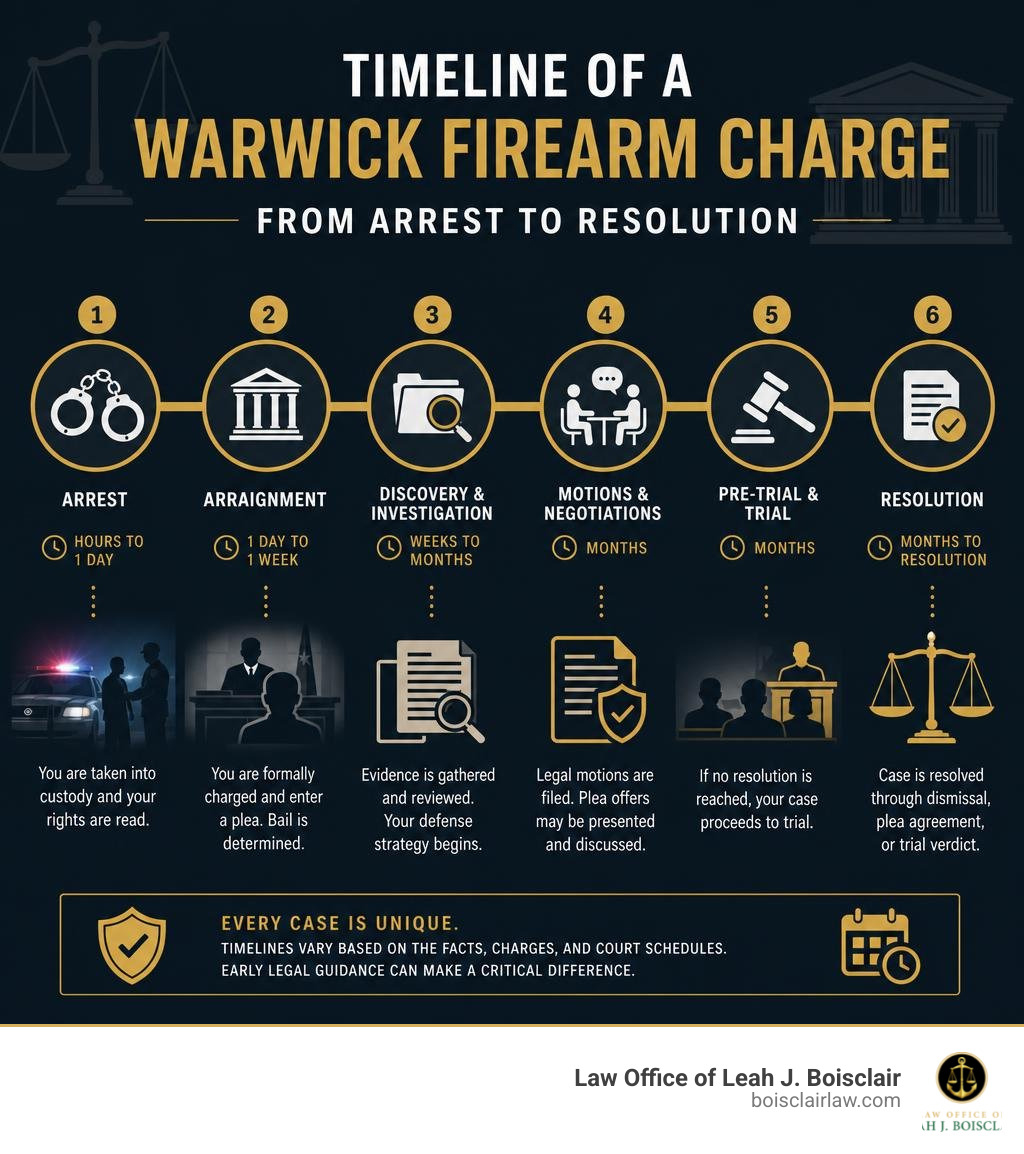
Facing a firearm charge defense Warwick situation is serious — and the decisions you make in the first 48 to 72 hours can shape the entire outcome of your case.
Here is a quick overview of what matters most:
- Most common firearm offenses: carrying without a license, possession of a stolen firearm, large-capacity magazine possession, ghost gun possession, and use of a firearm during a crime
- Key penalties: minimum 1 year up to 10 years in prison, fines up to $10,000 — some sentences run consecutively, not concurrently
- Where cases are heard: Third Division District Court and Kent County Superior Court (Leighton Judicial Complex) in Warwick
- Top defense strategies: challenging unlawful searches, disputing constructive possession, self-defense claims, and suppression motions
- First step: Stay silent, do not consent to searches, and contact a criminal defense attorney immediately
Rhode Island has some of the strictest firearm laws in the country. In 2025 alone, 384 large-capacity magazine charges and 81 ghost gun charges were filed statewide. A single traffic stop — like the case of a West Warwick man stopped for an expired registration — can lead to multiple serious felony charges.
The stakes are high. But charges are not convictions. The right defense strategy makes a real difference.
Common Firearm Offenses and Penalties in Rhode Island
Rhode Island’s gun laws are technically complex and strictly enforced. Under the Rhode Island Firearms Act, even an otherwise law-abiding citizen can quickly find themselves facing severe felony charges due to a simple misunderstanding of local regulations. Understanding the specific charges and the heavy penalties they carry is the first step in building a strong defense.
Carrying Without a License
In Rhode Island, carrying a handgun outside your home or business without a valid license is a major felony. Under R.I.G.L. § 11-47-8, a conviction carries a mandatory minimum sentence of 1 year in prison, with a maximum penalty of up to 10 years at the Adult Correctional Institutions (ACI) and fines reaching $10,000. Navigating a case like this requires a deep understanding of carrying or possession of firearm without license permit RI to challenge how the weapon was discovered and whether you actually had legal possession.
Possession of a Stolen Firearm
Knowingly or even unknowingly possessing a firearm that has been reported stolen is treated with extreme severity by local prosecutors. This charge can lead to a prison sentence of up to 15 years. Because the state must prove you knew or had reasonable cause to believe the firearm was stolen, a skilled defense focuses heavily on the “knowledge” element of the crime. To learn more about how these cases are structured, read our guide on the possession of stolen firearm RI.
Carrying Under the Influence
Just as you cannot operate a vehicle while intoxicated, you cannot carry a firearm while under the influence of alcohol or controlled substances. Doing so is a misdemeanor that can result in up to 1 year in jail and a fine of up to $1,000, along with the immediate forfeiture of your weapon and carry permit. If you are facing this unique intersection of traffic stops and firearms, read about carrying firearm under influence RI to understand your options.
The Rise of Ghost Guns and Large-Capacity Magazines
In recent years, Rhode Island has dramatically increased its prosecution of prohibited weapons. Ghost guns (unserialized, self-assembled firearms) and large-capacity magazines (LCMs holding more than 10 rounds) are major targets for law enforcement in Kent County.
Consider these striking statewide statistics from 2025:
- 384 large-capacity magazine cases were charged statewide.
- 81 ghost gun cases were prosecuted.
- Rhode Island recorded a firearm-related death rate of 3.1 per 100,000 people in 2022, which continues to drive aggressive legislative and prosecutorial crackdowns.
A real-world example of this aggressive enforcement occurred when a West Warwick man charged with illegally possessing firearm and 11 large capacity magazines was arrested following a routine traffic stop. What began as a stop for an expired registration and a suspended license escalated into a major felony indictment when police conducted an inventory search and discovered two handguns along with eleven illegal high-capacity magazines.
Navigating Firearm Charge Defense Warwick: Key Legal Strategies
When you are facing a firearm charge in Warwick, the prosecution will often present their case as an open-and-shut matter. However, an experienced weapons charges defense attorney knows that there are always two sides to every story, and the government’s evidence is rarely as flawless as it seems.
1. Fourth Amendment Violations (Unlawful Search and Seizure)
The police cannot simply search your vehicle, home, or person on a whim. They must have reasonable suspicion for a stop and probable cause—or a valid warrant—for a search. If officers discovered a firearm during an illegal traffic stop, or if they exceeded the scope of a search warrant, we can file a Motion to Suppress. If the judge rules that the search violated your Fourth Amendment rights, the firearm cannot be used as evidence, which typically leads to a complete dismissal of the charges.
2. Challenging Constructive Possession
To convict you, the state must prove that you possessed the firearm. This is straightforward if the gun was in your pocket (actual possession). However, in many Warwick cases, the gun is found in a glove box, under a passenger seat, or in a shared apartment.
In these situations, the state relies on constructive possession, meaning they must prove:
- You had knowledge of the firearm’s presence.
- You had the intent and capability to exercise control over it.
If a gun was found in a car with multiple occupants, simply being near the weapon is not enough to prove guilt. We challenge the prosecution’s ability to link the firearm directly to you.
3. Self-Defense and the Castle Doctrine
If you are charged with an offense involving the use or discharge of a firearm, Rhode Island law recognizes self-defense as a complete defense. Under the state’s “Castle Doctrine,” you have no duty to retreat if you are attacked inside your own home and reasonably believe that deadly force is necessary to prevent death or great bodily harm. We meticulously analyze witness statements, physical evidence, and 911 calls to establish that your actions were entirely justified.
State vs. Federal Firearm Offenses and Court Jurisdictions
Where your case is prosecuted depends on who arrested you, where the incident occurred, and your criminal history. Understanding the differences between state and federal jurisdictions is critical because the penalties and bail procedures differ dramatically.
Local Warwick Jurisdictions
If you are arrested by the Warwick Police Department or the Rhode Island State Police on state-level charges, your case will begin in the Third Division District Court (located at the Leighton Judicial Complex in Warwick) for your arraignment. Felony charges are later transferred to the Kent County Superior Court for pretrial conferences, motion hearings, and potential trials.
The Federal Threat: 18 U.S.C. § 922(g)(1) vs. R.I.G.L. § 11-47-5
If you have a prior felony conviction, possessing a firearm is a severe crime under both state and federal law. However, the legal definitions and consequences vary:
| Legal Element | Rhode Island State Law (R.I.G.L. § 11-47-5) | Federal Law (18 U.S.C. § 922(g)(1)) |
|---|---|---|
| Predicate Offense | Applies only if the prior conviction was for a “crime of violence.” | Applies to any prior felony conviction punishable by more than one year. |
| Maximum Prison Sentence | Up to 10 years in state prison. | Up to 10 to 15 years in federal prison (or life under the Armed Career Criminal Act). |
| Interstate Commerce | No requirement to prove how the gun arrived in RI. | Must prove the firearm traveled across state lines at some point. |
| Bail/Pretrial Release | Standard bail packages are highly accessible. | Strong presumption of detention under the federal Bail Reform Act. |
Federal prosecutors frequently step in to take over local cases if they believe the defendant has a significant criminal record or if the case involves alleged interstate trafficking. Federal sentencing guidelines are notoriously rigid, meaning early intervention by an experienced local attorney is essential to keep your case in the state court system whenever possible.
Frequently Asked Questions About Firearm Charge Defense Warwick
What should I do immediately after being arrested for a firearm offense in Warwick?
First, invoke your constitutional right to remain silent. Do not attempt to explain your way out of the situation, and do not discuss the origin of the firearm with police officers. Anything you say can and will be used to build a stronger case against you.
Second, demand to speak with an attorney immediately. When you contact our team, we will guide you through a comprehensive client intake process to gather crucial details:
- The exact arresting agency (e.g., Warwick Police or State Police).
- The location of the incident and whether a vehicle stop was involved.
- Your prior legal history, including any past charges or active restraining orders.
- The date of your upcoming arraignment or bail hearing.
Having this information ready helps us immediately build a strategy to secure your release and protect your rights.
How can a lawyer help with a Firearm Charge Defense Warwick case?
A dedicated criminal defense attorney does far more than just stand next to you in court. We thoroughly investigate the state’s evidence, hire independent ballistics or forensic experts if necessary, and identify procedural errors made by law enforcement.
We will draft and file aggressive suppression motions to throw out illegally obtained evidence, negotiate with Kent County prosecutors to reduce felony charges to misdemeanors, or prepare a compelling defense for trial. If you are exploring your options, reading about cranston gun charge attorney alternatives everything you need to know can give you valuable context on how local defense strategies are structured.
How do prior convictions or restraining orders affect my Firearm Charge Defense Warwick options?
Under Rhode Island law, you are classified as a “prohibited person” if you have been convicted of a crime of violence, are subject to an active domestic violence restraining order, or have certain documented mental health histories.
If you fall into any of these categories, possessing a firearm—even inside your own home—is a felony under R.I.G.L. § 11-47-5. Furthermore, having a prior conviction on your record makes it much harder to secure favorable bail conditions and can trigger immediate probation or parole violations. We work to review your prior record to determine if those earlier charges can be challenged or if they fail to meet the strict statutory definitions of a “predicate offense.”
Conclusion
A firearm charge can turn your life upside down, threatening your freedom, your clean record, and your constitutional rights. But you do not have to face the complex Rhode Island legal system alone.
At the Law Office of Leah J. Boisclair, we provide personalized, compassionate advocacy in Cranston, Warwick, and communities throughout Rhode Island. We pride ourselves on digging deep into the technical details of every case to find the flaws in the prosecution’s arguments, helping our clients secure the dismissals and reduced charges they deserve.
If you or a loved one is facing a firearm offense, do not wait. Contact our experienced weapons charges defense attorney today to schedule a confidential consultation and start building your defense.